Israeli Prime Minister Benjamin Netanyahu broke his silence in a stunning CBS News interview on Sunday. In his first U.S. broadcast appearance since the war with Iran began 11 weeks ago, he set bold conditions for peace, warned that military action remains on the table, and dropped a bombshell about cutting U.S. military aid to Israel.
What Netanyahu Says the War Still Needs
The conflict between the U.S., Israel, and Iran has now entered its 11th week. A fragile ceasefire has been in place since April 8, but Netanyahu made one thing clear: the war is far from finished.
Speaking to CBS News chief Washington correspondent Major Garrett on 60 Minutes, this was Netanyahu’s first U.S. broadcast interview since the war began. He laid out exactly what still needs to happen before any lasting peace is possible:
- Iran’s highly enriched uranium must be physically removed from the country
- Iran’s nuclear enrichment sites must be fully dismantled
- Iran’s regional proxy network, including Hezbollah, must be addressed
- Iran’s ballistic missile production must be halted
“We’ve degraded a lot of it, but all that is still there, and there’s work to be done,” Netanyahu said.
The war began on February 28, 2026, when the United States and Israel launched coordinated airstrikes against Iran, killing Supreme Leader Ali Khamenei and destroying key military and government sites. Iran responded with missile and drone strikes on Israel and Gulf Arab nations, and closed the Strait of Hormuz, a waterway that carries roughly one-fifth of the world’s oil.
Trump Said “I Want to Go In There”
The most gripping moment of the interview came when Garrett pressed the prime minister on exactly how Iran’s uranium would actually be removed.
“You go in, and you take it out,” Netanyahu said, with a short laugh.
When Garrett pushed further, asking whether that would involve Israeli or U.S. Special Forces, Netanyahu declined to lay out military specifics. But he revealed what President Trump had told him directly. “What President Trump has said to me is, ‘I want to go in there.’ And I think it can be done physically,” Netanyahu said. “If you have an agreement and you go in and you take it out, why not? That’s the best way.”
International monitors currently estimate that Iran holds approximately 970 pounds of uranium enriched to 60 percent purity. If enriched further to the weapons-grade threshold of 90 percent, that stockpile could theoretically power up to 10 nuclear bombs, according to the IAEA. Most of that uranium is believed to be stored in underground tunnels at Iran’s Isfahan nuclear complex.
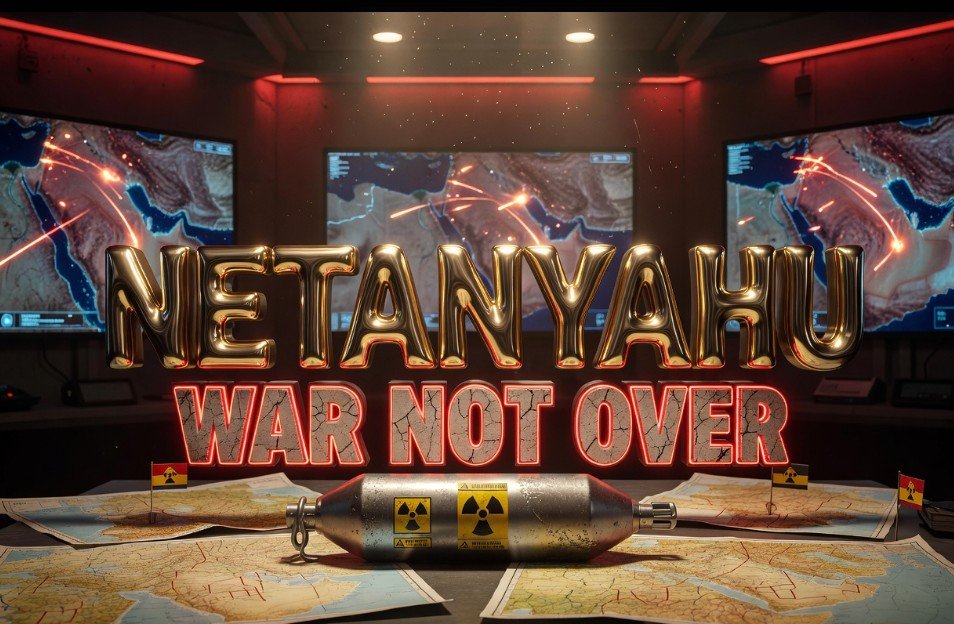
Iran’s military has not stayed quiet. Iranian Brigadier General Akrami Nia told state media that Iranian forces are on “full readiness” to protect nuclear storage sites, and that Tehran had already planned for possible infiltration or helicopter-borne operations to seize the material.
Netanyahu refused to give a timeline for achieving the goal. “I’m not going to give a timetable to it, but I’m going to say that’s a terrifically important mission,” he told Garrett. He also declined to say what Israel or the U.S. would do if no agreement is reached, stating plainly that he would not discuss military plans of any kind.
Ceasefire on the Edge as Gulf Drones Strike Again
Even as the interview aired, the fragile ceasefire was being tested. A drone ignited a fire on a cargo ship in Qatari waters on Sunday, while the United Arab Emirates and Kuwait both reported drones entering their airspace. The UAE directly blamed Iran for the attack.
Qatar’s Foreign Ministry called it “a dangerous and unacceptable escalation that threatens the security and safety of maritime trade routes.”
The Strait of Hormuz has remained largely blocked since the war started, and as of Sunday, peace talks between the U.S. and Iran appeared to have stalled again. Iran submitted its response to the latest U.S. ceasefire proposal through Pakistani mediators, but Washington quickly rejected it.
| What the U.S. Proposed | What Iran Demanded |
|---|---|
| Reopen the Strait of Hormuz | Sovereignty recognition over the Strait |
| Roll back Iran’s nuclear program | Nuclear program discussed separately, later |
| End hostilities | Ceasefire on all fronts, including Lebanon |
| No reparations discussed | Full compensation for war damages |
| Existing sanctions framework | Lifting of all sanctions and frozen assets released |
President Trump called Iran’s response “totally unacceptable.” He spoke with Netanyahu on Sunday evening as Tehran submitted the reply.
Oil markets reflected the growing tension. Brent crude prices rose 3.17 percent to $104.50 a barrel on Sunday, while U.S. crude climbed to about $98.48. The U.S. military has maintained a naval blockade of Iranian ports since April 13, turning back 61 commercial vessels and disabling four.
Netanyahu Drops a Bombshell on U.S. Military Aid
In a moment that surprised even his own cabinet, Netanyahu announced that he wants to end U.S. military financial support to Israel entirely.
“I want to draw down to zero the American financial support, the financial component of the military cooperation that we have,” he told Garrett. “Because we receive $3.8 billion a year. And I think it’s time that we weaned ourselves from the remaining military support.”
He said he has already told Trump and his own team. “Their jaws dropped,” Netanyahu said, describing the reaction in the room.
Netanyahu said he wants to start the process immediately and phase it out over the next decade, without waiting for the next Congress. The current U.S. commitment to Israel runs at $3.8 billion per year through 2028.
The move comes against a backdrop of sharply shifting public opinion. A recent Pew survey found that 60 percent of U.S. adults now hold an unfavorable view of Israel, up nearly 20 points in four years. Netanyahu attributed the decline almost entirely to social media, saying the drop “correlates almost 100 percent with the geometric rise of social media,” and accused unnamed countries of manipulating online platforms to hurt Israel’s image.
He also revealed that China had provided “certain components of missile manufacturing” to Iran, a claim that adds more tension to the upcoming summit between Trump and Chinese President Xi Jinping.
And on the big picture, Netanyahu offered his most pointed vision yet. “If this regime is indeed weakened or possibly toppled, I think it’s the end of Hezbollah, it’s the end of Hamas, it’s probably the end of the Houthis,” he said. “Because the whole scaffolding of the terrorist proxy network that Iran built collapses if the regime in Iran collapses.”
As drones continue to fly, oil prices keep climbing, and diplomats scramble for a deal that satisfies Washington, Jerusalem, and Tehran all at once, Netanyahu’s 60 Minutes interview has reset the entire conversation around this war. The conditions he laid out are sweeping, the stakes are enormous, and the clock is ticking. Whether the next chapter is written in a negotiating room or on another battlefield, the world will be watching very closely.
What do you think: can a deal be struck that brings a real end to this conflict, or is this war headed for a second round? Drop your thoughts in the comments below and share this story using #IranWar to keep the conversation going.