
The US dollar index held at 100.97 on Tuesday, barely changed from Monday, as a tenth straight night of US air strikes on Iran collided with inflation data soft enough to cool bets on a Federal Reserve rate hike. The euro edged up to US$1.1421. Brent crude climbed 24 per cent this month alone.
In New York or London, that reads as a wire-service shrug: markets stuck, waiting on the next data point. In Amman, Riyadh and Abu Dhabi, it lands differently. Jordan’s dinar and the Gulf’s dollar-pegged currencies are built to copy whatever the Fed decides in September, war on their doorstep or not.
Ten Nights of Strikes Keep the Dollar’s Bid Alive
The US military has now struck Iran for ten consecutive nights, reigniting tensions and pushing back investor hopes for a quick end to the conflict. Iran answered by hitting US-linked sites in Bahrain, Kuwait and Jordan, the kind of escalation that typically pushes flows into safe havens such as the dollar.
Iran’s strikes on Jordan this month exposed the cost of hosting US troops on Jordanian soil, a reminder that the kingdom is a target in this war, not just a bystander watching currency markets from a safe distance.
Diplomacy has not gone quiet. A senior Iranian official told Reuters on Monday that Teheran had received a proposal from mediators for a ten-day ceasefire. Nobody in the market is pricing that as settled.
What we know:
- The US has struck Iran for ten straight nights.
- Iran hit US-linked sites in Bahrain, Kuwait and Jordan.
- Brent crude is up 24 per cent this month.
What’s still unconfirmed:
- Whether Teheran accepts the ten-day ceasefire mediators have floated.
- How long shipping through the Strait of Hormuz stays disrupted.
- Whether the Fed actually delivers a hike in September.
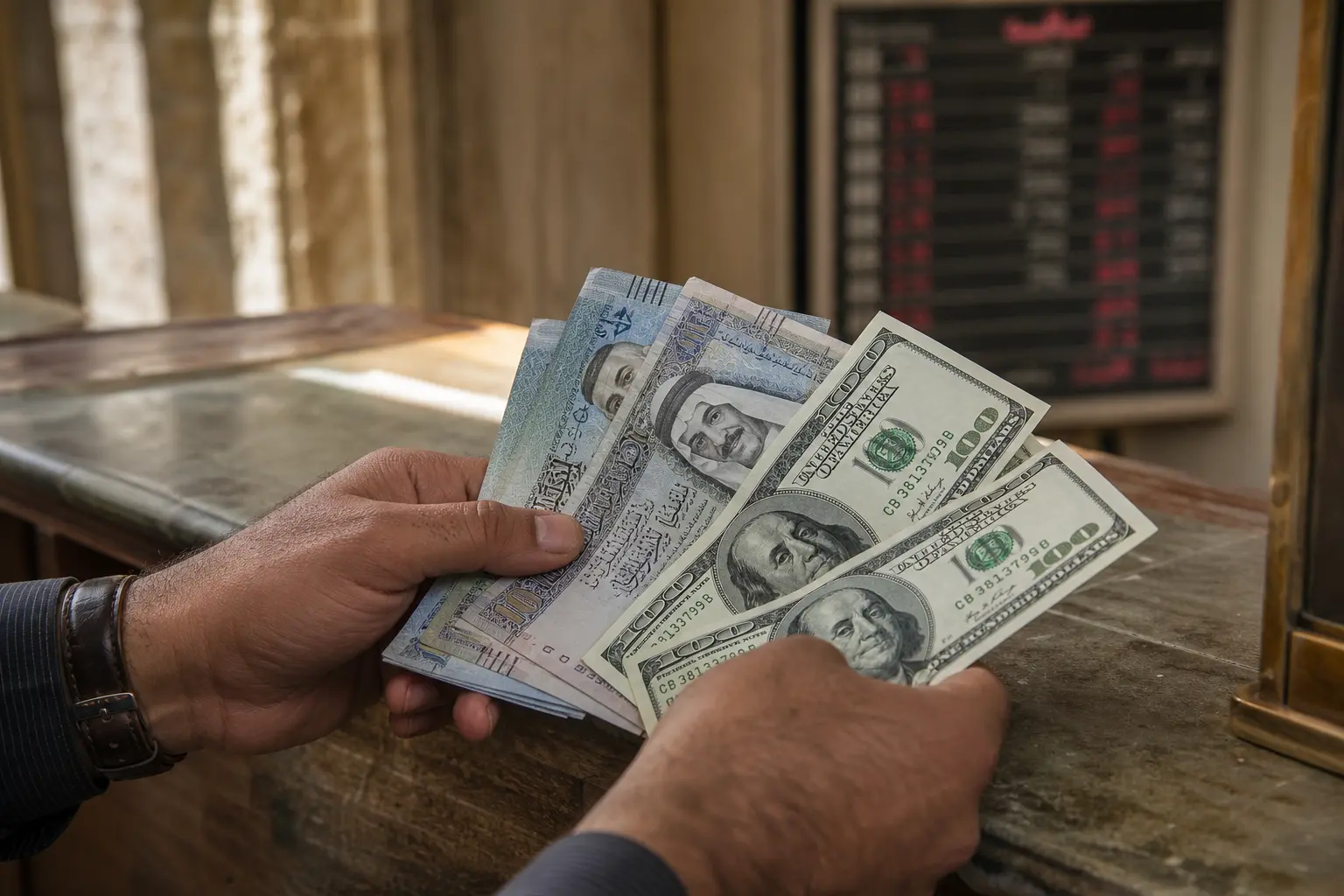
Why Do Jordan and the Gulf Have No Vote on Their Own Interest Rates?
Jordan’s dinar and the currencies of Saudi Arabia, the UAE, Bahrain, Qatar and Oman are fixed to the US dollar, some for close to four decades. To defend that fixed rate, their central banks keep local interest rates tethered to whatever Washington sets, regardless of their own inflation, growth or, in Jordan’s case, incoming fire.
The dinar has been pegged at 0.709 to the dollar since 1995. The Central Bank of Jordan’s Open Market Operations Committee held its key rate at 5.75 per cent at its most recent policy meeting this year, according to interest rate data compiled by Trading Economics. The central bank has separately reported foreign currency reserves of US$27.2 billion at the end of May, enough to cover 9.5 months of imports, with inflation running at a moderate 1.88 per cent over the first five months of the year. Those reserves are the buffer that lets Amman defend the peg when capital gets nervous.
The Gulf runs the same playbook on a bigger scale. The UAE’s central bank has held its base rate at 3.65 per cent, matching a Fed on hold for three straight months. Saudi Arabia’s SAMA has kept its repo rate near 4.25 per cent under the same 3.75 riyal-per-dollar peg it has run since 1986. Reporting from Economy Middle East on the region’s rate decisions noted that higher-for-longer policy across the Gulf is also meant to blunt the inflation pass-through from pricier energy and the disruption to goods caused by the Strait of Hormuz’s effective closure. In other words, the same war feeding the Fed’s hike odds is also the reason Gulf central banks cannot afford to cut even if they wanted to.
- Jordan – dinar pegged at 0.709 per dollar since 1995; key rate held at 5.75 per cent.
- Saudi Arabia – riyal pegged at 3.75 per dollar since 1986; repo rate near 4.25 per cent.
- United Arab Emirates – dirham pegged to the dollar; base rate held at 3.65 per cent.
- Bahrain, Qatar and Oman – dollar-pegged Gulf states that matched the Fed’s 2022 hikes almost move for move, by 50 basis points at a time.
Egypt offers the contrast. Its pound floats within managed limits rather than a hard peg, and it held firm against the dollar at Sunday’s close, giving Cairo room to breathe that Amman and the Gulf simply do not have.
Oil’s 24 Per Cent Climb Turns the Peg Into a Tax
Brent crude futures rose 1.4 per cent on Tuesday and have surged nearly 24 per cent this month. Bloomberg reported that Brent briefly topped US$90 a barrel this week as attacks threatened flows through the Strait of Hormuz, while US crude settled near US$83, its highest close since mid-June.
The strait matters because there is barely a substitute for it. The Strait of Hormuz carried an average of 20.9 million barrels a day in the first half of last year, close to a fifth of global petroleum liquids consumption and a quarter of all seaborne oil trade, according to the EIA’s World Oil Transit Chokepoints analysis. The International Energy Agency (IEA) put last year’s crude flow through the strait at nearly 15 million barrels a day, or roughly 34 per cent of all crude oil traded globally. Only Saudi Arabia and the UAE have pipelines that can move meaningful volumes around it.
A separate Houthi blockade in the Red Sea is already rerouting two Saudi oil tankers toward the Suez Canal, stacking a second chokepoint risk on top of the Hormuz standoff. For an oil importer with a fixed exchange rate, pricier crude does not show up as a weaker currency. It shows up as higher import bills and more pressure on the reserves defending the peg, and as a central bank that has to keep rates elevated to hold the line.
Canada Swallows a 50 Per Cent Tariff on Cars and Dairy
The Canadian dollar steadied on Tuesday after dropping to a one-month low. The US has imposed a fresh 50 per cent tariff on a wide range of Canadian goods, in response to what Washington called Ottawa’s discriminatory treatment of American-made cars, alcohol and dairy products.
It is a separate fight from the Middle East story, but it lands on the same currency desk the same week, forcing traders to price two unrelated shocks through one exchange rate.
A New Prime Minister Leaves the Pound Guessing
The British pound erased early gains and was last down 0.15 per cent against the dollar, at US$1.3411, as investors sized up a fresh political picture. Andy Burnham was installed as Britain’s seventh prime minister in a decade on Monday and repeated his commitment to the previous government’s fiscal rules. John Healey, the former defence secretary, was named the new finance minister.
Burnham has not yet said how he squares those fiscal rules with campaign pledges not to raise taxes on working people. “The greatest near-term risk lies with the UK’s fiscal outlook and Burnham’s plans around the prior government’s self-imposed fiscal rules,” Shaun Osborne, Scotiabank’s chief FX strategist, wrote.
Tuesday’s Currency Scoreboard
| Market | Tuesday’s Move | What’s Driving It |
|---|---|---|
| US Dollar Index | 100.97, little changed | Iran strikes offset by softer inflation data |
| Euro (EUR/USD) | US$1.1421, up marginally | Awaiting Thursday’s ECB decision |
| British Pound (GBP/USD) | US$1.3411, down 0.15% | New PM, unresolved fiscal rules |
| Canadian Dollar | Steadied after one-month low | New 50% US tariff on cars, alcohol, dairy |
| Brent Crude | Up 1.4% Tuesday, +24% this month | Strait of Hormuz disruption risk |
Read together, the table shows a dollar that is not so much strong as unopposed. Every other major currency has its own local wound.
The Fed’s September Meeting Is the Peg’s Next Test
Traders are pricing in a 63.1 per cent chance of a rate hike at the Fed’s September meeting, down from 90 per cent before last week’s inflation print. That drop is the whole reason the dollar has room to sit still instead of pushing higher.
A sustained depreciation of the US dollar looks more like a 2027 story. We expect the dollar to remain firm over the next few months until the inflation picture becomes clearer.
Jimmy Jean, chief economist and strategist at Desjardins, made that call. It doubles as a forecast for Amman and the Gulf: firm for longer means their own borrowing costs stay elevated for longer too, with no relief on the horizon before 2027 at the earliest.
Markets are also watching a European Central Bank meeting due later this week. Economists polled by Reuters expect the ECB to hold rates steady this time but still hike at least once more before the year is out. That does not change the arithmetic in Amman: whatever September brings, Jordan’s central bank will be defending 0.709 dinar to the dollar, not choosing its own rate.
