
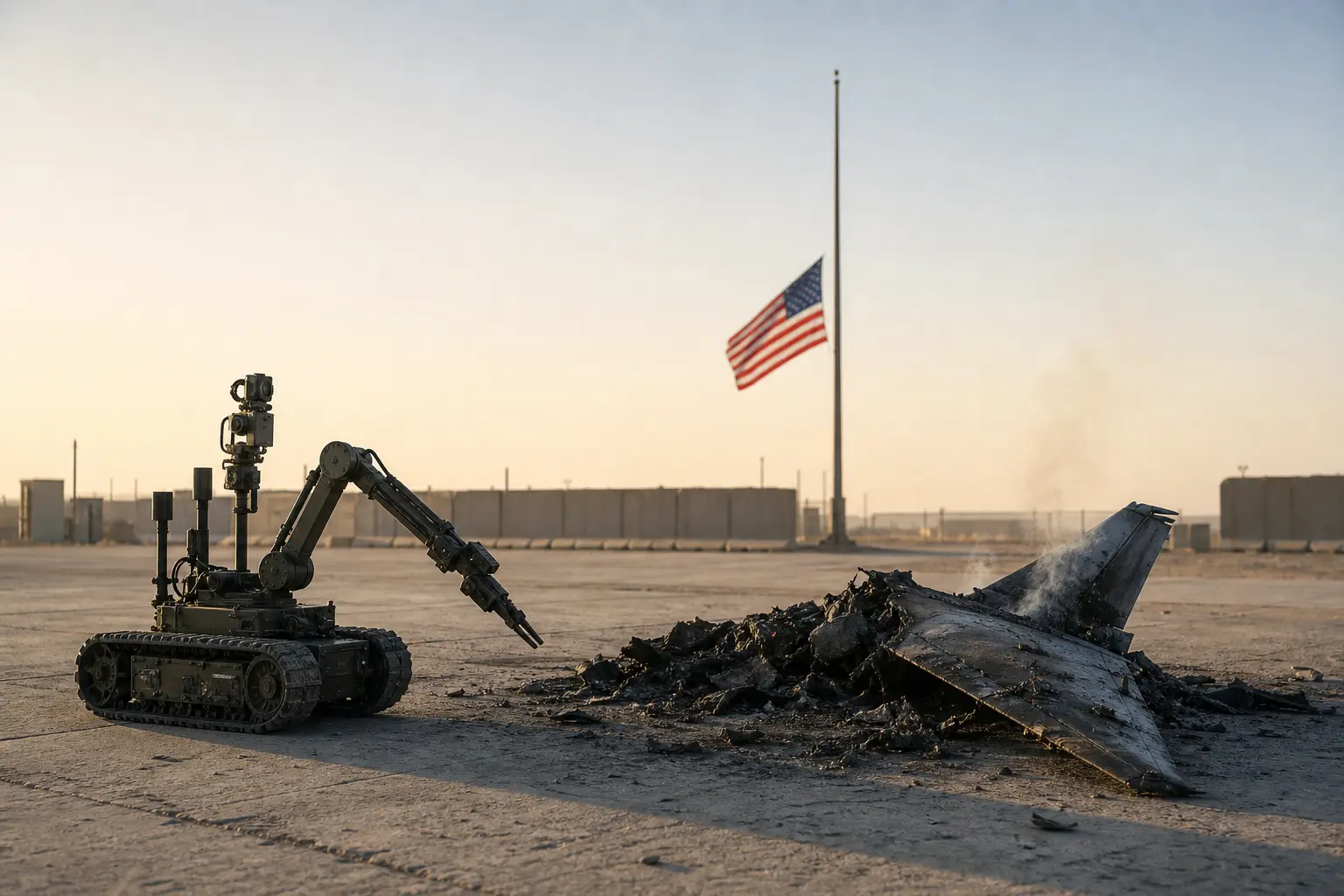
Sgt. Michael Emmanuel Swinton spent his Army career on a crew built to shoot Iranian drones out of the sky. On July 18, one killed him anyway, after his own unit had already brought it down. The 30-year-old from Fayetteville, North Carolina, died at Erbil Air Base in Iraq while troops were destroying the wreckage. He is one of three soldiers with Fort Bragg ties killed within two days this month, as the U.S. death toll in the war with Iran climbed to 17.
1st Lt. Tyler James Feehan and Pvt. Isabella Gonzales died from direct Iranian fire at a base in Jordan. Swinton’s death came during the cleanup afterward, from ordnance his own battalion had already stopped, a quieter hazard the war has kept producing since a ceasefire supposedly took hold in the spring.
Three Deaths, One Weekend
Pvt. Isabella Gonzales, 19, died July 17 in an Iranian missile strike on Muwaffaq Salti Air Base in Jordan. 1st Lt. Tyler James Feehan, 25, died the next day in the same strike. Sgt. Michael Emmanuel Swinton, 30, died July 18 as well, but nearly 500 miles away, during a controlled detonation of a downed Iranian drone at Erbil Air Base in Iraq.
| Soldier | Age and Rank | Where and When | Cause |
|---|---|---|---|
| Pvt. Isabella Gonzales | 19, private | Muwaffaq Salti Air Base, Jordan, July 17 | Iranian missile strike |
| 1st Lt. Tyler James Feehan | 25, first lieutenant | Muwaffaq Salti Air Base, Jordan, July 18 | Iranian missile strike |
| Sgt. Michael Emmanuel Swinton | 30, sergeant | Erbil Air Base, Iraq, July 18 | Controlled detonation of a downed Iranian drone |
Two of the three shared more than a weekend. Feehan and Swinton both served in the 2nd Battalion, 55th Air Defense Artillery Regiment at Fort Bragg, the same air-defense unit, in two different countries, killed by two different mechanisms within 24 hours of each other. Gonzales died alongside Feehan at Muwaffaq Salti; the Army has not yet released her unit or hometown.
Killed by a Drone His Own Unit Already Downed
Swinton was assigned to D Battery, 2nd Battalion, 55th Air Defense Artillery Regiment, part of the 108th Air Defense Artillery Brigade at Fort Bragg. U.S. Central Command said the drone that killed him was a downed Iranian one-way attack drone, a class of weapon designed to crash into a target rather than return to its launch point. A second service member was hurt in the same incident and treated for what the military called a minor injury.
Secretary of State Marco Rubio described the moment plainly to reporters that Sunday, saying the troops “were decommissioning ammunition and an accident happened in that process and they were harmed.”
Lt. Gen. John L. Rafferty, commander of the U.S. Army Space and Missile Defense Command, said Swinton died during an operation meant to protect the people around him. “His service will not be forgotten, and his sacrifice is not in vain,” Rafferty said. “We will support Sgt. Swinton’s family and his unit during this difficult period. His loss will inspire his fellow soldiers to continue the mission.”
The Pentagon’s own timeline has not been perfectly consistent. A Sunday bulletin from Central Command placed the detonation on Saturday, July 18. The Army’s Tuesday release identifying Swinton referenced Sunday instead, and one outlet’s Pentagon sourcing pointed to Friday. Officials have not said what caused a routine disposal procedure to turn fatal, and the incident remains under investigation.
Who Was Sgt. Michael Swinton?
Swinton enlisted from Fayetteville in 2017 as an air defense early warning system operator and spent nearly a decade in uniform. He lived in Spring Lake, North Carolina, a town built around the families who settle near Fort Bragg, with his wife and their two young children.
“His family was the center of his world,” his mother, Christel Swinton Andujar, told The Associated Press.
I will never recover from this. We had so many plans for when you got back, I’m sick to my stomach.
That was Mia Gonzalez-Swinton, his wife, posting on Facebook the Monday after his death. She and their two children, a 6-year-old son and a 4-year-old daughter, survive him.
The grief has moved beyond his own household. “When a family loses someone, we lose someone,” said Edward Beard, commander of Veterans of Foreign Wars Post 6018 in Fayetteville. North Carolina Governor Josh Stein also passed along condolences to the family this week.
The Army is promoting Swinton posthumously to staff sergeant. He is also set to receive a handful of decorations recognizing both his final actions and his years of service:
- The Bronze Star, typically awarded for meritorious achievement or service
- The Purple Heart, given for wounds or death from enemy action
- The Combat Action Badge
- The Army Commendation Medal and Army Achievement Medal, both earned earlier in his enlistment
He had already earned both of those last two medals well before this deployment, according to military officials, on top of several others accumulated over ten years in the field.
The Lieutenant Who Was Weeks From His MBA
Feehan grew up in Ewa Beach, Hawaii, and was working toward a very different kind of milestone when he deployed. He was assigned to the 2nd Battalion, 55th Air Defense Artillery Regiment, 32nd Army Air and Missile Defense Command at Fort Bragg, but he was also a graduate student at Southern Utah University in Cedar City, Utah, just weeks from finishing his MBA, according to the university’s own website.
He had commissioned as an Air Defense Artillery officer through Southern Utah University’s Army ROTC program in the spring of 2024, a path that took him from a college campus in southern Utah to an air base on the Jordan-Syria frontier in a little over two years.
Gonzales, 19, was the youngest of the three. She died a day before Feehan in the same missile strike on Muwaffaq Salti. Beyond her age, rank and the date of her death, the Army has released little else about her service record, hometown or family so far.
Jordan’s Remote Bases Have Buried Americans Before
This is not the first time a drone has killed American troops at a remote base near the Jordan-Syria border. On January 28, 2024, a one-way attack drone struck Tower 22, a small U.S. outpost in Rukban, Jordan, killing three Army Reserve soldiers, Sgt. William Jerome Rivers, Spc. Kennedy Ladon Sanders and Spc. Breonna Alexsondria Moffett, all assigned to the 718th Engineer Company out of Fort Moore, Georgia, and wounding dozens more.
A later military investigation found that attack was most likely preventable, citing a chain of failures that included confusing the incoming drone with a friendly one returning to base around the same time. Jordan has hosted American forces at bases like Muwaffaq Salti for years; the European Union’s top diplomat, Kaja Kallas, called Jordan the bloc’s most trusted Middle East partner during a visit to Amman earlier this year. That trust has not made the kingdom’s air bases any less exposed to the drones and missiles Iran and its allies keep sending across the region.
The State Department has grounded the current campaign’s legal footing in collective self-defense of Israel, arguing an international armed conflict with Iran predated the U.S. entering combat in February.
A War Washington Called Over Keeps Adding Names
The strikes that killed Gonzales, Feehan and Swinton did not happen in some new opening round of fighting. They happened months after the campaign that started the war was supposed to have wound down.
- Feb. 28, 2026: The U.S. and Israel launch Operation Epic Fury, a campaign the Department of War describes as built to dismantle the Iranian regime’s security apparatus, killing Supreme Leader Ali Khamenei in the opening strikes, which a Pentagon fact sheet says began at 1:15 a.m. that day.
- March 1, 2026: Six Army Reserve soldiers, most assigned to the 103rd Sustainment Command out of Des Moines, Iowa, are killed in a drone attack on Kuwait’s Port of Shuaiba.
- April 8, 2026: A Pakistan-brokered ceasefire takes hold, though sporadic strikes continue in the following weeks.
- July 17 to 18, 2026: Gonzales, Feehan and Swinton are killed within two days at bases in Jordan and Iraq, pushing the U.S. death toll to 17 since the war began.
How the campaign nets out for the wider region is still being argued over, from the war’s strategic verdict for the Middle East to whether the ceasefire ever really held. What is not in dispute is that soldiers from a single Fort Bragg battalion are still dying from it, months after Washington first said the fighting was winding down.
The paperwork promoting Swinton to staff sergeant went through this week. The investigation into what turned a routine detonation fatal has not closed. Operation Epic Fury, the Pentagon’s name for a war it has repeatedly described as over, has not closed either.
