
The Israel Democracy Institute has mapped the November 2022 Knesset vote by religious self-definition. The map looks almost identical to the one from 2021.
The IDI found that 97% of haredi voters backed parties that would form the governing coalition, 80% of national-religious voters did the same, and 66.5% of traditional voters followed. Secular voters went the other way: 74% backed opposition parties. The finding draws on responses from 12,322 Jewish adults collected across 20 IDI surveys conducted between November 2022 and October 2023. The structural relationship between religiosity and political affiliation barely budged between the two election cycles. What shifted was which specific party sat where on the map, as laid out in the full mapping of Jewish voting patterns by religiosity.
How IDI Mapped 12,000 Israeli Voters
The IDI study, authored by Ariel Finkelstein of the think tank’s Viterbi Family Center for Public Opinion and Policy Research, aggregated 20 surveys rather than running a single poll. The surveys were not election projections but routine opinion research that included questions about which list respondents voted for in the most recent Knesset election and how they defined themselves religiously.
The total sample was 12,322 Jews aged 18 and over, representative of Jewish society in Israel. Of those, 6.5% said they had not voted or cast a blank ballot, and another 6.5% refused to answer the vote question. The analysis of voting patterns is based on the remaining 10,694 voters. The study did not include Arab Israelis, who make up upwards of 20% of the population and hold 10 Knesset seats through parties not covered by the analysis.
The study used the Central Bureau of Statistics’ customary five-category division of Jewish religious self-definition.
By the numbers: The IDI sample
- 20 surveys, November 2022 to October 2023
- 12,322 Jewish adults surveyed
- 10,694 voters analyzed
- 5 religious self-definition categories
- Arab Israelis excluded from analysis
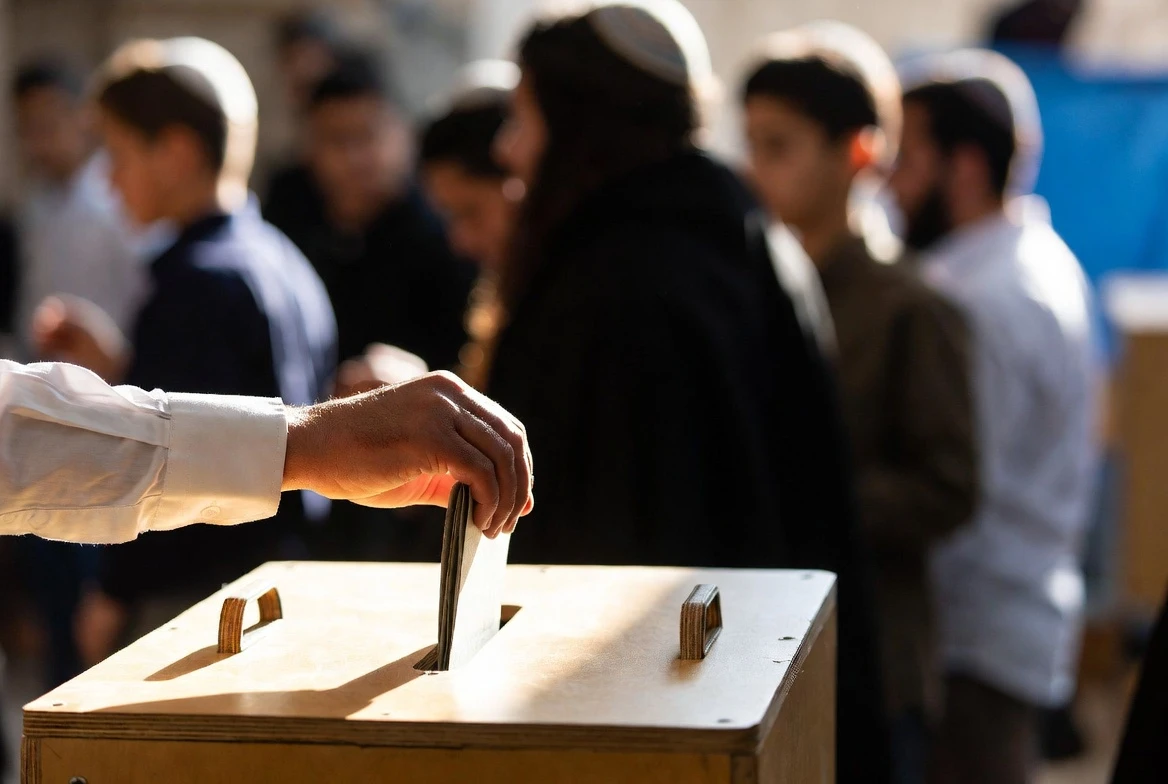
The Coalition’s Religious Base
The coalition that took office in December 2022 drew 80% of its voters from three groups: haredim, religious Zionists, and traditional Jews. The opposition drew 73.5% of its voters from secular Israelis. The numbers reflect a political market that sorts voters by religiosity almost as reliably as it sorts them by age or income.
Against the backdrop of the strengthening of ‘tribal’ trends in Israeli society, which are based to a large extent on the division of Israeli society into different groups along religious lines, it is especially important in Israel to examine the relationship between voting and the variable of religious self-definition.
Finkelstein, the IDI researcher who authored the study, wrote that in a note carried by the Times of Israel. The coalition’s hold on the haredi vote was the tightest. Among haredim, 86% voted for the two haredi parties, United Torah Judaism (58%) and Shas (28%). Another 7% voted for Religious Zionist-Otzma Yehudit, and 4% for Likud. The 86% figure was a slight decline from 89% in 2021, with the lost share going to Religious Zionist-Otzma Yehudit. Tensions over haredi political demands have spilled into the streets, as seen in the Haredi riots that followed a Supreme Court clash.
Where Religious Zionist-Otzma Yehudit Absorbed Yamina
The most significant change between the 2021 and 2022 elections was the expansion of the Religious Zionist-Otzma Yehudit alliance, which broadened its appeal beyond its traditional religious base. The 14-seat Knesset list, headed by Bezalel Smotrich and combining Religious Zionist, Otzma Yehudit, and Noam, absorbed most of the voters left behind when Naftali Bennett’s Yamina party dissolved.
Among national-religious voters, support for Religious Zionist-Otzma Yehudit rose from 30% in 2021 to 45% in 2022. The party’s share of traditional voters rose even more sharply, from 4% to 14%, while its share of secular and Haredi voters also increased substantially.
The Yamina dissolution explains most of the shift. In 2021, Yamina received 27% of the national-religious vote and 14% of the traditional vote. The party did not run in 2022. Ayelet Shaked’s successor list, The Jewish Home, won 9% of the national-religious vote but failed to clear the electoral threshold.
The national-religious vote split reveals a fault line within the religious Zionist world. Torani/Hardal voters, a smaller subset with stronger haredi-influenced practice, gave Religious Zionist-Otzma Yehudit 57% of their vote and the Haredi parties 29%. Non-Hardal national-religious voters gave the alliance a lower 42%, with 25% going to Likud and 12.5% to opposition lists. The rise of religious Zionism into state institutions is mapped in how the Temple Mount movement reached state power.
National-religious vote by party, 2021 vs 2022
| Party | 2021 | 2022 |
|---|---|---|
| Religious Zionist-Otzma Yehudit | 30% | 45% |
| Likud | ~23% | 22.5% |
| Haredi lists (Shas + UTJ) | 11% | 13% |
| Opposition lists | 9% | 10.5% |
| Yamina | 27% | Did not run |
| The Jewish Home | Did not run | 9% (below threshold) |
Likud Made Its Biggest Gain Among Traditional Jews
Likud strengthened its position among traditional voters, increasing its support from 39% to 46.5% between the 2021 and 2022 elections. The gain came partly at the expense of Yamina, which had won 14% of the traditional vote in 2021, and partly at the expense of National Unity, which fell from 18% to 12.5%.
Likud’s overall voter composition in 2022 reflected its base: 57% of Likud voters were traditional, 32% were secular, and 10% were national-religious. The party, founded as a right-wing secular movement, now relies heavily on traditional and religious voters.
Likud did not gain among national-religious voters. Its share of that group stayed at roughly 23% from 2021 to 2022. The party’s growth came from the traditional tier, not the religious Zionist one.
What Changed for Secular Voters
Secular voters moved leftward between the two elections, with the shifts concentrated in the centrist and left-wing parties. Yesh Atid expanded its backing among secular Israelis from 31% to 39%, becoming the largest single destination for the secular vote.
National Unity, the centrist alliance of Benny Gantz’s Blue and White and Gideon Sa’ar’s New Hope, declined from 18% to 13% among secular voters. Labor and Meretz together fell from 19% to 16%, with Meretz failing to clear the electoral threshold and winning 3.2% of the national vote. Twenty percent of secular voters backed Likud, a figure that reflects the party’s long history as a home for secular right-wing voters even as its base has shifted toward traditional and religious Jews.
Secular vote by party, 2021 vs 2022
| Party | 2021 | 2022 |
|---|---|---|
| Yesh Atid | 31% | 39% |
| National Unity | 18% | 13% |
| Labor + Meretz | 19% | 16% |
The Structural Map That Held
The IDI’s central finding is that the relationship between religiosity and party affiliation remained stable even as specific parties gained and lost ground. Voters became neither more nor less likely to sort by religion; they redistributed within the same religious tiers.
The Times of Israel reports that polls show a competitive race between the ruling right-wing and religious bloc and the largely centrist, left-wing, and secularist parties that hope to unseat Prime Minister Benjamin Netanyahu.
A 2025 IDI survey on Israeli religious identification, cited by the Times of Israel, puts the current breakdown at 43.6% secular, nearly a third traditional, nearly 13% national-religious, and 11.6% Haredi. For broader context on religion and state in Israel, see the 2022 Israel Religion and State Index.
Frequently Asked Questions
How many voters did the IDI study cover?
The study drew on 20 IDI surveys conducted between November 2022 and October 2023, with 12,322 Jewish adults aged 18 and over participating. After excluding non-voters, blank ballots, and refusals to answer, the voting-patterns analysis covered 10,694 voters.
What religious categories did the IDI use?
The IDI used the Central Bureau of Statistics’ customary five-category division: haredi, religious, traditional-religious, traditional non-religious, and secular. The IDI surveys split the religious category into two: national-religious and Torani/Hardal.
Which party gained the most from the dissolution of Yamina?
Religious Zionist-Otzma Yehudit absorbed most of Yamina’s former voters. Its share of the national-religious vote rose from 30% to 45%, and its share of the traditional vote rose from 4% to 14%.
Did secular voters shift their party preferences?
Yes. Yesh Atid expanded its backing among secular Israelis from 31% to 39%, while National Unity declined from 18% to 13% and Labor and Meretz together fell from 19% to 16%.
What does the data suggest for the next election?
The structural religious-political divide remained stable between 2021 and 2022, meaning party strategies will compete within the same religious tiers rather than break across them. The Times of Israel reports polls show a competitive race ahead.
