
The Israel-Hezbollah partial ceasefire announced Monday by US President Donald Trump covers roughly one square of map: Beirut. Israel agreed not to bomb the Lebanese capital in return for Hezbollah, the Iran-backed armed group, halting its cross-border attacks. The southern third of the country was left out of the bargain, and Israeli strikes there killed at least eight people on Tuesday, including a man, his son and his daughter.
Hezbollah did not negotiate any of this with the Americans or the Israelis. It talks to Iran, and Iran spent the weekend on the phone with Beirut. The protection of Hezbollah’s stronghold came out of that channel, and Tehran has now suspended its own talks with Washington, which leaves the whole arrangement riding on a far larger negotiation than anything happening over Lebanon.
Strikes Resumed Hours After the Announcement
Trump posted on Monday night that both sides had agreed to stop shooting. Within hours the Israeli military said it had intercepted two projectiles fired into northern Israel, and Hezbollah said its fighters had hit Israeli troops inside southern Lebanon. The cessation, such as it was, never reached the front line.
On Tuesday Israel issued a fresh evacuation order for the town of Nabatieh, warning residents it was “compelled to act forcefully” because of what it called Hezbollah’s violation of the deal. A dentist from the Christian village of Qlayaa was killed with his daughter and son in a drone strike on the road between Marjayoun and Nabatieh, according to Lebanon’s state-run National News Agency. Hezbollah’s military wing said it had targeted Israeli tanks and troops in Haddatha, Bayada and Zawtar al-Sharqiya with drones, missiles and shells. It made no mention of firing across the border.
Israel’s foreign ministry countered that Hezbollah had broken Monday’s understanding by launching “multiple missile and drone attacks from Lebanon against Israeli communities.” Two days earlier, Israeli forces had captured the hilltop fortress of Beaufort Castle, the kind of advance that does not pause for a political announcement. Benjamin Netanyahu put it plainly in his own statement: the army would “continue to operate as planned in southern Lebanon.”
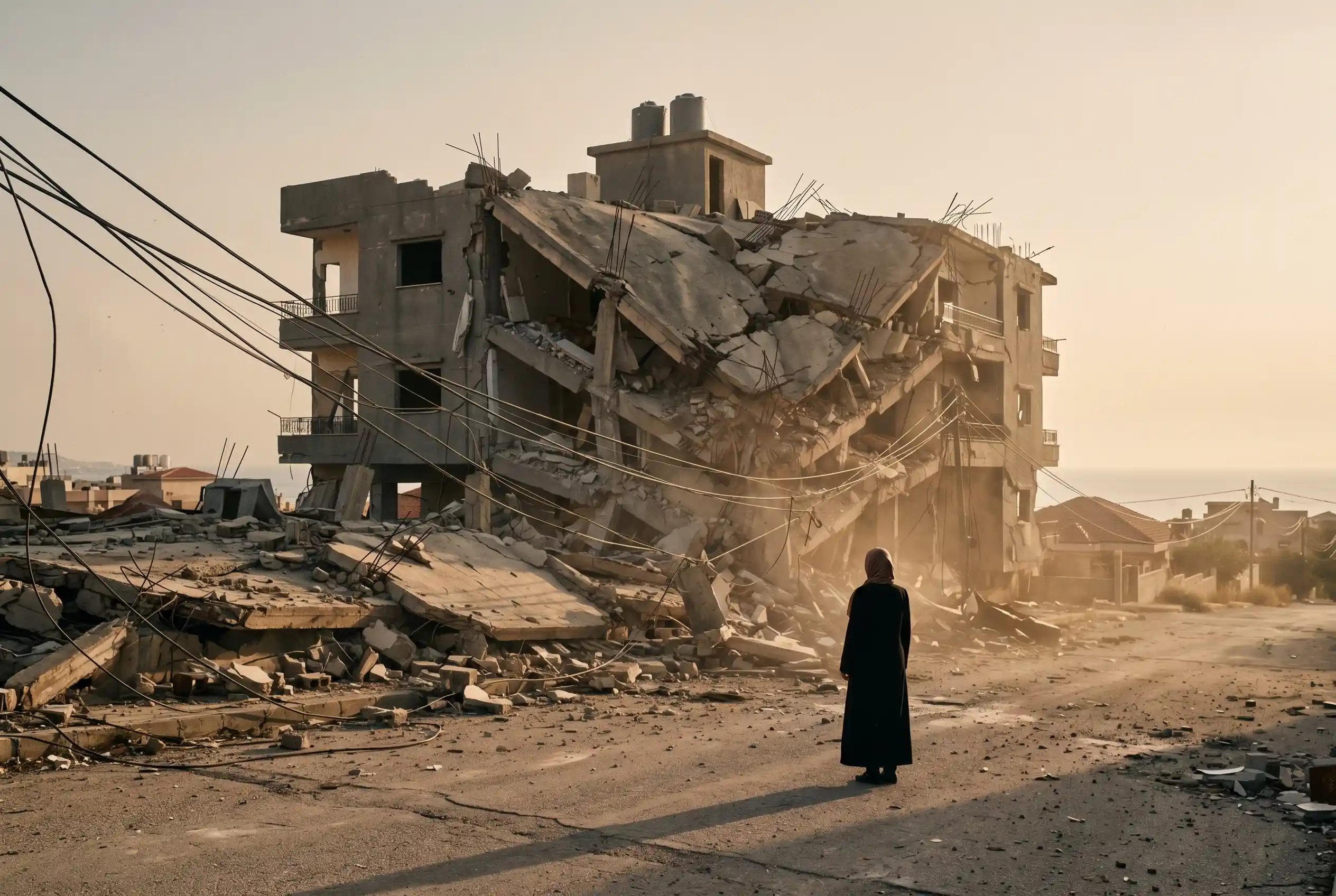
Tehran Drew the Line Around Dahieh
Strip the announcement of the American framing and a simpler mechanism shows through. The deal exists because Iran wanted Beirut’s southern suburbs left standing, and Iran had the leverage to get that.
The Only Channel Hezbollah Uses
Through the worst of the escalation, Hezbollah communicated with no party other than Iran, which kept daily contact with Lebanese Parliament Speaker Nabih Berri, the head of the Amal Movement and the group’s closest political ally. Berri became the relay between the militants and Washington precisely because the militants would not pick up the American line themselves. A Lebanese political official involved in the consultations described the whole machine in one sentence: Iran pressures Hezbollah to stop firing, the United States pressures Israel to stop firing.
Hezbollah’s own people were blunt about what Monday’s deal really was. Mahmoud Qamati, a member of the group’s Political Council and a former minister, told the BBC that threatened Israeli strikes on Dahieh had been blocked by Iranian pressure.
There was no ceasefire agreement, just the protection of Al-Dahieh.
Qamati said it to the broadcaster’s Newshour programme on Tuesday. Senior Hezbollah lawmaker Hassan Fadlallah went further on the group’s Al-Manar television, refusing to back what he called a “one-sided” ceasefire and demanding a comprehensive deal that ends with Israeli troops leaving the south.
Iran’s Warning to Berri
The threat behind the leverage was explicit. Iranian Parliament Speaker Mohammad-Bagher Ghalibaf told Berri that if Israeli aggression continued, Tehran would “not only halt the negotiations, but also move to confront the enemy directly.” That is not a side actor reacting to events. It is the party that decides whether Hezbollah holds its fire and whether the wider war stays cold.
What the Partial Deal Covers and Excludes
The geography is the whole story. One stronghold got a shield; everything south of it stayed inside the war. The arrangement was never a national ceasefire, and the table below sets out where it bites and where it does nothing.
| Area | Israeli air strikes | Israeli ground forces | Hezbollah obligation |
|---|---|---|---|
| Beirut and Dahieh suburbs | Suspended under the deal | None present | Refrain from attacks on Israel |
| South of the Litani River | Continuing daily | Five divisions deployed, still advancing | Still firing on Israeli troops |
That southern band is the same zone between the Blue Line and the Litani that a UN force has policed since 2006, when Resolution 1701 tasked it with keeping the area clear of armed groups other than the Lebanese state. The current round of Washington talks centres on a “move versus move” mechanism, a step-for-step sequence meant to convert Monday’s narrow understanding into something that covers all of Lebanon. None of it has stopped the bombing in the meantime.
The Toll in Tyre and Nabatieh
The deal arrived a day too late for the coastal city of Tyre. On Monday afternoon Israeli air strikes hit buildings next to Jabal Amel hospital, killing four people and injuring 127, among them 39 hospital staff, four of them in critical condition.
Inside Jabal Amel Hospital
The hospital director, Dr Wael Mroueh, described an ordinary shift cut in half. “It happened without any prior warning,” he said, denying there was any military target nearby. Corridors filled with broken glass, ceiling panels came down, and a row of incubators was left cracked by the blast. Four hours before the strike, a baby named Fares had been born in the maternity ward. Israel said it had struck “Hezbollah terrorist infrastructure,” acknowledged the hospital was damaged, and insisted the building “was not targeted,” accusing Hezbollah of embedding itself in civilian areas without offering evidence. Lebanon’s health ministry counts 128 paramedics and health workers killed in 159 attacks on ambulances and medical facilities over the past three months. Lebanon’s civil defence agency said a separate strike hit its centre in Kfar Sir on Tuesday, sharing photographs of the wrecked civil defence centre on X that showed metal beams torn from the ceiling.
A Country Already Broke
The wider numbers are worse. At least 3,468 people have been killed in Lebanon since the war restarted, according to the health ministry, whose figures do not separate fighters from civilians. The UN’s humanitarian office puts displacement at more than 1.2 million people, with Israeli evacuation orders now covering more than an eighth of the country, a scale of uprooting tracked in the UN response to the Lebanon emergency. All of this lands on a state that was already insolvent. The World Bank’s assessment of Lebanon’s economic collapse records a currency that has lost 98% of its value and more than a third of the population pushed into poverty, before this war added a single shell.
Why a Lebanon Strike Could Sink the Iran Talks
The reason a fight over Beirut’s suburbs rattled Washington has little to do with Lebanon. It runs back to the bigger war the United States and Israel started in Iran this spring, and to the fragile truce now holding it.
Tehran’s All-Fronts Doctrine
Lebanon was pulled into that war on 2 March, when Hezbollah fired rockets at Israel in retaliation for the 28 February assassination of Iranian Supreme Leader Ali Khamenei by US and Israeli forces. Iran treats the whole thing as one front. Foreign Minister Abbas Araghchi called the US-Iran truce “unequivocally a ceasefire on all fronts, including in Lebanon,” and warned that “its violation on one front is a violation of the ceasefire on all fronts.” When Netanyahu announced he had ordered strikes on Beirut’s southern suburbs, Tehran suspended its indirect talks with the United States the same day, citing Israel’s continuing operations in Lebanon.
Trump’s Expletive Call
That suspension is what moved the US president. The US outlet Axios, citing two American officials, reported that Trump “lashed out at” Netanyahu in “an expletive-laden call” and told him not to follow through on the Beirut plan, driven by fear the escalation would wreck the Iran negotiations. The reversal cost Netanyahu at home. Far-right National Security Minister Itamar Ben Gvir said “now is the time to tell our friend ‘no’,” and opposition leader Yair Lapid said Israel had become “a client state in full.” The prime minister’s office has not commented on either jab.
Washington Is Where the Next Move Gets Made
Israeli and Lebanese negotiators sat down at the US State Department on Tuesday for the first session of a two-day round, the venue where any expansion of Monday’s deal will be written or buried. Two questions dominate the table: how a ceasefire gets enforced, and how the step-for-step “move versus move” sequence between the two sides would actually run.
Lebanon’s own side is split. President Joseph Aoun and Prime Minister Nawaf Salam back the talks, with Aoun saying flatly, “There is no option other than negotiation.” Berri and Hezbollah prefer indirect contacts and argue that nothing can be agreed while the bombs are still falling. Berri has told the New York Times the group would accept what he calls a “real ceasefire,” code for a full Israeli withdrawal rather than a shield over one neighbourhood.
The Washington round runs through Wednesday. Whether the line around Beirut survives it depends on a table Tehran walked away from on Monday.
