
Yemen’s Foreign Ministry has warned Saudi Arabia that it will end what it calls the ‘aggression and break the crippling siege’ and will not retreat ‘regardless of the cost.’ The statement, released Sunday, came four days after an Iranian civilian aircraft landed at Sana’a International Airport. Yemen’s authorities describe the landing as the first breach of an 11-year closure of the capital’s only civilian air link.
The Foreign Ministry framed the warning as a sovereign declaration tied to a specific grievance: the closure of Sana’a International Airport, which has left Yemen’s capital cut off from civilian air travel since 2015. Yemen’s authorities argue that the airport has denied millions of Yemenis the right to travel, to seek medical treatment abroad, and to maintain family and commercial ties; the landing on Friday was, in their telling, the moment the closure was broken.
What Yemen Just Declared
The Sana’a government’s Foreign Ministry put the warning on the record in a Sunday statement. The reopening of Sana’a International Airport is, the Ministry said, a ‘sovereign right’ of Yemen, and Yemen ‘will proceed with this without anyone’s permission.’ The process of breaking the siege, the statement added, is ‘still in its early stages.’
The Ministry addressed the Saudi leadership directly. It advised the kingdom to focus on its ‘internal affairs, such as its oil fields, stock market, and Vision 2030 projects’ rather than continuing its campaign in Yemen. It dismissed Saudi claims of a roadmap for peace as ‘completely untrue,’ accusing Riyadh of being ‘behind the continued siege’ and of obstructing the payment of civil service salaries. Saudi Arabia was labeled a ‘Zionist tool’ acting ‘under American sponsorship,’ with the statement pointing to the kingdom’s role during Israel’s war on Gaza.
The closing message was a warning of consequences. ‘Let him return to his senses and realize the magnitude of the disaster that will befall him if he commits any folly,’ the Foreign Ministry said. Any further aggression, the statement added, would carry ‘a disastrous impact on the already unstable region and the global economy.’ Saudi threats of new action are ‘rejected.’
Let him return to his senses and realize the magnitude of the disaster that will befall him if he commits any folly.
The statement was issued by the Sana’a-based Foreign Ministry on Sunday, July 5, 2026, in its full Sunday warning to Riyadh.
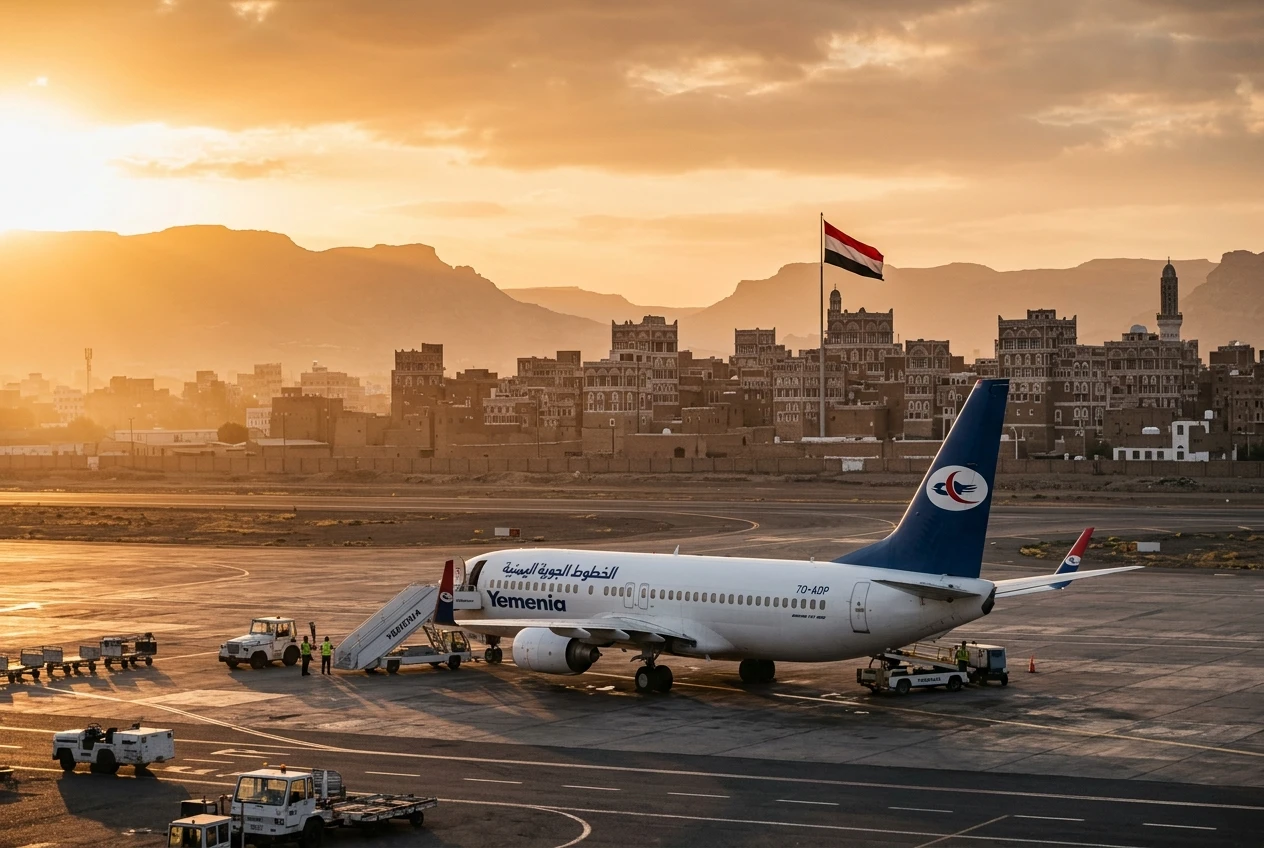
The Friday Flight That Cracked the Airport Siege
The statement was triggered by an event three days earlier. On Friday morning at 5:20 AM (02:20 GMT), Yemen’s Armed Forces released a statement on the airspace intrusion. A formation of Saudi enemy warplanes violated Yemeni provincial airspace. The formation was attempting to prevent an Iranian civilian aircraft carrying more than 200 stranded citizens, wounded, and sick passengers from landing at Sana’a International Airport. Houthi air defenses fired missiles, and the Saudi planes left Yemeni airspace.
The plane landed. Houthi media reported that it returned to Tehran carrying the Houthi delegation to attend the funeral of Supreme Leader Ali Khamenei, who was killed in United States-Israeli strikes. Yahya Saree said flights between Sana’a and Tehran will continue despite any ‘possible consequences.’
The airport has been under ‘comprehensive closure by the US-Saudi-led coalition’ since 2015, the statement said, leaving Sana’a cut off from civilian air travel to the outside world. Sana’a authorities have consistently condemned this measure as a form of collective punishment and a violation of international humanitarian law. The Friday landing, in Yemen’s official framing, is the first physical breach of that closure. Yemen’s Armed Forces statement called for ‘general mobilization and combat readiness’ in response to a directive from the group’s leader, Abdulmalik al-Houthi.
The ‘Sovereign Right’ Message Behind the Warning
The Sunday statement fused three distinct grievances. It accused Saudi Arabia of obstructing salary payments to civil servants in Houthi-held territory, repeated the call for an end to the airport closure, and tied both to a wider regional alignment. The Ministry said any country in the region should understand that Yemen only demands its freedom and independence. The directive to mobilize came from Abdulmalik al-Houthi, the group’s leader, whose standing orders the Armed Forces said they were ready to carry out.
The framing of Saudi Arabia as a ‘Zionist tool’ pulled the dispute into the wider Middle East conflict. The Ministry pointed to the kingdom’s role during the Gaza war, though it did not detail specific actions. Saudi Arabia should ‘learn from its failures over more than a decade of war and blockade,’ the statement said. Sana’a is no longer treating the war as a bilateral dispute. The message is as much a regional alignment signal as a Yemeni complaint, and it places Sana’a alongside Tehran in the regional confrontation with the United States and Israel.
Why This Reads as a Turning Point
The airport landing matters because Sana’a International Airport is the only civilian airport serving Yemen’s capital and the country’s most populous north. Its closure has, since 2015, blocked Yemenis from most international medical evacuation, commercial travel, and diplomatic access.
The Foreign Ministry said the siege-breaking ‘is still in its early stages.’ A single Iranian flight does not, by itself, reopen an airport, but it tests the Saudi-led coalition’s willingness to enforce the closure by air. If the coalition does not respond to the next flight, the closure in practice ends. If it does respond, Yemen’s Armed Forces have promised a ‘comprehensive response targeting your airports and vital interests on land and at sea.’
The Houthis were prepared to escalate before Friday. Their forces had already warned of strikes against Saudi airports and maritime assets. On Friday, Yahya Saree confirmed that ‘any options’ were on the table and that ‘their fingers are on the trigger to implement directives aimed at breaking the Saudi-American siege.’ The flight and the Foreign Ministry statement are the public phase of a posture that has been building.
The Wider War Behind the Headlines
The Saudi-led intervention in Yemen began in March 2015, after Houthi forces seized Sana’a and forced President Abd Rabbu Mansour Hadi into exile. A coalition of Gulf states led by Saudi Arabia and backed by US logistical and intelligence support launched a campaign of air strikes, naval blockade, and economic isolation. The air campaign has been described by humanitarian organizations as one of the most destructive of the century, according to one long-running conflict tracker on Yemen.
The human cost has been enormous. The UN estimated that 377,000 people had died in Yemen between 2015 and the beginning of 2022, with 60 percent of deaths the result of indirect causes such as food insecurity and lack of accessible health services. Twenty-one point six million Yemenis remain in need of humanitarian assistance, and more than 4.5 million are displaced. Yemen has been described by the UN as the world’s worst humanitarian crisis.
The two sides disagree sharply on the scale of the air campaign. The Council on Foreign Relations cites ‘over twenty-five thousand’ coalition air strikes since 2015, with ‘over nineteen thousand’ civilian casualties. Yemen’s Foreign Ministry, in its Sunday statement, put the figure at ‘over a quarter of a million’ airstrikes and tens of thousands of civilian deaths. Both figures are in the public record, and both are at odds.
| Source | Airstrike figure since 2015 | Date stated |
|---|---|---|
| Sana’a Foreign Ministry (via Press TV) | ‘Over a quarter of a million’ | July 5, 2026 |
| Council on Foreign Relations | ‘Over twenty-five thousand’ | April 14, 2026 |
Two ceasefire tracks have failed to end the war. Several milestones have followed in the years since, none of them a final settlement.
- The UN-brokered ceasefire expired in October 2022 without renewal.
- The Houthis made their first official visit to Riyadh since the war began in September 2023.
- The Saudi-backed government and the Houthis agreed to their largest prisoner exchange in May 2026, which included seven Saudis.
The airport landing on Friday and the Foreign Ministry warning on Sunday sit on top of that unresolved track.
The Saudi Reply and the Flight That Comes Next
The Saudi-led coalition has publicly dismissed the Houthi framing. It said the Houthi statements about the airspace confrontation were an attempt to ‘divert attention away’ from Houthi ‘violations,’ without elaborating. Saudi Arabia has not publicly confirmed or denied that its warplanes attempted to intercept the Iranian aircraft. The kingdom has also not detailed any response to the Foreign Ministry’s warning.
The next flight out of Sana’a, whenever it comes, will be the test. Yemen’s authorities have framed the Friday landing as the first breach of the airport closure, and Yahya Saree said flights between Sana’a and Tehran will continue despite any ‘possible consequences.’ The Foreign Ministry said on Sunday that the siege-breaking ‘is still in its early stages,’ and that is where the standoff now sits.
