
Greg Broussard was 19, with no driver’s license and no bank ID, when the first check for “Egypt, Egypt” landed: $40,000. A second $40,000 check came two days later. A third, worth $120,000, arrived the next day.
He performed as Egyptian Lover, a fixture of the Los Angeles electro scene who built his sound around a Roland drum machine most professional studios had already written off. More than 40 years on, he still owns every one of those masters, a position artists like Taylor Swift have spent hundreds of millions of dollars chasing. Broussard got there first, by turning down almost everything the music business offered him in 1984.
A DJ’s Gamble in Front of 10,000 People
By 1983, Broussard was deejaying for Uncle Jamm’s Army, a Los Angeles party and performance collective founded by promoter Rodger Clayton that also counted Ice-T, DJ Bobcat, DJ Pooh and Arabian Prince among its ranks. The crew’s electro sets packed the L.A. Sports Arena with 10,000 dancers a night.
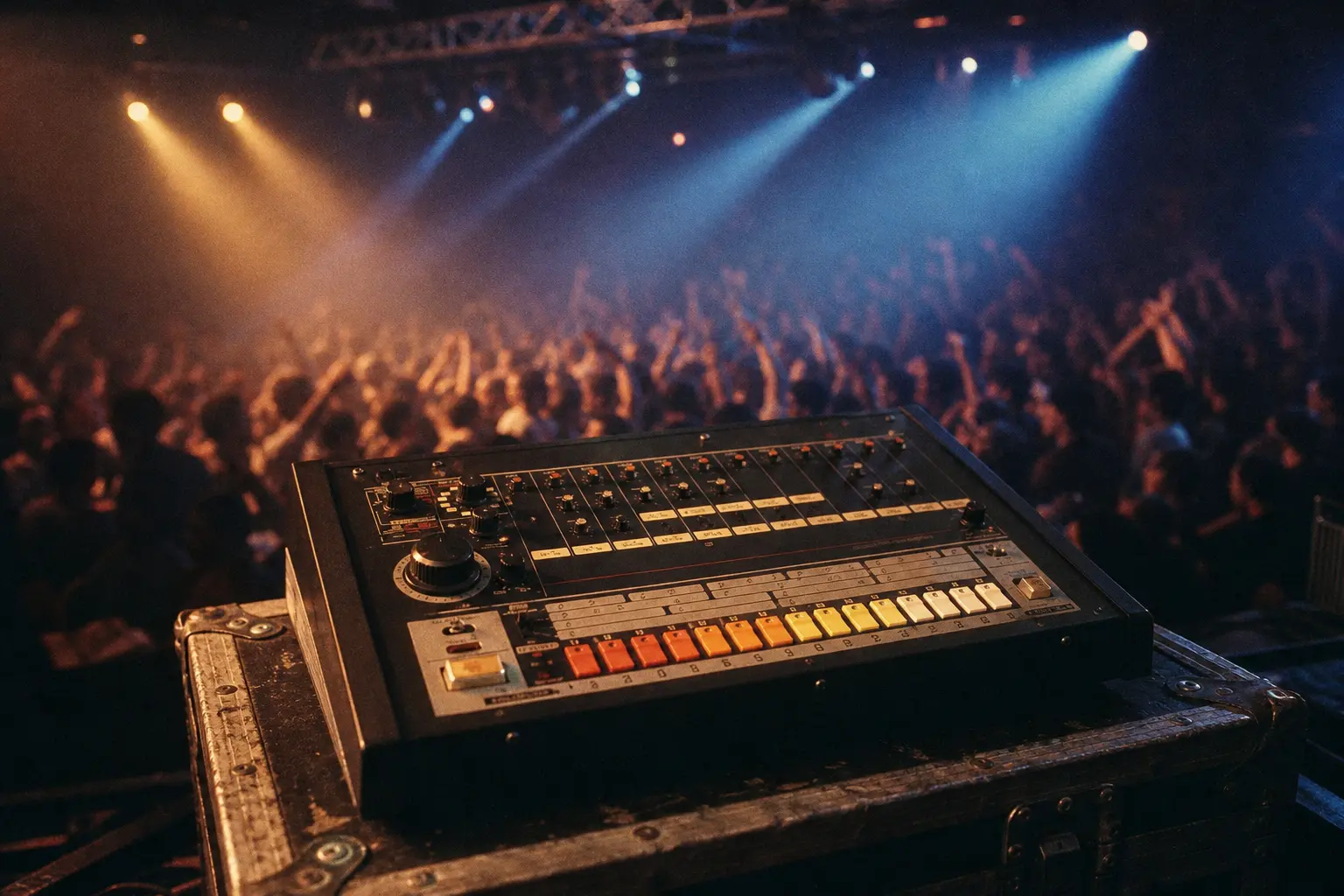
One of those nights, Broussard brought a Roland TR-808 drum machine onto the turntables, unsure whether a crowd that size would dance to a machine instead of a band. He was spinning Afrika Bambaataa’s “Planet Rock” when he cut the record on its breakdown and let the 808 play alone.
The crowd kept moving. Uncle Jamm’s owner ran over demanding to know what record was playing. Told it was a drum machine, all he said back was “Wow,” then told Broussard they needed to cut a record together.
Within days they recorded “Dial-A-Freak” and “Yes, Yes, Yes.” Broussard was so taken with what the studio could do that he saved up and went back a week later to record “Egypt, Egypt.”
Three Unfinished Songs Became One Anti-Hit Record
The session almost didn’t happen. Broussard had written a track called “Beast Beats” and was walking to the studio when, he says, he had a strange premonition about it making him famous, one he pictured as the devil walking beside him narrating his own future. Spooked, he cleared the room for 30 minutes, tore the song apart on the 808 and buried it in his songbook.
What came out instead was three different unfinished songs welded into one. Broussard took a “Pyramids” chant from one, a “freaky kinky nation” hook from another, and a vocoder passage from a third, stitching them together with no chorus and no bridge.
The engineer was confused. Broussard recalled him asking why every verse was different and where the chorus was. Broussard’s answer left no room for debate: “I’m making the greatest hits of the Egyptian Lover that never came out because I’ve never made a song before.”
The record’s now-signature tone was an accident. An engineer plugged a cable into the 808’s accent jack, the input that makes individual hits louder, and Broussard heard a sound he’d never gotten from his own machine in two months of owning it. He had the engineer route every drum through it, then stripped out the excess bass.
That same engineer, paid by the hour, took his time. Broussard says his unhurried EQ work is a big reason the record still sounds finished four decades later.
Waiting Six Months to Go No. 1
Broussard already had a record on the air. KDAY, the L.A. station spinning his single “Dial-A-Freak,” was the first place he brought the “Egypt, Egypt” tape. Program director and DJ Greg Mack wanted to put it on immediately.
Broussard said no. Someone in the business had warned him a second single so soon would kill the first and told him to sit on it for six months. He agreed, reluctantly, and pressed the record instead of airing the tape.
On the fifth month he went back into the studio, cut a long version and mastered it. A month later, KDAY finally played it, on the hour, every hour. Broussard says he had never heard a song get that kind of rotation before.
The station’s request lines told the story on their own. Every caller Broussard answered in person wanted the same track. Mack later told him the song had gone to No. 1, and rival stations started calling for copies once they noticed.
| Milestone | Figure |
|---|---|
| On the Nile entered Billboard’s Top Black Albums chart | No. 56, week of January 26, 1985 |
| Peak position on that chart | No. 44, over 9 weeks |
| U.S. single sales by March 1985 | 425,000 copies |
| First three distributor checks, paid across three days | $40,000, $40,000, then $120,000 |
Those numbers landed before Broussard even had a car.
The Video He Turned Down, the Deal He Rewrote
MTV called wanting a video. Broussard turned it down, worried fans would tape the broadcast instead of buying the 12-inch. One early concept for the video, by his own account, centered on “an escalator into hell.” It was never filmed.
The bigger rewrite happened on the business side. A friend who worked at Malaco Records told him to stop paying pressing plants out of his own pocket and make distributors cover it instead. The math was simple: order 50,000 records, pay $100,000 upfront.
- Distributors paid $2 upfront for every record they ordered, before a single unit shipped.
- Egyptian Empire used $1 of that advance to pay the pressing plant.
- The label kept the remaining $1 as guaranteed profit, regardless of what happened at retail.
With only about a dozen national distributors serving roughly 100,000 record stores, the math worked in his favor almost immediately.
A $1,200 Machine Nobody Wanted
The instrument behind all of it was already considered a flop. Roland launched the TR-808 in 1980 at $1,195, undercutting the sample-based Linn LM-1’s roughly $5,000 price tag, but professional studios wanted realistic drum sounds, and the 808’s analog tones weren’t that. Roland’s chief engineer, Tadao Kikumoto, chose cheap analog synthesis over sampling to keep the unit affordable.
Roland built about 12,000 units before discontinuing the 808 in 1983, once it could no longer source the out-of-spec transistors the design depended on. Secondhand units dropped to around $100, cheap enough for broke electro and techno producers, Broussard among them, to build entire genres on gear the rest of the industry had already discarded.
- TR-808 – Roland’s analog drum machine, sold from 1980 to 1983, whose unrealistic tones became the rhythmic backbone of electro, hip-hop, house and techno.
Broussard still tours with vintage 808 units today, running the same circuitry that made radio programmers do a double take in 1983.
Why Didn’t Egyptian Lover Ever Have to Fight for His Masters?
Because he set up Egyptian Empire Records in 1984 and pressed “Egypt, Egypt” himself, so there was never a major label contract to sign the masters away in the first place. Decades later, artists from Taylor Swift on down have spent fortunes buying back what Broussard simply never gave up.
The fight Broussard skipped is still going on across the industry. A provision in the 1976 Copyright Act gives recording artists a 35-year window to reclaim their masters from the labels that first signed them, according to legal analysis from the firm Tilleke and Gibbins, though few artists ever complete the process.
Swift took a faster, costlier route. Reports pegged her purchase of her own catalog from Shamrock Capital at roughly $360 million. Broussard never had to buy anything back. He already owned it.
The Pyramid Keeps Getting Reissued
Stones Throw Records, the Los Angeles label run by Peanut Butter Wolf, first reissued the single as a custom-made pyramid pressed on white vinyl, then followed it with a four-LP box set pulling 22 tracks from Broussard’s original reel tapes, with liner notes from music journalist Jeff Weiss.
A 2024 reissue celebrated the single’s 40th anniversary, backed with the instrumental “Girls” from On the Nile. Broussard and a friend named Victor cut a tribute video from decades of photos to go with it, the closest thing the song ever got to the video MTV wanted in 1984.
He’s still adding to the catalog. Broussard released 1987, a new album built on the same 808 and vocoder setup, through Egyptian Empire Records in 2025, and he still DJs sets around the world.
It’s just one of those songs that never dies.
Broussard told SPIN, comparing it to the electro records that shaped him, including “Planet Rock” and Twilight 22’s “Electric Kingdom.”
The checks eventually slowed. The song never did.
Frequently Asked Questions
Is Egyptian Lover still making music and touring?
Yes. Broussard released 1987, a new album recorded on the same TR-808 and vocoder rig he used in the 1980s, through his own Egyptian Empire Records in 2025, and he continues to DJ live sets internationally.
Why did Roland stop making the TR-808?
Roland discontinued the TR-808 in 1983 after building roughly 12,000 units and replaced it with the sample-based TR-909. The original’s scarcity is part of why collectors still chase it decades later.
What is an original Roland TR-808 worth today?
Working original units, once sold for scrap prices in pawn shops, now typically sell for $3,000 to $5,000 in good condition, with mint examples fetching more from collectors.
Who else was in Uncle Jamm’s Army with Egyptian Lover?
The Los Angeles collective, founded by promoter Rodger Clayton, also included Ice-T, DJ Bobcat, DJ Pooh and Arabian Prince among its DJs and performers during the early 1980s electro and party rap scene.
Did “Egypt, Egypt” ever get an official music video?
No full video was shot in the 1980s. Broussard turned down MTV’s offer at the time, and Stones Throw Records eventually built a tribute video from archival photos for the song’s 40th anniversary in 2024.
