
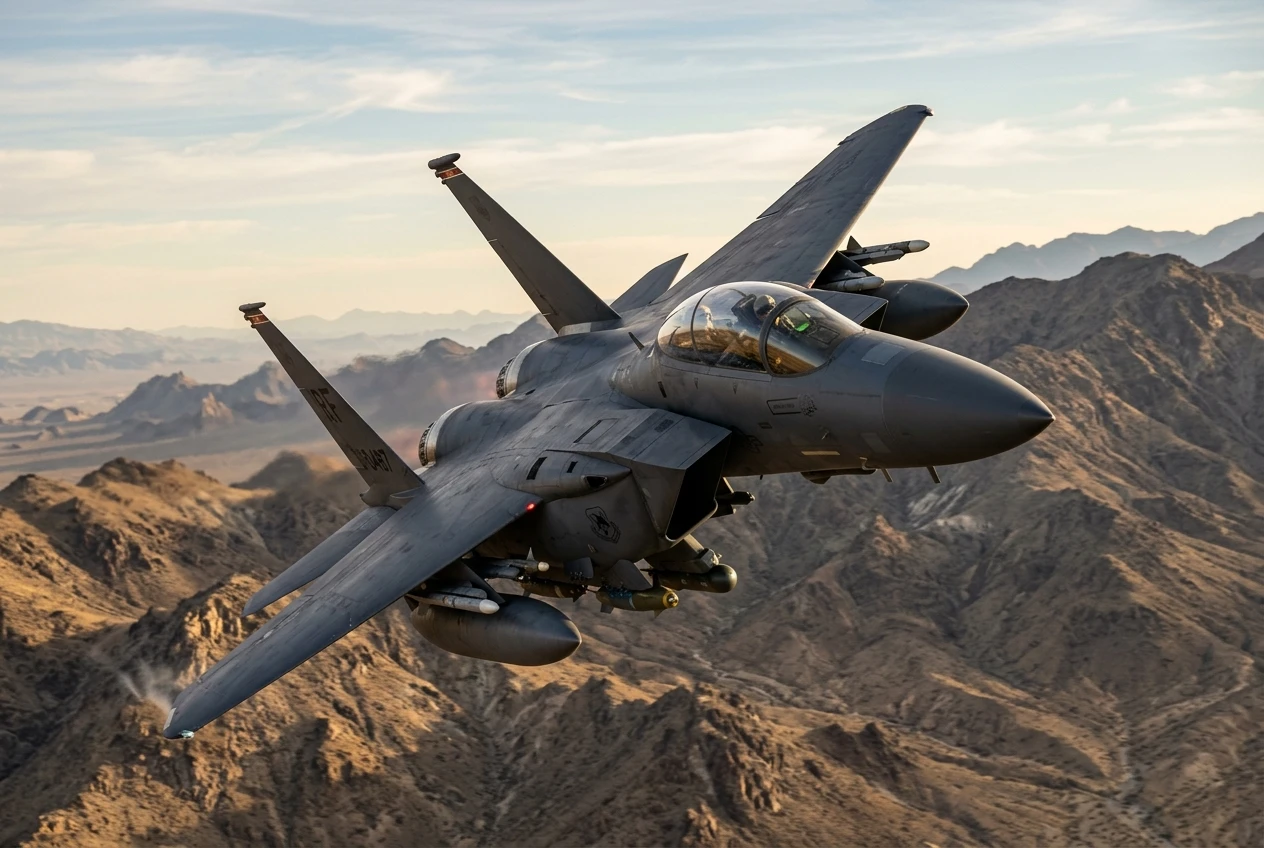
The F-15 Eagle has carried a perfect air-to-air combat record across more than fifty years, with 104 confirmed kills and zero losses to enemy fighters across every operator and every war that has put it in the air. That ledger faced its hardest test in 2026, when three U.S. F-15E Strike Eagles were lost to friendly fire over Kuwait and a fourth Strike Eagle was brought down over Iran during Operation Epic Fury. None of the 2026 losses involved another aircraft, and the F-15 family’s air-to-air ledger still stands at 104 and 0.
The Air Force, plainly impressed by what its oldest frontline fighter did under stress, has now doubled its planned buy of the latest Eagle variant to 267 F-15EX jets in its Fiscal Year 2027 budget. The 2026 losses count the way regular-season losses count in basketball: a Strike Eagle brought down by ground fire is a different category from an Eagle lost to a MiG, the same way a Game 3 loss is a different category from a Finals loss. The Eagles that flew top cover in Desert Storm and held the Bekaa Valley in 1982 have never lost an air-superiority engagement. The 104 still stands.
A Record Built to Be the Standard
The F-15 first flew on July 27, 1972. The aircraft emerged from a post-Vietnam reckoning, when the F-4 Phantom was being out-turned by lighter MiGs and the Air Force decided to forget every mission except the one in the sky. McDonnell Douglas built the Eagle around a single design maxim drafted by fighter pilot John Boyd: not a pound for air-to-ground.
Twin Pratt & Whitney F100 engines fed the airframe enough thrust to climb straight up without bleeding speed, and the resulting thrust-to-weight ratio still dominates fighters half a century later. A large wing gave the jet a lift-to-drag ratio that let pilots fight in the vertical domain where missiles could not follow. The original radar paired with a single-piece canopy let the pilot see and shoot down into ground clutter. The design philosophy came straight from Boyd’s energy-maneuverability theory, the principle that an aircraft which keeps its energy wins the dogfight.
The Israeli Air Force received its first F-15As in 1976 and called the type a different sport. Israeli pilot Moshe Melnik scored the first F-15 air-to-air kill in 1979, a Syrian MiG-21 over Lebanon. Within three years, Israeli Eagles would fly the kind of fight the type was built for, in the Bekaa Valley battles of 1982. F-15 pilots downed more than 40 Syrian aircraft across multiple MiG variants in those engagements, with not a single Israeli F-15 lost in air-to-air combat.
The U.S. Air Force took its turn in the original Gulf War in January 1991. F-15C pilots scored 34 of 36 confirmed USAF air-to-air kills during Desert Storm, plus two probable, against an Iraqi fleet led by MiG-29s. Saudi F-15s added additional kills to that tally, and the combined score climbed past 80 confirmed kills by the end of 1991. The score kept climbing through every subsequent operation, with no F-15 of any variant ever lost to another aircraft.
The air-to-air ledger has held across every operator since. Opposing air forces have filed claims of downed Eagles across roughly fifty years of combat, and no claimant has ever surfaced wreckage or gun-camera video to back the claims. Israel remained the type’s top operator by kills, accounting for more than half of the air-to-air total. By 2026, the score that mattered read 104 confirmed wins and zero losses.
The Air-to-Air Ledger to 104 Wins
Across every operator since 1979, the F-15 air-to-air record sits at 104 confirmed kills and zero losses. The scoreboard is the only one of its kind in modern fighter aviation, and it has not needed a different column in fifty years. The F-15’s undefeated 104-0 air-to-air history is sourced from Israeli Air Force combat records, U.S. Gulf War claims, and post-1991 confirmation of individual engagements.
Three milestones do most of the work. The first came in 1979, when Moshe Melnik’s Syrian MiG-21 over Lebanon opened an Israeli ledger that would come to dominate the type’s record. The championship run came in 1982 during the Bekaa Valley battles, when Israeli F-15 pilots downed more than 40 Syrian aircraft across multiple MiG variants without losing a single jet in air-to-air combat. The American chapter was Desert Storm in January 1991, when F-15C pilots scored 34 of 36 confirmed USAF air-to-air kills (plus two probable) against MiG-29s and other Iraqi types.
The pattern is identical at every stage: every opponent sent was beaten, every engagement was won. Saudi Eagles scored kills in smaller engagements, and Israeli pilots kept the ledger alive through strike missions over Lebanon and Syria. No air-superiority Eagle has ever been lost to enemy action, even when claims of downed Eagles have surfaced from opposing air forces. The final score, as the type entered its sixth decade in the air, was the mark that has defined it since 1979.
- 27 July 1972: First F-15 flight at Edwards Air Force Base
- 1976: First export F-15As delivered to the Israeli Air Force
- 1979: First F-15 air-to-air kill, Moshe Melnik downing a Syrian MiG-21 over Lebanon
- 1982: Bekaa Valley battles; Israeli Eagles score 40-plus Syrian kills with zero F-15 losses
- 1991: USAF F-15Cs score 34 of 36 USAF air-to-air kills during Desert Storm
- 2 March 2026: Qatari F-15QA downs two Iranian Su-24 bombers near Al Udeid Air Base
- 3 April 2026: F-15E (call sign DUDE 44) brought down by ground fire over Iran; both crews recovered
When 2026 Tested the Line
Operation Epic Fury began February 28, 2026, and put more Eagles in harm’s way than any U.S. campaign since the original Gulf War. Iran retaliated with ballistic missiles, drones, and combat aircraft against bases including Al Udeid Air Base in Qatar, Ali Al Salem in Kuwait, Al Dhafra in the United Arab Emirates, Naval Support Activity Bahrain, and Muwaffaq Al Salti Air Base in Jordan. By early April, four American F-15E Strike Eagles had been destroyed in two separate incidents.
The first incident came on the night of March 1 to March 2, 2026, when three F-15Es went down over Kuwait. U.S. Central Command attributed the strike to Kuwaiti air defenses and called the March 1 friendly fire incident an apparent case of friendly fire. All six aircrew members (three pilots and three weapons systems officers) ejected and were recovered in stable condition, and the losses sit outside the air-to-air record since no Eagle was engaged by another aircraft.
The same day produced the war’s first Eagle kill. The Qatari Ministry of Defense confirmed on March 2, 2026 that a Qatar Emiri Air Force F-15QA had shot down two Iranian Su-24 Fencer bombers flying at 80 feet above the Persian Gulf, about two minutes from Al Udeid Air Base. The fighters carried bombs and guided munitions and did not respond to Qatari warnings, so they were visually identified and engaged. CNN, citing Qatari and U.S. sources, identified the interceptor as an F-15QA Ababil, marking the first combat air-to-air victory for the advanced Eagle variant.
The next loss came six weeks later on a different front. On the morning of April 3, 2026, an Iranian shoulder-fired heat-seeking missile struck an F-15E over southern Iran and brought the Strike Eagle down. President Trump told reporters at an April 6 White House briefing that U.S. forces had neutralized local air defenses in the area, but a single Iranian service member “got lucky” with a missile that “got sucked right in by the engine.” The crew ejected, and both aviators eventually reached friendly territory in one of the largest combat search and rescue operations in U.S. military history.
- 104: F-15 air-to-air kills confirmed across all operators, by latest count
- 0: F-15 air-to-air losses across more than fifty years of combat
- 4: American F-15E Strike Eagles lost in Operation Epic Fury, March 1 through April 3, 2026
- 2: Iranian Su-24s downed by a Qatari F-15QA near Al Udeid Air Base, March 2, 2026
- 1: American F-15E (call sign DUDE 44) brought down by a shoulder-fired missile over Iran, April 3, 2026
The DUDE 44 Mission Over Iran
The two-seat Strike Eagle, call sign DUDE 44, came to rest in hostile Iranian territory shortly after sunrise on April 3, 2026. Air Force Gen. Dan Caine, the Chairman of the Joint Chiefs of Staff, told reporters at an April 6 White House briefing that rescue aircraft began moving toward the downed crew within hours of the shootdown. The first rescue wave put 21 military aircraft into hostile airspace for seven hours in broad daylight, with A-10 Warthogs laying down close-range suppressing fire on Iranian positions while HH-60W rescue helicopters pushed in. One A-10 took enemy fire so badly that its pilot bailed out over Kuwait after exiting the battlespace.
The DUDE 44 pilot, known to rescuers as DUDE 44 Alpha, was recovered first. Caine said the rescue helicopter “was engaged by every single person in Iran who had a small arms weapon” during the pickup, with another trailing helicopter taking additional small-arms hits and a minor injury. Once the first airman was aboard, the search expanded for the second crew member, designated DUDE 44 Bravo. Trump described the second airman as a colonel who had landed a significant distance from the pilot, was injured badly, and faced an immediate manhunt. Iran’s government placed a bounty on his capture, and Trump said the area was “teeming” with Islamic Revolutionary Guard Corps, Basij militia, and local authorities hunting him. The colonel scaled cliff faces while “bleeding rather profusely,” reached a hidden spot in “treacherous mountain terrain,” and treated his own wounds before making radio contact with U.S. forces.
The second rescue wave ran for another seven hours, this time in darkness, with 155 aircraft in the air at peak. That figure included four bombers, 64 fighters, 48 refueling tankers, and 13 rescue aircraft, along with CIA-run deception operations that drew Iranian searchers to seven decoy locations. CIA Director John Ratcliffe said the agency used both human assets and intelligence technology to misdirect Iranian forces while confirming that the colonel was alive and concealed in a mountain crevice. By the morning of April 5, U.S. forces had engaged Iranian units near the colonel’s hiding place and brought him out, ending an evasion of nearly 48 hours.
This was an incredibly dangerous mission, an incredibly dangerous undertaking. But a filled promise made to every American warfighter that you will not be left behind. We will always come find you, and we will always bring you home.
Air Force Gen. Dan Caine, the Chairman of the Joint Chiefs of Staff, said those words at the April 6, 2026 White House briefing that walked reporters through the two-day F-15E crew recovery operation. Both aviators reached friendly territory alive, and the F-15 community closed a chapter that began in Desert Storm: the type’s air-to-air record was untouched, even as the cost of operating under modern air defenses became clearer than it has been in decades.
The Comeback Contract for 267 Eagles
The Air Force had once wanted to retire the Eagle for good. As recently as 2022, officials had cut the planned buy of the F-15EX Eagle II to just 80 aircraft, citing resource constraints, and the type was meant to give way to fifth-generation replacements. The 2026 war reset the math. By April 21, 2026, Air Force leaders had unveiled a Fiscal Year 2027 budget plan that doubled the EX buy to 267 aircraft, more than twice what Congress had funded the year before.
An Air Force spokesperson confirmed the expansion and tied the Air Force’s 2027 F-15EX budget plan to completing existing F-15EX units and beginning the recapitalization of the aging F-15E fleet. The service had about 25 EXs in its inventory at the time, with contracts already in place for more than 100. Air Force officials at an April 21 budget briefing told reporters the F-15EX and the F-35A would buy together, with the Eagle’s heavy weapons load and Pacific role making it a complement rather than a rival to fifth-generation stealth.
The expansion pushes the buy rate high enough to support Boeing’s St. Louis production line into the 2040s. The FY27 buy of 62 fighters breaks down into 38 F-35As and 24 F-15EXs, a split Air Force officials described at the briefing as a balanced portfolio for combatant command needs. The latest variant wears the 1972 silhouette over an almost entirely new aircraft, with conformal fuel tanks and fly-by-wire controls on an airframe rated to haul more weapons than any fighter currently in American service.
The Air Force previously had planned to retire F-15E Strike Eagles down to a surviving fleet of 99 airframes. The 267-jet F-15EX buy changes that math, allowing the service to absorb F-15E airframes into EX configuration over the next decade. Boeing is producing the F-15EX at a rate high enough to support the planned buy, which is why the company is now advertising the airframe as one built to fly into the 2040s.
| Variant | Air-to-Air Record | 2026 War Status |
|---|---|---|
| F-15A/B/C/D | 104 confirmed kills, 0 losses across all operators | Active across multiple theaters |
| F-15E Strike Eagle | No air-to-air losses recorded | 4 lost in March-April 2026 |
| F-15EX Eagle II | No combat air-to-air kills to date | 267 total on order, about 25 in inventory |
| F-15QA (Qatar export) | 2 Iranian Su-24s downed March 2, 2026 | First air-to-air kill for the variant |
Why the Ledger Is the Jordan Argument
The F-15’s case for being called the Michael Jordan of fighter jets rests on the same test any all-time-best conversation uses: the games that counted, and how many were lost. The F-15 has logged 104 air-to-air wins and zero losses in the column that counts, and no other fighter type in the modern era has matched that mark. The 104-wins-and-zero column is what unbeaten looks like across fifty years and three continents.
The 2026 losses are the regular season. Three Strike Eagles brought down by a friendly air defense network, plus a fourth hit by a shoulder-fired missile over Iran, count as losses in war. They are not defeats by another aircraft, the only category that counts in this comparison. The air-superiority Eagles that scored 40-plus kills in the Bekaa Valley and flew top cover in Desert Storm have never lost an engagement to another fighter. The 104 stands.
Frequently Asked Questions
Has an F-15 ever been shot down in air-to-air combat?
No F-15 of any variant has ever been lost to another aircraft in air-to-air combat across more than fifty years of operations. The type’s official record sits at 104 confirmed air-to-air kills and zero losses, with operators including the U.S. Air Force, the Israeli Air Force, the Royal Saudi Air Force, and the Qatar Emiri Air Force. The 2026 losses of four F-15E Strike Eagles occurred against surface-to-air missiles and friendly air defenses, not enemy fighters. Operators have filed claims of downed Eagles across roughly half a century, and no claimant has surfaced wreckage or gun-camera video to back the claims.
How many F-15EX Eagle II jets has the Air Force ordered?
The Air Force doubled its planned F-15EX fleet to 267 aircraft in its Fiscal Year 2027 budget request, unveiled on April 21, 2026. About 25 EXs were in the U.S. inventory at the time, with contracts already in place for more than 100. The expansion completes F-15EX unit buildouts and pulls forward the recapitalization of the older F-15E fleet.
When did the F-15 Eagle first fly?
The F-15 first flew on July 27, 1972, at Edwards Air Force Base. McDonnell Douglas built the jet around John Boyd’s energy-maneuverability theory and a single design maxim, “not a pound for air-to-ground.” Israel received the first export Eagles in 1976 and scored the first F-15 air-to-air kill in 1979 with ace Moshe Melnik downing a Syrian MiG-21.
Who has scored the most F-15 air-to-air kills?
The Israeli Air Force is the top F-15 operator by kills, accounting for more than half of all air-to-air victories scored in the type. Israeli pilots scored the type’s first kill in 1979 and ran up the bulk of the air-to-air total through the 1982 Bekaa Valley battles and beyond. The U.S. Air Force’s largest contribution came during Desert Storm, when F-15C pilots recorded 34 of the war’s 36 USAF air-to-air kills.
What happened during the DUDE 44 rescue?
An F-15E Strike Eagle with the call sign DUDE 44 was shot down over southern Iran by a shoulder-fired missile on the morning of April 3, 2026, during Operation Epic Fury. Two aircrew ejected and reached the ground in hostile territory; the first was recovered within hours, and the second, a colonel, evaded capture across nearly 48 hours before being lifted out. The Chairman of the Joint Chiefs of Staff described the rescue as one of the largest combat search and rescue operations ever attempted, with a peak of 155 aircraft in the air at one point.
