
Egypt’s President Abdel Fattah al-Sisi said on 15 March 2026 that the Iran war has cost his country $10 billion in lost Suez Canal revenue, while domestic fuel prices climbed by as much as 30% and urban inflation reached 15.2%. The figures, drawn from Sisi’s own remarks and official Egyptian statistics, mark a wartime compression of costs the state once absorbed. For 108 million Egyptians, the crisis has moved from a regional headline to a household one.
The war itself has not touched Egyptian soil. Cairo is not a battlefield, and Egyptian cities have not been targeted by the missile and drone fire of the Gulf campaign. Yet for the country’s working poor, the conflict reaches the gas pump, the dinner table, and the electrical socket. Egypt did not fire a shot, but the bill has arrived in monthly instalments of higher fares, dearer meat, and rolling power cuts.
A $10 Billion Hole in the Suez Ledger
Sisi framed the loss at the “Egyptian Family Iftar” in Cairo on 15 March 2026, blaming regional conflicts for the $10 billion collapse in Suez Canal revenue and calling the March fuel-price increases an “inevitable” measure. He said the EGP 500 billion decline in receipts, combined with global supply-chain disruptions and rising energy costs from the conflicts in Gaza and Iran, had placed Egypt at a “historical crossroads.” “The state is fully aware of the scale of the pressures borne by the Egyptian citizen,” Sisi said. He directed the government to accelerate a new social protection package for low- and middle-income groups, and warned of “harsher options” if borrowing for consumption continued. The speech was attended by Prime Minister Mostafa Madbouly, Petroleum Minister Karim Badawi, and Pope Tawadros II.
- $10 billion: Suez Canal revenue loss since the crisis began (Sisi, 15 March 2026)
- 1.1 billion cubic feet per day: Israeli gas supply halted (Ahram, 28 February 2026)
- $1 million: extra fuel cost per round trip via Cape of Good Hope (BBC, Red Sea crisis background)
- 12%: share of global maritime trade through the Suez Canal (DAWN reporting)
The physical causes of the revenue loss are concrete. On 28 February 2026, the same day the US and Israel struck Iran, Israel invoked a force majeure clause and shut in roughly 1.1 billion cubic feet per day of gas supply from the Tamar and Leviathan fields in the eastern Mediterranean, halting exports to Egypt. At the same time, Red Sea attacks on shipping pushed the largest container lines to reroute around the Cape of Good Hope, with each rerouting adding roughly $1 million in extra fuel costs per round trip, according to background figures from the BBC’s Red Sea crisis reporting.
Egypt is taking a revenue hit on both ends of the canal at once. Sisi warned that the country “cannot continue borrowing foreign currency to cover consumption needs for a population that has reached 120m,” signalling that the state’s buffer is thin. With the foreign-currency cushion shrinking, every new shock is being passed through to the consumer rather than absorbed by the budget. The result is a quiet transfer of risk from the treasury to the household, a transfer visible in Sisi’s $10 billion Suez loss announcement at the Egyptian Family Iftar and in the canal’s collapse in earlier rounds of Red Sea disruption, described in how Red Sea tensions collapsed the canal’s 2024 revenue.
March at the Pump, and Fuel Prices Climb to 30%
The most visible pass-through landed on 10 March 2026, when Egypt’s petroleum ministry raised domestic fuel prices by up to 30% and blamed “exceptional” global energy pressures caused by the Middle East war. The hike was the fourth in two years and sits inside an $8 billion loan programme from the International Monetary Fund that ties Egypt’s energy pricing to global benchmarks. The ministry said the increases reflected “disruptions in supply chains, rising risk levels and higher maritime shipping and insurance costs” that have pushed petroleum product prices to “levels not seen in years,” as the 10 March 2026 fuel-price announcement detailed.
- Diesel: +17.1% to 20.50 EGP/litre
- 80-octane gasoline: +16.9% to 20.75 EGP/litre
- 92-octane gasoline: +15.6% to 22.25 EGP/litre
- 95-octane gasoline: +14.3% to 24 EGP/litre
- Compressed natural gas for vehicles: +30% to 13 EGP/m³
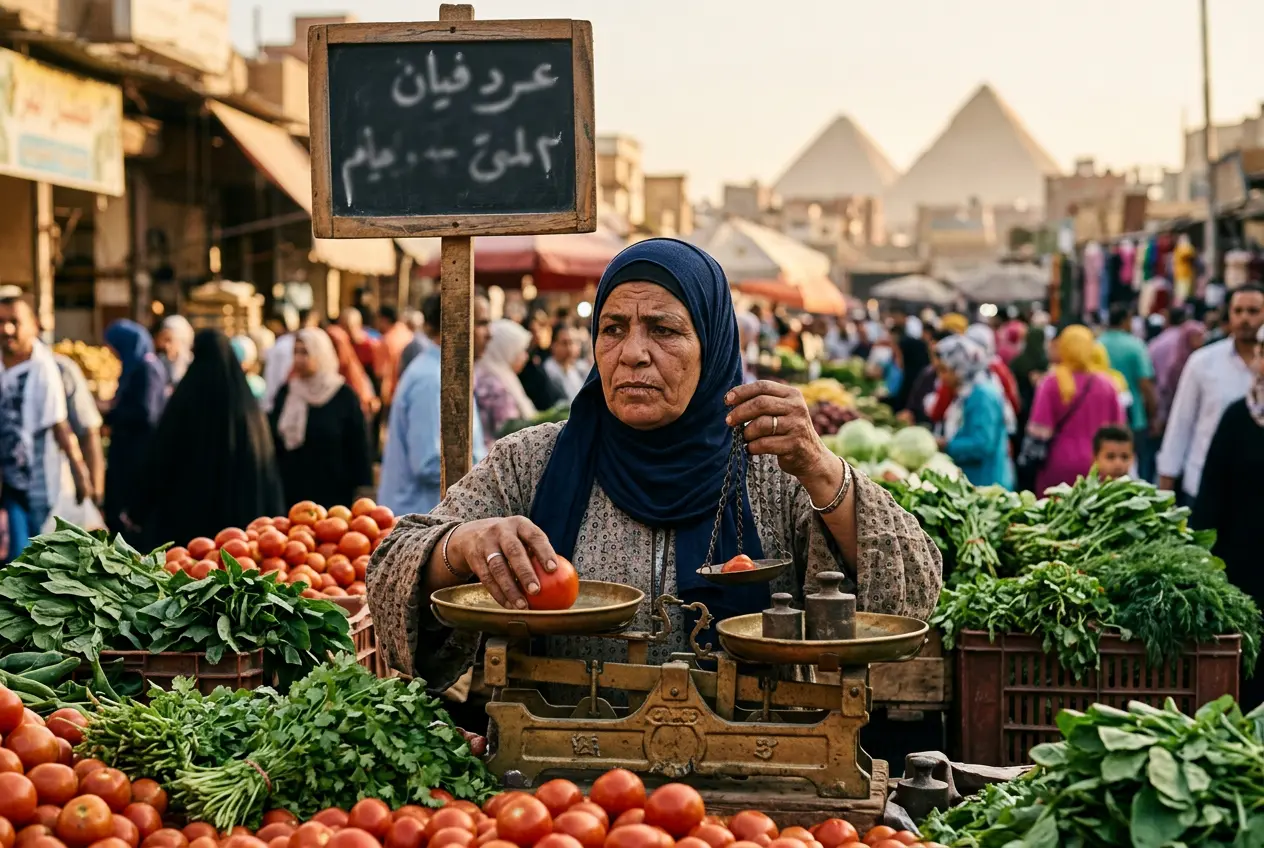
The pass-through into daily life began almost immediately. DAWN reports that public transportation fares have risen by as much as 15% and that fresh produce prices are up by 15% to 30% in some markets, with meat and poultry climbing 25% since the fuel hike. The ministry’s announcements set the headline, while the small shops of Cairo, Alexandria, and Upper Egypt decide how much of it lands at the till. The same pressure that lifted the headline price is also pushing the canal authority to consider Egypt’s plan to cut Suez Canal fees to win back traffic, a measure that would compound the revenue squeeze Sisi described.
Inflation at 15.2%, With Meat and Poultry Out of Reach
Urban inflation in Egypt reached 15.2% by April 2026, a number that is more than a statistic. Food and beverage prices, the largest component of the consumer basket, rose 5.8% year-on-year in March 2026, and the categories hardest hit for low-income households are the same ones where subsidies have shrunk. With Brent crude briefly touching $119 a barrel in late March, as Brent crude’s surge to $119 a barrel showed, the import bill for a country that buys more than 30% of its petroleum abroad has reset higher and shows no sign of rolling back.
The percentages arrive inside a particular household budget. DAWN reports that Sayyed Ragheb, a Cairo cafe worker, earns less than $100 a month and that his family could not afford new clothes for Eid.
Israeli Gas Stops, and Diesel Power Plants Switch On
The energy crisis is layered on top of the fuel-price crisis. On 28 February 2026, Israel formally notified Egypt of an indefinite halt to natural gas exports from the Tamar and Leviathan fields, citing a force majeure clause in its gas contracts. Egypt had imported 344 billion cubic feet of Israeli gas in the fiscal year ending June 2025, up 8% on the previous year, so the loss is structural rather than marginal. The Leviathan field, operated by Chevron, was among those shut down, Reuters reported, citing three sources, in the same force majeure that cut 1.1 billion cubic feet of daily gas supply.
The state is fully aware of the scale of the pressures borne by the Egyptian citizen.
Egypt’s daily production of 4.1 billion cubic feet of natural gas falls short of domestic demand of 6.2 billion cubic feet, a gap that imported Israeli gas had been filling. Cairo’s response, sketched by Prime Minister Mostafa Madbouly and Petroleum Minister Karim Badawi, includes leasing five floating storage and regasification units at Ain Sokhna Port with a combined capacity of nearly 2 billion cubic feet per day, and importing 75 additional LNG cargoes valued at roughly $3.75 billion. Petroleum reserves are described by Badawi as safe, though the LNG substitution is more expensive than the pipeline gas it replaces.
The shortfall has reached Egyptian light switches. Egypt’s government ordered shops, restaurants, and cafes to close by 21:00 each night for at least a month to save power, while daily power cuts returned across several governorates, with DAWN reporting severe effects in poorer areas of Upper Egypt.
Remittances and Gulf Tourists Keep Two Channels Open
Two revenue channels have held part of the line. The Central Bank of Egypt reported in March 2026 that remittances from Egyptians working abroad reached roughly USD 25.6 billion in July 2025 to January 2026, a 28.4% jump year-on-year, with January 2026 alone setting a monthly record at about $3.5 billion. Gulf state workers, a population the war has not displaced, account for a large share of the flow. The rise is the steepest in recent years and partly offsets the foreign-currency loss from the canal, even as Cairo continues to manage the wider regional track, including Egypt’s diplomatic track with the US and Iran.
Tourism has also pivoted. DAWN reports that European and North American travellers cancelled bookings at the start of the war, but Gulf visitors, seeking a relatively stable regional destination, have partly filled the gap. The Grand Egyptian Museum continues to draw visitors, and the substitution is partial, but for a tour guide at the Giza Plateau or a waiter in a Cairo restaurant the shift keeps service jobs intact at a difficult time.
A Global Shock With Egyptian Edges
Egypt is one of the most exposed non-Gulf states in a conflict the UNDP now describes as “development in reverse.” A 13 April 2026 brief from the United Nations Development Programme projects that more than 30 million people worldwide could be pushed into poverty by the Middle East war, with 32 million in the worst-case scenario. The figure concentrates in countries directly hit by the fighting, but the brief singles out energy-importing states with thin fiscal buffers, a description that fits Egypt precisely. UNDP estimates that as much as US$6 billion in targeted cash transfers would be needed across the most vulnerable countries to keep poor households from sliding back. “War is development in reverse,” UNDP Administrator Alexander De Croo said. “Conflict can undo in weeks what countries have built over years,” as outlined in UNDP’s 13 April 2026 poverty projection.
The inversion is the story. A war fought across the Gulf has reached the gas pump, the kitchen table, and the light switch in a country that was not a combatant and did not choose the conflict. The crisis, in UNDP’s framing, “forces impossible trade-offs between stabilizing prices today and funding health, education, and jobs tomorrow.”
For Egypt, the trade-off is being made in real time by 108 million people, with remittances and Gulf tourism cushioning the worst of it. The rest of the bill is being paid in monthly instalments no one voted for.
Frequently Asked Questions
How much has the Iran war cost Egypt so far?
President Abdel Fattah al-Sisi said on 15 March 2026 that the conflict had cost Egypt $10 billion in Suez Canal revenue since the Red Sea crisis began in late 2023. The figure does not include the parallel shock of halted Israeli gas exports, which removed 1.1 billion cubic feet per day of supply from Egypt’s energy mix from 28 February 2026 onward.
How high did Egyptian fuel prices go in March 2026?
Egypt’s petroleum ministry raised domestic fuel prices by up to 30% on 10 March 2026, the steepest increase in compressed natural gas for vehicles. Diesel rose 17.1%, 80-octane gasoline 16.9%, 92-octane 15.6%, and 95-octane 14.3% in the same round.
What is Egypt doing about the gas supply gap?
Egypt is leasing five floating storage and regasification units at Ain Sokhna Port with a combined capacity of nearly 2 billion cubic feet per day, and plans to import 75 LNG cargoes valued at roughly $3.75 billion. The measures are designed to offset the halted Israeli pipeline supply and meet a daily demand of 6.2 billion cubic feet.
Are Egyptian remittances offsetting the losses?
The Central Bank of Egypt reported in March 2026 that remittances reached USD 25.6 billion in July 2025 to January 2026, a 28.4% rise year-on-year. The flow has been a partial offset to the loss of Suez Canal revenue, though it does not compensate for the energy import bill.
What is the UNDP projecting for poverty from the war?
A 13 April 2026 UNDP brief projects that more than 30 million people worldwide could be pushed into poverty by the Middle East conflict, with 32 million in the worst-case scenario. The brief recommends targeted cash transfers of up to US$6 billion to protect the most vulnerable households.
