
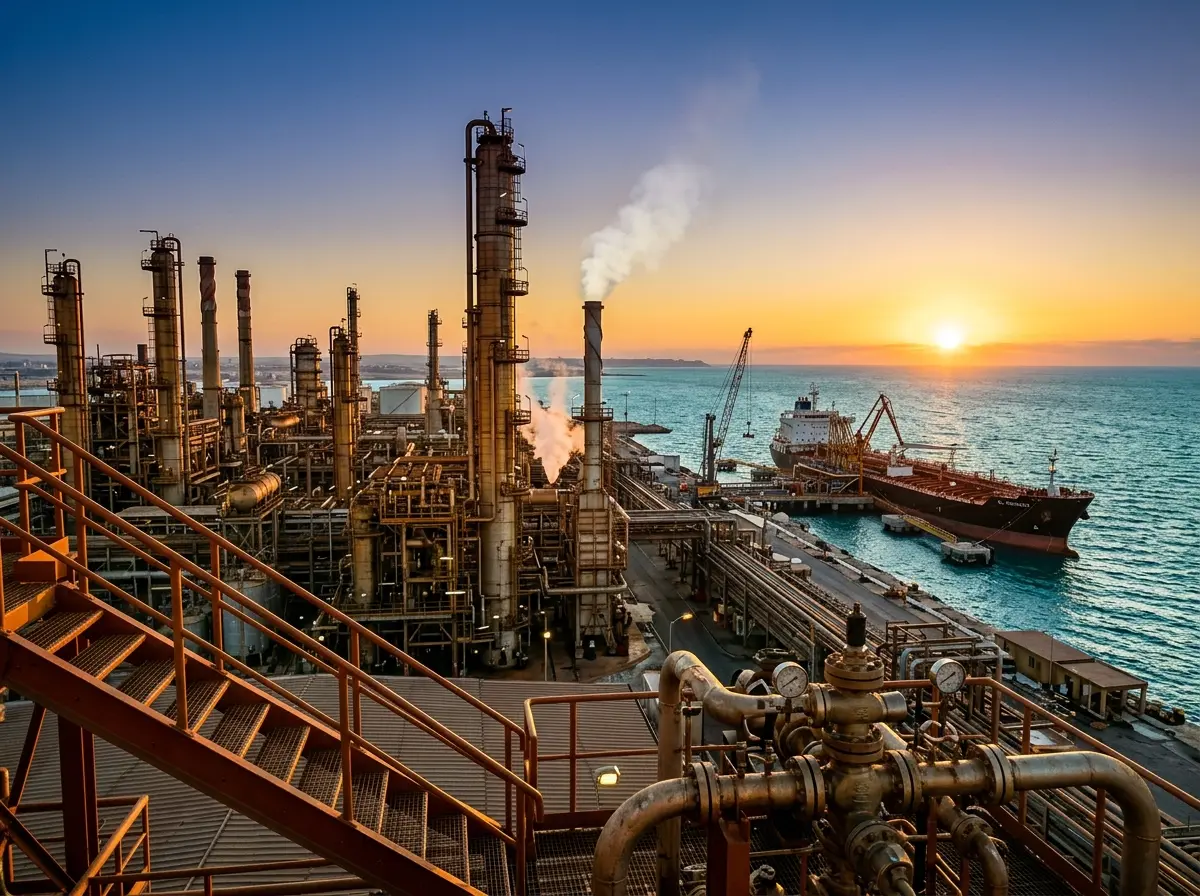
Egypt shipped more than 2.3 million tonnes of petroleum products worth $2.3 billion in the first half of 2026, matching all of last year’s export volume in half the time. The Petroleum and Mineral Resources Ministry credited a jump in refinery output and crude production, now running at its highest level in almost two years. Second-half exports are forecast to climb further, to 2.5 million tonnes.
The timing traces back to a single ledger entry. On June 10, Egypt made a final $440 million payment that wiped out $6.1 billion it had owed foreign oil and gas partners. The debt dated to the depths of the country’s dollar shortage, and it had throttled new drilling for two years.
From $6.1 Billion Owed to Zero
Karim Badawi, Egypt’s petroleum and mineral resources minister, framed the first-half numbers as the direct payoff of that repayment campaign.
Egypt’s crude oil production recorded its highest level in about two years.
Badawi said that in the ministry’s statement announcing the export figures. The ministry itself was blunter about the mechanism. It credited “the success of the ministry’s strategy to stimulate investment and increase local production” to settling what it owed its exploration partners. That, it said, encouraged them to intensify search, development and production work.
Here is how the debt disappeared:
- Mid-2024: Arrears owed to international oil and gas partners peak near $6.1 billion, the product of a prolonged foreign currency shortage that left Cairo unable to settle dollar-denominated contracts.
- 2024: Egypt signs a $35 billion deal granting the UAE development rights over a stretch of Mediterranean coastline at Ras El-Hekma, easing the currency crunch behind the unpaid bills.
- December 2025: The outstanding balance falls to roughly $1.3 billion as repayments continue.
- May 2026: Egypt pays $714 million toward what remains.
- June 10, 2026: A final $440 million payment clears the balance to zero.
Egypt’s national oil company told its board that settling those receivables had become the top priority, since unpaid partners stop drilling. Onshore fields, where new wells can be brought online faster than offshore projects, delivered the quickest response once payments resumed.
Oil Majors Follow the Cash
Within weeks of the final payment, international oil companies pledged more than $19 billion in new Egyptian investment over the next three years.
- Eni (Italy) – $8 billion, the largest single commitment
- bp (UK) – $5 billion
- Apache Corp. (US) – $4 billion
- Arcius Energy (UAE) – $2 billion
Eni, which unveiled a 2 trillion cubic foot gas discovery off Egypt’s coast in April, already holds a 50 percent stake in the renewed Temsah concession alongside bp. Both companies had spent years pressing Cairo to clear its bills before committing fresh capital to new wells.
Refineries Squeeze Out Every Extra Barrel
Refinery utilization climbed to around 80 percent this year, the ministry said, enough to meet domestic fuel demand, curb product imports and still leave a growing surplus to export. Individual plants account for most of the gain.
| Refinery | Operator | What Changed |
|---|---|---|
| Mostorod gasoline complex | Cairo Oil Refining Co. | Up about 45,000 tonnes a month of gasoline and 40,000 tonnes of jet fuel |
| Alexandria National Refining and Petrochemicals | ANRPC | Running above 110 percent of design capacity |
| Amreya Petroleum Refining Co. | Amreya | 92-octane gasoline output up 10,000 to 15,000 tonnes a month |
| Middle East Oil Refinery | MIDOR | Higher operating rates cited by the ministry |
| Alexandria Petroleum Co. oils complex | With Cairo Petroleum Refining Co. | Two boilers rebuilt after about 45 years in service |
Badawi inspected that last project in person. The refinery it belongs to has operated for nearly 75 years, and the boiler rehabilitation was carried out under the Egyptian General Petroleum Corp.’s supervision, part of a broader push to keep aging plants competitive rather than replace them outright.
Why Does Egypt Still Need LNG Cargoes?
Because the crude oil behind this export boom is a different resource from the natural gas that powers Egyptian homes and factories. Domestic gas output has fallen for four years running as the offshore Zohr field loses pressure to water infiltration. Egypt now imports record volumes of liquefied natural gas even as its refineries turn a profit on crude.
Gas production is on pace to average under 4.4 billion cubic feet a day this fiscal year, and the ministry’s own outlook has it slipping to 4.2 billion cubic feet a day next year. Egypt imported 985 billion cubic feet of gas between July 2025 and June 2026, including LNG cargoes and pipeline supply from Israel. That figure is projected to climb to 1,081 billion cubic feet over the following year. LNG alone supplied 72 percent of gas imports in the first quarter of 2026, up from almost nothing in 2023.
Egypt is now negotiating with Shell, TotalEnergies and bp for 15 to 18 LNG cargoes a month over at least three years, part of its hunt for a multi-year LNG supply deal with global majors. The tankers filling with petroleum products for export and the LNG carriers arriving to keep the power on are, for now, running on separate tracks.
A New $4.5 Billion Wager on Refining Capacity
The ministry is lining up a fresh package of refinery-development projects carrying estimated investment and financing of about $4.5 billion. It says the goal is to strengthen energy security, shrink the import bill and keep Egyptian exports competitive.
Most of this year’s export growth already came from refining rather than new wells alone. Egypt processed more of its own crude and larger volumes of imported crude, then sold the finished jet fuel, naphtha, waxes and vacuum distillate, capturing the value added along the way instead of shipping raw barrels.
Growth Numbers Give Cairo Room to Spend
Egypt’s wider economy is outrunning earlier forecasts. The International Monetary Fund’s July World Economic Outlook update put fiscal year 2025/26 growth at 4.6 percent, up from 4.4 percent the year before, after gross domestic product expanded 5.2 percent over the fiscal year’s first nine months.
The Fund’s latest review of Egypt’s finances projects the primary surplus climbing to 5 percent of GDP in fiscal year 2026/27, from 4.8 percent this year, after Cairo beat its own budget-balance and tax-revenue targets by the end of March.
Energy is only one line in that broader export recovery. Egypt’s chemical exports that reached $4.6 billion in the first half of 2025, and its food exports that hit $4.03 billion over the same stretch, show petroleum’s rebound running alongside gains elsewhere in the trade account.
The ministry’s target for the second half of the year is 2.5 million tonnes. Combined with the first half, that would put Egypt’s full-year petroleum product exports at roughly 4.8 million tonnes, more than double the 2.3 million tonnes it shipped in all of 2025.
