
Egypt’s Court of Cassation ruled on 27 January 2026 that a Baha’i marriage cannot be recorded in any state document, voiding a marriage that had lasted more than four decades. The court said the Baha’i faith “is not a heavenly religion” and that recognizing its marriages would disturb public order. The verdict, by Egypt’s highest appellate court for such matters, overturns a 2020 family court ruling that had approved the marriage.
The couple had been married on 5 September 1981 in a family ceremony, signing an informal marriage certificate with two witnesses. In 2020 the wife filed a lawsuit before the Heliopolis Family Court to register the marriage, and the court ruled in her favor on 16 August that year. The Ministers of Interior and Justice, joined by the head of the Civil Status Authority, then appealed. The Court of Appeal dismissed the appeal on procedural grounds, but the Court of Cassation accepted the case on its own motion, ruling against the Public Prosecutor’s recommendation that it be rejected.
The Court of Cassation’s Reasoning
The 27 January 2026 ruling was issued by the Civil Affairs Department of the Appeal Court in Cairo, the Egyptian Initiative for Personal Rights reported. The case was filed under Appeal No. 39/94 (Personal Status). The verdict was initially kept confidential and began circulating publicly in mid-April 2026.
In its reasoning, the court drew a sharp line between belief and its legal effects. “There is a difference between the freedom of belief guaranteed by the constitution and the legal consequences of this belief,” the court wrote, in a passage carried in the full report on the marriage ruling verdict by Christian Solidarity Worldwide. “Freedom of belief means that an individual may adopt whatever beliefs they wish, provided that this does not disturb the public order and the stability of the state.” It added: “The Baha’i faith is not a heavenly religion, and practicing it involves harming the established systems in the state.”
Constitutional articles backed that conclusion. The court relied on Article 2, which states that the principles of Islamic Sharia are the main source of legislation, and on Article 3, which confines recourse to religious laws in personal status matters to Christians and Jews. Article 64 was read by the government, and endorsed by the court, to limit the right to practice religious rites, including marriage, to adherents of the three “heavenly” religions.
The court also ruled that “the legal texts regulating all these rules are considered part of the public order; it is not permissible therefore to prove anything that contradicts or conflicts with them.” It framed marriage as a “religious rite” whose practice is restricted to those three faiths. The Public Prosecution had recommended that the case be rejected, but the court accepted it by determining that it pertained to public order and thereby overrode procedural considerations. The court also said: “What is founded on a violation of the Constitution and public order has no legal existence and produces no effect.”
The verdict overturned the 2020 Heliopolis Family Court ruling that had validated the marriage. That earlier court had ruled that the state was obliged to recognize the marriage and issue a certificate validating the union. The latest ruling means the marriage remains invisible in the eyes of Egyptian law.
From 2017 Lawsuits to January 2026
The 2026 ruling closes a chapter that opened in 2017, when Egyptian Baha’i couples began filing lawsuits in family courts. From 2017 to 2020, 43 couples filed lawsuits seeking marriage recognition, and family courts approved about 20 of them. Many of the couples were acting on official advice from the Egyptian Ministry of Justice, which had told them that a favorable court ruling was the only available legal avenue to secure registration. The government reversed course as the rulings accumulated.
By 2021, the Ministries of Interior and Justice were appealing the decisions, the Egyptian Initiative for Personal Rights documents in its full Egyptian rights analysis of the marriage ruling. The 2026 verdict sits inside that pattern, not outside it. The EIPR also documents what the marriage ruling does in practice.
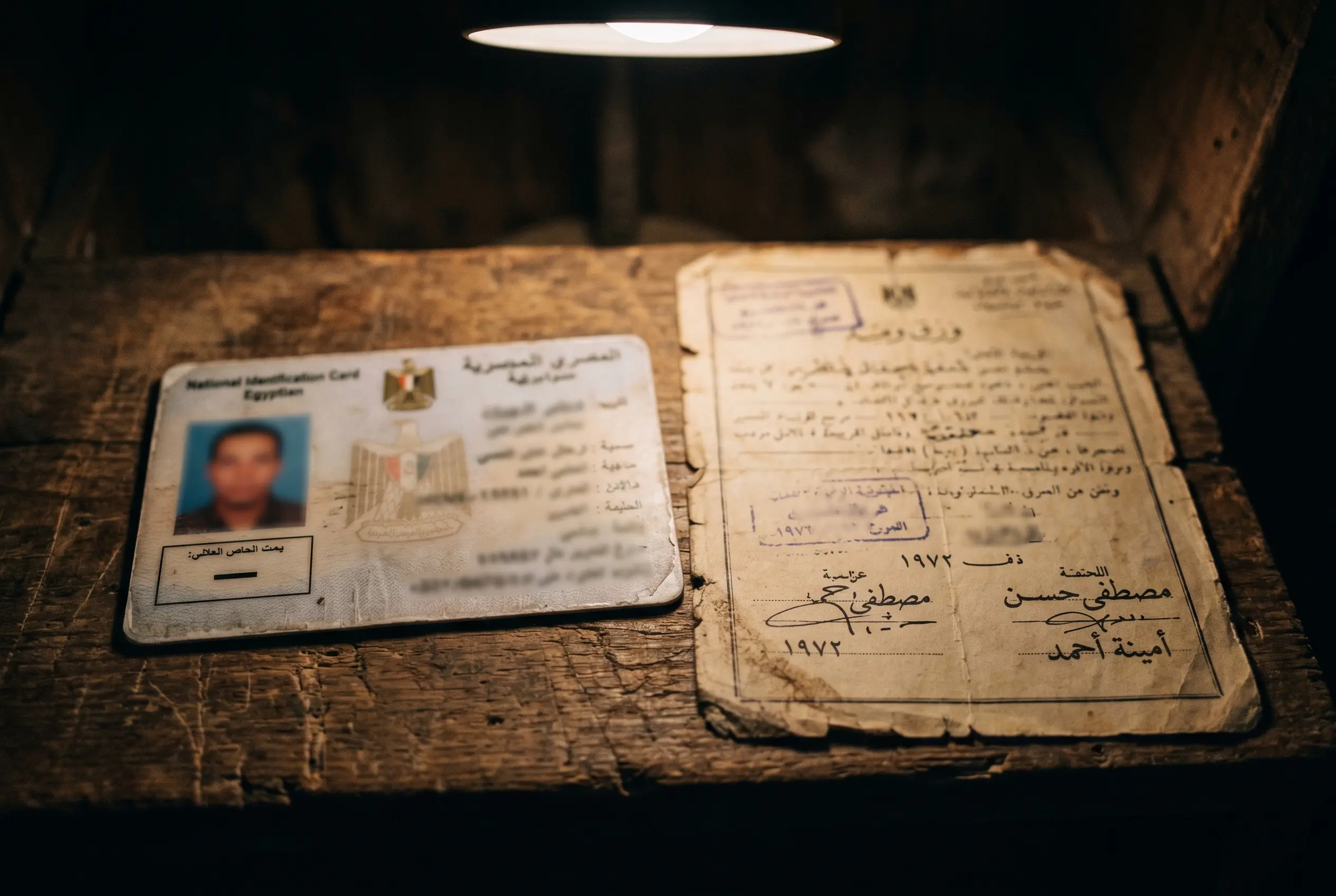
The court did not only void a 1981 marriage. It stripped a settled legal status from a couple whose documents had already been amended. Since 2021, at least four Baha’i families, eight individuals, who had managed to enforce earlier court rulings and have their correct marital status recorded in official documents have seen their status arbitrarily reverted to “single” in their national ID cards. Civil registry employees have told families that a new directive prohibits the registration of a “married” status for any person whose religion field contains a dash. The practical fallout shows up across the rest of daily life:
- Obtaining a pension when a spouse dies
- Distributing an inheritance
- Registering as spouses in professional syndicates and health insurance
- Enrolling children in schools
- Opening or operating joint bank accounts
- Obtaining family residency permits for non-Egyptian spouses
- Passing Egyptian nationality to children when an Egyptian Baha’i mother is married to a non-Egyptian
The Law That Was Already There
The January 2026 verdict did not create the exclusion. It codified one. In 1960, President Gamal Abdel Nasser issued Decree 263 of 1960, dissolving all Baha’i spiritual assemblies, banning Baha’i activities, and confiscating community property. The decree followed Nasser’s view of the Baha’is as “foreign” and “un-Egyptian,” tied in part to the faith’s world center in Haifa.
The 1960 decree was upheld by the Supreme Constitutional Court in 1975, and the legal architecture kept tightening. In 2006, the Supreme Administrative Court prohibited the entry of the word “Baha’i” in the religion field on mandatory identification documents. Then, in 2009, the Supreme Administrative Court, acting on a suit brought by EIPR, ruled that Baha’is could leave the religion field on their national ID cards blank, replaced by a dash. Interior Minister’s Decree No. 520 of 2009 implemented that ruling.
The 2009 dash was meant to be a shield. It was supposed to let Baha’is obtain the documents they needed without declaring one of Egypt’s three officially recognized faiths. Officials unfamiliar with it rejected cards bearing it. Others, familiar with what the dash meant, used it to single Baha’is out for discrimination.
Marriage was never covered by the dash ruling, and a separate regulation kept it out of reach. Article 134 of the Notary Public Directives prohibits the registration of marriages between Baha’is, including civil marriages conducted abroad. That directive still stands. The Bahá’í International Community notes that the 2026 ruling “risks setting a far-reaching precedent that in effect eliminates any remaining legal recourse for Bahá’í couples seeking state recognition of their marriages.” The legal arc looks like this:
- 1960: Nasser issues Decree 263/1960 dissolving Baha’i assemblies and confiscating property.
- 1975: Supreme Constitutional Court upholds the 1960 decree.
- 2006: Supreme Administrative Court bars the word “Baha’i” from the religion field on national IDs.
- 2009: Supreme Administrative Court rules Baha’is can leave the religion field blank; Interior Minister’s Decree No. 520 of 2009 implements the dash.
- 2017 to 2020: 43 Baha’i couples file marriage-recognition lawsuits; family courts approve about 20.
- 27 January 2026: Court of Cassation voids the 2020 marriage recognition on public-order grounds.
The Dash Becomes a Mark
The dash has tracked the community’s shrinking room. When it was introduced in 2009, Baha’is celebrated the result, the Baha’i Egyptian Samandary Hindawi wrote in a 14 June 2026 opinion piece in The Washington Times. But it was, in his words, “false hope.” Baha’is who could not demonstrate that their parents were also Baha’is could not get the cards, and others found that officials were reluctant to issue them. In the end, just one office in Cairo was authorized to do so. The very symbol designed to deflect attention became a way for officials to identify the Baha’i applicant.
The 2021 directive formalized what officials were already doing. When married Baha’is renewed or replaced their national ID cards, the civil registry marked them as “single.” Some Baha’is who had successfully recorded their marriages lost that status without warning. By 2026, an executive directive instructed the civil affairs authority to mark married Baha’is as “single” in any civil status documents. The community’s legal footprint, in numbers:
- Couple’s marriage date: 5 September 1981
- Baha’i families that lost their “married” status on national ID cards since 2021: at least 4 (8 individuals)
- Estimated Baha’i population in Egypt: 2,000 to 7,000
- Court of Cassation ruling date: 27 January 2026
- Baha’i community in Egypt, established: more than 150 years
Burial Lands and Al-Azhar
Baha’is in Egypt cannot bury their dead where they choose. For more than 60 years, since Nasser’s 1960 confiscation of Baha’i cemeteries and other community properties, the community has asked the Egyptian government for new burial land. The requests have not produced new burial grounds. The community has one cemetery in Cairo, and the community is running out of space.
The most recent refusal came from Al-Azhar, the Egyptian center of Islamic learning. In 2021, a provincial authority asked Al-Azhar for guidance on allocating burial lands to “those with the dash.” Al-Azhar answered that it was “not permissible” to do so. The reason it gave, in Hindawi’s quotation of the ruling, was that doing so “could lead to discrimination, further segregation and division, and rupture the fabric of the community.” Al-Azhar’s position drew on decades of anti-Baha’i statements from its senior clerics. The community’s one Cairo cemetery is now under pressure to take the remains of generations.
Hindawi wrote that the community may soon be forced to bury its loved ones upright in that single Cairo cemetery. The Bahá’í International Community says Baha’is are “forced to cram the remains of their loved ones into a single overcrowded cemetery.” The community calls for a government allocation of burial land. Egypt’s government has not announced one.
The International Response
International religious-freedom bodies have tracked the trajectory. The U.S. Commission on International Religious Freedom published an April 2026 country update on Egypt that singles out Baha’is. The update said: “The Egyptian government’s policy on national identity cards continues to present civil and social barriers to members of the Bahá’í community.” It added that “Bahá’ís were excluded and not invited to participate in the government’s ongoing National Dialogue throughout 2025.” The Bahá’í International Community also points to the UN High Commissioner for Human Rights, Volker Turk, and six UN Special Rapporteurs, and the UN Working Group on Arbitrary Detention, as having condemned the Egyptian government’s discrimination.
Coptic Solidarity’s full analysis of the public-order ruling frames the verdict as “a landmark ruling reinforcing the constitutional boundaries governing religious recognition in official documents.” The same analysis emphasizes that “all legal provisions regulating civil status documentation fall within the domain of public order, and therefore cannot be overridden or circumvented.”
Rights groups read the ruling as a final escalation, not an isolated act. The BIC, in its full statement on the marriage ruling, describes the verdict as “part of an intensifying pattern” and warns that classifying the matter as one of public order “raises serious concerns about ongoing and worsening religious discrimination against a peaceful religious minority.” The EIPR has called on the government to “guarantee family rights” and to adopt a “clear and equitable mechanism” for marriage registration. The Bahá’í community has asked the Justice Ministry to appoint delegated notaries authorized to document Baha’i marriages, the same remedy EIPR has proposed in its National Dialogue submissions.
Christian Solidarity Worldwide’s Founder President Mervyn Thomas said the ruling “sends a very disappointing message and adds to a body of legislation that effectively criminalises personal conscience and undermines Egypt’s constitutional obligations towards its own citizens.” He added: “It dismantles the fundamental rights to civil status and freedom of religion or belief, particularly for the most vulnerable members of Egyptian society.” CSW has called on Egypt to remove all laws that discriminate against the Baha’i community and other unrecognised faith groups.
This verdict sends a very disappointing message and adds to a body of legislation that effectively criminalises personal conscience and undermines Egypt’s constitutional obligations towards its own citizens. It dismantles the fundamental rights to civil status and freedom of religion or belief, particularly for the most vulnerable members of Egyptian society. CSW stands in solidarity with this couple and calls upon the Egyptian authorities to reform the legal system by removing all laws discriminating against the Baha’i community and all other unrecognised faith groups.
A Ruling Egypt Has Ignored
The community has a longer legal record than the 2026 verdict. In April 2018, the African Commission on Human and Peoples’ Rights ruled that Egypt, by refusing to recognize Baha’i marriages, had violated the African Charter on Human and Peoples’ Rights. The Commission ordered Egypt to adopt the measures needed to recognize Baha’i marriages and those of any other group whose legal status did not align with Egypt’s personal status laws.
The decision was approved by the AU Executive Council of African foreign ministers. The Egyptian government has not implemented it. The 2026 verdict, by making Baha’i marriage a public-order matter, has effectively foreclosed the path the Commission had ordered Egypt to clear. The Baha’i community in Egypt has been an integral part of the social fabric for more than 150 years, the BIC notes, and the AU Commission found the exclusion unlawful in 2018. Egypt’s highest court has now ruled the opposite.
A Model That Markets Itself
The 2026 ruling came first. On 27 January 2026, the Court of Cassation issued its verdict. Months later, on 28 May 2026, Egypt’s ambassador to the United States, Motaz Zahran, published a Washington Times opinion piece titled “Egypt’s religious freedom tradition an asset to America, the world.” In it, Zahran quoted President Abdel Fattah el-Sissi as saying that “the right to believe in any faith … is absolute and should be protected and respected.” Hindawi, a Baha’i Egyptian now living in Canada, responded in the same paper on 14 June 2026, calling himself “stunned by these words” and laying out the gap between them and the experience of his community.
The gap is visible in the numbers. Egypt’s cabinet has granted legal status to 3,804 churches and affiliated buildings since 2016, with about 1,700 congregations still waiting, per a recent running total of church approvals since 2016. The same period has produced zero state-recognized Baha’i marriages. Egypt’s thirtieth batch of church approvals came after the Baha’i ruling had already become public.
The European Union is also weighing Egypt’s religious-freedom record. In a letter ahead of the 15 June 2026 EU-Egypt Association Council meeting, fifteen rights groups told the EU that Egypt had made no progress on human rights despite its €5 billion partnership, per the EU’s €5 billion Egypt partnership and rights letter. The Bahá’í International Community’s remedy is to appoint authorized notaries for Baha’i marriages, the same proposal EIPR has put to the Justice Ministry.
