
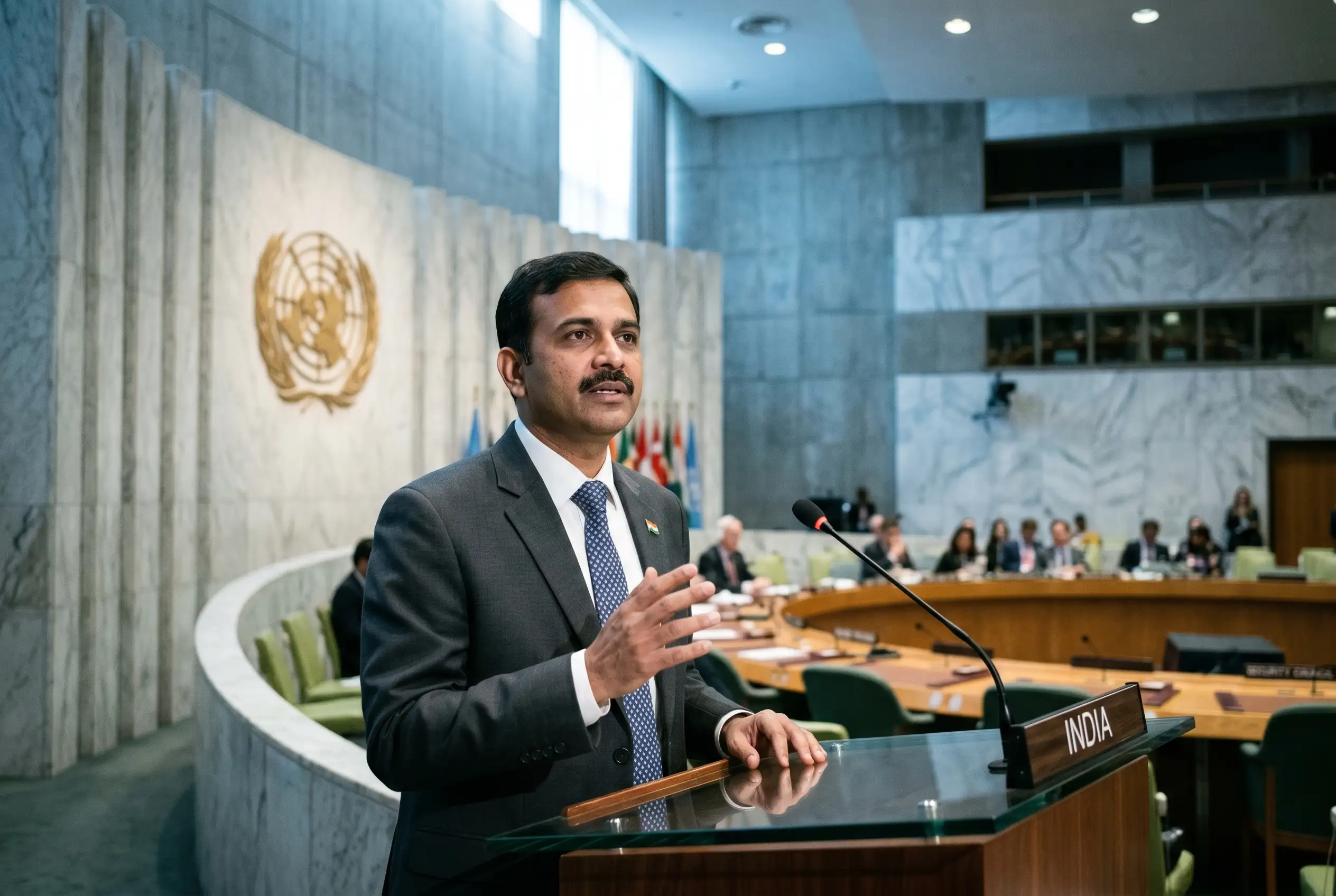
India went to the UN Security Council on 10 June 2026 with a single, joined-up pitch: ceasefire in the Middle East, a two-state solution on the lines New Delhi has held for years, and a rewrite of the Council’s eight-decade-old architecture. The framing Harish used was ‘a proximate neighbour with critical stakes of the region,’ a description that sits outside the usual ‘great power’ or ‘regional party’ scripts. That framing, and the specific Indian exposure that goes with it, is what made the statement cut differently from the P5-and-wannabes norm.
The debate, convened by Colombia under the title ‘Advancing Political Solutions in the Middle East: Mediation and Dialogue for Lasting Peace,’ brought Secretary-General António Guterres and a dozen Council members to the chamber. The UN’s own summary of the meeting records that Guterres called for ceasefires, humanitarian access and renewed diplomacy in Gaza, Lebanon, the Gulf, Syria and Yemen. The Indian intervention landed inside that broader call with a country-specific list of why New Delhi, in particular, has reason to push for a result.
The Three Stakes That Made India Speak First
Harish opened by listing the specific Indian costs of an unsettled Middle East. He framed India as ‘a proximate neighbour with critical stakes of the region,’ a country whose citizens, energy, and shipping are inside the blast radius of every escalation in the Gulf. He spoke against a backdrop the UN’s own meeting summary describes as one where the conflict is ‘spilling beyond the region,’ into civilian, energy, and shipping disruptions that hit India in measurable ways. The ‘proximate neighbour’ framing was deliberate. India is not a Council veto holder, not a signatory to the Abraham Accords, and not a co-belligerent in any of the live fronts. It is, by Harish’s own arithmetic, the country with the most skin in the game measured in citizens.
He identified three prime concerns. First, the safety of the ten million Indian citizens living and working in the Gulf. Second, the negative impact on the Indian economy from trade and energy disruptions. Third, the loss of Indian lives in global merchant shipping, with attacks on vessels and sea lanes now a regular feature of the conflict. The third concern is the one most often skipped in Western coverage, where the focus tends to be on Western naval deployments. India has lost mariners.
The ordering matters, with citizens first and shipping third, and the room heard the ordering clearly.
- Ten million Indian citizens living and working in the Gulf, the largest Indian stake named in the speech
- The negative impact on the Indian economy from trade and energy disruptions
- The loss of Indian lives in global merchant shipping from attacks on vessels and sea lanes
On Gaza, the Three-Part Ask Held
On Gaza, India made the standard three-part ask, in the same order the Council has used since the early months of the war: a sustained ceasefire, unhindered humanitarian access, and a credible pathway towards a durable and peaceful resolution. The first two items are short-term; the third is the political horizon. The Indian statement treated them as a single package, refusing to separate humanitarian asks from the political end-state.
That end-state, Harish said, is the two-state solution: a sovereign, independent and viable State of Palestine, living in peace and security alongside Israel within secure and recognized borders. India described the formula as the only realistic route to lasting peace and prosperity, language that has barely changed across decades of Indian UN statements. The point of restating it, in the Indian telling, is to keep the political destination on the table at a moment when the US-backed Comprehensive Peace Plan, which the Council endorsed under Resolution 2803 (2025), and the Israeli-Palestinian track are running on different clocks. India, the statement suggested, wants the destination of any current track to be a state, not an interim arrangement.
To underline that the formula is not theoretical, Harish cited the Israel-Egypt and Israel-Jordan peace agreements as the working proof of what UN Charter-grounded diplomacy can deliver. He used the examples to defend the Charter as a ‘foundational international instrument for peaceful solutions.’
The same paragraph carried a sharp caveat. Adherence to the Charter, Harish said, is not enough if the institutions built around it remain rigid, a sentence aimed squarely at the Council’s veto-wielding permanent members. India has, in parallel, refused to sign onto any reform that introduces new categories of membership, including the religion or faith-based parameters some members have floated, but it has continued to press for expansion in both permanent and non-permanent categories, a line that lines up with India’s G4 push to defer the veto since 2024.
On Lebanon, India Held to the 2024 Framework
On Lebanon, India did not break new ground but did restate the framework with unusual specificity. Harish urged full respect for Lebanon’s sovereignty and territorial integrity, full implementation of UNSC Resolution 1701, and adherence to the US-France mediated Declaration on the Cessation of Hostilities of 26 November 2024. The two-track ask, Council resolution plus separate ceasefire declaration, is the operating floor for Lebanon in Indian diplomacy.
The Indian statement made clear that the November 2024 deal is part of the architecture India expects the Council to defend, and the framing puts India on the same page as the co-signatories of the original declaration. The Lebanon section carried a personal stake the speech lifted up directly. Indian troops serve in the United Nations Interim Force in Lebanon, UNIFIL, and Harish used the moment to insist that UN peacekeepers carrying out a Council mandate ‘must not be targeted,’ a line that binds India to a position on blue-helmet protection long after the chamber clears.
On the Sea Lanes, India Drew Three Red Lines
On Yemen, the Indian ask was the framework Indian diplomacy has run for a decade: full support for unity, sovereignty, independence and territorial integrity, and a sharp line against attacks on maritime navigation. Harish described attacks on merchant shipping as ‘destabilizing for regional and global security,’ phrasing that, after the incidents of the last twelve months in the Red Sea and the Arabian Sea, lands with more weight than it would have a year ago. India is, in maritime terms, both a transit and a crew-sending country on every contested sea lane from the Bab el-Mandeb to the Strait of Hormuz, and the speech signalled that the maritime dimension is now a permanent Indian priority at the Council. He then laid down three regional red lines, drafted to apply to any actor at sea.
- No interference with freedom of navigation and trade
- No targeting of commercial shipping
- No harm to civilian population and infrastructure
Each line is the test, in the Indian telling, by which any future US- or European-backed maritime coalition should be judged, a quiet sharpening of a position that has until now lived mostly in op-eds and parliamentary statements rather than in the Indian UN record. The lines are also written broadly enough to cover Israel, Iran, the Houthis, and any other actor at sea, and the framing puts India on the side of the established maritime-law consensus rather than any single coalition.
The ‘Real Reform’ Pitch to the Security Council
The second half of the speech was the one that will travel furthest in New Delhi’s UN lobbying. Harish argued that the Council’s ineffectiveness in contemporary conflicts stems from its eight-decade-old architecture, a framing India has sharpened since 2024 and that lines up with the G4 position the country has run jointly with Brazil, Germany and Japan. The critique is not new. What is new is the linkage Harish built between the Council’s record on the Middle East and the case for structural change. The Council, in his telling, has been unable to act on Gaza, Lebanon, Yemen and the Gulf not despite its structure but because of it.
He called for ‘real reforms,’ through expansion in both permanent and non-permanent categories of membership, a line that ties back to the G4 negotiations India has been running since 2024. The Indian position is that expansion has to happen in both categories. The new permanent members must be given the veto on a deferred timeline, a formulation that puts India inside the G4 frame and outside the African Union’s parallel push for veto rights from day one. The full Indian position is on the record at the India’s Permanent Mission page for the 10 June statement.
The UNSC has to be fit-for purpose.
That line, in the chamber, was a directed shot at the Council’s two most active blockers. The body, in the Indian reading, is structurally mismatched to the 2026 distribution of power, and the cost of that mismatch is now being paid in Middle Eastern lives and Indian shipping.
How the Rest of the Council Read It
The chamber was not silent. Colombia, the Council President for June, convened the debate in the first place, and President Gustavo Petro used his national-capacity reply to make the case that ‘dialogue between civilizations can never involve destroying a civilization.’ Secretary-General António Guterres, in his remarks, called for ceasefires, humanitarian access and renewed diplomacy across Gaza, Lebanon, the Gulf, Syria and Yemen. The framing was visibly broader than the Indian statement, covering the same five fronts in a single sentence and putting less weight on any one member’s national exposure. That breadth is the point: the Secretary-General’s call is designed to be endorsable, not a position statement.
The United States, in a sharp counterpoint, anchored its intervention in the Comprehensive Peace Plan to End the Gaza Conflict, which the Council had endorsed in Resolution 2803 (2025). The US representative, Jennifer Locetta, said the plan had ‘facilitated humanitarian assistance, secured the release of all hostages held by Hamas and established a realistic pathway towards lasting stability,’ a position the Indian statement implicitly accepts but does not echo.
The State of Palestine’s permanent observer, Riyad Mansour, used his slot for harder-edged data. He said Israel now controls 70 per cent of Gaza, that 2 million Palestinians are squeezed into 30 per cent of the Strip in unlivable conditions, and that ‘fire has not ceased in the Gaza Strip.’ India framed its Gaza ask as a call for the political horizon. The Palestinian statement read as a call for the present. The gap between the two tells a reader most of what the Council is not yet agreeing on.
Other voices crowded in. Iran’s representative, Amir Saeid Iravani, used the same debate to accuse Israel and the United States of ‘repeated violations of the 8 April ceasefire’ and warned that Iran would continue to exercise its right of self-defence. Ireland’s Minister of State Emer Higgins told the chamber that 96 per cent of settler-violence incidents in the West Bank never lead to prosecution, a figure that landed hard in the same room where India was laying out its two-state horizon. The chamber, in other words, was not in agreement; it was in parallel, and the UN summary of the 10 June Middle East debate shows the divergence in print.
- 10 June 2026: date of the UNSC open debate, convened by Colombia
- Ten million: Indian citizens in the Gulf named by Harish as the first Indian stake
- 70 per cent: the portion of Gaza that Israel now controls, per Palestine’s permanent observer
- Two million: Palestinians squeezed into 30 per cent of the Strip, per the same intervention
- 96 per cent: West Bank settler-violence incidents that never lead to prosecution, per Ireland
Why the Indian Frame Cuts Differently
What India did on 10 June was not break with the diplomatic mainstream. It connected two usually-separate tracks into a single argument: track one is the political end-state in Gaza, Lebanon, Yemen and the wider region, and track two is the case for Security Council reform. India tied them with a single load-bearing fact, ten million citizens in the Gulf, plus energy, trade, and shipping exposures that are measurable in Indian economic output.
The pitch, in plain language, is that India is the country that pays in human and economic terms for the Council’s structural failure to manage the Middle East, and that the cost is high enough to justify the country demanding a seat at the table where the table is being redrawn. That demand is not new; it has been the G4’s standing position for two decades.
What changed is the surrounding evidence. The India-Middle East-Europe Economic Corridor is still on the table as a counter-route plan, with the How a war around Hormuz reshaped the IMEC plan showing the war-risk overlay, and India’s wider Gulf-facing diplomacy, including the Modi’s Amman visit and India’s multi-aligned Middle East play, has been running at the highest tempo in years. Indian troops remain deployed in UNIFIL in Lebanon, the country’s economic exposure to the Gulf is now structural, and the ‘proximate neighbour with critical stakes’ claim is, for the first time, a statement the Indian government can back with the same evidence it puts on the table at the Council.
