
The Pentagon is routing more F-16s and F-35s to Jordan’s Muwaffaq Salti Air Base, days after an Iranian missile and drone strike killed two American service members and left a third missing. Bitcoin slipped about two percent and kept trading in its usual range.
That muted response is the real story here. Coverage of the jet deployment has not mentioned crypto once, yet the pattern in Bitcoin’s price action says more about where this conflict is headed than another satellite photo of parked fighters ever could.
Jordan Turns Into a Fortress Again
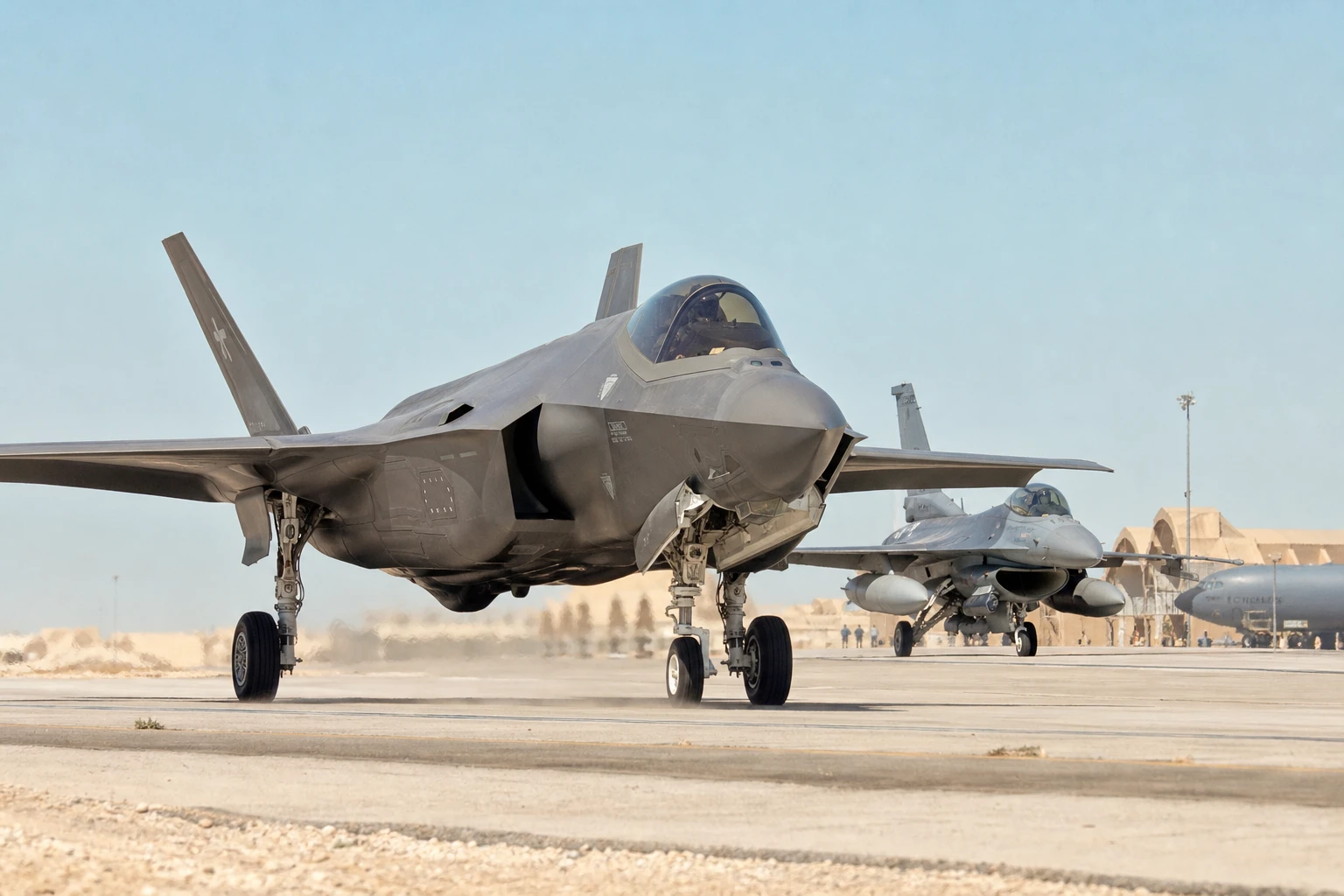
The buildup began around July 17, 2026, when F-16s from the 480th Fighter Squadron and F-35s from the 48th Fighter Wing, a unit normally based at RAF Lakenheath in the UK, started routing toward Jordan alongside refueling tankers. It is the latest wave in a military expansion that has been building since February.
Back then, at least 18 F-35As arrived from the UK as tensions with Iran first climbed. By the time satellite imagery caught up with the buildup, Muwaffaq Salti was hosting more than 60 US attack aircraft, roughly triple its normal complement. The base has since become one of the most concentrated forward points of American airpower in the region.
- F-16s – fresh jets from the 480th Fighter Squadron now routing to Jordan with refueling aircraft in support
- F-35s – stealth fighters from the 48th Fighter Wing, reinforcing an already crowded flight line
- 60-plus attack aircraft – the base’s peak 2026 headcount, about three times its usual size
- 18 F-35As – the size of the original February wave that started the buildup
The math is simple. A base built to host counterinsurgency rotations now holds a strike package designed for a state-level fight, and Iran has noticed. Gulf allies have been racing to backfill their own defenses at the same time, a pattern visible in Saudi Arabia’s own $1.96 billion anti-drone rocket deal signed as the region’s militaries stock up against exactly this kind of missile and drone threat.
The Attack That Restarted the Clock
This war has already gone through one supposed ending. A 60-day truce known as the Islamabad Memorandum, brokered by Pakistan, Qatar, Saudi Arabia and Turkey, held from mid-June until Iran struck three merchant ships in the Strait of Hormuz on July 6 and 7. President Trump declared the ceasefire over at a NATO summit in Ankara on July 8, and nightly US strikes on Iranian targets resumed within days.
Iranian ballistic missiles and drones hit Muwaffaq Salti on July 17. US Central Command confirmed the next day that two American service members had been killed and a third was missing, with four more wounded and later treated and released from Jordanian hospitals. It was the first confirmed American combat deaths since Trump’s ceasefire announcement, nine days earlier. The Pentagon answered with its eighth round of retaliatory strikes, hitting Iranian coastal surveillance, air defense and missile storage sites.
A separate piece on this site tracked how the same attack rattled oil markets and Fed rate odds within hours. The bigger arc traces back further, to the US-Israeli campaign Trump named Operation Epic Fury on February 28, whose strategic verdict is still being argued over five months later.
Bitcoin’s Shrinking Reaction
Bitcoin touched a monthly high of $65,500 on July 15. It slid to $64,064 the next day as Iran struck Gulf bases, then extended that drop toward $62,000 once CENTCOM confirmed the Jordan deaths, a peak-to-trough decline of roughly five percent spread across two separate legs. Around $350 million in leveraged positions were liquidated in the process.
What happened next is the part nobody flagged. By the time US strikes had hit more than 170 Iranian military facilities and Iran had retaliated against over 85 American installations across Bahrain, Kuwait and Jordan, Bitcoin had stopped falling. It was trading near $63,000, up 1.2 percent, even as the campaign widened.
Lay the last five months side by side and the pattern gets hard to miss.
| Date | Trigger | Bitcoin’s Move |
|---|---|---|
| June 2025 | Israel strikes Iranian nuclear facilities | Fell more than 7% over three days |
| Feb 28, 2026 | Operation Epic Fury launches | Moved sharply lower as oil topped $100 a barrel |
| March 2026 | Initial strike wave escalates | Slid to about $63,255 before recovering toward $69,000 |
| July 7, 2026 | CENTCOM strikes over 80 Iranian targets | Fell below $64,000, roughly 2%, $350 million liquidated |
| July 13, 2026 | Fourth strike wave near Hormuz | Dropped under 2% even as oil jumped 4% |
| July 17-18, 2026 | Muwaffaq Salti attack kills two US troops | Slipped toward $62,000, then stabilized within days |
The Fear and Greed Index sat at 26, solidly in fear territory, while Bitcoin’s dominance of the total crypto market held between 58 and 59 percent. The wider market cap has spent the entire conflict oscillating inside a $2.1 trillion to $2.5 trillion band. Traders are nervous, but they are not fleeing.
Why Did Bitcoin Stop Reacting to War?
Bitcoin has not stopped moving. It has stopped treating Iranian missiles as the reason to move. Five months of repeated strikes trained the market to expect the next round, and each new shock now buys less of a reaction than the last one did.
The pattern shows up clearest in the gap between February and July. When the US and Israel opened strikes in late February, oil broke $100 a barrel and Bitcoin dropped hard. By July, CENTCOM could launch a fourth wave of strikes near the Strait of Hormuz and Bitcoin would fall less than two percent even as oil jumped four percent in the same session. Bitcoin, in other words, had already priced in the war. What moved it instead was Federal Reserve policy and the mechanics of the spot Bitcoin ETF market, which now channel far more flow than any single geopolitical headline.
Analysts at VanEck, JPMorgan and Bitwise have taken to calling Bitcoin a liquidity sponge, an asset that swells when global money supply expands and shrinks when it contracts, regardless of who is bombing whom. The numbers back that framing up. The S&P 500 is up roughly 9 percent so far in 2026. Bitcoin is down about 31 percent over the same stretch, off its October 2025 peak near $126,000.
Gold Got the Safe-Haven Trade Instead
If Bitcoin gave up its claim to being digital gold, actual gold cashed in. Spot gold has gained roughly 21 to 22 percent in 2026, touching records above $5,400 an ounce as the conflict widened, with central banks buying throughout as they diversify away from the dollar.
A near-term boost in geopolitical risk premium is clearly aligned with our bullish view on gold, but it is far from the sole reason we remain structurally bullish on the metal.
Patrick Jones, a strategist at JPMorgan, wrote that assessment as the bank forecast gold reaching $6,300 an ounce by year end. Silver has climbed 17 percent over the same period. Both metals wobbled on individual sessions when the dollar firmed, but neither decoupled from the war the way Bitcoin has.
The Senate Bill Crypto Traders Fear More Than Tehran
Ask a crypto desk what actually keeps them up at night right now and the answer is rarely Tehran. It is the Digital Asset Market Clarity Act, the market structure bill that would finally tell the industry which regulator, the SEC or the CFTC, oversees which token.
The bill passed the House by a wide 294 to 134 margin back in July 2025. The Senate Banking Committee advanced its own version 15 to 9 in May 2026, and it has sat on the Senate calendar since June 1 waiting for a floor vote that keeps not happening. An informal July 4 signing target came and went. The Senate returned from its own recess on July 13, the same week fighting flared again in Jordan, with roughly three working weeks left before lawmakers leave for August recess.
Prediction markets have noticed the bill is stalling. Odds of passage this year have fallen from the low seventies into the low forties as ethics disputes, law enforcement objections and a fight over stablecoin yield keep the text from reaching a cloture vote. Brian Gardner, Stifel’s chief Washington policy strategist, wrote that the bill probably needs to clear the Senate by the end of July, and that missing the August recess would make its prospects deteriorate materially. The underlying legislation would regulate digital commodities under CFTC and SEC oversight, and a companion Senate Banking summary shows companies could raise up to $200 million under a new Regulation Crypto exemption, a detail that has drawn its own scrutiny from securities lawyers.
Law firm Davis Wright Tremaine flagged the bill’s stablecoin yield restrictions as one of the toughest remaining sticking points between Senate Banking and the crypto industry’s own lobbyists. Every week the bill sits without a vote is a week traders can point to and say that is what actually moved the market, not another round of strikes on Bandar Abbas.
The One Variable That Still Matters
This does not mean Bitcoin is immune to this war. It means the war has to change shape before Bitcoin notices again. A short exchange of strikes, however deadly to the people caught in it, gets priced in within days now. What would break the pattern is a sustained shutdown of the Strait of Hormuz itself, the corridor that carries roughly a fifth of the world’s oil on an ordinary day.
US officials maintain that commercial shipping through the strait continues despite the attacks. Two clocks are running at once heading into August: the Pentagon’s buildup at Muwaffaq Salti, which shows no sign of slowing, and the Senate’s own calendar, where the Clarity Act has a handful of legislative days left before its 2026 window closes. Crypto traders are watching the second clock more closely than the first.
Frequently Asked Questions
Why does Bitcoin fall when Iran and the US clash?
Rising conflict threatens oil supply through the Strait of Hormuz, which pushes crude prices up, feeds inflation expectations and tightens the financial conditions risk assets rely on. The pattern predates this war. Bitcoin dropped roughly 8 percent in a week during the early days of Russia’s 2022 invasion of Ukraine before recovering.
How much oil actually moves through the Strait of Hormuz?
Roughly a fifth of global oil and gas supply passes through the strait on a typical day. Attacks on tankers this year reduced traffic so sharply that one market tracker described the corridor as de facto closed for 136 days even though US officials say commercial shipping has continued.
What would the Digital Asset Market Clarity Act actually do?
It would draw a legal line between digital assets treated as commodities, overseen by the CFTC, and those treated as securities, overseen by the SEC. A joint SEC and CFTC interpretive release in March 2026 already classified 16 digital assets, including Bitcoin, Ethereum and XRP, as digital commodities ahead of the bill’s passage.
How many American troops have died in the 2026 Iran conflict?
The conflict has killed 16 American service members to date, including the two confirmed dead and one still missing from the July 17 attack on Muwaffaq Salti. Four other troops wounded in that strike were treated and released from Jordanian hospitals within days.
Is gold a better hedge than Bitcoin during this war?
On the数据 so far, yes. Gold has gained roughly 21 to 22 percent in 2026 and set fresh records above $5,400 an ounce during the conflict, while Bitcoin is down about 31 percent over the same period, suggesting investors are treating the two assets very differently despite years of Bitcoin marketing built around the same safe haven pitch.
Disclaimer: This article is for informational purposes only and does not constitute investment advice; crypto and precious metals prices are volatile and figures are accurate as of publication, so consult a licensed financial adviser before making decisions.
