
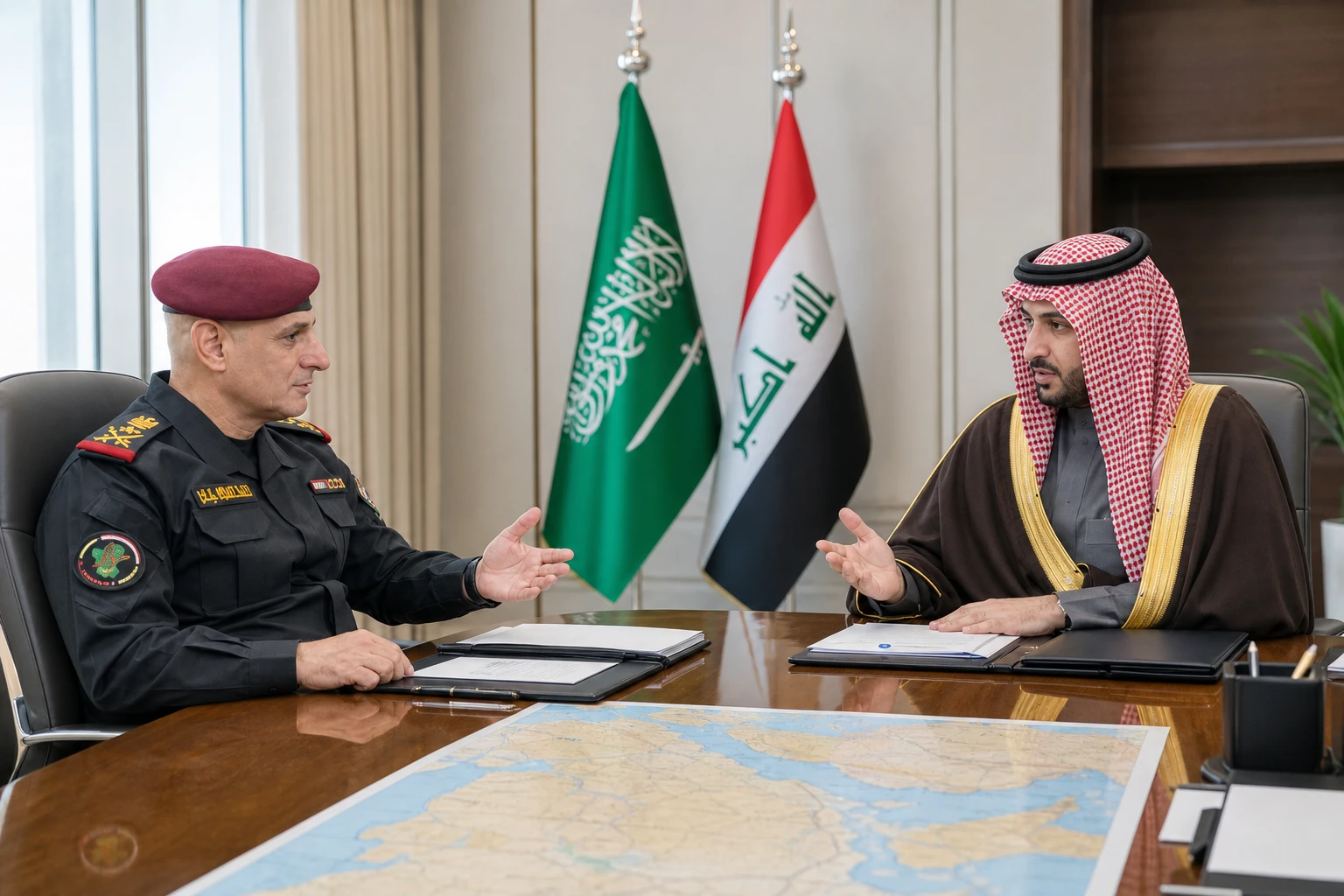
Saudi Defence Minister Prince Khalid bin Salman met Iraq’s top military office director in Riyadh on Thursday and called the country a “cherished neighbour,” two weeks after joint US-Saudi strikes killed at least 20 fighters from Iraq’s Popular Mobilisation Forces.
The talks reviewed military ties and regional developments. They also put bilateral coordination on a firmer footing before the US-led coalition completes its exit from Iraq by 30 September.
The sequence matters. A public strike, a cancelled prime ministerial trip, an intelligence chief’s shuttle to Baghdad, and then a full security delegation in Riyadh form a single diplomatic arc rather than four isolated events. Each step has tried to keep state channels open while the security file remains unsettled.
The Meeting and the Warm Language
Prince Khalid received Lt Gen Abdul Amir al-Shammari, director of the Office of the Commander-in-Chief of the Iraqi Armed Forces. The pair discussed defence relations and stressed continued coordination to serve mutual interests and regional security.
Iraq will remain a cherished neighbour, we share bonds of brotherhood, solidarity, and mutual support with its government and its brotherly people. The Kingdom will always stand by Iraq to support its security, stability, development, and prosperity, for the benefit of Iraq and its brotherly people.
Khalid bin Salman posted the full statement on X, where it drew more than a million views. The Arabic original used nearly identical phrasing about a dear neighbour and shared brotherhood.
This was the first announced visit by a senior Iraqi security official to the kingdom since Prime Minister Ali al-Zaidi cancelled his own trip after the 29 July strikes. Saudi intelligence chief Khalid bin Ali al-Humaidan had already visited Baghdad the previous week, renewing the invitation to the prime minister.
The warm language is deliberate. Brotherhood and neighbour framing lower the temperature after a joint military action that Baghdad condemned as a sovereignty breach. At the same time the statement commits Riyadh to Iraq’s security and stability, which ties the rhetoric to the practical agenda of drones, air defence and intelligence sharing.
Public posting on X amplifies the message beyond closed diplomatic cables. A million views mean the wording reaches Iraqi and regional audiences who also saw the funerals and the street chants. State messaging and public memory now share the same feed.
What the July Strikes Hit
On 29 July, US and Saudi forces struck logistics and weapons sites belonging to Iran-aligned groups across eastern Iraq and several provinces. It marked the first time Riyadh publicly joined Washington in such an operation inside Iraq.
- 20 PMF fighters killed, according to the Hashed al-Shaabi
- 32 wounded
- 5 Iranian military advisers among the dead, per PMF and Iranian reports
- Targets hit in Baghdad, Diyala, Basra, Wasit, Nineveh, Kirkuk and Karbala
Saudi Arabia said the action responded to drones launched from Iraqi territory against its oil facilities. Riyadh’s air defences had intercepted multiple drones in the days before. The kingdom warned it does not seek escalation but will answer any aggression.
Iraqi officials condemned the strikes as a sovereignty violation while also calling on armed groups to stop attacks on neighbours. Crowds carried bodies and shouted “Death to America.” The episode exposed Baghdad’s fragile grip on its own militias.
The target list spans the capital and provinces from the east to the south and north. That geographic spread underlines why both governments treat the drones file as a national rather than local problem. Logistics and weapons sites, not a single border outpost, were the stated focus.
Riyadh’s public role is the novelty. Previous intercepts of drones headed for oil facilities could be handled as defensive air action. Joining a strike package inside Iraq moved the kingdom from target to participant and forced Baghdad to manage both the sovereignty complaint and the neighbour relationship at once.
Why the Timing Fits the American Departure
Prime Minister al-Zaidi has declared 30 September the fixed and final date for ending the Global Coalition’s military mission in Iraq and completing the force departure. US officials have confirmed they expect to meet that deadline.
With American troops leaving, both capitals share an interest in stopping Iraqi soil from serving as a launchpad. A government official told The National that Thursday’s talks centred on mechanisms to halt cross-border drone activity, improve air-defence coordination and expand intelligence sharing.
The same official said the prime minister is still expected in Riyadh once security understandings are in place. The joint US-Saudi operation last month had risked freezing the entire track. The security delegation reopened it at the working level.
The calendar compresses every choice. After 30 September the coalition will no longer be present as a military backstop inside Iraq. Coordination that now involves three parties will have to run bilaterally. That is why mechanisms, not only statements, dominated the Riyadh agenda.
| Priority named in talks | Practical aim |
|---|---|
| Halt cross-border drone activity | Keep Iraqi territory from serving as a launchpad |
| Improve air-defence coordination | Share warning and response capacity |
| Expand intelligence sharing | Give both sides earlier notice of threats |
Reopening the track at working level also protects the prime minister’s eventual visit. A cancelled high-level trip after the strikes left a gap. Filling it first with the intelligence chief and then with a multi-service security package lets Baghdad and Riyadh test understandings before the political summit returns to the diary.
Who Sat Across the Table
The Iraqi side was not a single general on a courtesy call. It was a full security package.
| Official | Role |
|---|---|
| Lt Gen Abdul Amir al-Shammari | Director, Office of the Commander-in-Chief |
| Hamid al-Shatri | Head, Iraqi National Intelligence Service |
| Lt Gen Muhanad al-Asadi | Commander of Air Defence |
| Lt Gen Zaid Hawshi | Head of Counter-Terrorism Service |
Their presence signals Baghdad wants to cover both militia-sourced threats and wider border risks. The drones file sat at the centre of the agenda, according to the Iraqi government statement issued before departure.
Air defence and counter-terrorism sitting beside intelligence and the commander-in-chief’s office shows the file is treated as cross-cutting. Drones that leave Iraqi territory implicate air space control, militant networks and political authority over the armed factions. A single-service visit could not have carried all three strands.
The composition also answers a Saudi concern in kind. Riyadh sent its defence minister. Baghdad answered with the offices that own the launchpad problem, the air picture and the counter-terror portfolio. That match of briefs is itself a form of reassurance.
Baghdad Still Shares Authority with the Militias
The Popular Mobilisation Forces remain formally part of the Iraqi security architecture and report to the prime minister. In practice many factions retain independent command lines and strong ties to Iran.
An LSE mapping of PMF factions and state control described an umbrella of 50 to 70 groups with divided loyalties. Repeated efforts to fully institutionalise them have fallen short. That structure produced the launchpads Saudi Arabia says it hit, and it produced the funerals that followed.
- Some factions postponed kinetic retaliation after mediation by Badr Organisation leader Hadi al-Amiri.
- Hardline voices dismissed compensation talk and called a harsh military reply inevitable.
- Disarmament talk remains conditioned by some groups on full foreign-force exit and new air-defence systems for Iraq.
Crowd reaction on X to Khalid’s post mixed Saudi support for the brotherhood language with sharp Iraqi rejection. Several replies recalled past grievances and rejected the neighbour framing outright. State-to-state channels and street memory are running on different clocks.
The dual structure is the core constraint on any bilateral deal. Formal reporting lines run to the prime minister. Independent command lines and external ties mean some factions can still act without waiting for Baghdad’s green light. Mediation by Hadi al-Amiri bought time after the strikes. It did not resolve the underlying split.
Disarmament conditions tied to a full foreign-force exit and new Iraqi air-defence systems show how the September deadline and the drones problem feed each other. Groups that want the coalition gone also want hardware and political space in return. That bargain sits outside a purely Saudi-Iraqi channel and will shape what any new understanding can deliver.
Earlier Thaws Under Similar Pressure
Saudi-Iraqi ties have warmed and cooled for years as both sides managed Iranian influence and internal security.
- 2017: The two countries established a coordination council after Saudi Arabia returned an ambassador to Baghdad.
- 2019-2023: Iraq hosted multiple rounds of Saudi-Iran talks that helped produce the China-brokered restoration of diplomatic ties.
- 2024: A new military cooperation agreement was signed as part of the longer rapprochement.
- July-August 2026: Strikes, cancelled prime-ministerial visit, intelligence chief shuttle, then the Shammari-led security delegation.
Each step has tried to keep direct state channels open even when proxy violence spikes. The latest meeting follows the same pattern under tighter deadlines created by the wider Iran conflict and the coming US drawdown.
The pattern is consistent. When violence rises, the political track bends but does not fully break. Ambassadors, coordination councils, hosted talks and military agreements have all served as ballast. The Shammari visit fits that sequence: repair the working level first, then restore the higher visit once understandings exist.
What differs now is the exit clock. Earlier thaws unfolded while the coalition remained a presence inside Iraq. The current round must produce arrangements that can stand after 30 September without that presence. History supplies the method. The deadline supplies the urgency.
How the Two Capitals Define Success
Success for Riyadh is measurable in the short run. Drones launched from Iraqi territory against oil facilities must stop. Intercepts in the days before the July strikes showed the threat was active. An answer to aggression was delivered. The neighbour language now offers a path that does not require further public strikes if the launchpads stay quiet.
Success for Baghdad is double-edged. The government needs the Saudi channel open for security and for the prime minister’s eventual visit. It also needs to show that sovereignty complaints after the strikes were heard. Calling on armed groups to stop attacks on neighbours while condemning the operation tried to hold both lines at once.
- Riyadh wants grounded drones, working intelligence channels and air-defence coordination.
- Baghdad wants state-to-state respect, reduced cross-border friction and room to manage the PMF file without another public rupture.
- Both want the prime ministerial visit to proceed once security understandings are in place.
Those aims overlap without being identical. Overlap is what Thursday’s talks tried to widen. The risk is that militia autonomy, street anger and the coalition exit pull the overlap apart again before the understandings harden.
What the Exit Changes for Both Sides
After 30 September the US-led coalition’s military mission in Iraq ends on the timetable the prime minister has fixed and US officials say they expect to meet. The trilateral character of recent pressure on the drones problem will narrow. Saudi Arabia and Iraq will own more of the warning, the response and the political fallout.
That shift raises the value of the mechanisms named in the Riyadh talks. Intelligence sharing and air-defence coordination are substitutes, in part, for a coalition presence that will no longer be there. They are also tests of whether Baghdad can deliver restraint from factions that retain independent command lines.
The July strikes already showed what happens when restraint fails and Riyadh chooses to answer. The kingdom said it does not seek escalation. It also said it will answer aggression. Those two sentences remain the frame after the coalition leaves. The cherished neighbour language softens the frame. It does not erase it.
For Baghdad the exit removes one external actor from the domestic security balance. Some groups already condition disarmament talk on that exit and on new air-defence systems. The state will have to manage those conditions, the Saudi demand for quiet borders, and its own formal authority over the PMF at the same time. Thursday’s delegation was built to discuss that tangle at working level before the political visit returns.
The neighbour language is now on the record. The test is whether the drones stay grounded and the intelligence channel stays open once American forces are gone.
