
Houthi drones and ballistic missiles have struck Saudi energy facilities, airports and oil tankers since late July, while the group declared a maritime blockade of Saudi ports and shipping through the Bab al-Mandeb. Riyadh is evaluating fresh military options and has signed a new defense pact with Turkey and Pakistan, yet it enters any new round without the Emirati-backed southern forces that once produced the coalition’s only decisive ground advances.
Tina Ghazimorad, communications director to Prince Reza Pahlavi, argued in The Jerusalem Post that the Kingdom’s predicament is the bill for a decade of political choices. The record of attacks, alliance fractures and the southern collapse of early 2026 gives that claim concrete shape. Each strand of the crisis, from open Red Sea logistics to a hollowed partner map, traces back to decisions taken when victory still seemed within reach.
The Fire Resumes Along the Border
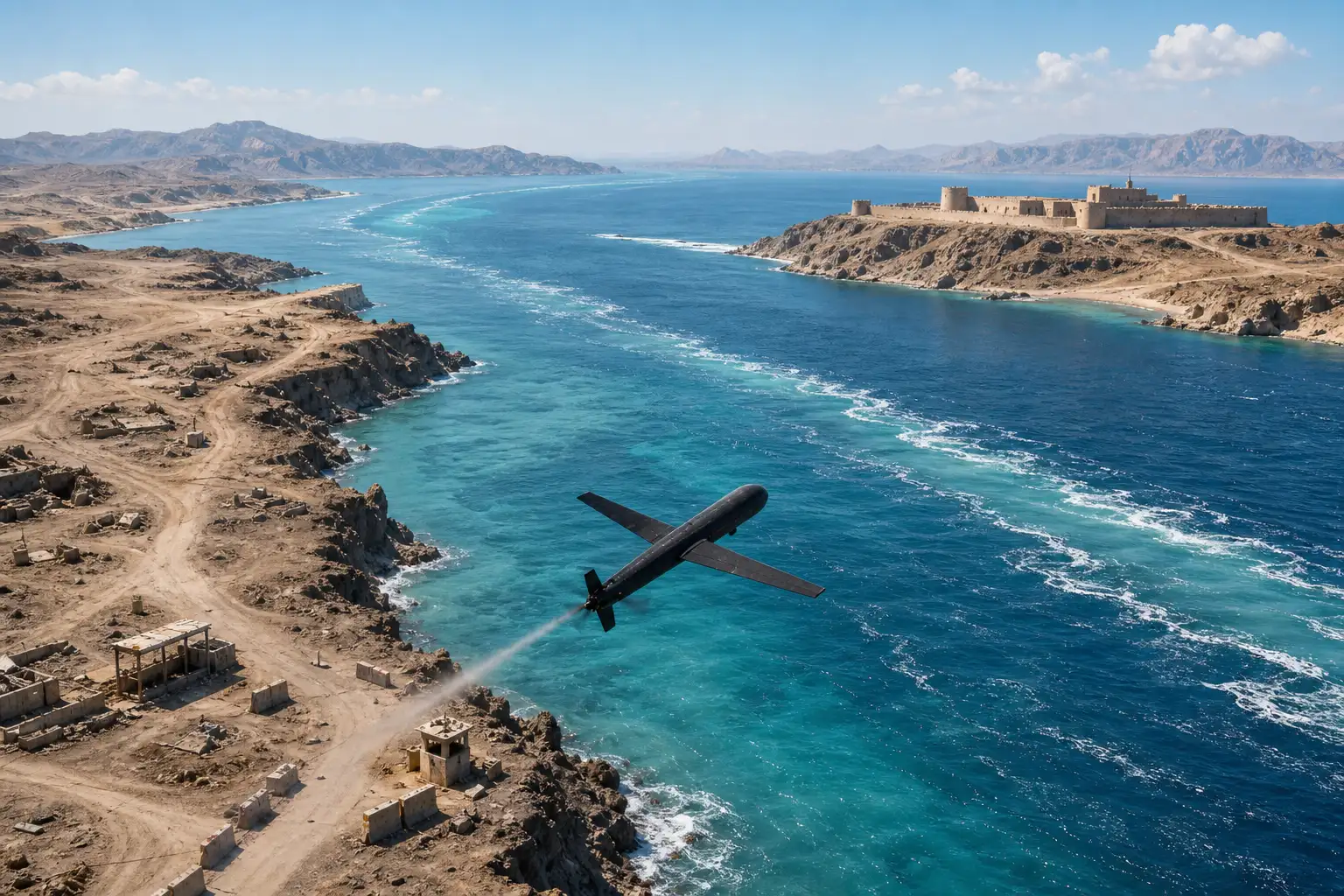
On 20 July the Houthis announced a “siege for a siege” blockade of Saudi ports and vessels in the Bab al-Mandeb. Within days they claimed strikes on energy sites at Yanbu and Jazan. Saudi Aramco suspended the Jazan refinery, which processes 400,000 barrels per day. Drones later hit facilities near Abqaiq. Tankers named Encelia, Layla, NCC Ghazal and others were targeted; Riyadh confirmed fire damage on at least one.
- 5 August: Houthi spokesman Yahya Saree claimed ballistic missiles hit the tankers Wafa near Yanbu and Daisy in the Gulf of Aden.
- 4 August: Claimed strike on Najran Airport; a later shelling in Najran province injured 11 civilians, including a child.
- Early August: Ballistic missiles hit al-Makha (Mocha) and Marib; one Mocha strike killed at least seven and wounded dozens.
- Ongoing: Foundation for Defense of Democracies tracking showed claimed attacks on eight Saudi-linked vessels after the blockade declaration.
The pattern is multi-axis by design. Energy infrastructure, civilian airports, provincial towns and commercial shipping face pressure in the same window, raising the political cost of any single Saudi response. Saudi officials have said they do not seek escalation but will not allow the balance on the ground to change.
Reports describe planning for a major offensive, possibly including Yemeni ground forces with Saudi air and sea support. A Riyadh-led Red Sea maritime coalition of more than a dozen countries launched in late July without the United States or European Union as members. Naval coordination can harden sea lanes. It cannot by itself retake highland launch sites or close the ports that feed the arsenal.
How Hudaydah Stayed Open
The current pressure rests on a decision made eight years ago. In 2018 UAE-backed Yemeni forces and southern fighters reached the gates of Al-Hudaydah, the Houthis’ main Red Sea port and smuggling artery. Victory looked close.
UN Secretary-General António Guterres brokered the Stockholm Agreement. The parties accepted an immediate ceasefire in the city and the ports of Hudaydah, Salif and Ras Issa, plus a mutual redeployment and UN monitoring. The ceasefire that entered force in December 2018 largely held in the city itself. An estimated 150,000 people returned. The offensive stopped. The ports stayed under Houthi control.
- December 2018: Stockholm Agreement signed; Hudaydah ceasefire begins.
- 2019: UAE draws down bulk of its Red Sea coast forces while keeping influence through local allies.
- 2022 onward: Broader truce periods come and go; Houthis restock missiles, drones and anti-ship weapons.
- July-August 2026: Full blockade and multi-axis strikes on Saudi targets resume.
Critics on X and elsewhere note Western pressure, arms-embargo threats and NGO campaigns helped force the halt. The operational result is unambiguous: the logistical artery that later sustained long-range attacks remained open.
Once the ports stayed in Houthi hands, every later truce became a rearmament interval rather than a path to disarmament. Missiles and drones that now reach Yanbu, Abqaiq and the Gulf of Aden moved through a corridor the 2018 halt left intact. The siege declared in July 2026 is the delayed product of that earlier pause.
The Islah Choice That Split the Coalition
While the front stagnated, Riyadh tried to shape a postwar Yemeni government around the Islah Party, the local Muslim Brotherhood-linked formation. For Abu Dhabi, political Islam is an existential red line. Southern secular and independence-minded fighters rejected northern Islamists for historical reasons that included the 1994 civil war.
| Actor | Position on Islah | Consequence |
|---|---|---|
| Saudi Arabia | Blacklisted the party in 2014, then restored support after the Houthi war began | Sought a postwar order built around Islah |
| United Arab Emirates | Treated political Islam as an existential red line | Refused to underwrite an Islah-centered settlement |
| Southern fighters | Rejected northern Islamists, citing the 1994 civil war | Withdrew political trust from the Riyadh track |
Saudi Arabia had blacklisted Islah in 2014 over Brotherhood ties, then restored support once the Houthi war began. High-level meetings in Riyadh in 2017 tried to paper over the UAE-Islah gap. They failed. The friction hollowed the coalition’s ground capacity at the exact moment southern fighters and Emirati logistics had shown they could take territory the air campaign alone could not hold.
Ghazimorad calls the Islah preference Riyadh’s most fatal political blunder. The subsequent prolonged ceasefire with the Houthis legitimized them as a governing authority while they rearmed. That sequence left the Kingdom with a permanent hostile presence on its southern border and fewer partners willing to bleed for the next round.
When Riyadh Struck Its Own Southern Partners
The rupture became kinetic in late 2025. The Southern Transitional Council, heavily backed by the UAE, launched a rapid offensive in December. Within days it seized most of the former South Yemen, including Hadhramaut’s oil fields, Al-Mahrah and the southern coastline. Estimates put STC control at roughly 52 percent of Yemen’s territory and the bulk of proven oil reserves at the peak.
| Phase | STC Position | Outcome |
|---|---|---|
| Early December 2025 | Lightning gains across six southern governorates | Seiyun, Tarim, oil sites, Mahrah coast taken |
| 30 December 2025 | Mukalla port under STC control | Saudi airstrikes hit vessels claimed as UAE weapons shipments |
| 2-7 January 2026 | Counteroffensive by PLC and Saudi air power | Seiyun, Mukalla, Aden recovered |
| 9 January 2026 | Leadership collapsed | STC dissolved itself on 9 January 2026; Aidarus al-Zoubaidi fled to UAE |
The internationally recognized government ordered all UAE forces out within 24 hours, canceled the joint defense deal and declared a state of emergency. The UAE announced a voluntary withdrawal of remaining troops. Riyadh had come to treat a rising independent South as a more immediate political challenge than the Houthis.
- UAE ground expertise and southern fighters removed from the anti-Houthi order of battle.
- Southern trust in Saudi intentions shattered; residual secessionist sentiment and later civil-disobedience calls in Aden persist.
- Coalition that once reached Hudaydah’s gates no longer exists in coherent form.
- Houthis left as the strongest coherent force inside Yemen while Iran’s wider “Axis” network faced simultaneous pressure elsewhere.
On X, one widely shared assessment called the STC collapse a total failure on every level after it had nearly taken the entire south. Another clip of an American analyst put the point bluntly: the Saudis failed to defeat the Houthis and then undercut the STC instead. The crowd reading matches the operational record. The force that had taken oil fields, ports and coastline in days was dismantled before it could be turned north.
Why a Pakistan-Turkey Pact Cannot Replace Ground Allies
On 7 August in Mecca, Crown Prince Mohammed bin Salman, Turkish President Recep Tayyip Erdoğan and Pakistani Prime Minister Shehbaz Sharif signed a joint defense agreement. An attack on one is to be treated as an attack on all. The pact arrived two days after a Houthi drone claim against the Jazan refinery and amid the heaviest single day of fighting in years, when Houthi missiles and drones killed at least 58 Yemeni government troops.
The agreement expands Riyadh’s external insurance after doubts about the reliability of older security umbrellas. It does not create mountain infantry, local knowledge of northern Yemen, or the political legitimacy among southern populations that the STC once supplied. No external alliance wins a war against the Houthis in the highlands of Saada and Amran. That work was always going to require Yemeni partners on the ground.
- Collective-defense language treats an attack on one signatory as an attack on all.
- The pact widens Riyadh’s circle of formal external guarantors.
- It supplies neither highland infantry nor southern political legitimacy.
- Quiet diplomacy through Oman continues alongside force evaluation and the new maritime coalition.
Saudi Arabia also continues quiet diplomacy tracks via Oman even as it evaluates force. The combination of new pacts, a maritime coalition and possible offensive planning still collides with the partner vacuum created in January.
The Partner Gap Constrains Every Offensive Plan
Any major Saudi-backed push now starts from a thinner order of battle than the one that reached Hudaydah’s gates. UAE ground expertise is gone. Southern fighters who once delivered the coalition’s only decisive territorial gains no longer operate inside a coherent anti-Houthi structure. Residual secessionist sentiment and civil-disobedience calls in Aden underscore how far trust has fallen.
Air and sea power remain available. The Red Sea maritime coalition of more than a dozen countries can patrol, escort and signal resolve. Reports of planning for Yemeni ground forces with Saudi air and sea support show that Riyadh still seeks a local infantry component. Yet local forces without the Emirati logistics and southern cohesion of earlier campaigns face a steeper climb against a Houthi movement that restocked through open ports and now fires on multiple axes at once.
The January sequence inverted priorities. A rising independent South was treated as the nearer political danger; the Houthis emerged as the strongest coherent force inside Yemen. External pacts signed in Mecca and naval groupings launched in late July fill some of the insurance gap. They do not refill the ground gap. That is the constraint that shapes every option now on the table.
Why the Southern Buffer Still Matters to Riyadh
For decades Riyadh treated a sovereign South Yemen as a threat to its own hegemony. The arithmetic of the present crisis runs the other way. Control of Hadhramaut’s oil fields, the Mahrah coast and the southern shoreline once offered a contiguous anti-Houthi belt along the Kingdom’s flank and the approaches to the Bab al-Mandeb. That belt is no longer organized under a single partner command.
Aligned coastal partners such as Somaliland still illustrate the wider logic of a non-Islamist littoral. Israeli interest in secure Red Sea commerce points along the same line. Without a functioning southern partner, Saudi developmental projects along the Red Sea stay exposed to the drone and piracy risks Ghazimorad flags, and shipping remains subject to the blockade declared in July.
The buffer was never only a map exercise. It was the political and military depth that let earlier advances stick. Rebuilding anything like it would require reversing the trust damage of January, not only adding new external signatories.
The Buffer That Saudi Policy Still Fears
For decades Riyadh treated a sovereign South Yemen as a threat to its own hegemony. The arithmetic of 2026 points the other way. A non-Islamist, anti-Houthi South, together with aligned coastal partners such as Somaliland, forms a natural buffer for the Kingdom’s southern flank and for the Bab al-Mandeb itself. The UAE long championed that vision. Israeli interest in secure Red Sea commerce points in the same direction.
Ghazimorad writes that the deepest failure was psychological:
A non-Islamist, fiercely anti-Houthi South Yemen is not a threat to the Kingdom; it is its vital shield.
She argues Riyadh must also confront the Iranian regime itself, aligning with Iranian opposition figures including Prince Reza Pahlavi, because trimming Houthi branches leaves the head of the network intact. Saudi developmental projects along the Red Sea remain exposed to a single successful drone or piracy action. Regional pushback against Houthi strikes continues at the UN and among neighbors, yet the core southern-partner problem sits inside Saudi decision-making.
If Riyadh steps back into major operations, it does so without the only partners who previously delivered meaningful territorial gains. The missiles flying north and the tankers diverting course are the visible cost of that decade. The quieter cost is the empty space where southern ground power used to stand.
