
Konecta has opened its regional headquarters and first global generative AI centre in New Cairo, a $100 million wager that Egypt can anchor the outsourcing giant’s push into automated customer service. The Spanish company already runs the site with 800 Egyptian specialists and wants 1,000 by December, rising to roughly 3,000 by the end of 2028.
Konecta’s own numbers tell a second story. Its average workforce in Spain fell by more than 7,000 people between 2023 and 2024, and deeper cuts are running through Italy right now, even as the Cairo count is set to nearly quadruple by 2028.
Egypt Lands Konecta’s First Global AI Centre
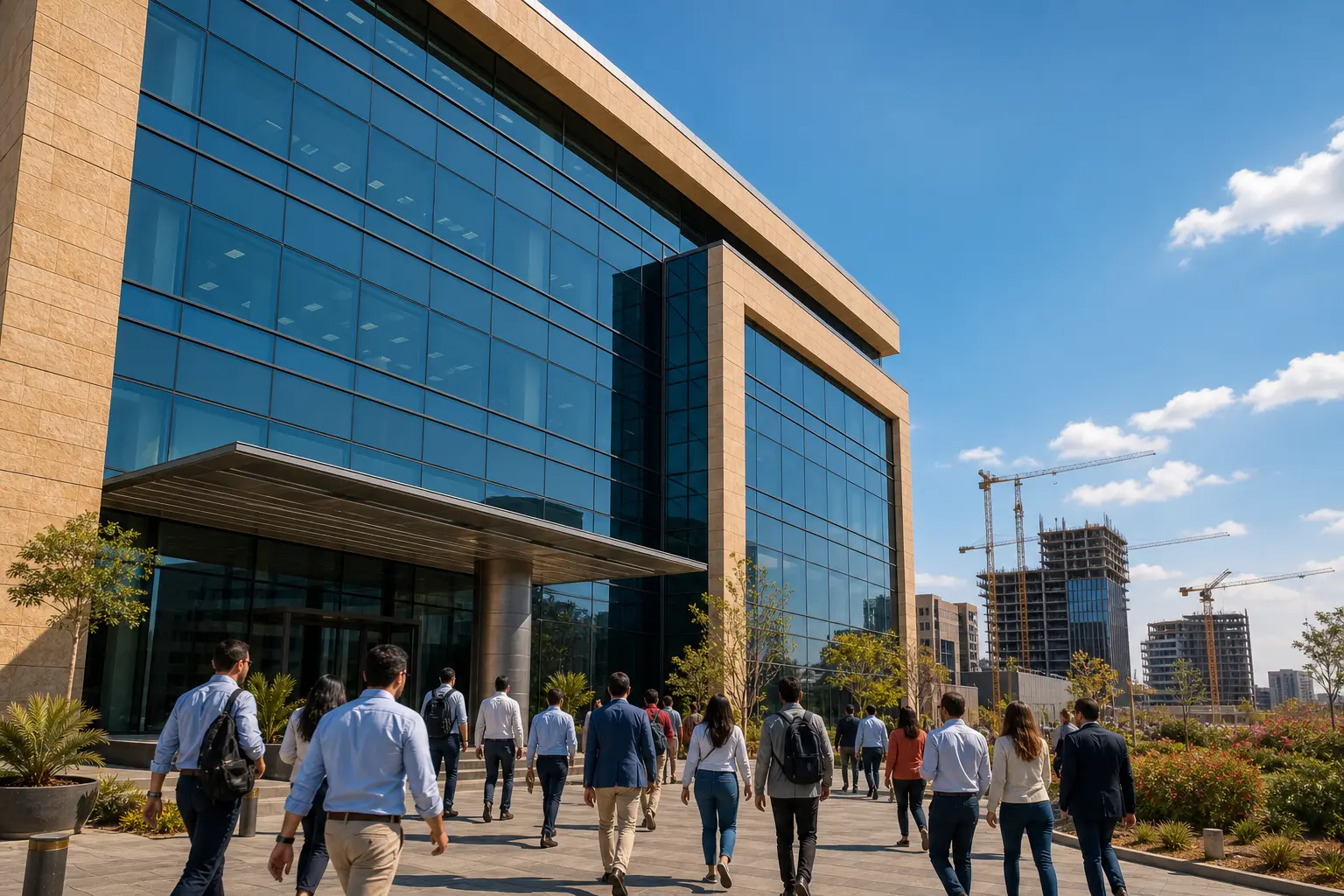
Egypt’s Ministry of Communications and Information Technology said Minister Raafat Hindi inaugurated the New Cairo facility as both Konecta’s regional headquarters and its first worldwide centre of excellence for generative artificial intelligence. The site is meant to serve clients across the Middle East, Africa, Europe and the Americas, covering digital customer experience, AI, data analytics, technical support and the Internet of Things.
Ahmed Al-Harrany, Konecta’s vice chairperson for the Middle East and Africa, tied the opening directly to the company’s global strategy.
Egypt is not just an operational site for Konecta, but our regional headquarters and hosts the group’s first global centre of excellence in generative artificial intelligence.
Al-Harrany said the growth of the Cairo team to 800 specialists, with 1,000 targeted by year end, reflects the depth of Egyptian talent and client confidence in services delivered from Cairo. Staff there already work in Arabic, English, French, German, Italian, Spanish and Dutch, serving a client base well beyond Egypt’s own borders.
Cairo Up, Spain Down
The contrast sits in Konecta’s own recent history. The company’s average workforce slid from 133,500 employees in 2023 to 126,447 in 2024, a drop of more than 5 percent, according to labor-restructuring tracking by Eurofound, the European Union’s work-conditions agency. Cuts have kept running through 2025 and into this year at centres in Guenes, Elche and La Carolina, with roughly 30 percent of the Spanish business affected and another 10,000 positions slated to go.
Spain’s tax agency, the AEAT, is pulling around 1,000 outsourced jobs back in-house at a Madrid call centre once its Konecta contract lapses in January 2027. In Italy, Konecta is shutting its Ivrea and Asti sites by June this year, pushing about 1,100 employees to relocate to Turin or leave.
| Location | Workforce Change | Timeline |
|---|---|---|
| New Cairo, Egypt | 800 rising to 1,000 specialists | By end of 2026 |
| New Cairo, Egypt | Up to roughly 3,000 specialists | By end of 2028 |
| Spain, nationwide average | 133,500 down to 126,447 workers | 2023 to 2024 |
| Elche, Alicante | 104 jobs cut | Announced December 2025 |
| Madrid, AEAT contract | About 1,000 jobs at risk | Contract ends January 2027 |
| Ivrea and Asti, Italy | Sites closing, about 1,100 relocating to Turin | By June 2026 |
Every one of those cuts sits inside the same company now celebrating a $100 million Egyptian expansion.
Katalyst 2028 Ties the Numbers Together
Konecta’s push into Cairo lands alongside a companywide plan called Katalyst 2028, which aims for roughly 2.5 billion euros (about $2.7 billion) in AI-driven revenue by 2028, built on technology developed with Google Cloud and the conversational AI firm Uniphore. The plan reframes Konecta less as a call centre operator and more as a seller of automation tools.
During his tour of the New Cairo site, Hindi reviewed digital solutions built there, including Konecta’s Kolibri agentic AI platform, and credited Egyptian teams with developing, testing and localising the technology. Agentic AI systems like Kolibri are designed to act on a customer’s behalf, handling authentication, data retrieval and routine resolution without a human agent on the line.
Ahmed El-Zaher, chief executive of Egypt’s Information Technology Industry Development Agency (ITIDA, the state body that courts outsourcing investment), said the expansion supports plans to grow Egypt’s service exports and highlights the country’s advancing capabilities in AI. The inauguration follows a memorandum of understanding ITIDA signed with Konecta in January 2025, witnessed by Prime Minister Mostafa Madbouly.
Why Do Outsourcers Keep Choosing Cairo?
Cairo offers global outsourcers a large, multilingual, relatively low-cost workforce, and Egypt’s government has spent years courting exactly this kind of investment through export targets and agency-brokered deals. Konecta is joining an already crowded field rather than opening new territory.
Egypt’s Ministry of Communications and Information Technology said last month it is targeting $6 billion in outsourcing service exports this year, up from about $5.2 billion in 2025. A Frost and Sullivan analysis hosted by ITIDA points to a fast-growing African business process outsourcing market as one reason global operators keep expanding their Egyptian footprints. Konecta now sits beside a lineup that includes:
- Teleperformance, running more than 4,000 seats across two Cairo campuses
- Vodafone Egypt, whose shared-services and VOIS units run over 3,000 seats of internal and third-party outsourcing
- IBM, Microsoft and Uber, all cited as companies servicing offshore markets out of Egypt
Founded in Madrid in 1999, Konecta employs about 109,000 people delivering services in 40 languages across 28 countries, so the New Cairo build represents a small but fast-growing slice of a much larger company now redrawing where its people sit.
What Gartner’s Data Says About Agent Jobs
The technology Konecta is building in Cairo arrives inside an industry already reshaping how many humans a customer service desk actually needs.
- 20 to 30 percent of service agents could be replaced by generative AI industry-wide by 2026, per Gartner’s widely cited forecast
- $80 billion in global agent labor costs could be stripped out by conversational AI deployed in contact centres, Gartner has projected
- 95 percent of customer service leaders surveyed still say they plan to retain human agents rather than eliminate the role entirely
- $15.12 billion is the projected size of the global AI customer service software market this year
The tension in those numbers is the same one running through Konecta’s own balance sheet. Automation is expected to erase a large share of frontline agent work, yet most employers insist they still want people around to manage what the software cannot.
The Clock Now Running on Cairo’s Jobs
Nothing about the Kolibri platform or Konecta’s broader AI ambitions is confined to Spain and Italy. The same agentic tools built and localised by Egyptian engineers in New Cairo are designed to work anywhere Konecta has a client, including Cairo’s own growing floor of specialists.
For now, the arithmetic favors Egypt. A cheaper, English-and-French-and-Arabic-fluent workforce, an active government courting the business, and a client base willing to route more work through Cairo add up to real hiring through 2028. Whether that headcount holds once Kolibri matures is a question Konecta’s Spanish workforce already knows the answer to.
