
A drone strike set fire to Saudi Aramco’s Abqaiq processing complex on July 27, knocking roughly 7 million barrels a day of capacity offline even as the United States and Iran held their fire for a third straight day. Jordan intercepted drones near its border. Israel shot down two more close to the Dead Sea. Houthi rebels in Yemen claimed a separate strike on oil transit sites feeding Saudi Arabia’s Red Sea port at Yanbu, and Brent crude jumped back above $100 a barrel.
None of the fighting involves American or Iranian forces directly. Washington paused its strikes to let Qatari and Pakistani mediators chase a new truce with Tehran, and that pause is holding. But the drones raining down on Saudi Arabia, Jordan and the Iraq-Israel frontier are being launched by the same web of Iran-backed groups the ceasefire talks were meant to quiet, and Riyadh has no seat at that table.
A Fragile Truce Enters Its Third Day
The current lull traces back to a brutal opening chapter. Israel and the United States struck Iran on February 28, killing senior leadership and destroying military sites. Iran answered with missiles, drones and a closure of the Strait of Hormuz that froze global tanker traffic. A two-week ceasefire followed on April 8, brokered largely by Pakistan, under which Tehran agreed to reopen the strait.
It did not go smoothly. Iran reopened Hormuz to some traffic but began charging tolls exceeding $1 million per ship, and the U.S. Navy moved to blockade Iranian ports on April 13 after follow-up talks in Islamabad collapsed. A research briefing tracing the ceasefire’s repeated breakdowns from the House of Commons Library counts this as at least the third time the April agreement has effectively fallen apart and been patched back together. Pakistani Prime Minister Shehbaz Sharif has since signed a fresh memorandum of understanding as mediator, with Qatar working alongside him to bridge Washington and Tehran’s competing readings of the deal.
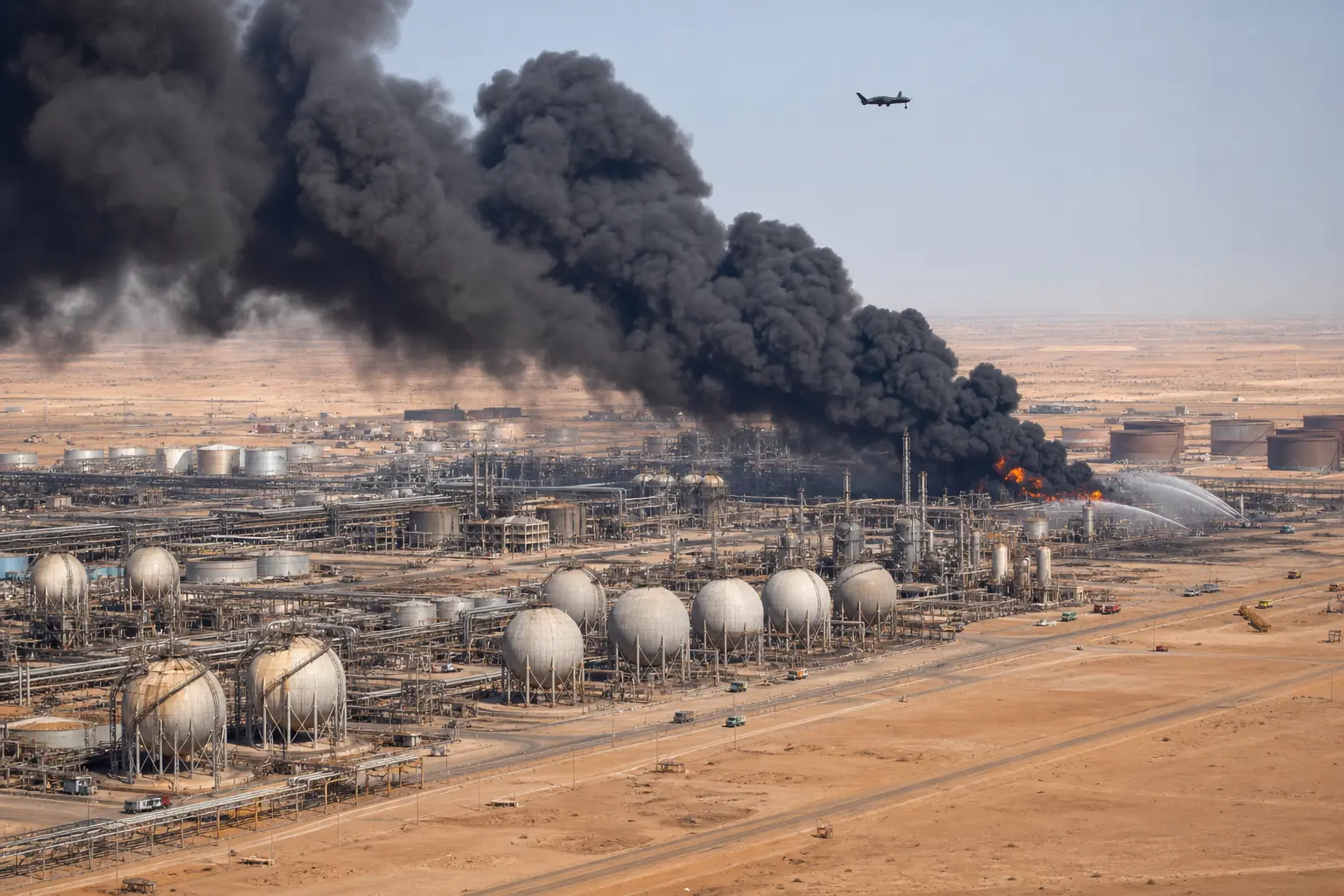
Abqaiq Burns Again
Abqaiq is the world’s largest crude stabilization plant, handling between 5% and 7% of global oil supply on an ordinary day. Saudi Arabia’s Defense Ministry said the drones that hit it, along with the nearby East-West Pumping Station, launched from Iraqi territory. Aramco suspended operations at the site afterward, and satellite images circulating online appeared to show a large black smoke plume over the complex.
The kingdom has been here before. On September 14, 2019, a combined drone and missile strike hit Abqaiq and the Khurais field, knocking out 5.7 million barrels a day, more than half the country’s output, and triggering the largest single-day oil price spike ever recorded. A Congressional Research Service assessment of that attack found it stripped out roughly 5% of global supply in one strike, and satellite data reviewed at the time by University of Wisconsin researchers tracking the strike’s thermal signatures showed the scale of the fires from orbit. The Houthis claimed that attack too, though Riyadh and Washington pointed at Iran directly.
| Detail | September 2019 Attack | July 2026 Attack |
|---|---|---|
| Facilities hit | Abqaiq and Khurais | Abqaiq, Jizan refinery, Yanbu-area transit sites |
| Output affected | 5.7 million bpd offline | About 7 million bpd of Abqaiq capacity offline |
| Share of global supply | Roughly 5% | 5% to 7% (Abqaiq’s normal throughput) |
| Claimed by | Houthi movement; Riyadh and Washington blamed Iran | Disputed; Iraqi militias deny it, point to Yemen |
| Oil price reaction | Largest single-day spike on record | Brent crude back above $100 a barrel |
This time the attribution is murkier. An umbrella of Iran-aligned Iraqi militias calling itself the Islamic Resistance in Iraq denied launching the strike, contradicting the Saudi Defense Ministry’s account that the drones came from Iraq. The group said Yemen carried it out instead, accusing Riyadh of blaming Iraqis because it was too cowardly to respond to the Yemeni Armed Forces directly.
- What we know: Saudi Arabia’s Defense Ministry says drones targeting Abqaiq launched from Iraqi territory, Aramco has suspended operations at the site, and Houthi forces claim separate strikes on Yanbu-area transit sites as retaliation for alleged Saudi drone incursions into Yemeni airspace.
- What’s unconfirmed: The Islamic Resistance in Iraq denies responsibility and blames Yemen instead, the origin of the two drones Israel downed near the Dead Sea remains under investigation, and Riyadh has not publicly answered the Houthis’ retaliation claim.
Why Is Saudi Arabia Down to One Oil Route?
Saudi Arabia is exporting crude through a single corridor because Iran shut the other one. The Strait of Hormuz closure that opened the February war forced the kingdom to route seaborne exports through the East-West Pipeline to Yanbu on the Red Sea instead. Ship-tracking data cited by market analysts show Yanbu handled about 92% of Saudi Arabia’s seaborne crude exports in June, with more than 4.5 million barrels a day moving through the port since April, roughly 70% of it bound for Asia.
That single corridor is now the target. The Houthis’ claimed strikes near Yanbu, paired with the Jizan refinery fire on July 25, pushed Brent crude from around $91 to above $100 within days. Some market analysts warn a sustained interdiction of Yanbu-bound tankers could push prices toward $115 to $120 a barrel, since ships would need to reroute around Africa at far higher freight and insurance cost. Reporting on the same squeeze has already tracked tankers reversing course away from a maxed-out pipeline route as shippers weigh the risk. With Hormuz still contested and Yanbu now under fire, Saudi Arabia has no third option if either route goes down for long.
Jordan and Israel Catch the Overflow
The drones are not staying inside Saudi Arabia. Jordan’s military said it intercepted multiple drones near its border. The Israel Defense Forces said Monday morning it shot down two more close to the Dead Sea; both stayed outside Israeli territory, and their origin is still under investigation. In northern Iraq, armed groups separately launched drones at camps housing Iranian Kurdish dissident groups, a front with no connection to Riyadh’s oil infrastructure but drawing on the same regional arsenal.
Jordan’s exposure is not new. Reporting on an earlier round of strikes has already examined how hosting American forces carries its own security cost for Amman, and Monday’s interceptions extend that pattern. Every one of these incidents sits outside the direct US-Iran military channel Washington paused. They are proxy business, run by groups Tehran arms and trains but does not always visibly command in the moment.
The Houthis Are Waging Their Own War With Riyadh
The Houthi movement’s fight with Saudi Arabia has a logic that does not depend on what happens between Washington and Tehran. The group announced a blockade of Saudi Arabia’s oil industry in the Red Sea days before the Yanbu-area strikes, framing its attacks as payback for what it called Saudi drone incursions into Yemeni airspace. Riyadh has not commented on that specific claim.
Saudi Arabia hit back anyway. Its air force struck what it described as Houthi military facilities in Yemen’s Hodeidah port, saying the goal was to protect maritime shipping. Neither side has signed onto the US-Iran pause, and neither has an obvious reason to stop on its own terms. This bilateral track can escalate or cool independent of anything Qatar and Pakistan negotiate in the other room.
Mediators Chase a Truce Riyadh Never Signed
Qatar and Pakistan are working to keep Washington and Tehran talking, and Sharif’s memorandum of understanding is the clearest sign of forward motion since the April ceasefire first frayed. None of that machinery includes Saudi Arabia, Jordan or Israel, the three governments actually absorbing drone strikes this week. A blockade aimed at Yanbu would strain the same mediators from a different angle, since a Red Sea oil blockade tests what those mediators can realistically absorb while still holding the US-Iran track together.
Brent crude sat above $100 a barrel as of Monday, Abqaiq remained offline, and no date had been set for the next round of US-Iran talks. The lull was still holding between Washington and Tehran. Everyone else was still under fire.
