
Aviv Moshe once ran seven non-kosher restaurants across Israel, the kind of tables that took weeks to book. He gave up every one of them. His newest venture, a kosher Italian osteria called Bella, has opened in Tel Aviv’s Ramat Aviv neighborhood, the latest stop in a run that turned one of the country’s most decorated chefs into an exclusively kosher operator.
Bella lands as kosher restaurants close in on half of Tel Aviv’s dining scene, according to a survey from the Israel Democracy Institute, a Jerusalem-based think tank, in a city where kosher tables barely existed outside hotel dining rooms a decade ago. Moshe’s own path, from Messa’s fine-dining stage to a three-restaurant kosher compound, tracks that shift chef by chef.
A Nuova Osteria Anchors a New Culinary Compound
Bella calls itself a nuova osteria, traditional Italian cooking reworked with contemporary technique. Its dairy kosher certification means the kitchen skips meat and poultry entirely, leaning on fish for its main courses instead.
The restaurant sits at 10 Einstein Street, on a boulevard running through one of Tel Aviv’s wealthiest suburbs. It anchors a three part complex its owners are calling Bella Mia.
- Bella – the dairy kosher Italian osteria at the center of the project, led by chef Aviv Moshe
- A Japanese izakaya – opening downstairs from Bella, still unnamed as of the soft opening
- A neighborhood fish bistro – the third venue, planned to complete the compound
Moshe co-owns the project with restaurateur Shuki Biton and Biton’s wife, singer Eden Ben Zaken, a former X Factor Israel finalist voted the country’s radio Woman of the Year multiple times since her 2015 debut album. The couple married in 2018.
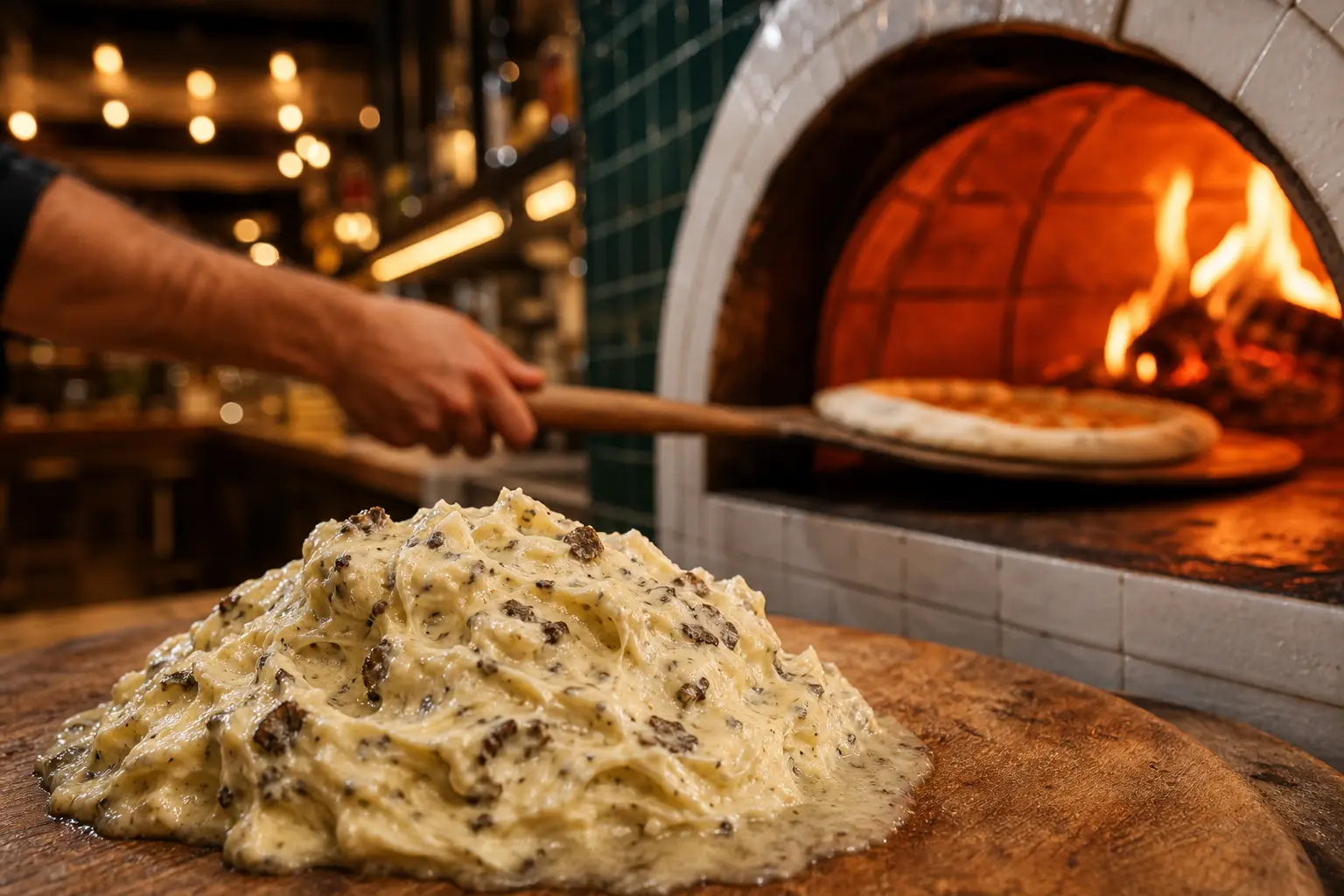
The interior barely changed from the space’s previous run as the Italian restaurant Serafina, keeping its bar and semi-open kitchen. The one new fixture sits beside the white wood-fired pizza oven: a mound of truffle butter, a hint at how often the ingredient turns up on the plates that follow, including a whole burrata that oozes its stracciatella center over chopped heirloom tomatoes and a red drum fish main served over potato gnocchi in a brown-butter bisque, the menu’s priciest dish at NIS 168 (about $45).
Bella runs dinner Sunday through Thursday from 5 p.m. to midnight, with a Friday lunch seating and Saturday service after Shabbat ends. A happy hour between 5 and 7 p.m. on weeknights cuts 20% off the entire menu. The same boulevard already holds a second kosher destination a few doors down, a new rooftop food court inside Israel’s self-described premier luxury-brand mall.
Kosher Restaurants Now Fill Half of Tel Aviv’s Tables
Kosher dining used to define Jerusalem, not Tel Aviv. Until a few years ago, Tel Aviv’s kosher options ran almost entirely through hotel dining rooms and shawarma counters, according to Aish, a Jewish educational and news outlet that has tracked the shift. That map has since redrawn itself.
- Nearly half of Tel Aviv’s restaurants now hold kosher certification, per a survey from the Israel Democracy Institute tracking the kosher shift.
- Over 90% of Jerusalem’s restaurants are kosher, the same survey found, keeping the city’s traditional lead.
- A decade ago, Tel Aviv’s kosher tables were mostly confined to hotel restaurants and shawarma stands.
The pattern reaches beyond Israel too. Kosher cuisine is having an international moment as more well traveled kosher diners push for higher end options, and Barcelona now has a kosher restaurant that carries a Michelin star.
Why Are Couples Paying $400 for a Kosher Dinner?
Because the money moved. Israel’s religious middle class has grown wealthier and increasingly works in high tech, and because many observant families skip movies and theater, dining out has become a primary form of entertainment, one where a couple can spend as much on a single meal as a weekend trip.
Yossi Ettinger, co-founder of the 200,000-follower religious social community DatiLicious, has told the Israeli financial paper Calcalist that restaurateurs who once overlooked religious diners now see them as a serious consumer force. His business partner, Eli Helman, puts a figure on it. “You see couples spending 1,500 shekels ($400) on a meal, and they keep kosher,” Helman told Calcalist about the community’s spending power.
Shahar Segal, a partner of celebrity chef Eyal Shani, has made a similar calculation public. Without kosher certification, he has said, the business would lose access to roughly 70% of its own clientele, a math problem few high end kitchens can still afford to ignore.
Seven Restaurants, Then Zero Treif Kitchens
Moshe built his reputation at Messa, a fine dining address in downtown Tel Aviv that stayed one of the hardest reservations in the city for years. At the peak of his career he had seven non-kosher restaurants running at once, with waits that could stretch for weeks.
Then he stopped. In 2022, Moshe persuaded the owners of a well regarded spot near Allenby Street to convert to kosher entirely. It reopened as Poupee, a high end restaurant he has led ever since.
I am more connected to the world of kashrut now.
Moshe told Aish in an interview, explaining that fans used to stop him on the street asking when he would finally open a kosher restaurant, and that he wanted his cooking within reach of anyone who kept kosher. From Poupee, the run continued to Maree Sky Lounge, a bar on the 15th floor of Netanya’s Vert Lagoon hotel, and now to Bella, his first Tel Aviv address since Messa.
Other Star Chefs Are Making the Same Bet
Several of Israel’s most recognized chefs have followed a similar arc over the past two years, some abandoning non-kosher kitchens entirely and others running kosher and non-kosher menus side by side.
| Chef | Non-Kosher Track Record | Kosher Move |
|---|---|---|
| Aviv Moshe | Messa and seven non-kosher restaurants around Israel | Poupee (2022), Maree Sky Lounge, now Bella in Ramat Aviv |
| Meir Adoni | Catit and Mizlala, two popular Tel Aviv restaurants | Closed the Carlton Hotel’s Lumina and Blue Sky; runs the kosher Dunya chain and is opening in Singapore |
| Assaf Granit | Michelin starred Machneyuda Group | Opened two separate kosher establishments |
| Eyal Shani | HaSalon, Miznon and North Abraxas, still non-kosher | Runs Malka and Dvora as parallel kosher restaurants |
| Haim Cohen | Known for unapologetic Israeli cuisine | Opened a kosher restaurant in Bnei Brak |
The wave traces back further than this year. Israeli celebrity chefs began opening kosher restaurants inside luxury hotels as early as 2010, using a built-in guest base to offset the risk of an untested format. “I believe those were the best five years of my career,” said Victor Gloger, an Israeli-Argentinian chef who ran the kosher Chloelys restaurant at the Hilton Tel Aviv before the format lost momentum and he stepped away six years ago.
Kosher Comes in More Than One Flavor
Some kitchens are hedging instead of converting outright. A looser trend called kosher-style has taken hold in parts of Tel Aviv: restaurants that follow kosher kitchen rules, keeping meat and dairy apart and skipping pork and shellfish, without seeking formal certification from the Chief Rabbinate or the Tzohar organization.
Chef Moshik Roth pulled meat entirely off the menu at his restaurant Moshik& earlier this year, keeping seafood on a separate section rather than pursuing a kashrut certificate. Not everyone is convinced the middle ground holds up. “There is either kosher or non-kosher; there is nothing in between,” Roth said of the gray-area approach some peers have adopted.
- Mehadrin – the strictest tier of kosher supervision available in Israel, layering tighter ingredient and oversight standards on top of baseline Rabbanut certification. Bella carries a Dairy Mehadrin certificate, the same tier used by many of Tel Aviv’s most observant kosher kitchens.
The conversions have critics too. Aviram Katz, who owns a Tel Aviv restaurant, has pushed back publicly, framing the wave as a form of pressure rather than pure consumer demand. The economics can also cut in unexpected directions. At Itzik HaGadol, a longtime Tel Aviv meat institution that converted to kosher, weekly fish orders reportedly fell from 100 to 15 once the kitchen’s meat became certified, evidence that many diners had ordered fish before only because the meat on the menu wasn’t kosher.
Bella’s own kitchen carries one quirk that has nothing to do with kashrut. Despite the wood-fired oven and the all-Italian menu, it serves no espresso and no hot drinks of any kind; management’s only explanation is that it was the owners’ decision. The izakaya and the fish bistro, the other two thirds of the Bella Mia complex, have not yet opened.
