
Italy bought $477.1 million worth of Egyptian goods in April 2026, more than any other country in the European Union and 57% more than a year earlier. The figures come from Egypt’s Central Agency for Public Mobilization and Statistics (CAPMAS), which tracks the country’s foreign trade month by month. That is a jump of $173.2 million from the $303.9 million Italy spent in April 2025.
Most of the increase, $235.1 million, came from one customs category: fuels, mineral oils and distillation products. It landed in the same month Cairo raised domestic fuel prices and imposed a business curfew to cope with a gas import bill that has very nearly tripled.
A Record $477 Million Month
The $477.1 million figure made Italy the single largest destination in Western Europe for Egyptian goods last month, ahead of every other country in the bloc. Egypt’s total shipments to Western Europe reached roughly $1.59 billion in April, which means Italy alone accounted for close to 30% of everything Egypt sent to the region. CAPMAS put Italy’s share of Egypt’s total exports, among its five biggest destinations that month, at around 9.4%.
| Export Category to Italy | April 2026 Value | Year on Year Change |
|---|---|---|
| Fuels, mineral oils and distillation products | $235.1 million | Largest single category |
| Aluminum and aluminum products | $60 million | Second largest category |
| Plastics and plastic products | Approximately $46.6 million | Third largest category |
| Fertilizers | $9.8 million | Down 28.3% |
| Vegetables and plants | $4.6 million | Down 19.3% |
| Total exports to Italy | $477.1 million | Up 57% |
Nationally, Egypt’s exports climbed 21.1% year on year to $5.1 billion in April, up from $4.2 billion a year earlier, according to the same monthly bulletin. Petroleum products led the national gains, up 44.8%, followed by ready made garments, up 30%, and fresh fruit, up 62.6%. Italy topped the full list of export destinations that month, ahead of the United Arab Emirates, Saudi Arabia, Turkey and the United States.
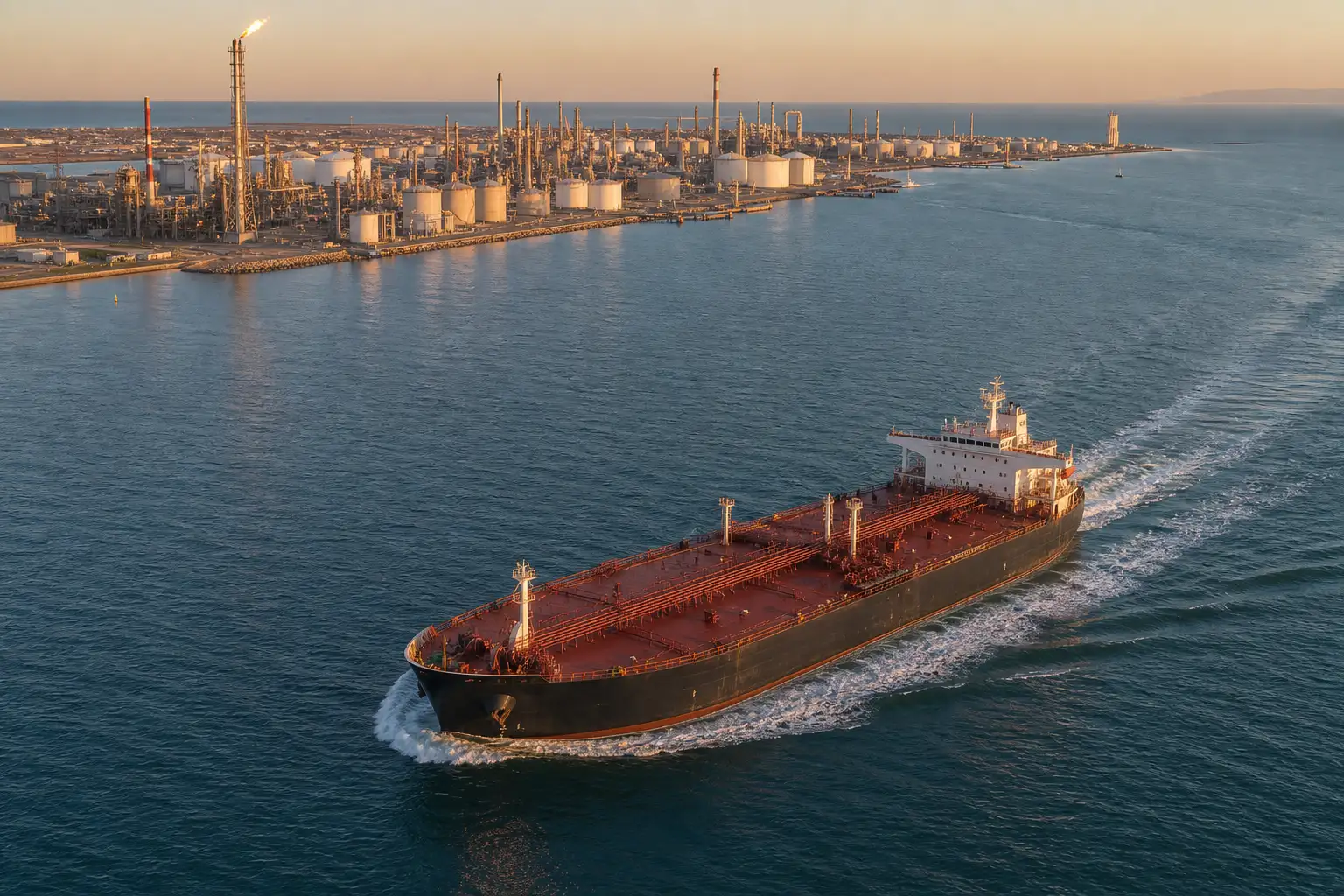
Refineries, Not Gas Fields, Explain the Number
Fuels, mineral oils and distillation products is a wide customs basket. It covers crude oil, refined fuel such as diesel and fuel oil, and liquefied natural gas alike. Anyone who follows Egypt’s energy trade might assume Zohr, the giant offshore gas field near Port Said, sits behind a number this size.
The national figures argue otherwise. Egypt’s LNG exports to every country combined totaled just $49.7 million in April, up from $35 million a year earlier. Coal shipments were smaller still, at $1.53 million. That leaves little room for gas inside the $235.1 million Italy bought on its own.
What is left is refined product, diesel, fuel oil and naphtha, moving out of Egyptian refineries at Suez, Alexandria and Sidi Kerir. Eni, the Italian energy company with the deepest footprint in Egypt, still runs the Damietta gas liquefaction plant on the Mediterranean coast, though that facility has had far less LNG to process since Egypt became a net gas importer.
Cairo Pays Nearly Triple for the Gas It Still Needs
Egypt’s own energy math looks nothing like Italy’s shopping list. The country turned into a net gas importer in 2023 after years spent promoting itself as a regional energy hub. National gas production peaked at 71 billion cubic meters in 2021 and had fallen to 45 billion cubic meters by 2024, according to energy research firm Enerdata.
Zohr tells a similar story. The field peaked at 2.7 billion cubic feet a day in 2019 and had slipped to 1.9 billion cubic feet a day by early 2024, Egypt’s oil ministry has reported.
The war between Israel and Iran made the shortfall costlier. Egypt’s prime minister said in March that the conflict had nearly tripled the country’s monthly gas import bill, from $560 million to $1.65 billion. Israel’s Tamar field, one of Cairo’s main outside suppliers, faced production cuts of its own during the fighting, tightening the squeeze further.
Egypt’s government answered with a familiar playbook.
- A business curfew aimed at trimming evening power demand during the worst of the shortage.
- Higher domestic fuel prices, passed on to drivers and industry to slow consumption.
- Slower government projects, freeing up gas and budget for the power grid.
- Roughly 300 LNG cargoes lined up through 2026 by the Egyptian Natural Gas Holding Company to plug the gap.
The refining and export side of the business runs on different economics than the power grid, and Italy kept buying regardless.
Why Rome Keeps Betting on Egyptian Energy
Italy’s appetite for Egyptian fuel is not new, and it is not really about Egypt alone. Prime Minister Giorgia Meloni’s government has spent years trying to turn Italy into a gas hub for the Mediterranean, replacing Russian pipeline supply with flows from North Africa.
Algeria did most of the early heavy lifting, overtaking Russia as Italy’s top gas supplier in 2022, part of a shift that cut Russian gas to under 5% of Italy’s imports by 2023, down from roughly 38% before the invasion of Ukraine. Then Qatar, which normally supplies about 10% of Italy’s gas imports, lost production capacity in March 2026 when Iranian strikes hit its Ras Laffan LNG complex, an outage expected to last three to five years.
Egypt fits into that same push. Eni operates Zohr and holds stakes in Egypt’s other major gas fields, and it announced a fresh discovery in Egyptian waters on April 7, the same month the CAPMAS export figures cover. The plan behind all of it has a name: the Mattei Plan and its six pillars covering energy, water and agriculture, launched by Meloni in 2022.
An operational and structural reality, which is generating tangible results for our peoples.
Meloni used her address to the African Union in Addis Ababa in February to describe how far the plan had come since its launch. Eni chief executive Claudio Descalzi said last year the company would invest roughly €24 billion ($26.3 billion) across Algeria, Libya and Egypt over four years.
Fertilizer Shipments Absorb the Squeeze
Fertilizer moved the opposite way. Egypt’s fertilizer exports to Italy fell 28.3% in April, to $9.8 million, and vegetable and plant shipments dropped 19.3%, to $4.6 million. Nationally, fertilizer exports fell even harder, down 58.4% year on year.
Fertilizer and gas are tightly linked in Egypt. Natural gas makes up roughly 70% to 80% of the cost of producing ammonia, the base ingredient for urea and other nitrogen fertilizers. When gas gets scarce, fertilizer plants tend to feel it before power plants do.
That already happened once. In May 2025, the government cut industrial gas supplies by around 50%, mostly to state owned fertilizer and petrochemical plants, to offset a temporary drop in Israeli imports. Electricity generation eats about 60% of Egypt’s gas, petrochemicals another 20%, and officials chose to protect the grid first.
The government also raised the price fertilizer producers pay for feedstock gas, and in March it moved to link that price directly to international fertilizer export prices through a flexible formula. Khaled Abu Al Makarem, chairman of Egypt’s Chemical and Fertilizers Export Council, said the new system would let gas prices “fluctuate in relation to export prices.”
Europe has its own stake in keeping Egyptian fertilizer flowing. Regulators are moving to exempt Egyptian fertilizer producers from the European Union’s carbon border tax through 2027, sparing them an estimated $317 million a year in charges, after France and Italy pushed for the exemption over fears their own farmers would face a 25% cost jump without it.
- 50% cut to industrial gas supplies in May 2025 to protect Egypt’s power grid
- $4.5 to $5.5 per MMBtu the new gas price for nitrogen fertilizer plants since September 2025
- 55% share of output producers must now sell domestically under a quota system
- 28.3% the drop in Egyptian fertilizer shipments to Italy alone in April 2026
The gas that used to feed those plants is increasingly going somewhere else, either to Egyptian power stations or, in refined form, onto tankers bound for Italy.
Eni’s Temsah Find Reshapes the Math
On April 7, the same month covered by the CAPMAS export data, Eni and Egypt’s petroleum ministry announced a gas discovery off Egypt’s Mediterranean coast. Preliminary estimates point to about 2 trillion cubic feet of gas, roughly 57 billion cubic meters, plus 130 million barrels of petroleum condensates, in the Temsah Concession’s Denise W-1 well.
Eni operates the discovery with a 50% stake through its Petrobel joint venture with BP, following a 20 year renewal of the Temsah Concession signed in July 2025. The well still needs testing, and Egypt would need more wells and an offshore platform before any of that gas reaches a customer.
Egypt’s petroleum minister, Karim Badawi, has separately been in talks with Eni about doubling crude output and routing gas from Cyprus’s Cronos field through Egyptian infrastructure, positioning the country as a processing hub for the wider Eastern Mediterranean. The ministry has scheduled 101 new wells for this year across the Western Desert, the Gulf of Suez, the Mediterranean and the Nile Delta.
Two refinery projects are meant to add to the fuel export pipeline on the industrial side: a $3 billion diesel and hydrocracker complex in Assiut, and a $7 billion petrochemical complex planned for New Alamein. Egyptian officials have set a target of $100 billion in annual exports by 2030. Last month, it was refineries, not gas fields, doing the heavy lifting toward that number.
Frequently Asked Questions
What is CAPMAS and how often does it publish trade data?
CAPMAS, the Central Agency for Public Mobilization and Statistics, is Egypt’s official statistics body. It releases a monthly foreign trade bulletin, typically on a Monday, covering exports, imports and the trade balance broken down by country and by commodity category.
Does Italy still import Egyptian natural gas directly?
Very little, for now. Italy was Egypt’s top LNG customer as recently as 2022 through 2024, importing around 24.4 billion cubic meters over that stretch through the Damietta and Idku terminals. Egypt’s shift to net gas importer status since 2023 has left far less surplus gas available for export.
Where does the name Mattei Plan come from?
It is named for Enrico Mattei, the founder of Eni, who built the company’s early deals with oil producing nations around a 75/25 profit split favoring the producer, an unusually generous arrangement at the time compared with the standard 50/50 split. Meloni’s government revived his name for its 2022 Africa strategy.
How large is Egypt’s overall trade deficit?
Egypt’s trade deficit widened 20.2% to $4.8 billion in April 2026, up from $4 billion a year earlier, as imports rose 20.7% to $9.9 billion on higher purchases of wheat, copper and plastics.
How dependent is Italy on natural gas for electricity?
Heavily. Natural gas generates more than 40% of Italy’s electricity, according to the International Energy Agency, which is why Rome keeps signing new supply deals across the Mediterranean even while investing in renewables at home.
