
Saudia will fly nonstop between Riyadh and Tokyo three times a week starting November 17, 2026, using Boeing 787-9 Dreamliners on a route the carrier once walked away from. The flights land at Narita, not Haneda, and no other airline currently flies the two countries nonstop, according to schedule tracking cited by aviation data firm CAPA.
Saudia, Saudi Arabia’s national flag carrier, previously served Tokyo and Osaka directly before quietly dropping both routes years ago. This time the relaunch arrives with an Asian Cup deadline attached, a fleet-doubling plan running behind it, and a new state-owned rival already eyeing the same long-haul markets.
Three Weekly Departures on a Long-Haul Dreamliner
Tickets for the Riyadh-Narita service are already on sale through Saudia’s website and authorized agents, months ahead of the first departure. The airline confirmed the route in partnership with the Air Connectivity Program (ACP), a government initiative that signs airlines up to open new Saudi routes, and the Saudi Tourism Authority.
| Flight | Route | Departure | Arrival | Operating Days |
|---|---|---|---|---|
| SV824 | Riyadh to Tokyo Narita | 01:00 | 17:25 same day | Tuesday, Thursday, Saturday |
| SV825 | Tokyo Narita to Riyadh | 21:30 | 05:25 next day | Tuesday, Thursday, Saturday |
The outbound leg from Riyadh to Narita takes about 10 hours and 25 minutes. The return runs longer, roughly 13 hours and 55 minutes, landing back in Riyadh the following morning. Both flights use Terminal 1 at Narita. Saudia is also a SkyTeam member, the global alliance the carrier joined years ago.
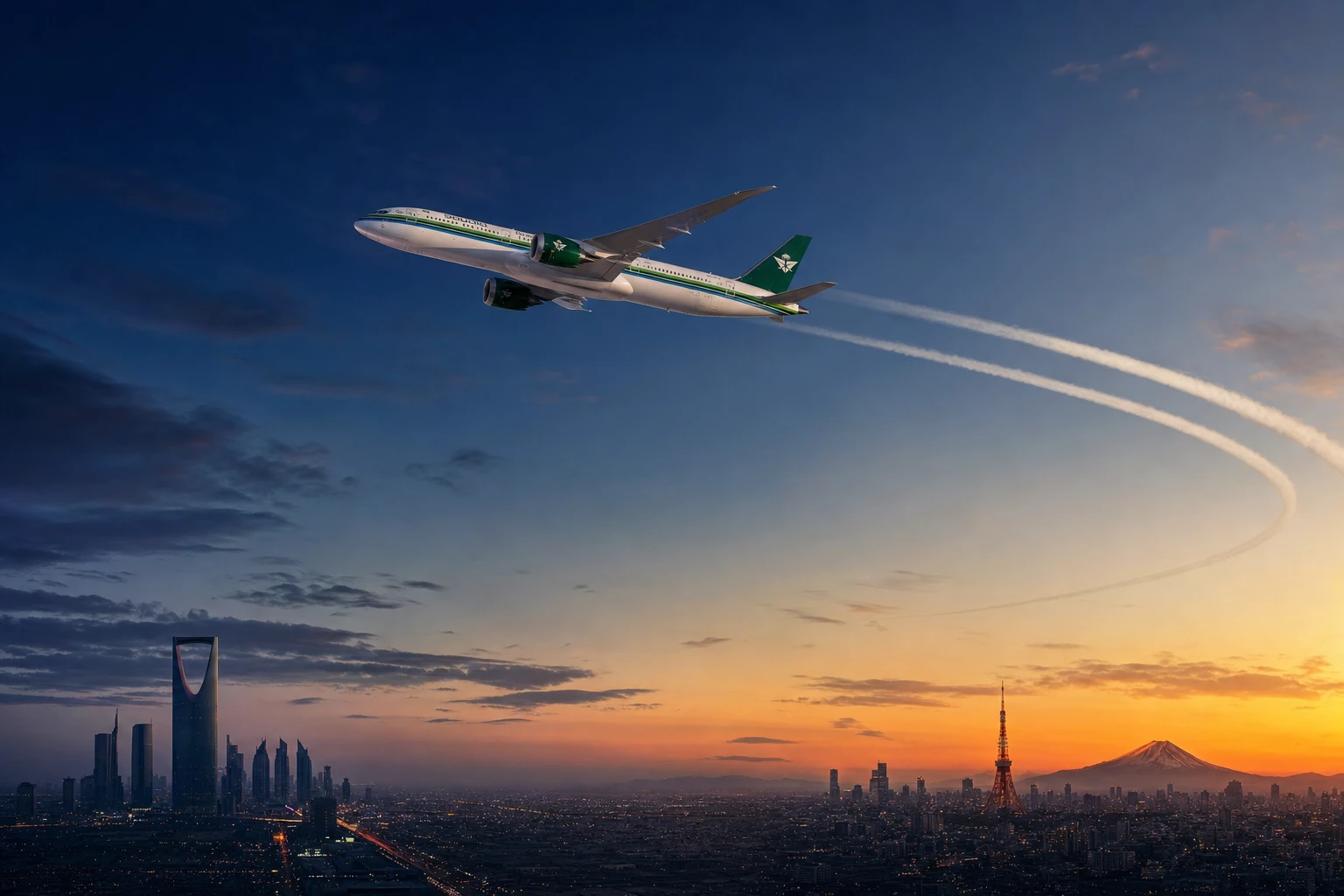
A Route Timed to the Air Connectivity Program and a Football Deadline
Saudia framed the new destination as more than a scheduling update. In a written statement announcing the route, the airline said the following.
The addition of Tokyo carries strategic importance beyond traditional air connectivity. It creates a new bridge between Saudi Arabia and Japan, supporting the growing relationship between the two countries and their people.
The route also advances three government plans running in parallel: the National Aviation Strategy, the National Tourism Strategy and Vision 2030. All three share one aim, positioning Saudi Arabia as a global tourism and logistics hub.
The timing is not incidental. The launch lands ahead of Saudi Arabia’s first hosting of the AFC Asian Cup, set for January 7 to February 5, 2027, when the kingdom welcomes 24 national teams across eight stadiums in Riyadh, Jeddah and Al Khobar. “The local organizing committee is committed to delivering an exceptional edition of the Asian Cup that meets the high expectations of football fans across the continent,” said Yasser Al Misehal, president of the Saudi Arabian Football Federation. Gulf Research Center commentary on the kingdom’s sports strategy points to stronger ties with Asian nations including Japan as one dividend of hosting the tournament.
Who Actually Fills These Seats
The route is built around four groups of travelers in particular.
- Japanese leisure travelers heading to AlUla, the Red Sea coast and Riyadh’s heritage sites
- Saudi business travelers and investors working Tokyo’s commercial districts
- Football fans and federation staff traveling ahead of the Asian Cup
- Gulf-based passengers who previously connected through Dubai, Doha or Istanbul
For that last group, the new nonstop removes a connection entirely, giving Saudi and wider Gulf travelers a same-carrier option to Japan for the first time in years. The Saudi Tourism Authority is also working with Japanese travel agencies to build packages around the new schedule.
Saudi Arabia Flew This Exact Route Before
This is not Saudia’s first attempt at the Japanese market. The airline’s own historical route records show it once ran sustained service to both of Japan’s major business centers.
- Before 2022: Saudia operates direct flights to Tokyo Narita and Osaka Kansai.
- Around 2022: Both Japan routes are discontinued.
- September 2026: Saudia runs a brief passenger service to Osaka, testing the market ahead of a bigger commitment.
- November 17, 2026: Riyadh-Tokyo Narita restarts as a standing three-times-weekly service.
The gap between the 2022 exit and this year’s return spans a period when long-haul demand across the industry swung sharply, and when Saudi Arabia’s own tourism ambitions expanded far beyond what they were the last time these routes ran.
Saudia’s Monopoly Has a Shelf Life
Saudia’s network keeps growing underneath this single route. The airline serves more than 100 destinations across four continents with 153 aircraft today and has 112 new aircraft on order to expand further.
Deliveries are already moving. Twelve new aircraft arriving through 2026 should push the fleet toward 161 planes by year end, Saudia Group Director General Ibrahim Al-Omar said. “In a highly competitive aviation sector, modernising and growing the fleet must be guided by clear market insight, network requirements, and alignment with national priorities under Saudi Vision 2030,” Al-Omar said.
That growth fits a longer pattern. Saudia Group, which also owns budget carrier flyadeal, said last year it would add 191 aircraft over seven years, more than doubling a 168-plane base and pushing its combined network past 145 destinations by 2030. Chief Marketing Officer Khaled Tash said the group would receive over 100 new aircraft in 2026 and 2027 combined, calling that pace roughly a new plane every week.
Tash was also asked about Riyadh Air, the kingdom’s newly launched premium carrier and a direct sibling in the same Vision 2030 aviation push. “Even with Saudia doubling its fleet and pursuing all its ambitious growth plans there is sufficient demand for both airlines to operate successfully,” he said.
The Seven Weeks Between Takeoff and Kickoff
Riyadh Air’s own ambitions add a wrinkle to Saudia’s current exclusivity on this route. The carrier launched its first commercial flight to London on July 1, 2026, and has named Japan among the major global markets its network eventually wants to reach on the way to a stated goal of more than 100 destinations by 2030.
For now, the calendar belongs to Saudia. Between the November 17 launch and the Asian Cup’s January 7 opening match sits a window of about seven weeks, the stretch in which Saudia and its tourism partners will find out whether three flights a week are enough to move fans, sponsors and business travelers into the kingdom before the whistle blows.
Frequently Asked Questions
Can travelers already book tickets for Saudia’s new Tokyo route?
Yes. Tickets for the Riyadh-Narita service are already for sale through Saudia’s website and authorized travel agents, months before the November 17 start date.
Is Saudia the only airline flying nonstop between Saudi Arabia and Japan?
Yes, for now. Schedule data tracked by CAPA, the Centre for Aviation, shows no other carrier currently operates a direct route between the two countries, though that could change as Gulf and Japanese airlines keep expanding their own networks.
Which Tokyo airport will Saudia use, and how far is it from downtown?
Flights land at Narita International Airport’s Terminal 1 rather than the closer Haneda Airport. Narita sits roughly 60 to 90 minutes from central Tokyo by train.
Do Japanese and Saudi travelers need a visa to use the new route?
Japanese visitors generally need an eVisa or visa on arrival to enter Saudi Arabia, while Saudi nationals need an electronic visa to enter Japan. Requirements can change, so travelers should confirm with each country’s authorities before booking.
Has Saudia flown to Japan before this relaunch?
Yes. The airline previously served Tokyo Narita and Osaka Kansai directly before dropping both routes around 2022, then tested the market again with a brief Osaka passenger service in September 2026 ahead of this sustained relaunch.
