
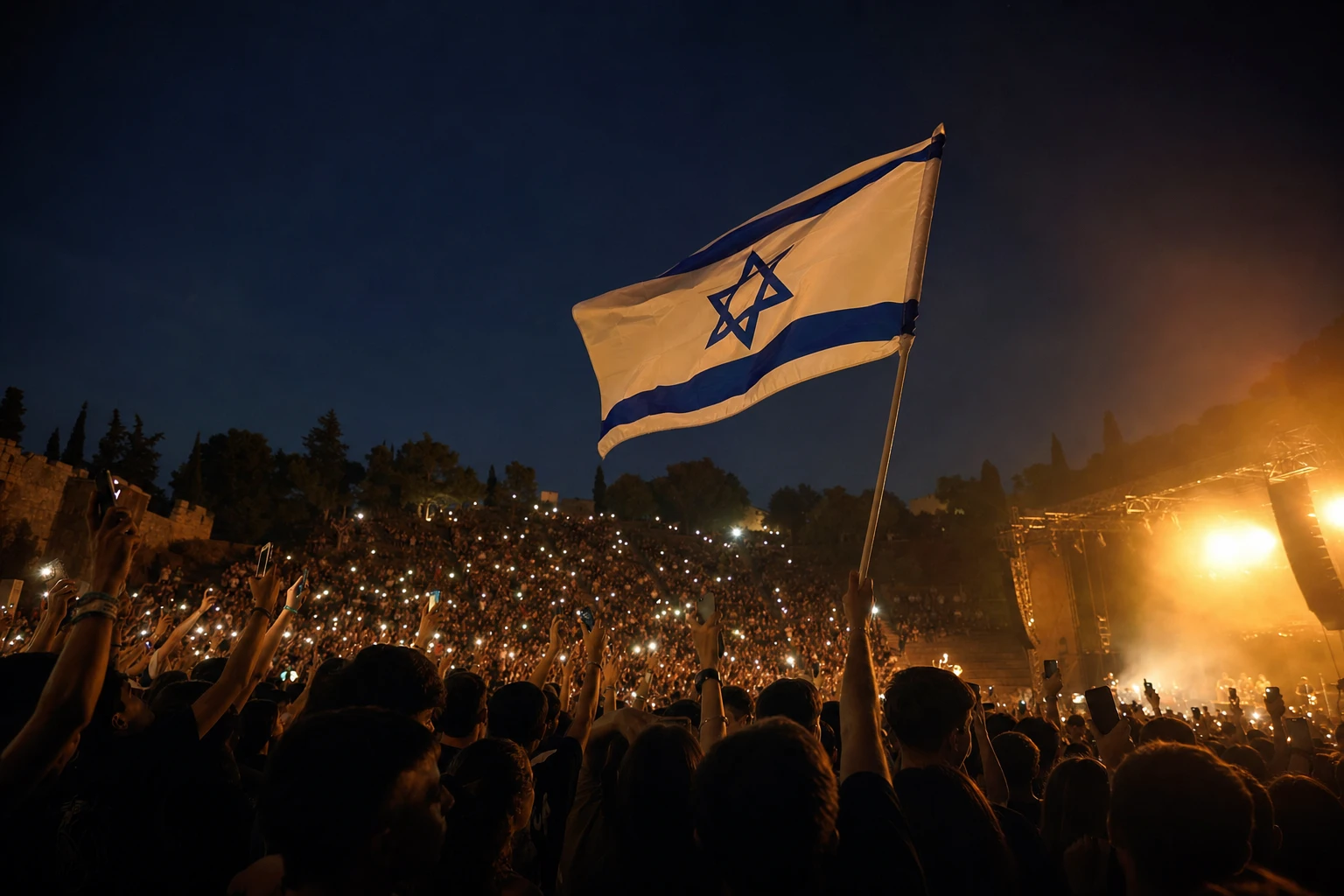
Nearly 5,000 Jewish teenagers from the United States, Canada and Israel packed Rishon Lezion’s Live Park on Sunday for RootOne’s Big Tent event, the biggest crowd the gathering has drawn in its five years and the first since Hamas’s October 7, 2023, attack forced organizers to shut it down. Roughly 4,000 came from North America, joined by about 500 Israeli peers, according to organizers and multiple attendees on site.
RootOne built the event on a wager made years before the war: that a friendship formed in person with an Israeli teenager outlasts an argument absorbed on a phone screen. Sunday’s turnout, set against fresh survey data on rising antisemitism aimed squarely at young Jews, suggests that wager is paying off.
Live Park Fills Up for the Biggest Crowd Yet
Thousands filled the amphitheater outside Tel Aviv as the sun went down, part of RootOne’s summer cohort of teens on multi week travel programs across Israel. RootOne is a Jewish teen Israel travel initiative run through The Jewish Education Project, and Big Tent is its signature yearly reunion for kids scattered across dozens of separate trips.
“The Big Tent event is an opportunity for teens to feel like they’re connected to something bigger,” said Nadav Shachmon, RootOne’s director of Israel partnerships. “They’re not just wandering Jews around the world. You know it, but to come here, you feel it.”
Shachmon said the energy teens absorb at the event travels home with them, aimed at a very specific problem. “They might be the only Jew in class,” he said. “This experience really makes you feel you’re not alone, you’re part of something bigger, and you have to hold it in your heart.”
Around the park, teens packed care kits for children of Israel Defense Forces (IDF) reservists, met Israeli pen pals face to face for the first time and traded contact information before flying home. “We are packing for children of families who are in the IDF reserves so those kids can have toys while their parents are away,” said Evan, a teen on the Ramah Israel Seminar trip.
Sofia, an American teen from Florida traveling with Young Judaea Gesher, said the bond formed fast. “The Israelis have genuinely become like my family, and we just met a few days ago,” she said. Ella, her Israeli counterpart from Holon, agreed. “I’ve learned a lot about Americans, and it’s really fun to meet people who are different from me,” Ella said.
Why Is This the First Big Tent Since 2023?
Big Tent hasn’t happened since the summer before the Hamas attack because war kept interrupting it. October 7 triggered evacuations and canceled trips that year, then a nearly two year gap. Israel’s 12 day war with Iran in 2025 delayed the comeback again, just as programs were trying to rebuild the in person meetups between American and Israeli teens.
That timing matters more given where Diaspora Jewish teens have landed since 2023. Isaac, on the Young Judaea Gesher trip, said he already had Israeli friends back home, but that it’s rare that seeing them does not require someone to “travel 1000 miles plus” to do it face to face. Shir Greenberg, a Texas teen who co-emceed the event, told The Jerusalem Post the night reminded her why the country still matters to her personally.
“It was such a privilege being able to co-host such an important, inspiring event,” Greenberg said. “I was reminded of the true importance of going to Israel and why Israel is so important to the Jewish people.”
The instinct behind Sunday’s crowd echoes what drew a Colel Chabad leader’s call for every Jew to keep a living tie to Israel at an earlier Jerusalem Post gathering: that the relationship has to be personal, not theoretical, to survive. It also runs against a documented headwind. At a Jewish Federations of North America conference last November, presenters cited data showing 65% of Jews under 40 feel morally conflicted over Israel’s actions, even as many of that same generation showed up in greater numbers to synagogues and Jewish events after October 7.
A Program Interrupted by War, Three Times Over
RootOne’s growth curve has never been a straight line. It has instead moved in bursts, each one cut short by conflict and then rebuilt larger than before.
| Year | Teen Turnout at Big Tent | What Was Happening |
|---|---|---|
| 2022 | 2,300 North American teens | First large Big Tent as pandemic era travel restrictions eased |
| 2023 | About 4,000 North American teens, including 95 from Arizona | Last Big Tent before the war, held that July |
| 2024 to 2025 | No Big Tent held | Fallout from October 7, then Israel’s 12 day war with Iran disrupted teen travel again |
| 2026 | About 4,000 North American teens plus 500 Israeli peers | First Big Tent since 2023, billed as the first since the war began |
The 2025 disruption hit a part of the program organizers consider irreplaceable: the in person meetup, or mifgash, between American and Israeli teens. Roughly 1,000 teens who canceled Israel plans that summer left a gap RootOne tried to patch with alternate destinations, before finally staging Sunday’s full reunion in Israel itself.
Ike Diamond, a Houston teen who co-emceed the evening as a BBYO participant, put the recovery in blunt terms. “One of the things we have seen since Oct. 7 is the power of community. People are showing up, reaching out and choosing not to look away. That is the power of this Big Tent,” Diamond said.
David Bryfman, CEO of The Jewish Education Project and RootOne’s interim executive director, framed the night as evidence for the program’s original thesis. “When young Jews from North America and Israel get to know one another as people, not headlines, they build trust, empathy and a shared future,” Bryfman said.
The Antisemitism Numbers Behind the Bet
RootOne was seeded by the Marcus Foundation with a specific worry in mind: that Diaspora teens heading into college were unprepared for what waited there. New data released this year backs up the concern.
- 42% of Jewish college students said in a February 2026 survey that they personally experienced antisemitism during their time in school, up from 35% a year earlier.
- 48% of non-Jewish students reported witnessing or engaging in anti-Jewish behavior over the past year, according to a companion campus survey.
- 58% of the 150 colleges assessed in a 2026 campus report card earned top grades for policy, up from just 23.5% two years earlier, even as day to day student experience lagged behind.
- Nearly two-thirds of Jewish Americans overall say they feel less safe than they did a year ago.
The 42% of Jewish students reporting antisemitism figure comes from a joint study by the American Jewish Committee (AJC) and Hillel International, the campus organization that absorbs many RootOne alumni once they reach college. The nearly half of non-Jewish students witnessing anti-Jewish behavior finding comes from ADL (the Anti-Defamation League), which tracks both campus policy and campus climate separately, and found the two do not always move together.
What a $3,000 Voucher Actually Buys
RootOne does not run trips itself. It funds them, working through roughly 40 trip provider partners that range from youth movements to residential camps.
- BBYO, the international Jewish teen movement that sent Ike Diamond to Israel and co-emcee duty.
- NCSY, the Orthodox Union’s teen network, which sent Shir Greenberg on her summer program.
- Hillel, Taglit, Masa and Young Judaea, longtime Israel trip and gap year providers now folded into RootOne’s voucher system.
A RootOne voucher covers $3,000 of a trip lasting three weeks or more, or $2,000 for a shorter two to three week program, against an average total Israel trip cost of roughly $10,000. Luke Jaffee, a BBYO participant from Boca Raton, Florida, said the subsidy is the difference for a lot of families.
“There are thousands of teens out there, and I am sure that if there were not RootOne and the $3,000 voucher, there would be far fewer people who would have the opportunity to go to Israel,” Jaffee said. BBYO’s own summer program page confirms vouchers open to 2026 graduating seniors for the first time this year, a small eligibility expansion layered on top of the usual 9th through 11th grade pool.
A Former Hostage Explains Why She Keeps Talking
The night’s most charged moment came when Moran Stella Yanai took the stage. She was kidnapped from the Nova Music Festival on October 7, 2023, and held hostage in Gaza for 54 days before her release.
Resilience, I don’t think that it’s something that you can teach.
Yanai told the crowd resilience has to be found, not taught, and that she draws hers from faith and from the Jewish people, whom she called the “big lion” standing behind her. Earlier in the evening, Daniel Weiss, a musician and survivor of Kibbutz Be’eri whose parents were murdered on October 7, performed for the same crowd.
President Isaac Herzog appeared by video message from the stage, tying the individual stories to a wider charge. “And may it leave you with the courage to fight what really matters, even when it is difficult, to fight for our people, for Israel, and for a world of justice, democracy, and peace without antisemitism,” Herzog said.
The Campus Test Waits This Fall
Big Tent ends and these teens scatter back to roughly a thousand different high schools and, soon, college campuses. That is where RootOne’s bet gets its real test, and where the numbers get less comfortable.
Jewish Americans between 18 and 29 report the sharpest exposure of any age group. Young Jews report the sharpest antisemitism spike, with 47% saying they were personally targeted in the past year, compared with 28% of Jewish Americans 30 and older.
That gap is exactly why organizers keep returning to the same phrase: peoplehood over politics. It is the same impulse that drew thousands to Tel Aviv for an Oct. 7 memorial mourning the hostages months earlier, translated into a summer concert instead of a vigil. By September, most of Sunday’s crowd will be back in American classrooms, testing whether one night in Rishon Lezion travels as far as the program’s funders hope.
Frequently Asked Questions
What Is RootOne?
RootOne is a Jewish teen Israel travel initiative run through The Jewish Education Project, launched in September 2020 with seed funding from the Marcus Foundation, founded by Home Depot co-founder Bernie Marcus. It gives eligible teens vouchers toward an immersive Israel trip and requires pre-trip and post-trip learning through its own online portal.
How Much Does a RootOne Voucher Cover?
RootOne offers a $3,000 voucher for trips of three weeks or longer and $2,000 for trips of two to three weeks, against an average total Israel trip cost of about $10,000. For summer 2026, the program opened vouchers to graduating high school seniors for the first time, in addition to the usual 9th, 10th and 11th grade pool.
How Is RootOne Different From Birthright Israel?
Birthright sends young adults after high school on free 10 day trips to Israel. RootOne targets current high schoolers, in 9th through 12th grade, on longer subsidized trips of two weeks or more. Birthright’s own attendance peaked at more than 48,000 participants in 2018 before falling to roughly 35,000 by 2022.
Who Performed at the Big Tent Event?
Noam Bettan, runner up at the 2026 Eurovision Song Contest, headlined the show. Daniel Weiss, a survivor of Kibbutz Be’eri whose parents were murdered on October 7, also performed. The venue, Rishon Lezion’s Live Park, regularly hosts major touring Israeli acts on nights when RootOne isn’t there.
Why Wasn’t There a Big Tent Event in 2024 or 2025?
The Hamas led attack of October 7, 2023, and its aftermath halted the gathering entirely. In 2025, Israel’s 12 day war with Iran added a second disruption, after the Israeli Education Ministry barred independent youth delegations from traveling abroad, a directive that stayed in effect into late July of that year.
