
Three Iranian missiles landed inside Jordan early Sunday without causing casualties, the Jordanian Armed Forces said, in the kingdom’s third reported strike of July alone. Iran’s Islamic Revolutionary Guard Corps claimed it had hit a US military facility at Prince Hassan Air Base with ballistic missiles, and listed Jordan among five Gulf states it attacked overnight. The barrage followed the US Central Command’s third consecutive night of strikes against Iran, which CENTCOM said hit about 140 military targets.
What changed overnight was the scale. CENTCOM said its three-night campaign has now struck more than 300 targets inside Iran, after Tehran closed the Strait of Hormuz and fired on a Cyprus-flagged container ship, leaving one civilian crew member missing. Bahrain, Kuwait, Qatar, Oman and the UAE each reported Iranian missiles or drones crossing their airspace on Saturday and Sunday. Qatar said three people, including a child, were injured by falling debris from interceptions. Jordan’s Royal Engineering Corps teams were sent to the impact sites to secure missile remnants, and the armed forces said they remained at the highest level of readiness.
Three Missiles Land Inside Jordan
Inside Jordan, the night of July 12 began with three Iranian missiles landing at separate locations across the kingdom, a military source at the General Command of the Jordan Armed Forces told state media. The source said the strikes caused only minor material damage and no deaths or injuries. Royal Engineering Corps teams were dispatched to the impact sites to secure the areas and dispose of missile remnants in line with approved technical procedures. The military said it would respond firmly to any further threat to the country’s sovereignty.
Amman framed the incident as a violation it would not absorb quietly. The General Command warned that Jordan’s airspace and territory would not be allowed to become an arena for conflict threatening its security and stability. All military formations and units remain at the highest level of readiness, the source added. Jordan’s state news agency, Petra, reported the damage as limited to minor material losses. The kingdom did not directly attribute the strikes to Iran in its initial statement, but said the missiles had been launched from Iranian territory, per the army’s account of the missile landings.
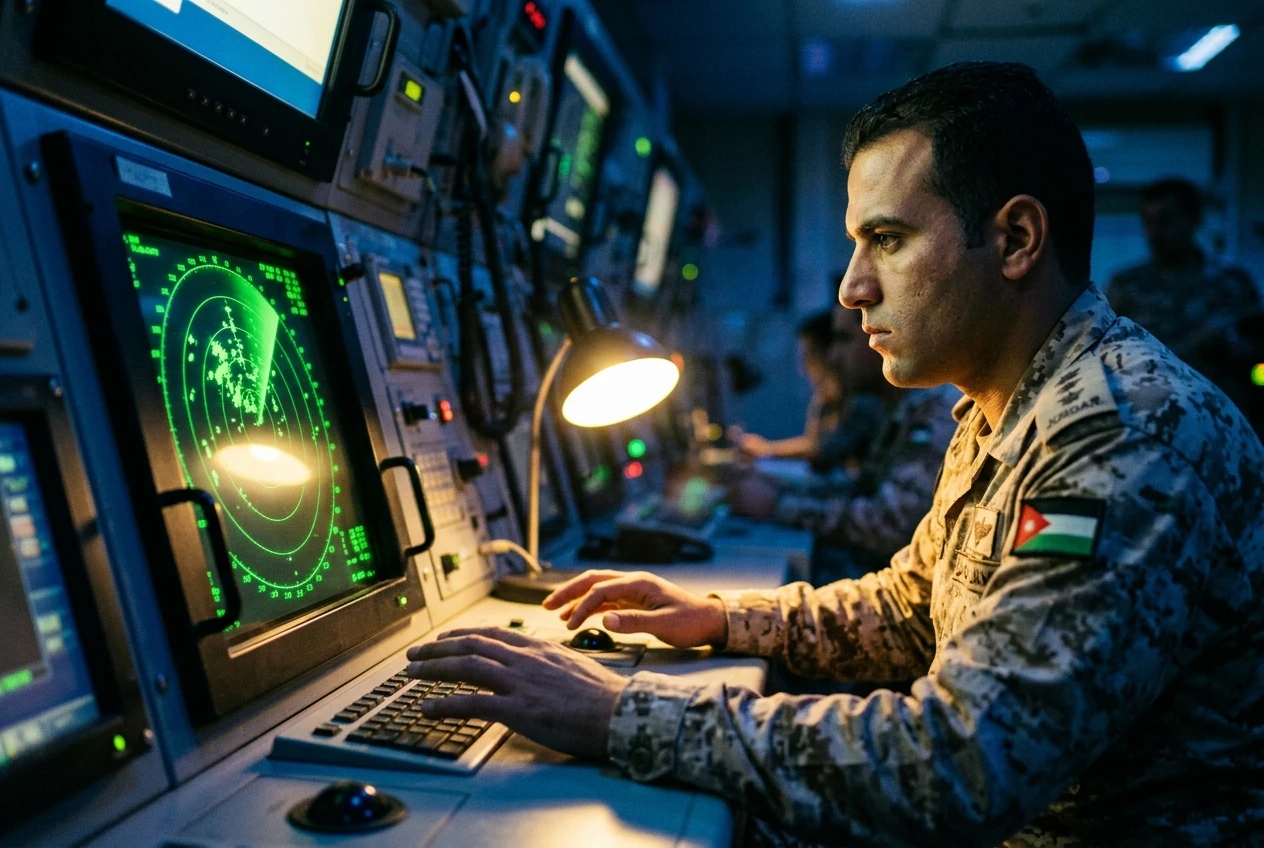
Tehran Claims a Prince Hassan Strike
Iran’s state-affiliated media and the IRGC told a different story. The Guards said they had targeted US military facilities at Prince Hassan Air Base in Jordan with several ballistic missiles, claiming to have destroyed a command-and-control center and hangars housing MQ-9 drones. They cast the attack as retaliation for US strikes on Iranian cities along the southern coast.
The era of one-sided deals is over. We told you: keep your word or pay the price. Reality is knocking.
That line came from Mohammad Bagher Ghalibaf, Iran’s parliament speaker and a key negotiator in past US-Iran talks, who posted it on X alongside an image of Article 5 of the MoU, the section on reopening the strait.
Tehran made parallel claims against four other US-hosting states. It said it had struck logistics support centers and refueling platforms used by US aircraft carriers at the port of Duqm in Oman, calling those sites destroyed in statements carried by state broadcaster IRIB. In Qatar, the IRGC said it had hit the Al Udeid airbase with ballistic missiles and claimed to have destroyed a fighter-plane maintenance center and a command-and-control facility there. Iran’s army separately said it had used explosive drones against a Patriot air defence system, an ammunition depot and a radar site belonging to the US military in Kuwait. Bahrain, the IRGC added, was hit with drone attacks on US communications and radar systems.
Iranian officials framed the multi-country barrage as a single retaliatory act. The IRGC’s public relations office told IRIB that the Duqm logistics sites were “destroyed.” None of those destruction claims have been independently verified on the ground, and Jordan’s military made no reference to Prince Hassan Air Base being struck in its own statement. The gap between Tehran’s account and Amman’s leaves the actual outcome at the base uncertain, a pattern visible across the wider picture of Iranian claims against five Gulf states in a single night.
CENTCOM’s Third Night of Strikes
As punishment for an attack on commercial shipping, US Central Command framed the latest round. The command said its forces completed a third round of strikes against Iran in the week ending July 12, hitting approximately 140 military targets in response to what it described as Tehran’s attack on the M/V GFS Galaxy, a Cyprus-flagged container ship. The strikes used precision-guided munitions launched from land-based and sea-based fighter aircraft, drones and naval vessels, the command said. Targets included Iranian missile and drone sites, naval capabilities, ammunition storage facilities, communication networks and coastal surveillance locations.
| Country | What local authorities reported on July 12 |
|---|---|
| Bahrain | Air raid sirens activated; drone attacks targeted US communications and radar sites |
| Kuwait | Army said it was responding to hostile aerial targets; explosions came from intercept operations |
| Qatar | Three people including a child injured by falling debris from interceptions |
| Oman | Drone attacks reported in northern Musandam governorate; authorities condemned the strikes |
| UAE | Air defence intercepted ballistic missiles, cruise missiles and unmanned aerial vehicles |
| Jordan | Three Iranian missiles landed; no casualties, minor material damage |
The three-night total now exceeds 300. CENTCOM said in a post on X that “During three nights of strikes this week, CENTCOM has struck more than 300 targets at the direction of the Commander in Chief to degrade Iran’s ability to attack civilian mariners and commercial vessels freely transiting the strait.” Iran has rejected US allegations of attacking commercial vessels, saying its military operations were carried out in response to US strikes inside Iran. Tehran said the loss of lives and the extent of damage from the US campaign were under review, per CENTCOM’s statement on the latest strikes.
Five Gulf States Caught in the Barrage
Overnight, the barrage spread across at least five Arab states that host US military assets. Iran claimed attacks on Bahrain, Kuwait, Jordan, Qatar and Oman as a single response to renewed US bombings along Iran’s southern coast. The UAE also reported interceptions of Iranian missiles and drones on Saturday.
Reactions ranged from condemnation to air-raid sirens. Qatar said the attacks were a “flagrant violation of the sovereignty and territorial integrity” of its territory and a “blatant breach of international law,” and raised its internal security threat level to high. Kuwait’s army said its forces were responding to hostile aerial targets in the country’s airspace, with the sounds of explosions coming from its own defence systems intercepting attacks. Bahrain’s Interior Ministry activated air-raid sirens and urged residents to remain calm. Oman’s state news agency reported drone attacks targeting sites in the northern governorate of Musandam and condemned the assault, even as it had hosted Iran’s foreign minister the previous day to discuss shipping through the strait.
Each state drew a different line at what it would acknowledge. The UAE’s Ministry of Defence said its air defense systems engaged Iranian missile and drone attacks, with sounds heard across parts of the country coming from intercepting ballistic missiles, cruise missiles and unmanned aerial vehicles. Qatari authorities did not confirm the IRGC’s claim to have destroyed a fighter-plane maintenance center at Al Udeid airbase. Bahrain, Kuwait and Oman reported attacks but did not detail damage assessments by midday Sunday.
What Iran said it hit, by country:
- Oman: Logistics support centers and refueling platforms at Port of Duqm
- Qatar: Al Udeid airbase; a fighter-plane maintenance center; a command-and-control facility
- Kuwait: A Patriot air defence system; an ammunition depot; a radar site
- Bahrain: US communications system; a radar site
- Jordan: Prince Hassan airbase; a command-and-control center; MQ-9 hangars
Jordan’s Impossible Geography
Jordan sits between Israel, Iraq and Saudi Arabia, a position that has repeatedly exposed it to missiles and drones crossing regional airspace during periods of heightened conflict. The kingdom has sought to avoid direct involvement in the widening confrontation between the United States and Iran, a posture it has held since the start of the 2026 Iran war in late February. Its leaders have made a public bet that staying out of the fight is cheaper than joining it.
The 2026 record shows how often that corridor turns into a target. On July 9, Iran fired 10 ballistic missiles at the Muwaffaq Salti Air Base in Azraq; Jordan said eight were intercepted with no casualties. In March, the Jordanian military said Iran launched 119 missiles and drones directly at Jordanian sites in a single week, and 108 were intercepted. The repeated pattern is documented in the full timeline of Iran’s strikes on Jordan in 2026.
The repeated strikes have not changed Amman’s public stance. Jordan’s military has framed each incident as a defensive matter handled by its own air force, with no public call for US troops or Iranian retaliation. The June 10 and June 11 strikes on the Azraq area and Muwaffaq Salti Air Base were met with the same brief, technical statement. That pattern suggests the kingdom’s strategy is to absorb each round, log the intercepts, and avoid any rhetoric that would drag it deeper into the fight. With three missiles now landed on Jordanian soil in July, the cost of that posture is harder to disguise.
Earlier Iranian and Iranian-aligned strikes inside Jordan had heavier consequences. On March 1, Iranian missiles and drones hit a Bundeswehr field camp in eastern Jordan, and on March 4 two drones crashed in Jordanian territory, one of them in Azraq, wounding a girl and damaging nearby homes. By March 19, Bloomberg reported that a US General Atomics MQ-9 Reaper drone had been destroyed on the ground in Jordan by Iranian attacks. The same year also saw an Iranian drone strike on the US Embassy compound in Riyadh that hit the CIA station inside the compound. The pattern now stretches across more than four months and at least three distinct Jordanian bases, a toll no official framing has summed up.
Why the Ceasefire Died This Week
Behind the latest round is a collapsed US-Iran memorandum of understanding. US President Donald Trump announced on Wednesday that the ceasefire with Iran was over. Iran’s Supreme Leader Mojtaba Khamenei, who succeeded his father after his killing, pledged to avenge it. Within days, the IRGC said it had struck three commercial vessels in the Strait of Hormuz, including a Qatari LNG tanker off the coast of Oman, and the tit-for-tat resumed.
Our current military strikes will produce very little against Iran. If they are meant to show the Iranians the cost of attacks again at ships, they will fail. Iran’s leaders think they gain more from their attacks since they show control of the Straits.
That assessment came from Dennis Ross, a former US Middle East envoy, writing on X on Saturday.
The IRGC announced the closure of the Strait of Hormuz on Saturday night after attacking a Cyprus-flagged container ship using what it called an unapproved route. On Sunday, a second vessel was hit. The strait will remain closed, the IRGC said, until the end of US interference in the region.
Iran’s parliament speaker Ghalibaf drew the line in sharper terms. He posted on X that “The era of one-sided deals is over” and shared an image of Article 5 of the US-Iran MoU, the section on the reopening of the strait. Iranian officials told state media the US military has been trying to create an “illegal route” through the strait, causing insecurity in the area. The US and the Gulf Cooperation Council countries have rejected Iran’s claim on the strait and demanded that navigation be freed of interference or any sort of fees. Tehran has insisted only routes it approves should be used during transit, and has said it is open to managing the strait only with Oman, the other coastal country. The shift in tone tracks with Jordan’s July 7 condemnation of the Damascus bombings during Macron’s Syria visit, the same week the kingdom was absorbing Iranian missiles at home.
The Strait of Hormuz Problem
The shipping lane at the center of the crisis carries about a fifth of global energy flow. CENTCOM said commercial vessel transits through the strait continued even after Iran’s closure announcement, and the command added a tally of how much traffic it has shepherded since early May. US forces had facilitated the passage of more than 800 commercial vessels carrying about 400 million barrels of crude oil through the strait since early May, according to CENTCOM. Iran’s Revolutionary Guard Navy said the strait would remain closed until the end of US interference in the region.
The numbers behind the latest round:
- 140 Iranian military targets hit in CENTCOM’s third round
- 300+ Iranian targets hit over three nights, per CENTCOM
- 800+ commercial vessels facilitated by CENTCOM since early May
- 400 million barrels of crude oil carried through the strait since early May
- 1 civilian crew member missing from the M/V GFS Galaxy
Iranian Foreign Minister Abbas Araghchi landed in Oman on Saturday to discuss shipping and management of the waterway. Iran’s argument is that only routes it approves may be used during transit, a claim the US and the GCC countries reject. The IRGC commander-in-chief, Brigadier General Ahmad Vahidi, said on Saturday that Iran’s demand for revenge over what he called US-Israeli aggression would remain a lasting priority. With Jordan now in its third reported strike of the month and the strait shut on paper, the corridor that ties Iran’s hold on global oil flows is also the one pulling more Arab states into the line of fire.
Frequently Asked Questions
Did anyone die in Jordan from the Iranian missiles?
No. The Jordan Armed Forces said the three Iranian missiles that landed on July 12 caused only minor material damage and no deaths or injuries, and Royal Engineering Corps teams were dispatched to the impact sites.
What is Prince Hassan Air Base?
Prince Hassan Air Base is a Jordanian airbase the IRGC named as the target of its July 12 ballistic missile strike. Iran claimed to have destroyed the base’s command-and-control center and hangars housing MQ-9 drones; Jordan’s military made no reference to the base being hit in its own statement.
Why did Iran close the Strait of Hormuz?
The IRGC said the strait would remain closed until the end of US interference in the region. The closure followed an Iranian attack on the Cyprus-flagged container ship M/V GFS Galaxy and what Iran called a US-Israeli pattern of aggression.
How many Gulf states were hit overnight?
Iran claimed attacks on five states: Bahrain, Kuwait, Jordan, Qatar and Oman. The UAE separately reported intercepting Iranian missiles and drones on Saturday, and Qatar said three people including a child were injured by falling debris from interceptions.
Is there a ceasefire between the US and Iran?
No. US President Donald Trump said on Wednesday that the ceasefire with Iran was over. Iran’s Supreme Leader Mojtaba Khamenei pledged to avenge his father’s killing, and the exchange of strikes has continued since, with CENTCOM reporting more than 300 targets hit in three nights.
What did CENTCOM say it hit in Iran?
CENTCOM said its third round of strikes hit about 140 military targets including missile and drone sites, naval capabilities, ammunition storage facilities, communication networks and coastal surveillance locations. The command said more than 300 targets were struck over three nights.
