
Two improvised explosive devices tore through central Damascus on Tuesday, wounding at least 18 people on the second day of French President Emmanuel Macron’s first visit by a major Western leader to Syria since the fall of Bashar al-Assad in late 2024. Jordan’s Ministry of Foreign Affairs joined the cascade of diplomatic responses within hours, framing the blasts as terrorism and reaffirming its support for Syrian sovereignty and territorial integrity.
Syria’s Interior Ministry, which reported the casualty figures through state media, said four of the wounded were police officers and that no deaths had been immediately reported. The blasts hit near the Tourism Ministry and the Four Seasons Hotel, the building where Syrian media said Macron was meant to stay during his meetings with Syrian President Ahmed al-Sharaa. By Tuesday night, no group had claimed the attack.
What Hit Damascus on Tuesday
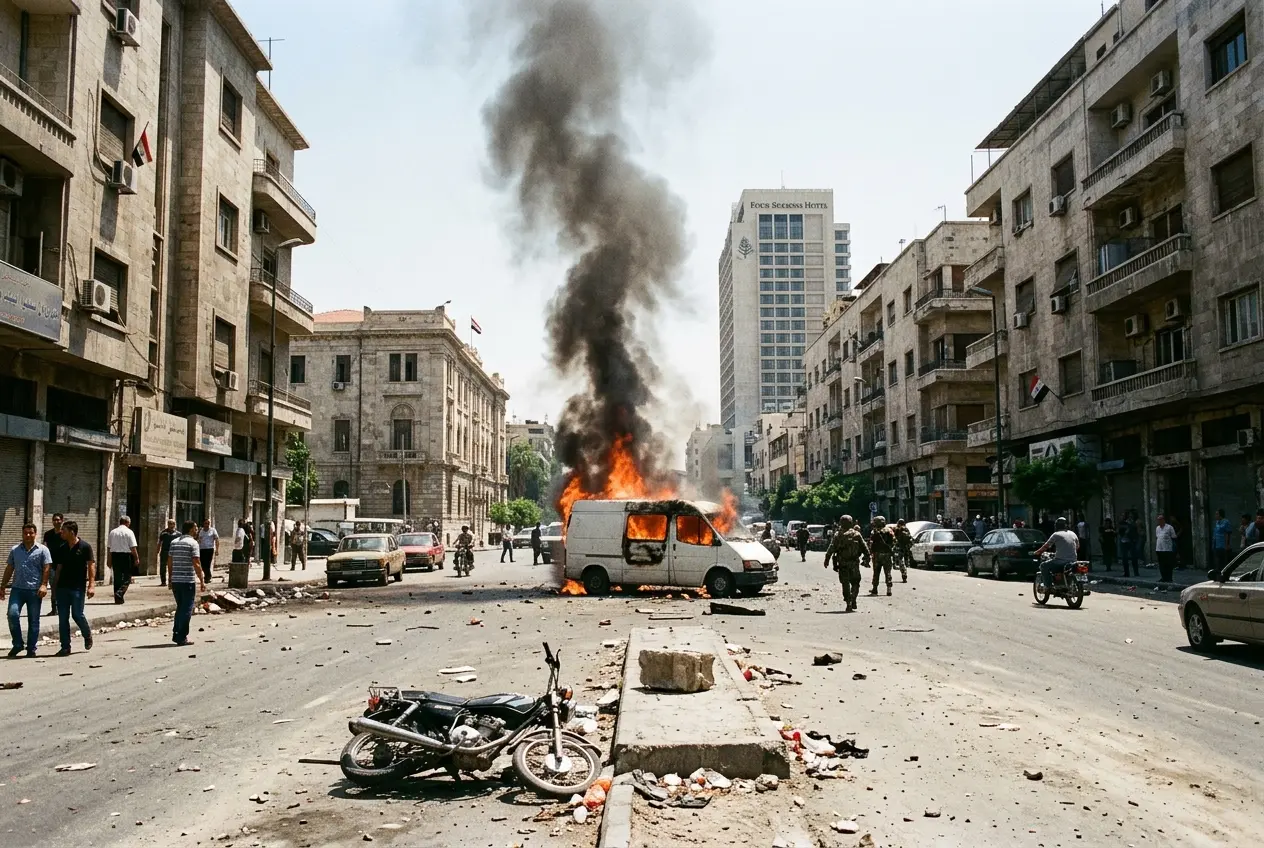
Two devices detonated inside the security perimeter set up for Macron’s visit, according to the Interior Ministry statement carried by Syrian state news agency SANA. One was concealed inside a vehicle parked along the roadside; the other was hidden in a trash container. The ministry said both explosives went off after security forces had located them and dispatched specialists to dismantle them, which suggests the blasts were triggered during the response rather than by remote timers.
Television footage showed plumes of smoke rising over the city, and Al Jazeera’s verified video showed a vehicle on fire in central Damascus. An Al Jazeera correspondent at the presidential palace described the situation as calm, with Macron continuing his scheduled programme. A security expert in Damascus told the network the targets were not yet clear. “It is clear that the aim is to create unrest,” Ismat al-Absi said, “and send a negative message.”
The geography of the attack placed it inside a security zone that had been sealed for the French president. Footage shared on social media and verified by multiple outlets showed a van and a motorcycle on fire and bloodstains on a busy street near the headquarters of the Tourism Ministry and the Damascus National Museum. Two improvised explosive devices were the working theory of the Syrian investigation by Tuesday evening.
Syria’s new rulers have wrestled with outbreaks of violence as they assert control, but the capital had been largely peaceful in the months since Assad fell. The blasts landed as the country’s most prominent Western partner was physically present in the city for the first time since 2012.
Damascus attacks, side by side
| Detail | July 2 cafe blast | July 7 twin blasts |
|---|---|---|
| Where | Cafe near the Palace of Justice, central Damascus | Near the Tourism Ministry and Four Seasons Hotel |
| Devices | One explosive device inside the cafe | Two improvised devices, one in a vehicle, one in a trash container |
| Killed | At least 10 | None reported immediately |
| Wounded | More than 20 | At least 18, including four police officers |
| Claim | None immediately | None immediately |
A Visit Built to Reset a Relationship
Macron had arrived in Damascus on Monday. The trip was the first by a European head of state to Syria since insurgent groups toppled Assad, and the first by any major Western leader. France had closed its embassy in Damascus in 2012 and only symbolically reopened it in early 2025.
The day’s programme was heavy with deliverables. Macron and al-Sharaa signed more than a dozen agreements with Paris and large French companies during the visit. One deal kicked off the process of returning some 51 million euros ($58.3 million) in illicit assets that had belonged to Rifaat al-Assad, the late uncle of the deposed ruler. Other agreements covered rebuilding water and electricity infrastructure in the city of Homs, technical assistance to Syria’s Central Bank, and capacity upgrades at cargo facilities at Damascus airport.
At a joint appearance after the blasts, al-Sharaa and Macron announced they had agreed to reappoint ambassadors after more than a decade without full-ambassador level representation. Macron was scheduled to fly to Ankara later Tuesday for a NATO summit that al-Sharaa was also expected to attend. PBS NewsHour’s account of the day placed the visit in the context of France’s push, alongside the United States, to drop most sanctions imposed on Syria under Assad.
Nothing can smother the aspiration of Syrian women and men to live in a fully sovereign, safe, pluralistic, and united Syria.
Macron’s office said the line came from the French president’s post on X, hours after the blasts.
Amman’s Statement, Word for Word
Jordan’s reaction came through Foreign Ministry spokesperson Ambassador Fouad Majali, the same official who speaks for the kingdom on regional security statements. The statement, carried by Ammon News and the state-run Petra news agency, used the word “terrorism” twice in three sentences and offered no caveats. “The Kingdom’s full solidarity with the government and people of the Syrian Arab Republic,” Majali said, “and its rejection of all forms of violence and terrorism aimed at destabilizing security and stability.”
Majali reiterated Jordan’s support for “Syria’s security, stability, sovereignty and territorial integrity, as well as the safety of its citizens.” The phrasing stops short of endorsing Syria’s new leadership by name, but it commits Amman to a position aligned with Damascus against any actor trying to destabilise the country.
The Larger Recalibration
The speed of Amman’s response fits a pattern that has built over eighteen months. Since Assad fell, Jordan has moved from careful distance toward Syria’s new authorities to a posture of open diplomatic engagement, even as it keeps a wary eye on its own northern border. The kingdom hosts large Syrian refugee populations and shares a long frontier that has been repeatedly tested by Israeli and Iranian-backed activity.
That posture is shaped by several regional pressures at once. Jordan’s diplomats have spoken out repeatedly against violence on Syrian soil this year, including denunciations of Israeli strikes on Syrian territory and of earlier bombings in Damascus. The consistent thread has been opposition to instability on Syria’s side of the border, regardless of who carries it out.
Macron’s visit gave Amman a reference point. Western re-engagement with Damascus reduces the pressure on Jordan to be the regional interlocutor with Syria, but it also means Amman has to declare its position more publicly. Tuesday’s statement did that, in language that can be read as solidarity with the new Syrian government. The Cairo-Damascus rapprochement brokered in Amman earlier this year points in the same direction, as Arab capitals have rebuilt ties with the post-Assad government one after another.
None of that closes the gap between Amman and Damascus. Border security, refugee returns, water-sharing, and the presence of Iranian-aligned militias inside Syria remain unresolved. The Tuesday statement was the public face of a position that will be tested in quieter moves over the weeks ahead.
The Bombing That Came First
Tuesday’s blasts were the second attack to shake Damascus in a week. On Thursday, July 2, an explosive device detonated inside a cafe in the Al-Hijaz area, near the Palace of Justice, killing at least 10 people and wounding more than 20. Syria’s health ministry updated the toll from nine to ten the following day. No group claimed that attack either.
At least 18 people were wounded in Tuesday’s blasts, including four police officers. Second attack in a week is the framing the Syrian government itself has put on the pair of incidents, and the framing that shaped the international response.
Earlier bombings have hit Damascus in 2025 and 2026. A suicide bombing at the Mar Elias Greek Orthodox Church on June 22, 2025 killed at least 25 people during Divine Liturgy and was followed by pledges of protection for Syria’s religious minorities from the new authorities. A March 2026 attack near the Palace of Justice courthouse killed dozens and was claimed by ISIS, according to regional press reporting at the time.
The numbers from Tuesday
- 18 people wounded, per Syria’s Interior Ministry
- 4 police officers among the wounded
- 2 improvised explosive devices, one in a vehicle, one in a trash container
- 0 deaths reported immediately
- 0 groups claiming responsibility by Tuesday night
What the Day Produced
For Syria, the immediate test is whether the government can keep its diplomatic calendar on track while its security services trace who planted the two devices. Macron’s continuation of his programme and the agreement to restore ambassadors suggest Damascus held the line on the day. The Interior Ministry told SANA the blasts took place “outside the security zone designated for the French President’s residence, and did not pose any direct threat to the residence or the official visit programme, which is proceeding according to the planned schedule.”
For Jordan, the test is whether its stated position of solidarity translates into coordinated action with Damascus. The Tuesday statement was the public face; what comes next will show up in border meetings and refugee file-shuffles rather than communiqués. A Syrian foreign ministry official, speaking anonymously to The Associated Press, said “attempts to destabilise the country will not alter this trajectory.” Tuesday’s blasts were an attempt. The diplomatic choreography of the same day was the reply.
