
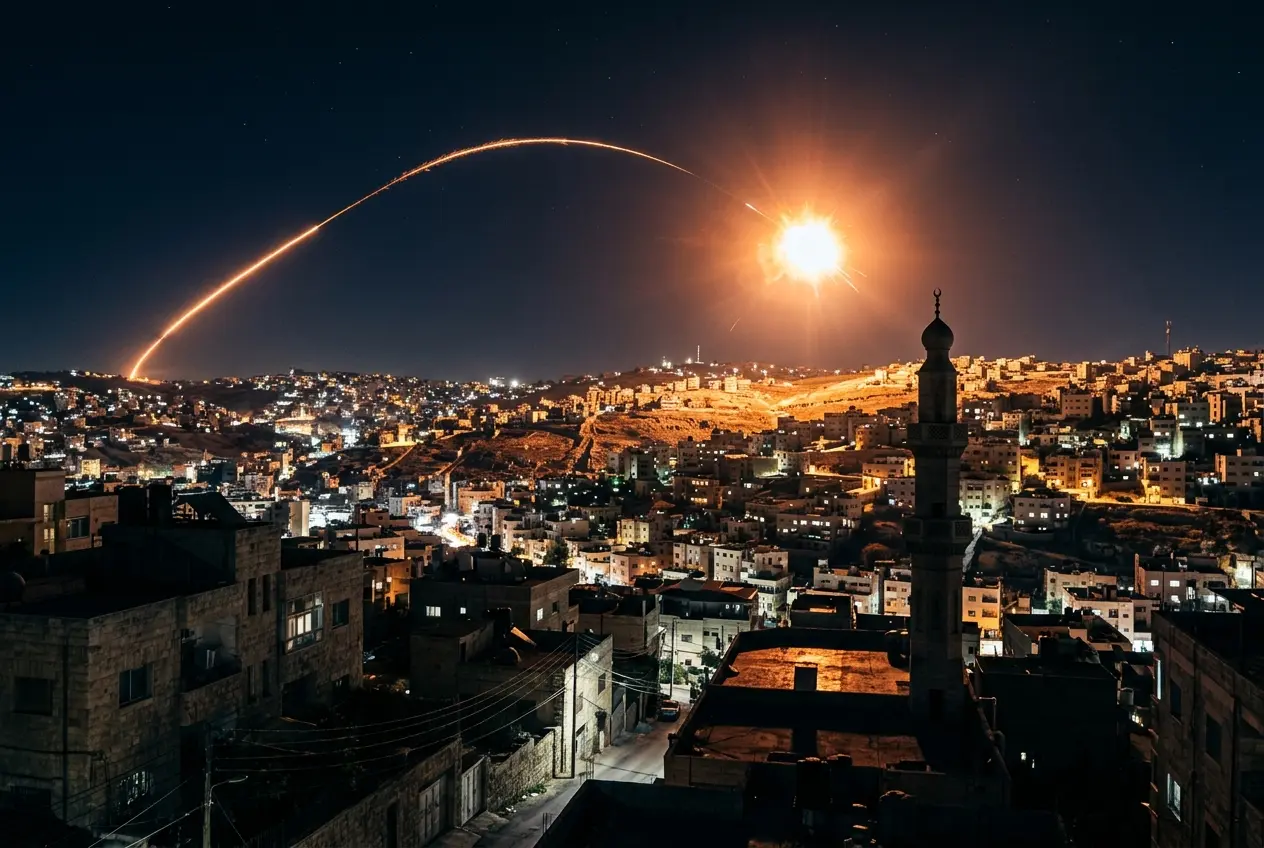
Iranian ballistic missiles have landed inside Jordanian territory for the first time in the 2026 war, the kingdom’s armed forces said on Sunday. Three projectiles fired from Iranian territory struck several locations inside the country in the early hours. No casualties were reported.
That disclosure came four days after Jordan’s air defenses intercepted eight of ten ballistic missiles launched from Iran toward the Muwaffaq Salti Air Base. Across three weeks of war, the Royal Jordanian Air Force says it has intercepted the vast majority of what came at Jordan. Civil defense teams have logged debris across cities from Irbid in the north to Aqaba on the Red Sea.
Three Missiles Land Inside Jordan
The military source at the Jordan Armed Forces General Command said three projectiles landed in several locations in the early hours of Sunday. Royal Engineering Corps teams were dispatched to the affected sites to handle missile debris and unexploded remnants. No injuries were reported, and damage was limited to minor material losses, according to the official QNA news agency.
Iran’s Revolutionary Guards said it had targeted critical military infrastructure at Prince Hassan Air Base, claiming to have destroyed the base’s command and control center and the hangars for MQ-9 drones. Jordan’s armed forces spokesman, Brig. Gen. Mustafa al-Hayyari, framed the strikes differently. The missiles and drones targeted Jordanian sites, he said, vital installations inside Jordanian territory, according to a briefing in Amman reported by The Media Line.
Four days earlier, on July 9, the Jordan Armed Forces statement on the July 9 intercepts said its air defenses had intercepted eight missiles launched from Iran toward the kingdom, with shrapnel falling in several areas and no injuries or material damage reported. The Iranian Revolutionary Guards said it had fired ten ballistic missiles at the Muwaffaq Salti Air Base. Anadolu Agency reported the strikes came amid escalating military exchanges between Iran and the US for a second consecutive day.
Three Weeks, 240 Projectiles
The cumulative tally is sharper than either day’s count. Across the war’s first three weeks, Iran and Iran-aligned militias fired 240 missiles and drones at Jordan, and the Royal Jordanian Air Force intercepted the vast majority of them.
The escalation has unfolded in almost weekly installments:
- February 28, 2026: 49 drones and missiles intercepted, including 13 ballistic missiles, on the day the 2026 war began
- March 7, 2026: 119 projectiles fired in week one, 108 intercepted by Jordanian defenses
- March 14, 2026: 85 missiles and drones in week two, 79 intercepted, with five drones and one missile landing inside Jordan
- June 11, 2026: 20 missiles intercepted at Azraq, no casualties reported
- July 9, 2026: 10 missiles at Muwaffaq Salti Air Base, 8 intercepted, no injuries
- July 12, 2026: 3 missiles land inside Jordan; Iran claims strike on Prince Hassan Air Base
June and July brought the largest single volleys. The June 11 barrage of 20 missiles was aimed at the Azraq area. The July 9 volley of ten missiles at Muwaffaq Salti was the next single-day peak. By Sunday, three projectiles were on the ground.
The Buffer That Did Not Hold
Jordan’s airspace had been part of the regional missile defense before. During the April 2024 Iran-Israel exchange, the Royal Jordanian Air Force intercepted Iranian drones and missiles crossing Jordanian airspace toward Israel, coordinating with the United States, the United Kingdom and France. Jordan repeated the role during the Twelve-Day War in June 2025. The line in both previous rounds was that Jordanian airspace was a corridor, not a target.
That framing is gone.
The missiles and drones targeted Jordanian sites, vital installations inside Jordanian territory.
Jordan had notified all parties before the war began that it would not serve as a battlefield, al-Hayyari said at a joint press briefing in Amman. The strikes came anyway. Jordan has since activated defense cooperation agreements with partner countries for additional air cover, he said, declining to identify them. Britain’s Prime Minister Keir Starmer confirmed later that UK aircraft based in Cyprus had been deployed to help defend Jordanian airspace.
The strategic bind was visible before the first missile crossed the border. On February 20, eight days before the war began, the US ambassador to Israel, Mike Huckabee, told Tucker Carlson it would be fine if Israel seized territory between the Nile and the Euphrates, land that includes Jordan. The Trump administration said the remarks had been taken out of context. Jordan’s parliament did not accept that answer. House Speaker Mazen Al-Qadi called them a blatant provocation and a serious breach of state sovereignty. A week later, Iran struck an American radar installation that Jordan’s government was hosting on its soil. On March 19, the United States approved a $70.5 million package to sustain Jordan’s existing fleet of F-16 and F-5 fighter jets and C-130 transport aircraft.
Iran-aligned groups have widened the threat beyond Iran’s own launches:
- Saraya Awliya al-Dam (Iraqi militia): claimed a drone strike on Jordanian territory on March 4
- Kataib Jund al-Karrar (Syrian pro-Iranian): claimed an attack on Tower 22, a US base in Rukban, on March 8
- Rijal al-Bas al-Shadid (Islamic Resistance in Iraq affiliate): claimed drone attacks on Muwaffaq Salti Air Base with Shahed-101 kamikaze drones on March 6
What Got Through
The most consequential strike hit a US radar system at Muwaffaq Salti Air Base in Azraq. The radar, built by Raytheon and worth nearly half a billion dollars, detects incoming ballistic missiles and guides interceptors toward them. A US official confirmed the loss to Bloomberg. CNN satellite imagery showed two craters near the site, and all five trailer components were destroyed or seriously damaged around March 1 or 2. That base had hosted more than 50 fighter jets since at least mid-February. Ukrainian President Volodymyr Zelenskyy confirmed that Kyiv sent drone specialists and equipment to protect American bases in Jordan. The United States has since moved to replace the damaged radar.
On the ground, the war has reached population centers. Civil defense teams logged 414 debris incidents across the kingdom. Missile fragments landed on a street in Irbid, a city of 800,000 in the north. An intercept was reported above Aqaba, Jordan’s only port. On the morning of Eid, King Abdullah was performing prayers in Aqaba when a missile fragment fell in the Wadi Saqra area of central Amman. On Monday, a child was wounded after rocket shrapnel struck his family’s home in the Beit Ras area west of Irbid.
The political stress runs deeper than the military tally. There are several risks Jordan could face, beyond direct or indirect targeting by missiles or drones if Iran decides to expand the level of chaos in the region, security analyst Amer Sabaileh told The Media Line. Some of these missiles could have consequences that cannot be fully controlled, and they could strike sensitive areas inside Jordan. Political scientist Hassan Barari said the escalation could strengthen public mobilization and expressions of solidarity against what many see as aggression toward Iran, especially as the war in Gaza continues.
A War Beyond Jordan’s Borders
The strikes on Jordan are part of a wider campaign. The Associated Press reported that Iran launched drone and missile attacks targeting Bahrain and Kuwait on Sunday, after new US airstrikes on the Islamic Republic. Bahrain said the Iranian strikes damaged a residential building near the international airport; no one was killed. Kuwait, which hosts a major US military base, said its air defenses intercepted Iranian drones and two missiles. Later on Sunday, Qatar said a civilian had been killed and another hurt by shrapnel related to military operations in the area.
US President Donald Trump accused Iran of violating the ceasefire and warned on social media that if attacks continue, the Islamic Republic of Iran will no longer exist. The Strait of Hormuz has effectively shut to commercial traffic. Oil prices are up more than 40% since the war began, and Jordan imports nearly all of its energy. The Trump administration said technical talks with Iran were on track for the coming days.
Jordan’s Foreign Minister, Ayman Safadi, condemned the strikes on the night the war began. Iran had attacked Jordan without justification, he said, at the very moment it knew what the kingdom had done to shield it: refusing to allow Jordanian territory or airspace to be used against Iran and pressing for a peaceful resolution, according to The Media Line. Jordan signed onto a joint statement with the United States and the Gulf governments hit the same night, condemning Iran’s attacks as violations of sovereign territory that endangered civilian populations.
Iran’s strikes have hit at least five Arab states since the war began. The Iran closes the Strait of Hormuz and strikes five Gulf states account has tracked the widening campaign, while the earlier Iran retaliates against US bases across five Arab states report covered the first round of regional retaliation in June.
What Jordan Says Now
The official line is unchanged. JAF is closely monitoring regional developments and remains at the highest level of operational readiness to safeguard the Kingdom’s airspace, a military source said on July 9. The source stressed that the Jordan Armed Forces will not allow any party to violate Jordanian airspace under any circumstances. Al-Hayyari told reporters the military picture understates the actual exposure.
The domestic line is more strained. Pro-government dailies Al-Rai and Addustour have criticized both Israel and Iran, framing each as pushing extreme religious agendas that threaten regional stability. Former Information Minister Samih Al-Maaytah called for legal action against individuals publicly praising Iranian missile attacks. Jordan’s Cybercrime Unit said it had detected social media accounts spreading rumors or questioning the state’s positions. The unit warned it is monitoring online platforms and could pursue legal measures.
The Raytheon radar destroyed at Muwaffaq Salti was a US asset, not a Jordanian one. The strikes that landed on Sunday were on Jordanian soil. The buffer that held for a decade is broken, and Sabaileh’s warning that the missiles already counted are not the ceiling hangs over the next round of talks.
Frequently Asked Questions
How many Iranian missiles has Jordan intercepted in the 2026 war?
The Royal Jordanian Air Force says it has intercepted 222 of 240 missiles and drones fired at Jordan since the war began on February 28, 2026. Eighteen projectiles got through, and 24 people were injured across three weeks of fighting. All have recovered.
Why is Iran targeting Jordan?
Iranian state media says it is striking US military infrastructure in Jordan, Bahrain, Kuwait and Qatar in retaliation for US airstrikes on Iran. Jordan hosts US forces, including at Muwaffaq Salti Air Base, where more than 50 fighter jets have been based since mid-February. Jordan’s armed forces say the projectiles have hit vital installations inside Jordanian territory, not just transit routes.
Has anyone in Jordan been killed by Iranian missiles?
No. Twenty-four people have been injured across three weeks of strikes; all have recovered, according to the Jordanian military. Damage has been limited to material losses and a US radar system at Muwaffaq Salti Air Base destroyed around March 1 or 2, valued at nearly half a billion dollars.
What was the radar that was destroyed?
It was a US Raytheon radar at Muwaffaq Salti Air Base in Azraq, valued at nearly half a billion dollars, that detects incoming ballistic missiles and guides interceptors. CNN satellite imagery showed two craters and all five trailer components destroyed or seriously damaged. The United States has since moved to replace the radar.
For the broader pattern of Iranian strikes across the region, the cumulative record of Iran’s 2026 strikes on Jordan tracks each wave since February. The Sunday statement on three Iranian missile landings confirms the latest strikes and the absence of casualties.
