
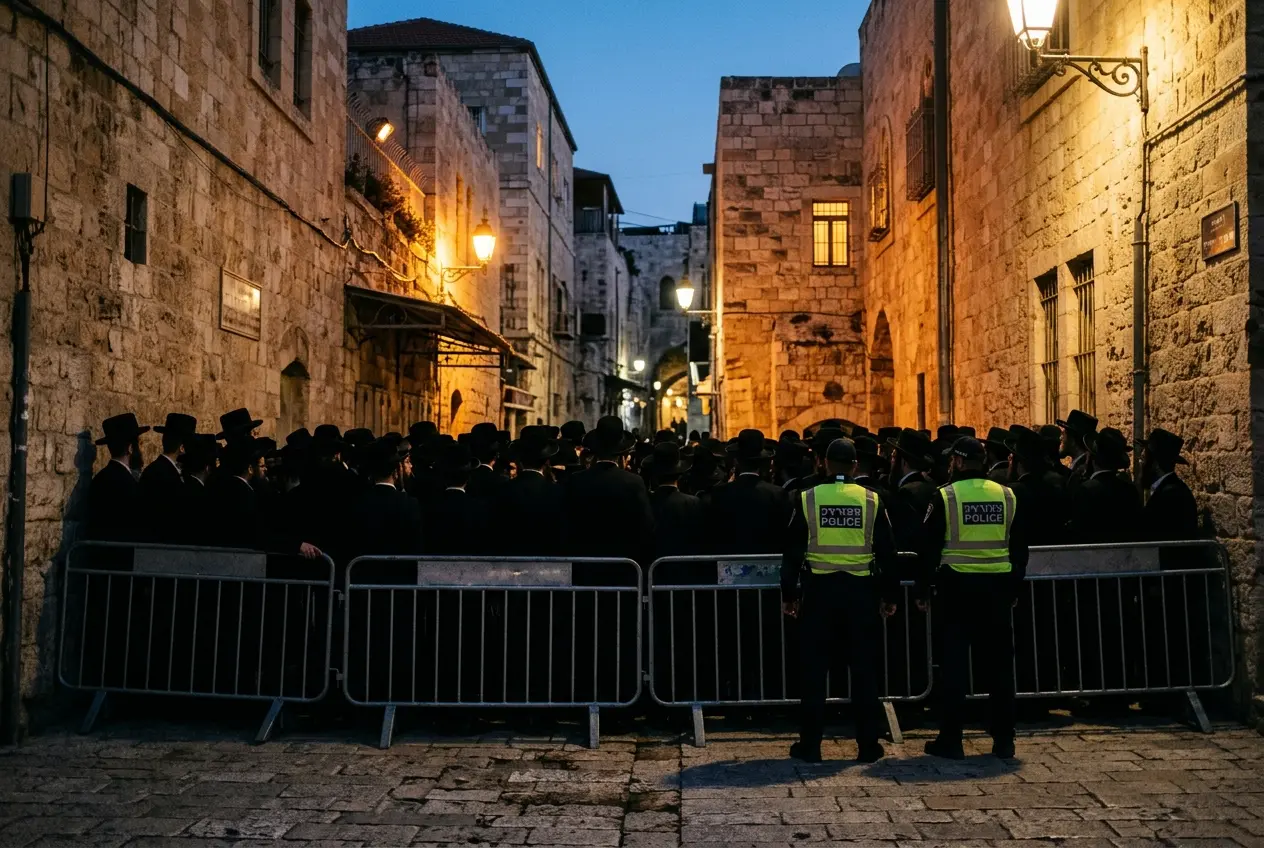
Hundreds of ultra-Orthodox men rioted through Jerusalem and Beit Shemesh on Friday night, trying to break into the Russian Compound police station and hurling stones at officers in an assault requiring Border Police reinforcements to contain. The Haredi draft riots erupted after sundown on the Jewish Sabbath, the day Jewish law bars labor, staged in defense of a military exemption whose legal foundation has always rested on the community’s religious observance.
The disturbances completed a five-day sequence that alarmed Israel’s judiciary and deepened a coalition crisis already simmering for months. Sixty-two people were arrested Wednesday after a mob vandalized the private home of Supreme Court Deputy President Noam Sohlberg in the Alon Shvut settlement; his wife, Meira, called it “a pogrom” and invoked Kristallnacht while standing outside her damaged front door.
Five Days of Escalating Disorder
The confrontations built in stages across the week, each one extending further than the last.
- April 2026: Members of the radical Jerusalem Faction broke into the home of Israel’s Military Police chief while his family was inside, one of the first direct home invasions targeting a law enforcement official over the draft dispute.
- June 1: Haredi rioters stormed the Beit Shemesh police compound after military police arrested a suspected draft dodger there; several breached the compound walls. Police arrested eight but released them within hours after admitting in court they had insufficient evidence.
- June 1 (same day): Separate protests blocked Highway 1, Highway 4, and rail tracks near Ben-Gurion Airport. Three police officers were lightly injured during dispersal efforts.
- June 3: A mob gathered at the Alon Shvut settlement home of Justice Sohlberg, shattering windows, smashing his car’s windshield, breaking flowerpots at the front door, and scattering cards bearing an Israeli flag with a swastika printed where the Star of David belongs. Police arrested 62 people and described the operation as coordinated, not spontaneous.
- June 5 (Shabbat): Hundreds rioted in Jerusalem, attempting to break down the gate of the Russian Compound police station, according to the Ynet news site. Simultaneously, rioters in Beit Shemesh threw stones and objects at officers. A secular Israeli bystander reported being kicked in the head by the crowd.
Prime Minister Benjamin Netanyahu condemned the Sohlberg attack and called the justice personally. His condemnation arrived as his governing coalition simultaneously pushed for legislation to re-enshrine the Haredi draft exemption the courts have struck down multiple times.
The Attack on Justice Sohlberg’s Home
The choice of target on June 3 carried specific meaning. Sohlberg, 64, is the Supreme Court’s deputy president and by reputation one of its more conservative members, an Orthodox Jew living in a West Bank settlement. Within Haredi legal circles, he had been seen as a jurist more likely to understand the community’s concerns than to push against them.
That perception shifted as Sohlberg began writing enforcement rulings. In November 2025, a five-judge panel he chaired ordered the government to develop a concrete enforcement policy covering criminal prosecution of draft evaders and withdrawal of economic benefits. That decision followed the court’s unanimous June 2024 judgment, which invalidated all existing exemption frameworks and left every draft-age Haredi man legally subject to conscription under the standard Security Service Law. A follow-up order in April 2026, again led by the same panel, gave the government until June 1 to report progress on implementation. The mob arrived at his door two days after that deadline passed.
Senior Israel Police Superintendent Chaim Taieb, speaking to the 103FM radio station the following day, left little doubt about the operation’s nature. “This was a secretive and organized operation, comparable to those of major intelligence organizations,” Taieb said. Several factions were involved, he added, including the Jerusalem Faction and other Haredi groups from the area.
It cannot be that Jews do this to one another. We are children of Holocaust survivors. Jews harming each other like this. How can it be? How can it be? Look at the destruction. A pogrom. What is this? A Kristallnacht. How is this possible? There are no words.
Meira Sohlberg spoke those words to reporters outside her vandalized home in Alon Shvut on June 3, 2026.
Rioting on the Sabbath
The Friday night disturbances added a dimension none of the week’s earlier episodes had carried. The Jewish Sabbath begins at sundown on Friday. Jewish law, codified in the fourth of the Ten Commandments, specifically prohibits labor on it. In Israeli domestic politics, Shabbat observance has long been a defining concern for Haredi parties; in 1999, the United Torah Judaism faction withdrew from Prime Minister Ehud Barak’s coalition after the government authorized railway maintenance work during the Sabbath.
The Haredi exemption from military service traces to the same religious framework. In 1948, Prime Minister David Ben-Gurion deferred service for a small group of yeshiva students, treating Torah study as a form of national service. The arrangement expanded as the community grew, then expired in June 2023, leaving tens of thousands of Haredi men in a legal gray zone after the Supreme Court eventually ruled the exemption unconstitutional on equality grounds.
On Friday evening, rioters threw stones through Sabbath hours at police officers enforcing arrest warrants for draft evaders.
- 76,000 draft-age men declared draft evaders or under active draft orders, per state data cited in the April 2026 High Court ruling
- Roughly 80% of those men are Haredi, according to the same court documents
- Only 17 Haredi draft evaders were arrested through proactive Military Police operations in the 13 months from January 2025 to January 2026
- Enlistment runs at roughly 88% among non-Haredi Jewish Israeli men, compared with under 2% among Haredi men of draft age
MK Avigdor Liberman, leader of the hawkish opposition Yisrael Beytenu party and a longtime critic of Haredi draft exemptions, wrote on X after Friday’s riots: “Even on Shabbat, the draft-dodging rioters prove that they aren’t Jewish, don’t observe mitzvot and have no God.” Mitzvot, in Jewish law, are commandments; Shabbat observance is among them.
The Enforcement Gap
The Legal Timeline
The road to Friday’s disturbances runs through a series of court rulings the government consistently failed to implement. When the Torato Omanuto (Torah-as-vocation) exemption arrangement expired in June 2023, Israel was left without any binding legal basis for exempting yeshiva students from conscription. The government attempted temporary orders and missed deadlines. The April 2026 High Court enforcement ruling arrived in a contempt-of-court framework, after the state failed to meet the prior November 2025 targets.
| Date | Development | Effect |
|---|---|---|
| June 2023 | Torato Omanuto exemption arrangement expires | No lawful basis remains for exempting yeshiva students |
| June 2024 | Supreme Court unanimously invalidates all exemption frameworks | All draft-age Haredi men legally subject to conscription |
| November 2025 | Supreme Court panel orders enforcement policy with criminal and economic measures | Government given firm deadline to develop concrete steps |
| April 2026 | High Court orders immediate action; criticizes police for refusing to assist Military Police | June 1 reporting deadline set; contempt applications filed |
Enforcement on Paper Only
Research by the Israel Democracy Institute tracking the year after the June 2024 ruling found that of 19,000 draft summons issued to Haredi men by early June 2025, only about 5% reported to induction centers and just 1.2% were actually conscripted. State data cited in the same April 2026 ruling showed only 17 Haredi men were arrested through proactive Military Police operations across the full 13 months between January 2025 and January 2026. Of 442 indictments filed against draft evaders in 2025, just 81 targeted Haredi men.
The government’s posture was legislative delay. Israel’s 2026 state budget passed earlier in the year without the contested exemption law; Finance Minister Bezalel Smotrich cited the wartime election calendar as the reason to shelve it. A policy analysis of the Knesset’s Bismuth enlistment bill found the proposed first-year recruitment target of 4,800 Haredi men represented roughly 5% of an eligible pool estimated at 100,000, against an 88% enlistment rate for other Jewish Israeli men. The Israel Defense Forces (IDF) itself told the court it could absorb the entire annual Haredi male cohort from mid-2026 onward, making the bill’s thresholds look calibrated to coalition arithmetic.
With no legislative fix and court patience gone, arrests of individual draft evaders began to increase. Each arrest produced a protest. The protests grew.
The Condemnations Changed Nothing
Opposition Seizes on the Contradiction
Netanyahu said after the Sohlberg attack that “law enforcement must apply the full force of the law against the rioters” and called the justice personally to check on his family. The prime minister’s coalition simultaneously pushed legislation to restore a broad draft exemption the courts have repeatedly invalidated.
The opposition was sharper. Gadi Eisenkot, head of the Yashar party and a former IDF chief of staff, called the June 1 Beit Shemesh station raid a “black flag over Israeli democracy.” Democrats Party leader Yair Golan wrote on X: “When Netanyahu and [National Security Minister Itamar] Ben-Gvir turn draft refusal into a coalition anchor, the message to the field is clear: deserters are worth more than police officers.” Former Prime Minister Naftali Bennett said the extremist group “receives protection from the government and permits itself to go further and further,” warning of potential casualties “the next time.”
Retired Supreme Court President Dorit Beinisch warned that the country was sliding toward anarchy and blamed top political leadership directly. Current Chief Justice Isaac Amit called the Sohlberg attack an assault on the entire legal system and the rule of law.
The Coalition’s Impossible Position
Inside Haredi leadership itself, disavowal arrived alongside defense. United Torah Judaism (UTJ) leader Yitzhak Goldknopf said “there is no place for violence in our camp” while simultaneously expressing “full support for the Torah students whose honor and standing have been trampled under the feet of the current government and are expressing their pain.” UTJ and its sister party Degel HaTorah have been among Netanyahu’s essential coalition partners throughout his current government. Weeks before Friday’s riots, Degel HaTorah’s spiritual leader labeled Netanyahu a “liar” and called for Knesset dissolution after the prime minister told Haredi party leaders he lacked the votes to pass an exemption bill before elections now scheduled for between September 8 and October 20.
For Netanyahu, the bind has no clean exit: the Haredi parties whose political demands generated these protests are the same partners his majority requires.
The political arrangement behind Haredi exemption outlasted every court ruling for two decades; Friday night produced something harder to dismiss.
