
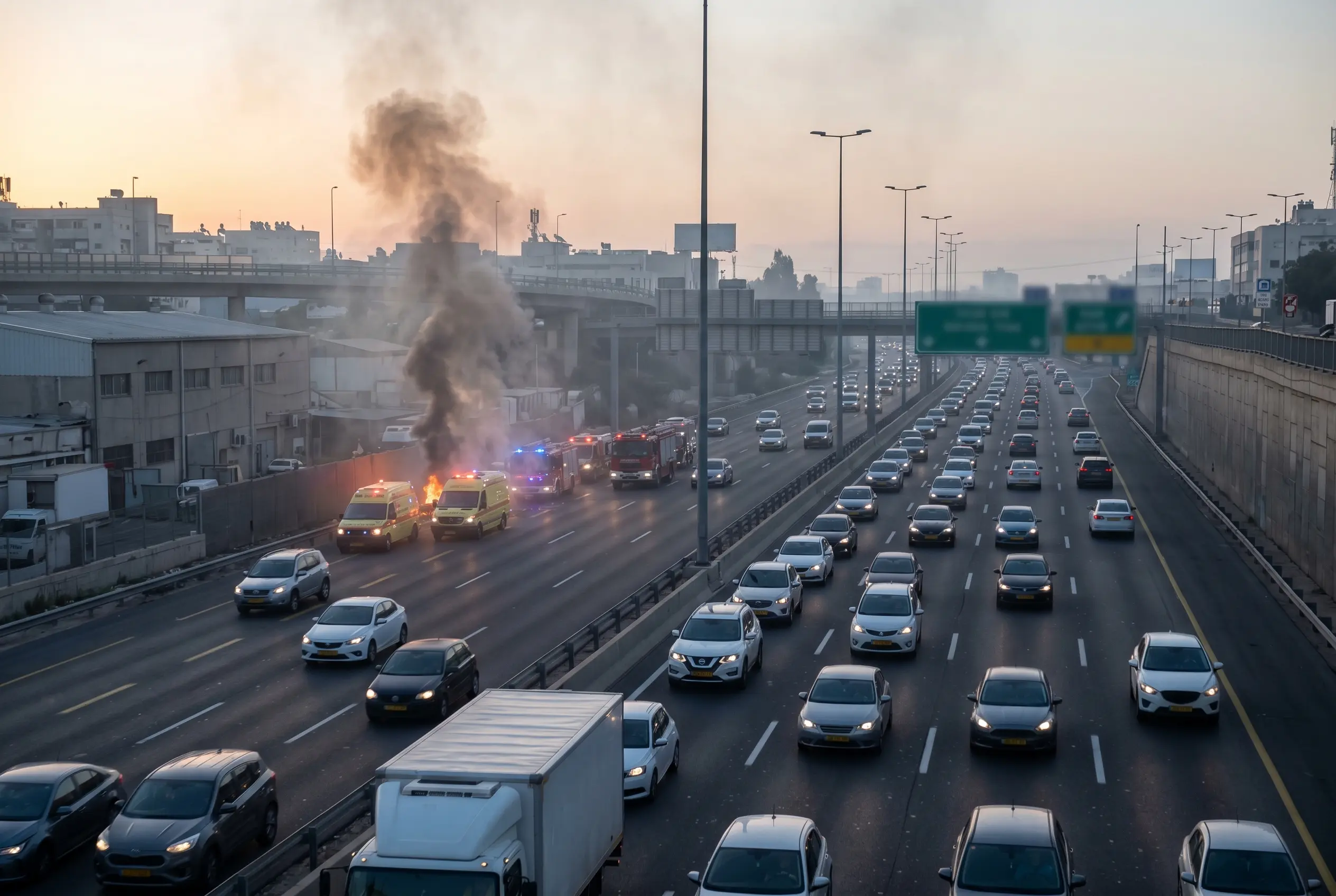
About an hour before a bomb planted under her driver’s seat killed her on the Ayalon Highway, Lia Malka posted a photo of her two-year-old daughter to social media. The accountant and former police officer, 35, from Rishon Lezion, died on June 4 when the half-kilogram device detonated in morning rush-hour traffic near the Holon Junction on Highway 20, one of the busiest arteries in the Tel Aviv metro area. Magen David Adom emergency medics found her next to her burning car and pronounced her dead at the roadside.
Her father, Yaakov Malka, told the Israeli news outlet Ynet that his daughter had filed at least one police complaint against her estranged husband over alleged threats, months before her death. The suspect, 32, had already been questioned on suspicion of threatening her family. On Friday, the Petah Tikva Magistrate’s Court extended his detention by 10 days; he is now suspected of premeditated murder and conspiracy to commit a crime.
Bomb Under the Driver’s Seat
The explosive was placed beneath the driver’s seat, police said. The car belonged to her brother; she had borrowed it for the morning commute, and neither she nor her brother had a criminal record, per Ynet. Tel Aviv District police chief Haim Sargaroff, speaking at the scene, confirmed the device weighed half a kilogram, roughly one pound. Investigators were still working Friday to determine whether it had been triggered by remote detonation or a preset timer.
The Ayalon Highway passes through the heart of the Tel Aviv metro area and carries some of Israel’s heaviest daily commuter traffic. The explosion happened in the middle of morning rush hour near the Holon Junction interchange and was visible from surrounding lanes. United Hatzalah medics who responded to the scene reported the vehicle had caught fire; the Israel Fire and Rescue Service dispatched crews to extinguish the blaze while police sappers and forensic teams secured the area.
Her mother previously served in the Israel Police and is now retired. The Walla news agency, citing the family, reported that several complaints had been filed against the suspect in recent months. Ynet confirmed independently that she had filed at least one formal complaint about specific threats, several months before the bombing.
Israel Police opened a criminal homicide investigation within hours and confirmed publicly that the incident was criminal in nature, not terrorism-related.
First responders found her unresponsive beside the burning vehicle and pronounced her dead at the roadside. A child’s car seat found in the wreckage briefly alarmed the teams on scene; police confirmed quickly that her daughter had not been in the vehicle at the time.
A gag order covers the investigation, restricting what details police can disclose publicly.
The Complaints Her Family Filed
Her cousin posted on social media the morning she was killed, before police had formally named any suspect:
Yes, it’s supposedly still under investigation. But it’s clear to everyone that her husband, her estranged husband, is the one who likely ordered her murder or did it himself. The murderer threatened her and my aunt and uncle for some time, and he continued to walk free and plan the murder. Nobody stopped him.
Tom Nisani, identified in news reports as her cousin, wrote those words the same morning the bomb went off. Police confirmed the estranged husband’s arrest later that Thursday evening. His lawyer, per the Maariv newspaper, denied the client’s involvement, saying he had been asleep at home when the device detonated. Police declined to confirm or refute that account publicly, citing the investigation’s gag order.
Before Thursday’s arrest, the suspect had already been brought in for questioning over suspicion of threatening her relatives, per Kan, Israel’s public broadcaster. Under Israeli law, that questioning can produce a restraining order, an extended remand, or release pending further investigation. He was released. The couple shared custody of their daughter and were in the middle of divorce proceedings at the time of the killing.
Hebrew-language media, citing investigators, reported that police believe the attack was planned in advance and arranged during the acrimonious divorce. The method, a device planted in a borrowed car, required access to the vehicle and preparation time.
The Petah Tikva Magistrate’s Court extended his detention by 10 days on Friday, to June 14. The court found sufficient grounds to hold him on suspicion of premeditated murder and conspiracy to commit a crime. Formal charges had not been filed as of Friday.
Five Deaths in Four Explosions
The June 4 bombing was the latest in a sequence of vehicle explosions on Israeli roads since May 26. Per Ynet’s accounting of the full sequence, five people died across four separate incidents in ten days.
| Date | Location | Deaths | Police Classification |
|---|---|---|---|
| May 26 | Afula, northern Israel | 1 (Ovenach Yitzhak Dinko) | Organized crime suspected |
| May 26 | Route 2 near Or Akiva, Coastal Highway | 1 (Daniel Lugasi, Haifa) | Organized crime suspected |
| June 1 | Route 40 near Be’er Sheva (Goral Junction) | 2 | Criminal; gag order imposed |
| June 4 | Ayalon Highway (Hwy 20), Holon Junction area | 1 (Lia Malka) | Criminal; estranged husband detained |
The two May 26 bombings, which struck different cities in the same workday, are documented in earlier reporting on the Afula and Or Akiva blasts. Police treated both as organized-crime assassinations. The June 1 double killing near Be’er Sheva is also under a gag order; police confirmed that an explosive device had been placed inside the car before it detonated on Route 40.
Investigators found no organized-crime connection to the June 4 blast. The victim had no criminal record, the car was her brother’s, and the suspect detained is her former spouse, held on suspicion of arranging the attack during contentious divorce proceedings.
Violence Crossing Sector Lines
Israel’s criminal homicide wave has run predominantly through Arab communities for several years. The June 4 killing arrived in a different demographic context, but inside a picture of violence that has been spreading steadily into Jewish communities as well.
- 122 people killed in Arab communities in Israel so far this year, per Ynet’s running count, exceeding the pace at the same point in 2025, which was the deadliest year on the Abraham Initiatives’ records
- 12 people killed in Jewish communities in the six weeks preceding June 4, including two in the Be’er Sheva car bombing on June 1
- 5 people killed in criminal vehicle bombings on Israeli roads between May 26 and June 4
The murder rate in Palestinian communities in Israel rose from 4.9 per 100,000 in 2020 to approximately 11 per 100,000 in recent years, a level comparable to rates in Sudan and Iraq, per Haaretz data cited in Al Jazeera reporting from May 2026. In Jewish communities, the comparable rate stands at roughly 0.6 per 100,000.
Opposition lawmakers and Arab community leaders have directed sustained pressure at Itamar Ben Gvir, Israel’s National Security Minister, who oversees the Israel Police, and at Justice Minister Yariv Levin, who has declined to fill dozens of vacant magistrate and district court seats. Ben Gvir cut funding for the previous government’s anti-crime initiative in Arab communities within months of taking office in late 2022 and dismissed the senior police official in charge of fighting crime in Arab society the following year. He has rejected responsibility, attributing the violence to the attorney general’s refusal to authorize tools including administrative detention of suspects.
The Abraham Initiatives, the Jewish-Arab civic organization tracking those homicide figures, found the 2025 total reached 252 murders, the worst annual figure in their records.
When Filed Complaints Don’t Stop a Killing
The complaint trail the family assembled before the bombing sits alongside a national pattern that Israeli domestic-violence researchers have documented for years.
The Record in This Case
Yaakov Malka described to Ynet a formal complaint his daughter filed months before June 4, over alleged threats from the suspect. The Walla news agency, citing the family, reported that several complaints had been filed in the preceding months. Per Kan, the suspect had been brought in for questioning over those threats before the bombing took place.
Under Israeli law, a person questioned on suspicion of threatening an intimate partner can be remanded, subjected to a restraining order, or released pending further investigation. He was released. Investigators have not said publicly what protective conditions, if any, were attached to that release.
Israeli legal advocates have documented the structural gap this case illustrates. A threat complaint moves through a process calibrated for disputes involving physical confrontations: questioning, a possible temporary order, and in most cases release. That process is not built to catch a suspect who plans a bombing months in advance.
The Petah Tikva court’s 10-day hold on Friday was a product of the murder investigation. The prior complaint file had produced no equivalent hold. That gap, between what a threat complaint can achieve and what a murder investigation generates, is what the family points to when they say nobody stopped him.
What National Data Shows
The Israel Observatory on Femicide’s 2024 annual report, produced under the auspices of the Hebrew University of Jerusalem, found 20 femicide cases in Israel that year. Only 20% of those victims had sought police assistance for prior domestic violence before they were killed. The IOF defines femicide as the intentional killing of women because they are female, encompassing killings by current or former partners during separation and divorce proceedings.
A study in the Israel Journal of Health Policy Research, drawing on national registry data, noted that more than 20 women are killed annually in Israel by a spouse or family member, and that roughly half of those femicide victims had filed a police complaint before their death. The other half left no complaint trail at all.
The IOF’s 2024 report also documented a data gap of roughly 22% between police records and the IOF’s own count: Israeli police recorded 29 femicide cases that year; the IOF found 37. The discrepancy is most visible in cases where a woman killed in organized-crime violence is logged in police records as a general criminal homicide rather than a gender-motivated killing.
Prof. Shalva Weil, who heads the IOF at the Hebrew University, has argued that Israeli police classify intimate-partner killings too broadly as generic criminal matters, slowing the urgency of protective intervention. After the year’s first femicide in January, Lily Ben-Ami, chief executive of the Michal Sela Forum, an Israeli advocacy group focused on femicide prevention, said the government had failed to treat the problem as a national emergency.
His detention runs to June 14, the deadline the murder squad works toward on a case a complaint file alone could not close.
