
Egypt is putting up to $4.5 billion of state and partner money into a single new terminal at Cairo International Airport, the heart of an aviation modernization drive that aims to double the hub’s annual capacity from 30 million to 60 million passengers. The plan binds public cash, private operators, biometric gates and Internet-connected sensors into one wager: that geography, once digitized, converts into traffic, trade and tourism revenue.
The timing is deliberate, and so is the risk. Across the Red Sea, Gulf rivals are pouring far larger sums into mega-hubs designed to swallow the same East-West passenger flows Egypt wants to capture. The bet is whether Cairo, Hurghada and Sharm El-Sheikh can modernize fast enough to claim a seat at that table before the window closes.
Egypt’s $4.5 Billion Airport Wager Starts in Cairo
The centerpiece is Terminal 4 at Cairo International Airport. Minister of Civil Aviation Sameh El Hefny put the project’s scale on record in September 2025, framing it as a four-year build that would lift the country’s busiest gateway past 60 million passengers a year. The government has described the wider plan as a multi-billion-dollar national aviation overhaul anchored in Cairo, with cost estimates running between $3.5 billion for the terminal shell and the higher all-in figure quoted by the ministry.
Cairo is the anchor, but it is not alone. Sharm El-Sheikh International is in the middle of a phased upgrade, and Hurghada International is being handed to a private operator. Read together, the three projects show how Egypt is spreading the wager across its three highest-traffic airports rather than concentrating it in the capital.
| Airport | Project | Investment | Capacity goal |
|---|---|---|---|
| Cairo International (Terminal 4) | New terminal, state and partner financed | Up to $4.5 billion | 30M to 60M passengers/year |
| Hurghada International | Private operator under a long-term PPP | $100M+ in direct investment | Above current 10.5M traffic |
| Sharm El-Sheikh International | Phased terminal modernization | $420 million | Beyond 10M passengers/year |
The operational pressure behind those numbers is already here. “Cairo International Airport and other major airports are handling a continuous increase in passenger traffic while keeping operations smooth and maintaining service quality,” said Aly Sameh, an aviation operations specialist, citing peak-hour congestion and coordination between airport stakeholders as the daily friction points the construction is meant to relieve.
Why the Bet Lands Now
Cairo handled 30.94 million passengers in 2025, up 6.8% from 28.97 million the year before. That single figure explains the urgency: the airport is already running at the capacity its current terminals were built for, so growth from here means congestion unless the steel goes up.
The tourism math points the same way. Egypt has set a target of 30 million annual tourists by 2030 under its national sustainable tourism strategy, and airports are the chokepoint that decides whether those visitors can actually land. Hurghada and Sharm El-Sheikh feed the Red Sea resorts; Cairo feeds everything else.
- 30.94 million passengers through Cairo International in 2025, up 6.8% year on year
- 10.5 million passengers at Hurghada in fiscal 2024/2025, a 22% jump
- 28 million passengers handled across Egyptian Airports Company sites in 2025, up from 22.9 million
- 30 million annual tourists targeted by 2030, roughly double the current run rate
Private Capital and the Hurghada Tender
The part of the wager that turns on outside money is Hurghada. Egypt is keeping ownership of the airport with the state holding company, EHCAAN, while leasing out management and development to a private operator under a public-private partnership (PPP, a long-term contract that hands operations and capital spending to a private firm while the asset stays public).
From One Advisor to a Shortlist of Ten
The structure runs through the World Bank’s private-sector arm. In March 2025 the government brought in the International Finance Corporation (IFC) as lead transaction advisor across an eleven-airport privatization program, with Hurghada as the pilot. The investor response was loud.
- March 2025: IFC signs on as lead PPP advisor for 11 Egyptian airports, Hurghada first.
- December 2025: the Civil Aviation Ministry opens the bid for single entities and consortia.
- March 2026: the tender collection window is extended, with 68 international companies and consortia having taken the qualification documents.
- Now: a technical committee reviews 10 shortlisted consortia on technical, financial and technology criteria, with state oversight on national-security grounds.
Why the Gulf Wants In
The shortlist tilts toward the Gulf. Revised bids understood to be backed by entities from the UAE, Qatar and Saudi Arabia have moved to the front of the review, and the project needs more than $100 million in direct investment to qualify. For Gulf operators already running their own mega-hubs, a stake in Egyptian traffic is both a growth play and a hedge. That same appetite for Egyptian assets shows up elsewhere; private developers have been expanding billion-pound project pipelines inside Egypt on the same bet that the country’s footfall keeps climbing.
“Egypt is committed to building a private sector-led economy that drives growth and jobs,” said Rania Al-Mashat, Minister of Planning, Economic Development and International Cooperation, when the IFC deal was signed. The Hurghada award is the first real test of whether that pledge translates into a signed operating contract.
Biometrics, AI Scheduling and IoT on the Tarmac
Concrete is the visible half of the bet. The quieter half is software and sensors, and that is where Egypt is trying to leapfrog rather than catch up.
Faster Lines, Smarter Schedules
Inside the terminals, the modernization targets biometric check-in, automated boarding and AI-driven resource planning. “Biometric check-in systems help reduce queues and speed up passenger processing,” Aly Sameh explained. “AI-driven scheduling also helps airports and airlines manage resources more efficiently, improve staff allocation, and reduce operational delays.” In a hub already at capacity, shaving minutes off processing is the cheapest way to add throughput without pouring foundations.
Sensors That Flag Failure First
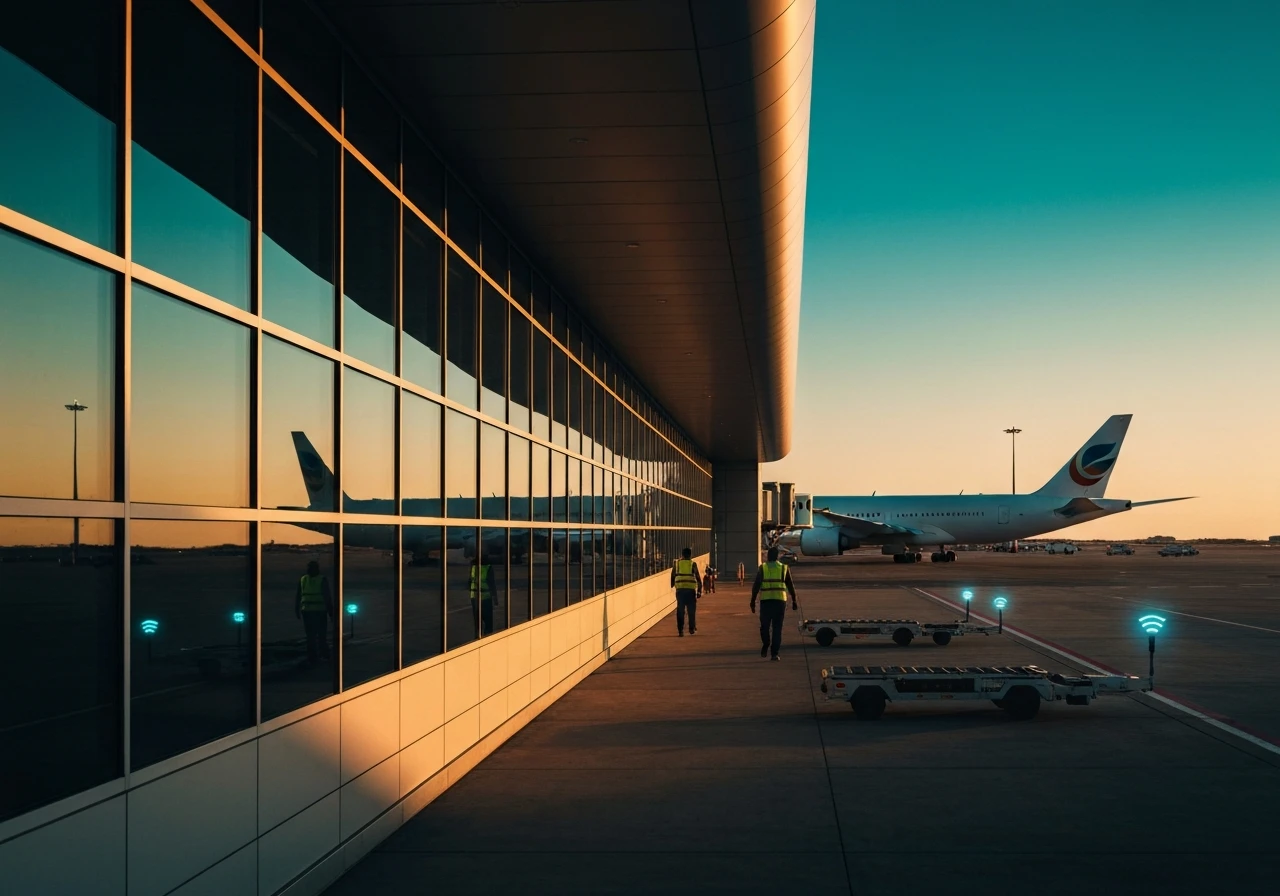
The cargo side is where the Internet of Things (IoT, a network of physical equipment fitted with data-sending sensors) does the heavy lifting. Mohamed Elshazly, a logistics and airport operations specialist, told Arab Finance that Egypt is wiring up critical ground equipment so failures get caught before they ground a flight. Sensors on high-loaders, conveyor belts and X-ray machines stream four readings in particular:
- Vibration and motor hours, to predict wear before a breakdown
- Hydraulic pressure, flagged the moment a high-loader reads abnormal
- Temperature on unit load devices carrying pharmaceuticals
- Shock data, triggering inspection when a shipment takes a hard impact
The cargo equipment is monitored against IATA unit load device standards so sensitive freight stays compliant in transit, while digital customs clearance through the Nafeza platform has cut release times from days to hours. The same logistics upgrades sit behind Egypt’s recent run of fresh-produce export wins into new markets, where speed at the border decides whether perishable cargo arrives saleable.
In short, IoT gives us full visibility. We move from hoping equipment works to knowing it will work, which is the foundation of airport safety and on-time performance.
That was Elshazly, summing up the shift from reactive repair to predictive maintenance that the sensor network is meant to deliver.
The Gulf Build-Out Egypt Is Betting Against
Here is the part that makes this a wager rather than a sure thing. Egypt is modernizing into one of the most crowded aviation arms races on the planet. Some 48 airport projects worth roughly $182.6 billion are underway across the Middle East and North Africa, and two of them, Dubai’s Al Maktoum International and Saudi Arabia’s King Salman International, account for almost 80% of that spend.
The scale gap is stark. Dubai is building toward 260 million passengers a year. Riyadh’s King Salman International targets 185 million. Istanbul, just north, is pushing from 96 million toward 200 million by 2028. Cairo’s leap to 60 million is real and necessary, but it is a different weight class, which means Egypt has to compete on cost, location and efficiency rather than raw size.
The domestic barriers are just as concrete. Elshazly points to the friction of bolting new pre-clearance and advanced screening systems onto legacy government frameworks, and to the time it takes to retrain customs officers and ground staff to run them with confidence. The capital outlay is heavy up front; the return, he argues, comes later through faster operations, tighter security and lower demurrage fees.
If the Hurghada award lands a credible operator and Terminal 4 opens close to schedule, Egypt buys itself a place in a market the Gulf is spending $182 billion to dominate. If the legacy systems and training gaps stall the digital rollout, the steel still rises on time and the efficiency it was supposed to unlock arrives late, or not at all.
Frequently Asked Questions
Who is bidding to operate Hurghada Airport?
Ten consortia remain under review after 68 international firms collected qualification documents, with Gulf-backed groups understood to involve entities from the UAE, Qatar and Saudi Arabia leading the field. Ownership of the airport stays with the state holding company EHCAAN, while the winner gets a long-term management and development contract requiring more than $100 million in direct investment.
How much will Cairo’s Terminal 4 cost and when will it open?
Cost estimates run between $3.5 billion for the terminal itself and a higher all-in figure cited by the Civil Aviation Ministry, with construction expected to take about four years from the September 2025 announcement. Once finished it is designed to lift Cairo International’s total capacity to more than 60 million passengers a year.
What is the IFC’s role in the privatization?
The International Finance Corporation, part of the World Bank Group, signed on in March 2025 as lead transaction advisor for a program covering 11 Egyptian airports. It advises the Ministry of Civil Aviation on PPP strategy and runs the Hurghada tender as the pilot transaction.
Which Egyptian airports are next for private operators?
The ministry has named Sphinx, Luxor and Sharm El-Sheikh as the next candidates after Hurghada, as part of the broader plan to bring private management to 11 airports. Preparatory work on the follow-on sites has been targeted for the second half of the 2025/2026 fiscal year.
