
Iran fired a barrage of ballistic missiles at U.S. forces in the Middle East on July 28, and U.S. Central Command (CENTCOM) says every one of them was intercepted. Within hours, five American refueling tankers were airborne over a corridor stretching from Jordan to the Gulf of Oman. The barrage shattered a fragile pause in the fighting that mediators had spent weeks trying to hold together.
Away from the flight paths, a quieter repricing is underway. Marine insurers and prediction-market traders had already spent the past month betting against a quick return to normal shipping through the Strait of Hormuz, and Tuesday’s attack just proved them right. Their numbers, not the missile count, are the clearer measure of how long this lasts.
Iran’s Missile Barrage Breaks a Fragile Pause
The Islamic Revolutionary Guard Corps launched multiple ballistic missiles at American forces stationed in the region late Tuesday, according to CENTCOM. All were intercepted before reaching their targets, the command said. No U.S. casualties were reported from the barrage itself.
The timing mattered. Mediators had been pushing both sides back toward negotiations after weeks of reduced hostilities, part of a war that has run since February 2026 following a military buildup that began even earlier. Tuesday’s launch ended that pause almost as soon as it had taken hold.
CENTCOM’s intercept claim also lands against a backdrop of strained missile-defense stocks. U.S. commanders had already begun rationing which incoming missiles to intercept to conserve interceptor inventories earlier in the campaign, a detail that gives Tuesday’s clean intercept record real weight rather than routine reassurance.
- What we know: Iran launched multiple ballistic missiles at U.S. forces on July 28; CENTCOM says all were intercepted; the attack broke a mediated pause in fighting; five U.S. refueling tankers are airborne from Jordan to the Gulf of Oman.
- What remains unconfirmed: Whether Doha mediators will resume talks after this week’s barrage; whether Iran intends further direct strikes on shipping; the precise number or type of missiles fired; how long the current tanker posture will hold.
Both sides have reasons to keep a channel open. Iran’s economy depends on the same strait its forces have threatened, and Washington has shown no appetite for a ground campaign. Neither fact guarantees the pause returns quickly.
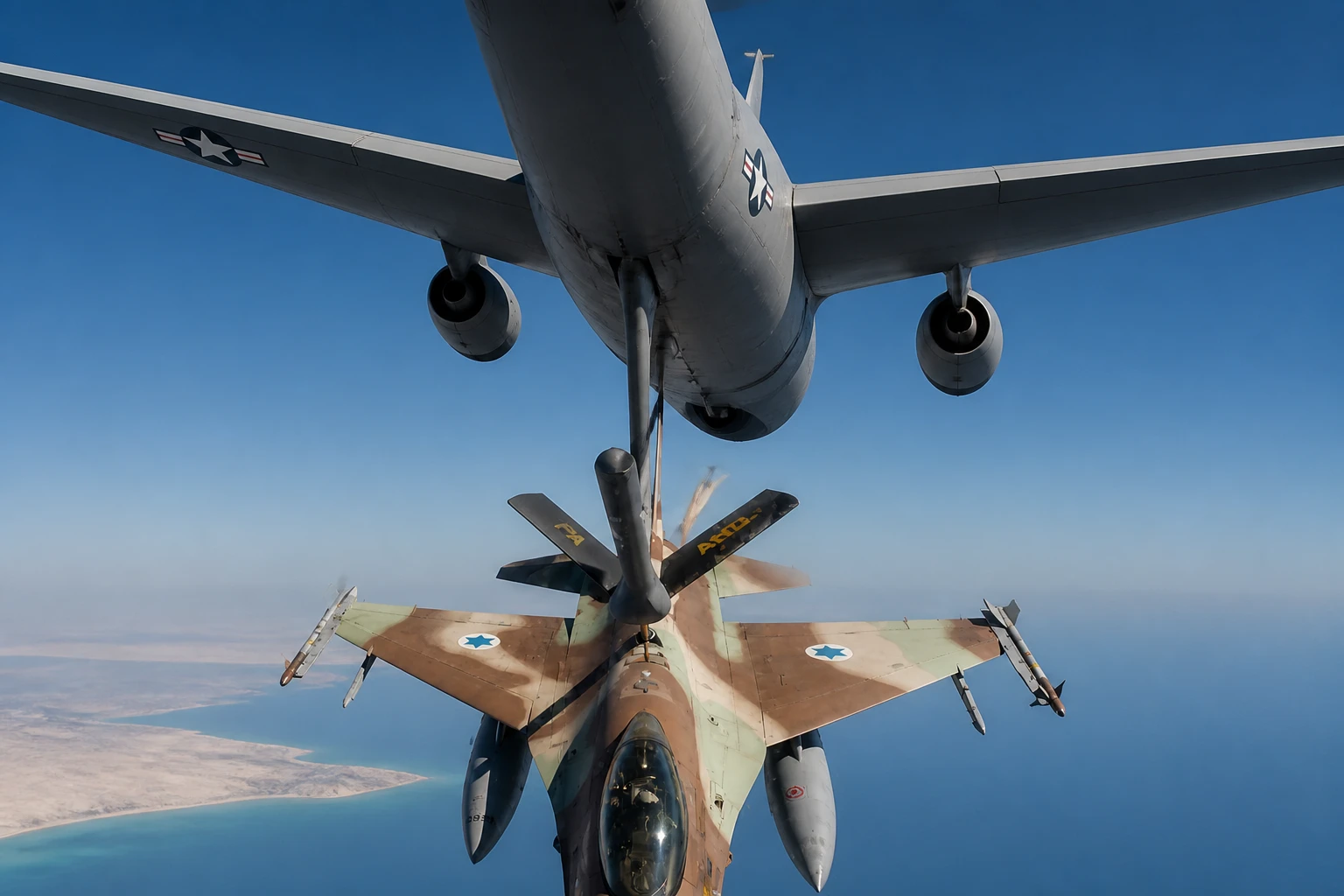
The Tanker Bridge From Jordan to Oman
Refueling tankers don’t fight. They extend the range of aircraft that do, letting fighters and strike planes loiter longer, fly farther, and hit targets without landing to refuel at a base that might be in range of Iranian missiles. Five airborne tankers spread across a corridor from Jordan to the Gulf of Oman point to sustained operations, not a single defensive sortie.
This isn’t the first time tankers have surged into the region this year. Defense trackers reviewing satellite imagery documented a similar buildup in January, when a dozen KC-135 Stratotankers moved from European bases to the Middle East within 48 hours and four more tankers arrived in Jordan alongside a wing of F-15E Strike Eagles. Jordan’s Muwaffaq Salti Air Base has functioned as a central node in that buildup, hosting roughly three dozen fighters and heavy cargo traffic since. The current deployment echoes that pattern across a wider footprint, spanning Israel, Jordan, Saudi Arabia, the Persian Gulf, and the outer edges of the Gulf of Oman.
The human cost of that sustained air campaign has already registered. Reporting on the broader conflict has documented a third American soldier killed by falling drone wreckage, a reminder that extended air operations carry risk even when interceptors work exactly as designed.
Prediction Markets Price In a Longer Blockade
Traders on Kalshi and Polymarket, the two largest U.S.-facing prediction-market platforms, have wagered more than $200 million on how the Iran conflict resolves in 2026, according to a Bitcoin.com News tally of activity across both venues. The single largest cluster of that money sits on one question: does the Strait of Hormuz get back to normal by the end of August.
Polymarket’s contract on Strait of Hormuz traffic returning to normal by August 31 resolves against a specific technical threshold: a seven-day moving average of ship arrivals tracked by the International Monetary Fund’s PortWatch platform has to hit 60 or higher. It’s a mechanical trigger, not a vote of confidence, which is what makes the price swing below so telling.
| Market | Platform | What It Tracks | Latest Signal |
|---|---|---|---|
| Hormuz traffic normal by August 31 | Polymarket | IMF PortWatch 7-day ship-arrival average versus a threshold of 60 | 10.5% YES, down from roughly 50% earlier in July |
| Hormuz closure, 7-day blockade | Kalshi | Whether the strait sees a full week-long shutdown | $7.3 million traded |
| Combined Iran conflict outcomes | Kalshi and Polymarket | Assorted war-related contracts | More than $200 million wagered in 2026 |
Earlier this month, with a June interim deal still holding and Doha talks underway, that same Polymarket contract traded near 50%, roughly a coin flip on normal shipping resuming by the deadline. By Tuesday, after the missile barrage and weeks of reduced transits following late-June attacks on tankers, the price had fallen to 10.5%. The market moved before most news coverage caught up.
What Is War Risk Insurance Costing Shippers Now?
War risk premiums for tankers transiting the Strait of Hormuz have climbed to between 7.5% and 10% of a vessel’s hull value, roughly four times the five-year average, up from about a quarter of one percent before the war began. For an owner insuring a single transit, that is the difference between a routine cost and a decision that can sink a voyage’s economics.
- Pre-war baseline: war risk premiums ran near 0.25% of hull value.
- Current range: premiums sit between 7.5% and 10% of hull value, about four times the five-year average, according to reporting reviewed by Al Jazeera.
- Dollar terms: a $100 million tanker now faces roughly $3 million to $10 million in war risk premiums for a single transit, versus about $250,000 before hostilities, per The National’s review of underwriting data.
- The trigger: two UAE-flagged supertankers were struck in late June, killing one sailor, an attack that hardened owner reluctance to sail regardless of what any ceasefire says.
Reinsurance broker Howden Re has tracked the same climb in its own assessment of Strait of Hormuz war risk exposure, while S&P Global’s commodity analysts have noted that war risk costs eased from their highs but remain elevated across the Persian Gulf. Reopening the strait diplomatically won’t automatically make it cheap to sail again. Underwriters tend to keep premiums high well after the shooting stops, waiting for a track record of calm before they cut rates.
Crude Oil’s Quiet Disconnect
Here is the gap that matters most for anyone watching from outside the region: Brent crude eased back toward $70 a barrel in recent weeks, a level analysts described as pre-war normal, even as insurers and prediction markets kept marking up the odds of prolonged disruption. Oil traders have been betting that global inventories and alternative supply routes can absorb a partial Hormuz slowdown. Insurers and Polymarket traders have been betting the opposite.
The strait carries roughly a fifth of the world’s oil and gas on a normal day, according to Al Jazeera’s reporting on the shutdown, making it the single busiest energy chokepoint on the planet. A market that shrugs at that exposure while premiums quadruple and reopening odds crater is either right that the barrage changes nothing, or it hasn’t caught up yet. Tuesday’s attack is the kind of event that forces a catch-up.
Jordan Holds the Region’s Most Exposed Middle Seat
Jordan isn’t a combatant in this war, but its airspace and bases now anchor one end of the tanker corridor connecting to the Gulf of Oman. Muwaffaq Salti Air Base hosts American fighters and cargo traffic that didn’t exist there in normal times, a footprint that comes with exposure Jordan didn’t choose and can’t easily opt out of.
That exposure sits awkwardly next to Jordan’s diplomatic standing. The European Union’s own foreign policy chief recently traveled to Amman and named Jordan the EU’s most trusted regional partner, a vote of confidence in Amman’s stability that arrives at the same moment its bases are absorbing the operational weight of a live war next door. Hosting the bridge and being praised for steadiness are not the same thing as being insulated from what flies over it.
The Only Off-Ramp Left Is Doha
Nothing about Tuesday’s barrage forecloses talks. Mediators kept the June interim deal alive through late-June tanker attacks and weeks of reduced Hormuz traffic before this latest strike, and officials on both sides have signaled they’d rather negotiate than escalate further. But the market that has tracked this conflict most closely, dollar for dollar, priced a return to normal shipping at barely one in ten as of Tuesday.
Polymarket’s contract keeps running toward its August 31 deadline regardless of what happens next in Doha. Five tankers are in the air right now. The next PortWatch reading will say more about where this goes than any statement out of Tehran or Washington.
