
Turkey confirmed Tuesday that unmanned aerial vehicles struck two Turkish-owned civilian ships in the Black Sea on Monday evening, injuring several crew members including Turkish nationals after the vessels left the Russian port of Novorossiysk.
The Foreign Ministry identified the ships as Yaşar and Nadezhda and said the safety of citizens remains the top priority while authorities monitor their condition. The strikes fit a lengthening 2026 sequence of drone hits on commercial traffic linked to Turkey.
Monday’s events again placed Turkish beneficial owners and mixed crews in the path of a conflict they do not control. The ministry’s language stayed measured. The operational picture did not.
What the Strikes Looked Like on Monday Night
According to Turkey’s Directorate General of Maritime Affairs, the Cameroon-flagged roll-on/roll-off cargo ship Nadezhda was hit roughly 20 nautical miles off Novorossiysk while sailing toward the Turkish port of Samsun. Earlier accounts that placed it inbound with fruit and vegetables were revised.
- 3 August evening: UAVs strike Yaşar and Nadezhda after both depart Novorossiysk.
- Around 4:30 p.m. local (per captain reports for Nadezhda): Multiple drones, described by the master as six or seven, hit the Ro-Ro.
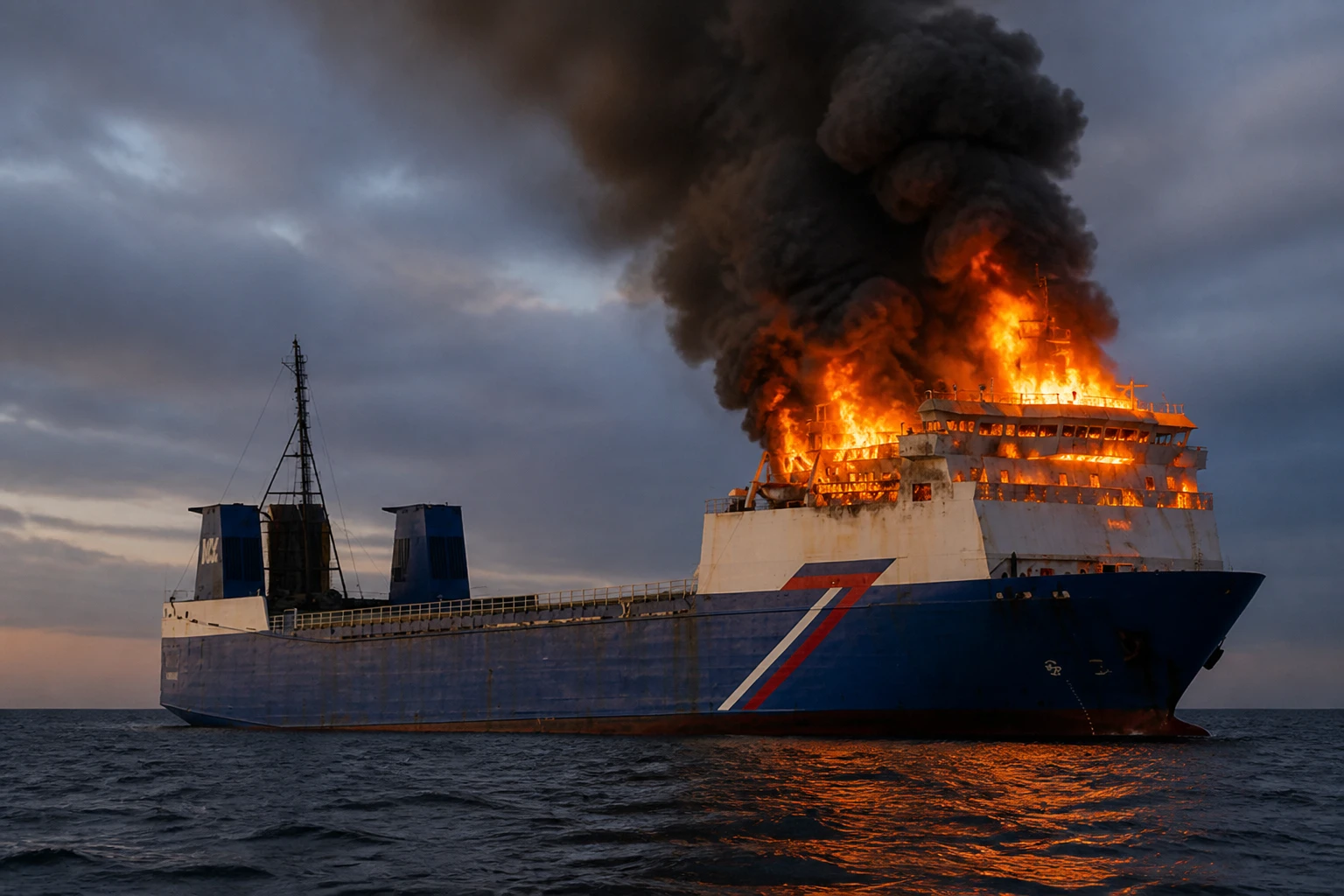
- Immediate aftermath: Fire breaks out in the bow and living quarters; Russian naval units coordinate with the MRCC Novo rescue center.
- Evacuation: All 22 crew from Nadezhda reach safety in Russia; three suffer serious injuries.
- 4 August: Turkish MFA issues its formal statement condemning the spillover.
Captain Yalçın Şahin told Ihlas News Agency that Ukraine carried out the attack. That attribution has not been independently confirmed, and neither Kyiv nor Moscow issued an immediate claim or denial. Footage circulating on X shows thick smoke and flames climbing the superstructure after the hit.
The master’s count of six or seven drones points to a coordinated pass rather than a single stray platform. Fire in the bow and living quarters forced an immediate abandon-ship sequence. Russian naval units and the MRCC Novo rescue center managed the recovery while the drone threat still hung over the scene, which is why rescue craft held back at first.
Distance from shore mattered. At roughly 20 nautical miles off Novorossiysk, Nadezhda sat inside the envelope where low-altitude UAVs have repeatedly found commercial traffic this year. The revision of earlier cargo reports underscores how quickly initial details shift once masters and flag authorities compare notes.
The Two Ships and Their Crews
Both vessels fly foreign flags yet belong to Turkish companies. MarineTraffic data and ministry language place ownership firmly with Turkish firms. Nadezhda is linked to Samsun-based Kalyoncu Shipping. It measures about 119 meters long and 19 meters wide and carried 22 crew, 13 of them Turkish citizens.
| Ship | Flag | Type / Notes | Crew Impact |
|---|---|---|---|
| Nadezhda | Cameroon | Ro-Ro cargo, Kalyoncu Shipping, ~119 m | 22 total (13 Turkish); 3 serious injuries; all evacuated |
| Yaşar | Panama | Civilian cargo, Turkish-owned | Personnel injured including Turkish citizens; fewer public details |
A fire continued burning in Nadezhda’s bow after the crew left. Rescue craft initially held back because of the ongoing drone threat in the area. Yaşar details remain thinner in official releases, though the ministry grouped both under the same UAV attack.
The ownership pattern is familiar. Foreign flags on the stern, Turkish capital and management behind the scenes, and mixed crews that include a high share of Turkish nationals. That structure has not kept hulls off target lists when they sail from Russian ports. Nadezhda’s 13 Turkish citizens among 22 total crew made the human cost immediate for Ankara. Yaşar’s thinner public file still produced injuries that the ministry chose to record in the same statement.
Samsun appears at both ends of the Nadezhda story: the owner’s base and the intended destination after Novorossiysk. The route is ordinary commercial traffic. The outcome was not.
Ankara’s Line on Escalation and Food Security
The official MFA statement on the attacks is concise and direct.
Turkish-owned civilian vessels “Yaşar” and “Nadezhda” were reported to be attacked by unmanned aerial vehicles yesterday (3 August) evening after departing from the Port of Novorossiysk, resulting in injuries to a group of crew members including Turkish citizens. The safety of our citizens is our utmost priority and their condition is being closely monitored. We are deeply concerned that the war between Russia and Ukraine is spreading further into the Black Sea, also affecting civilian vessels, despite all our warnings. Unless preventive measures are taken, the escalation in the Black Sea will have multifaceted negative repercussions, including for food security. We therefore reiterate our call to all relevant actors, particularly the warring parties, to urgently implement concrete measures to ensure the safety of navigation in the Black Sea.
The ministry released the text as No: 151 on 4 August 2026. The food-security clause is not new language for Ankara, yet it lands harder when Turkish-owned hulls carrying commercial cargo are the ones burning. TRT World report on the crew evacuation underscored that all 22 from Nadezhda reached Russian soil safely while the fire persisted.
Citizen safety leads the statement. Escalation language follows. The food-security warning closes the circle. Ankara has used that sequence before. What changes is the proximity of the burning decks to Turkish beneficial ownership and Turkish passports among the injured.
No perpetrator is named in the formal text. The call goes to “all relevant actors, particularly the warring parties.” That phrasing keeps diplomatic space open while still recording the spillover as unacceptable. Concrete measures remain the demand. None were announced alongside the statement.
A Familiar 2026 Sequence of Hits
This is not an isolated incident. Turkish-owned or Turkish-crewed commercial ships have absorbed repeated drone and related strikes across the Black Sea this year.
- July 2026: Drone strike on Turkish-flagged bulk carrier Reyhan Sarı, hauling coal from Taman to Trabzon, killed one sailor and wounded others near the same Russian coast.
- Late July / early August window: Separate reports of hits on vessels such as ATA-2 near Ukrainian ports and other dry-cargo traffic.
- May 2026: Multiple tankers reported attacked north of the Turkish coast; Ankara warned of uncontrolled escalation.
- June 2026 and earlier: MFA statements on Turkish-owned dry cargo vessels struck; Turkey, Romania and Bulgaria already run a joint mine-clearance effort after years of floating ordnance.
Foreign Minister Hakan Fidan has previously proposed a maritime and energy target moratorium if a full ceasefire remains out of reach. The pattern shows those appeals have not altered the operational reality for ships leaving Russian ports or moving grain and bulk cargo. An earlier Istanbul Karaburun drone close call already illustrated how Black Sea UAV activity can reach Turkish shores and infrastructure.
Read across the year and the geography tightens. Taman to Trabzon, Novorossiysk outbound lanes, waters north of the Turkish coast, and approaches near Ukrainian ports all appear in the same incident file. Coal, dry cargo, tankers, and now a Ro-Ro sit on the same risk map. Fatalities have already occurred. Serious injuries continue.
| Period | Example traffic | Noted outcome |
|---|---|---|
| May 2026 | Multiple tankers north of Turkish coast | Ankara warns of uncontrolled escalation |
| June 2026 and earlier | Turkish-owned dry cargo | MFA statements; joint mine clearance continues |
| July 2026 | Reyhan Sarı (coal, Taman to Trabzon) | One sailor killed, others wounded |
| Late July / early August | ATA-2 and other dry cargo | Hits near Ukrainian ports reported |
| 3 August evening | Yaşar and Nadezhda out of Novorossiysk | Crew injuries; three serious on Nadezhda |
The moratorium idea remains on the table in political terms. It has not become practice on the water. Each new strike refreshes the same Turkish warning without visibly shrinking the target set.
Who Absorbs the Cost of Open Lanes
Shipowners, insurers and crews carry the immediate bill. War-risk premiums climb after each publicized hit. Masters film low-flying drones that look like Shahed-type platforms and post the clips; those videos circulate widely and harden the perception that commercial routes near Novorossiysk or other contested approaches remain high-threat. Open-source analysts note that even “mission kills” that leave a hull afloat still force navies and coast guards to divert short-range air defense and patrol assets to merchant escort duties.
Turkey walks a narrow line. It hosts grain-corridor diplomacy history, keeps commercial channels open with both sides, and runs joint naval activity with partners. Recent Egypt-Turkey naval drills show Ankara still projects maritime presence even while its commercial fleet absorbs spillover. Russian navy units performed the Nadezhda evacuation this time. Ukrainian forces have openly targeted vessels they describe as supporting Russian military logistics or energy exports. Civilian flags and Turkish beneficial ownership have not created a reliable shield.
- Crew safety: Three serious injuries on Nadezhda alone; prior fatal cases this year.
- Insurance and routing: Higher premiums and longer diversions for Black Sea calls.
- Food and bulk trade: MFA explicitly flags multidimensional risks including food security if the pattern continues.
- Diplomatic bandwidth: Repeated Turkish statements without a matching drop in incidents.
X posts from accounts tracking the footage show sailors filming drones at low altitude shortly before or around the Nadezhda hit. One widely shared clip captured a burning vehicle carrier with flames climbing the superstructure after the strike. Those images, not the diplomatic phrasing, drive the public sense that the waterway’s commercial layer is now a regular target set.
Premium spikes and route diversions compound quietly. A mission kill that leaves a ship afloat still removes it from schedules, ties up salvage and escort capacity, and feeds the next insurance reassessment. Crews absorb the physical risk first. Owners and underwriters price what follows. Governments issue statements. The cycle has repeated through 2026 without a break in the sequence.
Captain Reports Leave Attribution Open
Captain Yalçın Şahin’s account to Ihlas News Agency named Ukraine as the attacker. That remains a master’s report, not a verified finding. Neither Kyiv nor Moscow moved quickly to claim or deny the Monday strikes. The Turkish MFA statement likewise stopped short of naming a perpetrator.
The gap between onboard testimony and formal attribution is now part of the pattern. Sailors film low-flying drones. Footage spreads on X. Governments register concern and demand navigation safety. Confirmation, when it comes at all, arrives later or not at all. For crews and owners, the operational fact is the hit itself. Legal and political labeling trails behind the smoke.
That lag shapes the information environment. Public perception hardens around the images of flames on the superstructure. Diplomatic text stays careful. The two tracks run side by side after each incident, and Monday’s strikes followed the same split.
Regional Partners Already Share Mine Risk
Turkey, Romania and Bulgaria already run a joint mine-clearance effort after years of floating ordnance in the Black Sea. That work sits in the background of every commercial transit warning. Mines and drones are different threats, yet both force the same conclusion: the waterway’s civilian layer needs active protection that individual flag states cannot supply alone.
Foreign Minister Hakan Fidan’s earlier proposal for a maritime and energy target moratorium fits the same logic. If a full ceasefire stays out of reach, limit the target set. The 2026 record of hits on Turkish-owned and Turkish-crewed ships shows the proposal has not changed day-to-day exposure for masters leaving Russian ports or moving bulk cargo.
Joint mine clearance proves regional coordination is possible on one class of hazard. Drone strikes on commercial hulls test whether that habit can extend to another. Ankara’s repeated calls for concrete measures from the warring parties keep asking that question without yet receiving a durable answer on the water.
Navigation Safety Remains an Open Demand
Ankara’s Tuesday statement closes the same way earlier ones did: a call for concrete measures from the warring parties. No new mechanism was announced. No perpetrator was formally named by the ministry. The three seriously injured sailors are under monitoring. The fire on Nadezhda burned on after the crew left. Yaşar’s full damage assessment has not been released in the same detail.
Black Sea commercial traffic continues under the same risk envelope that produced the Monday strikes. Turkish companies still own and crew ships that call Russian ports. The 2026 record shows that ownership and foreign flags have not insulated those vessels from UAV attack. The pattern is established. The next incident will test whether the warnings finally produce the concrete measures the MFA keeps requesting.
Until those measures appear, the costs stay distributed exactly as they are now: among crews who film the approach, owners who pay the premiums, and a ministry that issues numbered statements after each new fire on the water.
