
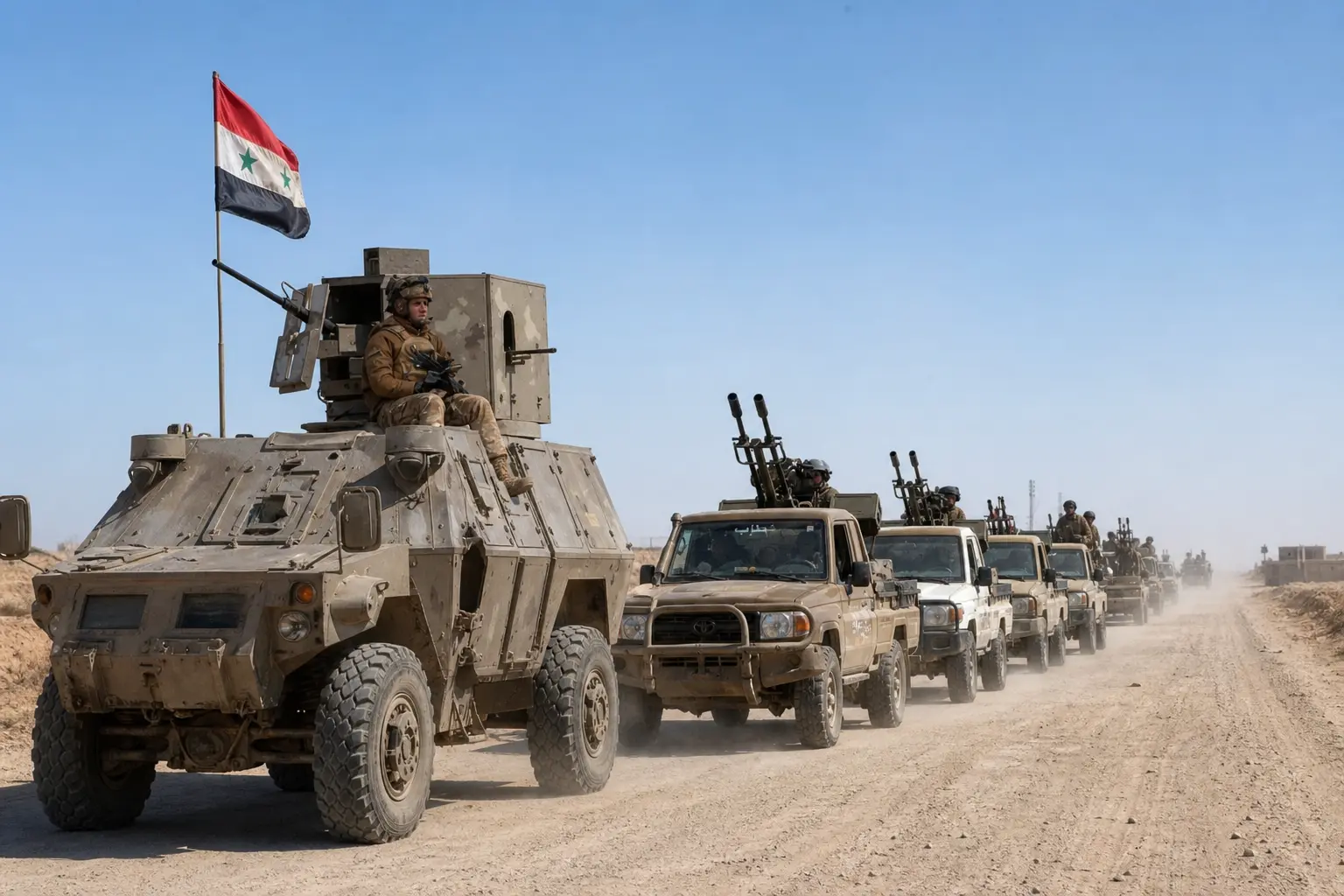
Syrian forces entered nationwide Alert Level C on 4 August 2026, recalled personnel from leave and pushed reinforcements including units of the 86th Division toward the Iraq frontier. No public explanation came from Damascus.
Military sources and outlets including Al Arabiya and North Press Agency reported the Defence Ministry order. The transitional army under President Ahmed al-Sharaa now sits at heightened readiness along a border long used by Iranian-linked networks.
The order covered the full force structure rather than a single sector command. That scale, paired with the leave recall, marked a sharper shift than a local border adjustment would require.
Nationwide Alert Hits the Eastern Frontier
Orders placed all formations on Alert Level C. Soldiers and officers were told to report to units at once. Columns moved into eastern border zones opposite Iraq.
Syrian state media and independent monitors confirmed the posture change. The 600-kilometer frontier includes three main land crossings: Al-Yarubiyah-Rabia, Al-Bukamal-Al-Qaim and Al-Tanf-Al-Waleed, plus the Semalka-Faysh Khabur river link.
- Alert Level C applied nationwide across the armed forces
- 86th Division units among the eastern reinforcements
- Leave personnel ordered back to active duty immediately
- No end date or named threat issued by Damascus
Iraqi security sources told monitors the mobilization opposite their territory had already run more than 72 hours and included armored vehicles.
Armored movement opposite Anbar and Nineveh raised the visible weight of the deployment beyond light infantry posts. The absence of a stated end date left the elevated posture open-ended on both sides of the line.
Each of the four crossings serves a different stretch of the frontier. Concentration opposite the central and southern gates matched the zones where militia traffic and smuggling have drawn the most recent scrutiny.
Defence Ministry Calls It Routine Redeployment
A Syrian Defence Ministry source told Shafaq News the movements were not an alert or emergency. The source said they were Defense Ministry described the moves as routine redeployments under approved plans, including repositioning units, testing readiness and reorganizing deployments.
Baghdad’s side kept watching. Iraqi forces adopted their own precautionary steps and stressed coordination. One later report circulating on X said Iraqi authorities viewed the Syrian troop moves as fully coordinated and no threat to Iraq itself.
The gap between “Alert Level C” reporting and the official “routine” label left the purpose open. Speculation centered on Iranian-backed groups still active near the line.
| Frame | Source line | Practical effect |
|---|---|---|
| Alert Level C | Military sources, Al Arabiya, North Press | Nationwide readiness, leave recall, eastern columns |
| Routine redeployment | Defence Ministry source to Shafaq News | Repositioning, readiness tests, approved plans |
| Coordinated, no threat | Iraqi view reported on X | Precautionary Iraqi steps without confrontation |
Holding both descriptions at once lets Damascus signal resolve to networks on the ground while offering Baghdad a lower-temperature account for domestic and diplomatic use. The force movements themselves did not change with the wording.
The Warning Damascus Sent Baghdad Three Days Earlier
On 1 August an Iraqi political source told Al Arabiya that Syria had contacted Iraqi officials directly. Syrian authorities said they had detected movements by Iran-backed militias near the border strip.
The message was blunt. Syria warned Iraq any attack would not go unanswered. The same day Jordan had already warned Baghdad it would target such militias if they struck Jordanian territory.
That sequence sits immediately before the alert order. It supplies the missing motive that pure mystery framing left out.
- 1 August: Syria informs Iraq of militia movements and issues retaliation warning
- Mid-July: Syrian forces seize advanced weapons shipment at al-Tanf said bound for Hezbollah
- Late July: Iranian-backed Iraqi militias linked to drone attacks on Jordan and Saudi targets
- Early August: Iraqi government forms joint security committee and begins penalties for officials tied to cross-border attacks
Crowd discussion on X quickly tied the alert to those militia movements rather than a sudden southern Israel contingency. The eastern focus matched the warning, not the Golan file.
Three days separated the diplomatic warning from the nationwide order. That interval left time for Baghdad to absorb the message and for Syrian units to move from garrison to border approaches without a public drumbeat.
Jordan’s parallel warning on the same day showed more than one neighbor reading the late-July drone activity as a shared problem. Syria’s note to Iraq fit that wider pattern rather than standing alone.
Smuggling Busts and Drone Traffic on the Old Corridor
The Iraq-Syria line has long carried more than legitimate trade. In mid-July Syrian authorities intercepted a large shipment concealed in an oil tanker truck at the al-Tanf crossing. The load included long-range missiles, rockets, drones and related components. Interior Ministry sources said it was headed for Hezbollah in Lebanon. The group denied any link.
Oil tanker traffic through al-Tanf has grown as an alternative export route. The same dense civilian flow offers cover for weapons. Earlier in 2026 Syrian forces dismantled other networks moving weapons and drugs across the same frontier.
| Crossing | Links | Recent note |
|---|---|---|
| Al-Tanf-Al-Waleed | Syria-Iraq-Jordan triangle | July weapons seizure in oil tanker |
| Al-Bukamal-Al-Qaim | Deir ez-Zor to Anbar | Historic militia corridor |
| Al-Yarubiyah-Rabia | Hasakah to Nineveh | Northern monitoring point |
| Semalka-Faysh Khabur | Northeast to Kurdistan Region | River crossing still active |
Regional reporting also linked Iranian-backed Iraqi militias to drone activity against neighbors in late July. Those actions prompted Saudi, Jordanian and Kuwaiti warnings and later Iraqi measures against militia cross-border attacks.
Concealing missiles and drones inside tanker traffic exploits the volume of legitimate fuel movement. Intercepting one load at al-Tanf does not close the method, yet it showed the new authorities willing to act on the route rather than ignore it.
Drug and weapons networks dismantled earlier in 2026 pointed to the same corridor logic. The July seizure fit an existing enforcement pattern, not a one-off publicity raid.
Who Faces Pressure Along the 600-Kilometer Line
Iranian-backed factions inside the Popular Mobilization Forces structure face the sharpest squeeze. Many have resisted full disarmament deadlines tied to US coalition drawdown plans. Some units evacuated headquarters in Ninewa after earlier strikes.
Hezbollah’s overland resupply options shrink if Syria actually seals the route. The new government in Damascus has already said it will not allow Syrian territory to threaten neighbors and has voiced support for Lebanese efforts to disarm the group.
Iraq itself sits in the middle. Baghdad must rein in proxies enough to satisfy neighbors and unlock held funds while avoiding a direct clash with Syria’s rebuilt army. Joint border talks between Damascus and Baghdad had already increased in recent months.
The Syrian military reportedly declared a state of military alert with no official explanation. Troops placed on Alert Level C, units deployed to the Syria-Iraq border, and all personnel ordered to report to their units immediately.
Mario Nawfal’s post carrying that summary drew tens of thousands of views within hours and framed the core public question: defensive move against Iranian-backed groups or something larger.
Pressure lands unevenly. Factions that kept cross-border options open now confront a Syrian army willing to mass armor on the opposite bank, an Iraqi government forming a joint security committee, and neighbors that have already issued strike warnings.
- PMF-linked factions resisting disarmament timelines
- Hezbollah overland resupply through Syrian territory
- Iraqi officials tied to cross-border attacks facing new penalties
- Baghdad caught between neighbor demands and proxy constraints
Public attention on the Nawfal summary kept the core question alive even as official Syrian language stayed muted. The eastern map, not the southern one, answered it for most observers.
How the New Army Differs From Assad’s Border Era
Under Bashar al-Assad the eastern frontier functioned as a permissive corridor for Iranian logistics and allied militias. The December 2024 collapse ended that arrangement. Ahmed al-Sharaa’s transitional authorities have spent 2025 and 2026 reclaiming territory, absorbing or sidelining rival forces, and signaling they will not host threats against neighbors.
A US policy overview of the Syrian transition notes the government advanced into former SDF areas, transferred thousands of Islamic State prisoners to Iraq, and opened security talks with Israel while insisting on Golan recovery and Israeli pullback from positions taken after December 2024.
- December 2024, Assad falls; Israeli forces expand beyond the 1974 line into parts of Quneitra and Daraa
- 2025-early 2026, Transitional forces consolidate, US begins base handovers, sanctions relief starts
- April 2026, Earlier reinforcements noted on Lebanese and Iraqi borders
- July 2026, Tanf weapons seizure; militia drone attacks on regional states
- 1 August 2026, Syria warns Iraq over militia movements
- 4 August 2026, Nationwide Alert Level C and eastern deploy ordered
Southern dynamics remain separate. Israel maintains its expanded security zone and rejects full withdrawal. Al-Sharaa’s government has held talks on arrangements while demanding pre-December 2024 lines. There is no public link between the Iraq-border alert and the Golan file, though both test the new army’s capacity. Coverage of recent Israeli airstrikes inside Syrian territory shows the southern pressure continues in parallel.
April’s earlier border reinforcements showed the eastern and Lebanese files already on the transitional army’s list. The August alert raised the same effort to a nationwide readiness tier rather than inventing a new mission.
Prisoner transfers to Iraq and talks with Israel belong to the same consolidation phase. They illustrate a government trying to close old external vulnerabilities while it rebuilds internal command.
Iraq Balances Watchfulness With Coordination
Baghdad’s response mixed precaution with public calm. Iraqi forces took their own steps opposite the Syrian columns yet stressed coordination and, in at least one circulating account, described the moves as no threat to Iraq.
That balance reflects the bind already visible in early August. The government had formed a joint security committee and begun penalties for officials tied to cross-border attacks, moves aimed at neighbors and at unlocking held funds.
A rebuilt Syrian army on Alert Level C complicates any residual hope that the frontier would stay porous by default. Joint border talks that had increased in recent months now face a harder test: whether coordination language can keep pace with armored deployments and leave recalls.
Iraqi security sources tracking more than 72 hours of Syrian mobilization, including armor, gave Baghdad its own timeline independent of Damascus messaging. Watchfulness did not require accepting every Syrian label at face value.
The Alert Tightens Pressure on Proxy Routes
Sealing or even heavily policing the old corridor hits more than one actor at once. Hezbollah’s overland options narrow if tanker and civilian cover no longer guarantees passage. Iranian-backed factions inside the PMF structure lose depth if Syrian ground forces stay deployed in strength.
Late-July drone activity against Jordanian and Saudi targets had already drawn warnings from Riyadh, Amman and Kuwait. Syrian enforcement on the supply side of that activity aligns with the pressure those states sought from Baghdad.
US and Saudi strikes on Iraqi militia sites had raised costs before the Syrian alert. The eastern deployment adds a ground dimension from the Syrian side of the same networks’ operating space.
None of that requires the alert to last indefinitely. A visible period of nationwide readiness and forward armor can change calculations even if the formal level later eases.
Border Moves Leave Little Room for Ambiguity
The combination of a prior diplomatic warning, a high-profile weapons intercept, and the sudden recall of leave personnel points past generic readiness drills. Damascus may prefer the softer “redeployment” language for Iraqi ears and international partners. The force posture itself still signals that residual Iranian-linked activity on the eastern line will meet organized resistance.
That stance continues the earlier navigation of Iranian tensions and Arab ties that marked the first year and a half of the transition. It also lands against the backdrop of US and Saudi strikes on Iraqi militia sites that already raised costs for the same networks.
Whether the alert stays elevated or eases after the show of force, the eastern frontier is no longer the open corridor it was. The transitional army has put steel on the ground to make that change visible.
Leave recalls and armored columns are harder to walk back quietly than a press line. Even a later return to routine wording will leave neighboring capitals and the networks themselves with a clearer map of Syrian intent on the 600-kilometer line.
