
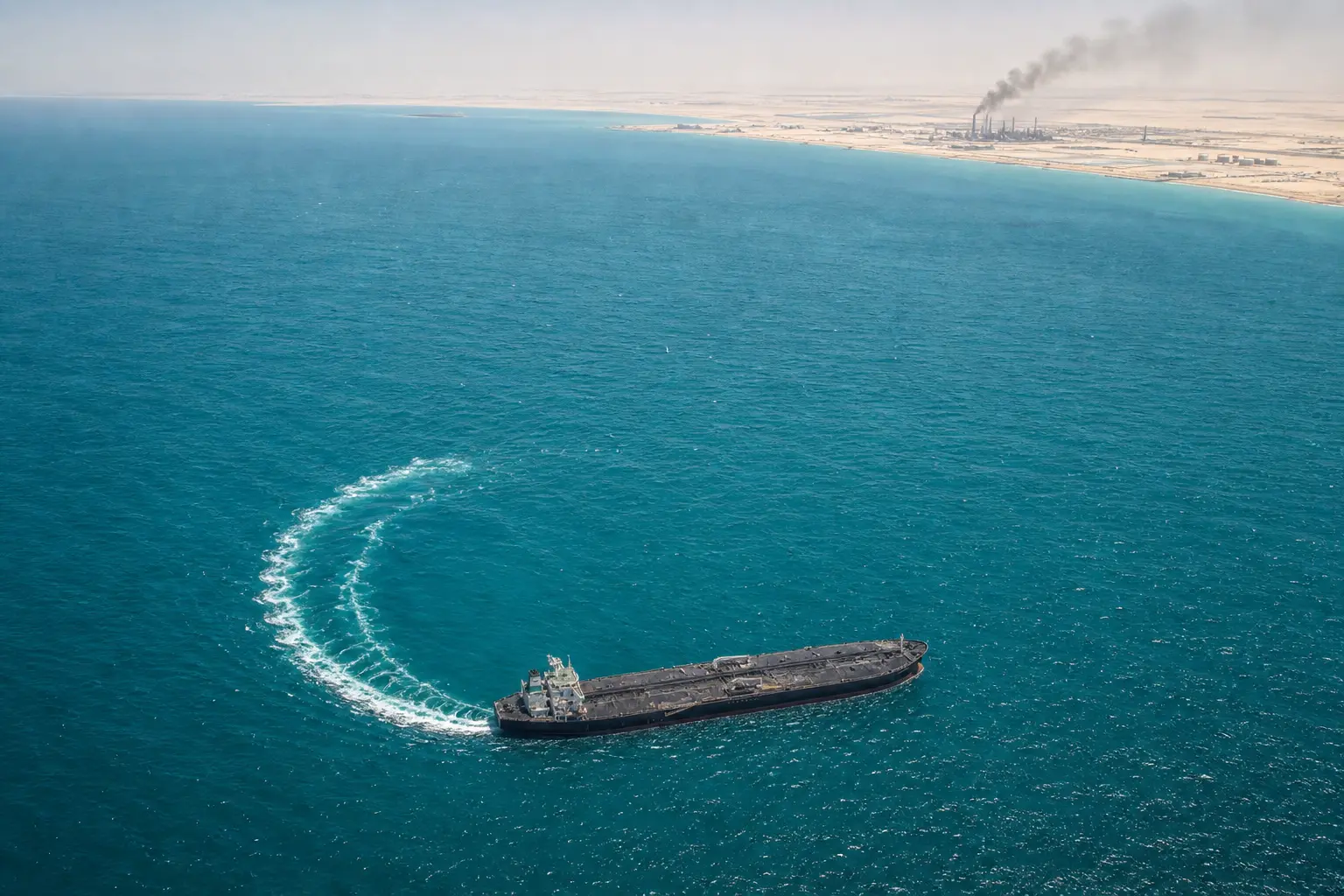
Satellite passes this week show the tanker berths at Saudi Arabia’s Ras Tanura and Kuwait’s main export terminals standing empty, with almost no loaded crude carriers waiting offshore. Houthi missiles hit two Saudi Aramco refineries on Saturday, the group’s first direct strike on the kingdom’s oil infrastructure in four years.
The missiles explain why crews are frightened. They do not fully explain why so many owners are leaving anyway. A committee of London underwriters had already priced much of the Gulf out of reach weeks earlier. That financial blockade is running alongside the military one, and it is landing hardest on countries that cannot easily replace the barrels, India chief among them.
Where the Tankers Went
Marine tracking data reviewed by shipping analysts this week shows the same pattern spreading from the Persian Gulf side of Saudi Arabia to its Red Sea coast: fewer port calls, longer idle periods offshore, and crews reluctant to hold position near terminals that have already taken fire once this year.
Two tankers carrying Saudi crude reversed course in the Red Sea after a Houthi warning earlier this month, according to shipping trade reports, turning back rather than risk the final approach to a Saudi terminal. Marine traffic data also showed the first confirmed crude loadings inside the Persian Gulf since early March, a detail that undercuts any assumption that Gulf shipping had already returned to normal before this week’s strikes.
Kuwait’s main crude export hub shows the same emptying pattern in recent satellite frames. That is notable because Kuwait had not been hit by anything. Its berths are clearing out on risk alone.
Yanbu Was Saudi Arabia’s Last Open Corridor
To understand why an unstruck Kuwaiti port would empty out, rewind to the war’s opening weeks. A drone strike on Aramco’s Ras Tanura refinery, on the Gulf side of Saudi Arabia, forced a shutdown and a reroute of exports toward the Red Sea. Iran had declared the Persian Gulf restricted to all nations except China, according to regional reporting, leaving Saudi Arabia dependent on Red Sea ports it had treated as a backup option.
Yanbu became the workhorse. Its two Aramco-run terminals list a combined 4.5 million barrels a day of loading capacity, split between a northern and a southern berth complex, enough to carry a large share of the kingdom’s seaborne exports once the Gulf route closed.
- February 28: The United States and Israel open a new war against Iran, setting off a chain of regional retaliation.
- Early March: A drone strike hits Ras Tanura; Aramco shuts the refinery and shifts exports toward Yanbu on the Red Sea after Iran restricts Gulf shipping.
- March 3: Lloyd’s Joint War Committee expands its listed high-risk zones to cover Bahrain, Kuwait, Oman, Qatar and Djibouti, turning the whole Arabian Gulf into a designated war-risk area.
- July 25: Houthi forces strike the Jizan and Yanbu Aramco facilities directly with dozens of missiles and drones, the group’s first hit on Saudi oil infrastructure since 2022.
Saturday’s strikes hit both ends of that backup plan at once. Yemen’s Houthi movement said it fired dozens of ballistic and cruise missiles and drones at Jizan and Yanbu, calling the operation retaliation for Saudi-led strikes on the port of Hodeidah and Kamaran Island. A fire broke out at the Jizan refinery, which processes about 400,000 barrels of crude a day; NASA’s FIRMS satellite monitoring service picked up an abnormal heat signature at the site in the early hours of Saturday local time.
Blockade for blockade and escalation for escalation.
Yahya Saree, the Houthi movement’s military spokesman, made that vow while claiming the Jizan and Yanbu strikes, promising to widen operations in the coming days. At Yanbu, initial reports said a Patriot battery staffed by Greek personnel intercepted two of the incoming ballistic missiles, drawing on the same finite stock of interceptors already stretched thin by the missile shortage on Jordan’s front in the wider Iran war, though that detail has not been independently verified. Saudi authorities and Aramco have not released a comprehensive damage assessment from either site.
Underwriters in London Are Rationing the Gulf
The Joint War Committee is not a government body or a navy. It is a working group inside the Lloyd’s Market Association, made up of underwriters who decide which waters count as too dangerous to insure at normal rates. When the committee places a stretch of ocean on its list, the effect on shipping is closer to a blockade than a warning.
Every vessel entering a listed area needs additional war-risk cover at the prevailing rate, or it sails uninsured. In practice, no port authority, lender or charter company will touch an uninsured ship, so the committee’s bulletin functions as a hard gate. It publishes a running list of areas of perceived enhanced risk for shipping, and that list now covers the entire Arabian Gulf plus stretches of the Gulf of Oman, the Gulf of Aden and the southern Red Sea.
None of that required a single missile to land on a specific ship. The designation alone was enough to reroute money, and money moved the fleet faster than fear did.
What Does It Cost to Insure a Tanker Now?
A very large crude carrier heading into the Persian Gulf now costs roughly $2 million to $3 million to insure for one voyage, brokers say, up from about $250,000 before the war. Overall Gulf war-risk premiums have climbed 340% since the fighting began in late February, and vessels linked to the United States, Britain or Israel are charged about three times the standard rate.
| Voyage or Vessel Type | Before the War | Now |
|---|---|---|
| VLCC, single Persian Gulf voyage | About $250,000 | $2 million to $3 million |
| Overall Gulf war-risk premiums | Baseline rate | Up 340% since February 28 |
| Saudi Red Sea voyages (Jizan, Al Shuqaiq) | Standard cargo rate | Up to 3% of insured value |
| US, UK or Israeli-linked vessels | Standard war-risk rate | About three times the standard rate |
Those numbers are before Saturday’s strikes are priced in. Underwriters typically reassess within days of a confirmed hit on a listed facility, and Jizan and Yanbu both qualify.
Shipowners Choose the Cape of Good Hope Over the Blockade
Ambrey, a UK-based maritime security firm that advises shipowners on threat levels, has sorted vessels into a high-risk category for Houthi attack using three criteria.
- Saudi-flagged vessels – any ship carrying the kingdom’s flag, regardless of cargo or route
- Saudi-owned or operated vessels – ships controlled by Saudi entities even when flagged elsewhere
- Red Sea-bound Saudi cargo – vessels sailing to or from the kingdom’s Red Sea ports, including Yanbu and Jizan
Marine insurers have begun refusing war-risk cargo cover for ships that fall into any of those three buckets. Some vessels carrying Saudi cargo have already turned back toward the Mediterranean, choosing a detour of thousands of extra nautical miles around the Cape of Good Hope over a Red Sea passage that underwriters will no longer touch at any price.
Marcus Baker, global head of marine, cargo and logistics at the insurance broker Marsh, has said insurers are charging more for Red Sea risk because their own sense of the danger has risen, not because every ship is a target. That distinction barely matters to an owner deciding whether a voyage pencils out. If the cover costs more than the cargo can bear, the ship does not sail the direct route, whether or not it would have been hit.
India and China Chase the Same Barrels of Russian Crude
China’s crude imports have fallen 41% as the Hormuz disruption ripples through its supply chain. Iran once supplied roughly 13% of China’s seaborne crude at a steep sanctions discount, and that flow has largely stopped, leaving a shortfall estimated at 1 million to 1.4 million barrels a day. The strait carries 45% to 50% of China’s total crude imports, but Beijing’s stockpiles can cover three to four months of demand.
India has less cushion. An estimated 50% to 55% of its crude oil and LNG imports transit the Strait of Hormuz, and its strategic petroleum reserves cover only eight to nine days of demand, far short of China’s buffer. India and China are now competing directly for the same alternative barrels, mainly Russian crude and, to a lesser extent, Saudi grades still finding a way to market.
India’s government has pushed back on suggestions that the squeeze is disrupting its energy diplomacy. Officials said the country still imports crude oil from 40 countries, and Petroleum Minister Hardeep Singh Puri has rejected claims that Iranian crude cargo bound for Vadinar was quietly diverted to China instead. Analysts tracking the fallout say India’s search for alternate crude grades is already raising refining costs, even before Saturday’s attack on Jizan and Yanbu is fully reflected in freight and insurance quotes.
Riyadh’s Options Are Narrowing Fast
Saudi Arabia built its Red Sea export corridor as insurance against exactly the kind of Gulf closure Iran imposed earlier this year. That backup has now taken a direct hit at both Jizan and Yanbu in the same operation, leaving the kingdom with fewer working alternatives than it had a week ago.
Riyadh is leaning on the US military buildup across the region to keep what export lines remain open, including the Patriot coverage now defending Yanbu. Yemen’s Houthi movement has promised more strikes in the coming days, and the Red Sea corridor once treated as Saudi Arabia’s last open oil corridor is the one now on fire.
Aramco has not said how much of Jizan’s 400,000 barrels a day remains offline. Brent crude was still trading above $100 a barrel late Sunday, roughly 40% higher than where it started the month.
