
Jordan has digitized 85.5 percent of its targeted government services and is pushing to finish the remaining eligible ones before 2026 ends. Minister of Digital Economy and Entrepreneurship Sami Smeirat told the Jordan News Agency Petra the figure climbed from 82.5 percent in the first quarter, part of a four-year shift from scattered projects to one citizen-centered system.
The same push has lifted the Sanad national digital identity app past 2.88 million active users while making digital ID mandatory for public services. The next stretch will test whether that coverage turns into everyday use backed by AI and new skills.
The Numbers Behind the Push
Smeirat framed the gain as alignment with the country’s Economic Modernization Vision goals. The ministry is re-engineering procedures at the same time it moves them online, aiming for speed and fewer paper steps for citizens and investors.
- 85.5% of targeted government services now digitized
- 2.88 million active Sanad digital identity users
- 15 comprehensive service centers handling roughly 200,000 monthly transactions
- 98% user satisfaction at those hybrid centers
Mobile internet already reaches about 99 percent of the population and more than 90 percent of citizens own smartphones, giving the digital channels a wide base. Digital signatures and pure online access are rising alongside the centers.
| Metric | Latest Figure | Context |
|---|---|---|
| Digitized services | 85.5% | Up from 82.5% in Q1 2026; full eligible target end-2026 |
| Sanad users | 2.88 million | Grew from 2.4 million in May |
| Service centers | 15 | 229 services from 34 public entities |
| Monthly citizens served | Over 120,000 | About 200,000 transactions |
Officials present the 85.5 percent of targeted procedures digitized as proof the fragmented phase is ending.
The three-point rise since the first quarter shows the remaining eligible services are moving in batches rather than one by one. That pace matters because the year-end target leaves little room for another slow quarter. Re-engineering work runs in parallel so a service that goes online is already stripped of spare paper steps.
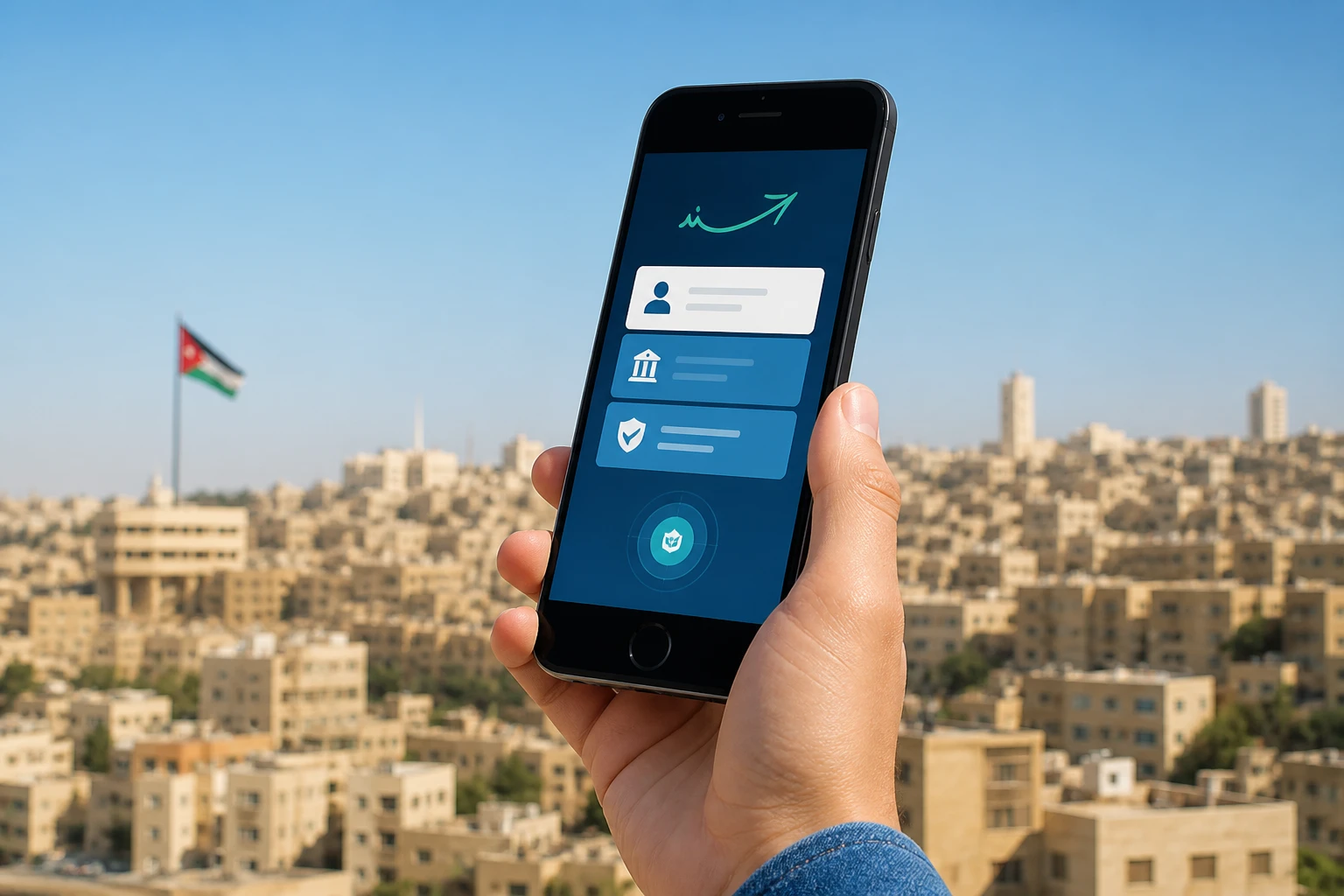
Sanad Turns Iris Scans Into Everyday ID
Sanad is the single gateway. It carries the digital ID that now has full legal status under the amended Civil Status Law published in May. The app relies on IrisGuard iris biometrics for digital ID verification, letting users activate identities remotely without a station visit after earlier upgrades.
By May the user count had already passed 2.6 million, with hundreds of thousands added since the start of 2026. More than 17,000 school certificates had been issued through the platform that same month. Digital ID became mandatory for accessing public services in April, removing the option to stay fully offline for many transactions.
- Start of 2026: Hundreds of thousands of new Sanad users begin joining the platform.
- April 2026: Digital ID becomes mandatory for access to public services.
- May 2026: Amended Civil Status Law gives the digital ID full legal status; user count passes 2.6 million and more than 17,000 school certificates issue through the app.
- Later tracking: Active users reach 2.88 million as remote iris activation continues to cut station visits.
Local users notice the practical change. One Jordanian developer posted that citizens no longer need to carry a physical ID card or driving license because everything sits in the app, calling it a rare clear win. That lived experience matches the official growth curve.
The same biometric layer appears in related experiments, including facial recognition trials at Jordanian schools, showing how identity tech is spreading across public life.
Remote activation matters for citizens abroad as much as for those at home. Once the iris record is on file, the legal digital ID travels with the phone. That removes a classic friction point for expatriates who once needed consular visits for routine civil status tasks.
How the Maturity Scoreboard Moved
Coverage percentages alone do not capture quality. The United Nations ESCWA Government Electronic and Mobile Services Maturity Index scored Jordan at 71 percent on the 2025 GEMS index, up eight points from 63 percent in 2024 and the highest mark in four years.
The climb from 59 percent in 2022 to 71 percent now places the kingdom in the “advanced” maturity category. Jordan’s one-year jump exceeded the total gains of the prior two years combined.
| GEMS Pillar or Indicator | Jordan Score |
|---|---|
| Overall 2025 | 71% |
| Interoperability among institutions | 97% |
| Portal service development | 95% |
| Open government data | 95% |
| Service continuity | 91% |
| Digital channel security | 89% |
| Access via digital identity | 80% |
| Service availability and development | 72% |
| Usage and user satisfaction | 65% |
| Public outreach | 82% |
The assessment covered 99 priority services from 41 institutions. High interoperability and open data scores show back-end plumbing is catching up with the front-end apps. The lower usage pillar flags the remaining work: getting more people to prefer the digital path every time.
The Kingdom shifted from isolated digitalization efforts to building an integrated, citizen-centric digital government ecosystem built on efficiency, speed, and accessibility.
Smeirat made that point when he described the four-year arc to Petra.
Read together, the pillar scores explain the shape of the gain. Interoperability at 97 percent and portal development at 95 percent mean agencies can already share records and expose services through one front door. Usage at 65 percent shows that technical readiness still outruns habit. Closing that gap is now the clearer test of the program.
Hybrid Centers Keep the Door Open
Not every resident will go fully digital overnight. The 15 comprehensive government service centers blend physical counters with digital tools under one roof. They deliver 229 services drawn from 34 public entities and process roughly 200,000 transactions a month for more than 120,000 citizens.
The 98 percent satisfaction rate suggests the hybrid model works as a bridge. Citizens who still want face-to-face help, or who need help activating Sanad, can finish multiple tasks in a single visit. The centers also function as on-ramps that feed more people into the pure digital channel over time.
Because each center pulls services from dozens of entities, a single trip can replace what used to be a circuit of separate offices. Staff on site can walk a first-time user through Sanad activation, then complete the underlying transaction while the new digital ID is live. That sequence turns a potential exclusion point into a conversion moment.
- One roof covers 229 services from 34 entities
- Monthly load runs near 200,000 transactions
- More than 120,000 citizens use the centers each month
- Measured satisfaction holds at 98 percent
AI, Automation and Skills Define the Final Stretch
Smeirat said the next phase will expand artificial intelligence inside service delivery, strengthen data management and automation, and push digital skills so the workforce can support a digital economy. The goal is proactive services that anticipate needs rather than simply reacting to applications.
Full digitization of every eligible service by December creates the data foundation those AI tools require. Without clean, interoperable records the algorithms stay limited. The same holds for skills: high smartphone ownership helps citizens, yet government staff and private-sector partners still need training to redesign processes around the new stack.
The Economic Modernization Vision already lists higher competitiveness, better government efficiency and improved quality-of-life rankings among its targets. Completing the digital layer in 2026 is meant to accelerate those outcomes rather than stand alone.
Proactive service design depends on the same interoperability score that already sits near the top of the GEMS table. When institutions share clean records, an AI layer can flag a renewal before a citizen asks, or pre-fill an investor form from existing licenses. Skills training determines whether staff trust those prompts enough to redesign the counter workflow around them.
How One Gateway Replaces Scattered Projects
The four-year arc Smeirat described is visible in the way Sanad now sits above the older patchwork. Earlier efforts left citizens with separate logins and paper hand-offs between agencies. The super-app model collapses those steps into one verified identity that already carries legal weight.
High interoperability among institutions makes that collapse possible. A 97 percent score on that pillar means the back-end connections required for a single gateway are largely in place. Portal service development and open government data, both at 95 percent, supply the content that gateway can surface.
Investors and ordinary residents gain from the same architecture. Fewer duplicate forms and fewer agency-by-agency visits cut time on both sides of the counter. The hybrid centers remain available for anyone who still needs a guided first step, so the shift does not depend on every user arriving fully digital on day one.
That design choice also sets up the AI phase. Shared records and a common identity layer give automation something coherent to read. Scattered projects could not have supplied the same foundation.
A Quiet Regional Contender Takes Shape
Fellow Gulf states, notably the UAE, sit closer to full digital government benchmarks. Jordan’s combination of near-universal mobile coverage, a single super-app, legal digital ID and rising GEMS scores positions it as a denser, more integrated model for smaller populations. The iris-backed identity reduces fraud risk and speeds remote activation for citizens abroad as well as at home.
Success will show up in transaction volumes, reduced processing times and whether the usage pillar of the next GEMS report climbs with the availability numbers. Failure modes are familiar: services that exist online but remain hard to complete, or new exclusion for anyone left offline. The hybrid centers and skills push are the insurance policies against both.
By the time the calendar turns to 2027 the percentage will either be a finished baseline or a reminder that digitization without adoption is only half the job. Current momentum, user growth and the minister’s public timeline all point toward the first outcome.
Why the Usage Pillar Still Trails the Rest
Availability and back-end scores have moved faster than daily habit. Service continuity at 91 percent and digital channel security at 89 percent show the channels are ready. Usage and user satisfaction at 65 percent show many citizens still treat the digital path as optional when a familiar counter remains open.
The April mandate narrowed that option for public services, which helps explain the sharp climb in Sanad users through the year. Mandatory access alone does not guarantee smooth completion. If a form still stalls or a supporting document still requires a separate visit, users bounce back to the hybrid centers or abandon the task.
That is why the skills and automation work in the final stretch matters as much as the last percentage points of digitization. Staff who can redesign a process around the app turn a mandatory login into a faster outcome. AI that pre-fills known data reduces the chance a user hits a blank field and walks away.
The next GEMS cycle will reveal whether usage rises with the finished coverage map. Until then the hybrid centers, the 98 percent satisfaction they already post, and the continued growth of active Sanad accounts remain the best live indicators that adoption is catching the infrastructure.
Frequently Asked Questions
What is Jordan’s Sanad app and how does it work?
Sanad is the official government super-app that issues and stores a legally valid digital identity verified by iris biometrics, then routes users to hundreds of public services across health, education, finance and civil status without needing separate logins for each agency.
When did digital ID become mandatory for Jordanian public services?
Digital ID became mandatory for access to public services in April 2026, and the Sanad-issued digital identity received full legal equivalence to the physical national ID card under the amended Civil Status Law published in May 2026.
How did Jordan’s score change on the UN ESCWA GEMS index?
Jordan rose from 63 percent in 2024 to 71 percent in the 2025 assessment, an eight-point gain that marked its highest result in four years and moved it into the advanced maturity category after earlier scores of 59 percent in 2022 and 64 percent in 2023.
Which company supplies the iris biometrics for Sanad?
IrisGuard provides the iris biometric technology that powers identity verification and activation inside Jordan’s Sanad digital ID system, including remote activation options for citizens and expatriates.
What share of Jordan’s population can reach digital services today?
Mobile internet covers roughly 99 percent of the population and more than 90 percent of citizens own a smartphone, giving the large majority practical access once they activate a Sanad identity.
