
Egypt inaugurated its Water Museum on 4 August 2026 in the New Administrative Capital, with Water Resources and Irrigation Minister Hani Sewilam calling the collection a strategic asset for future development rather than a simple cultural display. The opening gathered Transport Minister Kamel El-Wazir, Environment Minister Manal Awad, other senior officials, EU representatives and Grand Egyptian Museum CEO Ahmed Ghoneim.
Sewilam framed the project as documentation of “a long journey of work, science and achievement in water resources management” that now feeds the ministry’s second-generation Water 2.0 programme.
What Visitors Will See
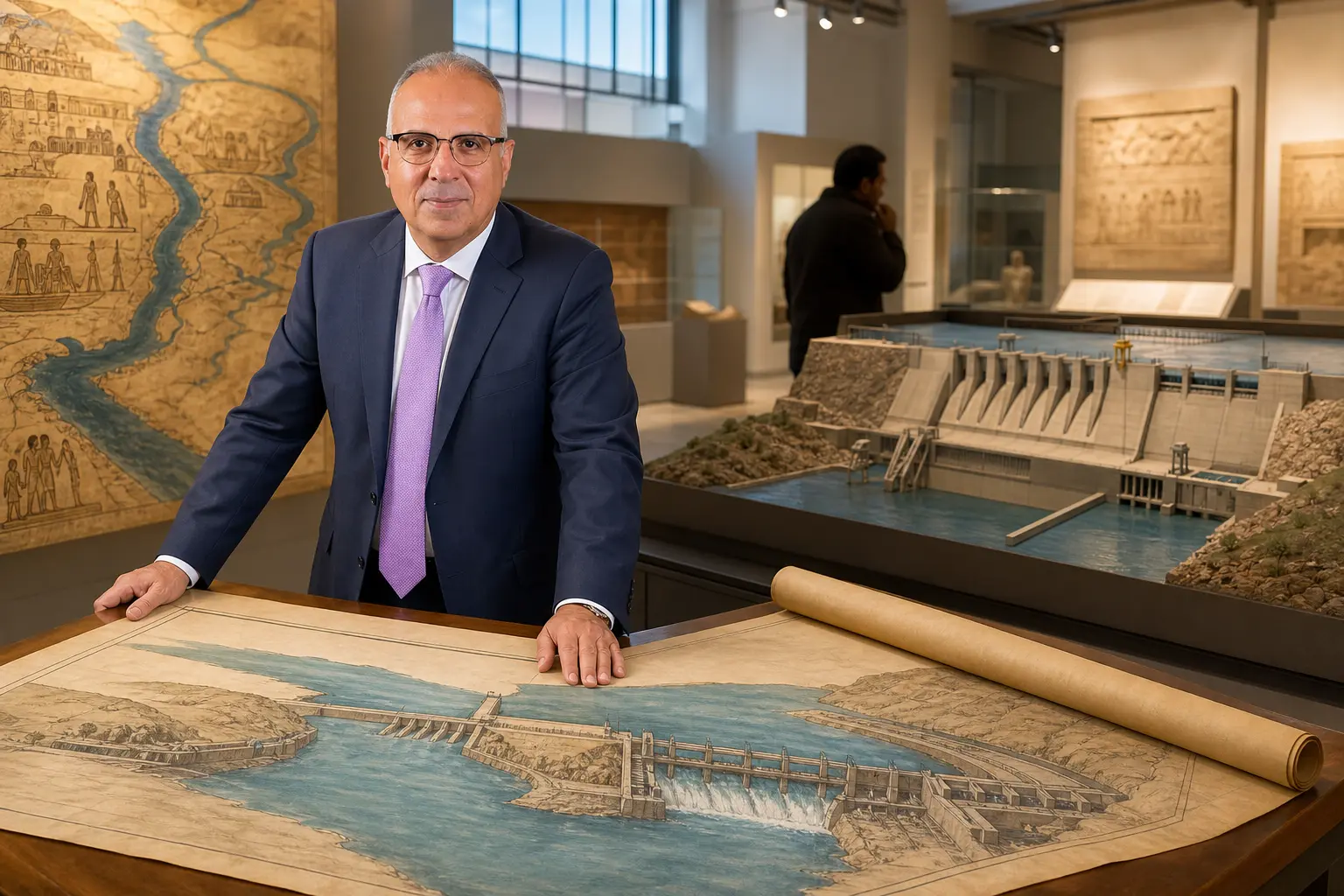
The museum sits inside the ministry’s New Administrative Capital building. It holds historical documents, engineering drawings, maps, artefacts, scientific instruments, engineering models, rare books and interactive screens. A High Dam Panorama is among the restored and digitised displays.
- Archival maps and technical drawings that trace canal and barrage design across decades
- Physical models of major hydraulic works and scientific tools once used in the field
- Digitised reports and interactive stations aimed at students and researchers
- The High Dam Panorama as a centrepiece of modern infrastructure memory
Ministry statements earlier described the space as both cultural landmark and educational tool. Sewilam said it will serve researchers, students and the public interested in Egypt’s water heritage while raising awareness of scarcity and sustainable use.
Water 2.0 Turns Memory Into Operating System
The museum is explicitly tied to Water 2.0, the ministry’s current framework. That programme rests on roughly ten pillars: water treatment and reuse, smart management, digital transformation, infrastructure rehabilitation, climate adaptation, governance and institutional development, plus capacity building.
Stats snapshot of the current push:
- New Delta conveyance for the wastewater treatment plant: 79% complete, 13 pumping stations, 174 km network, targeting 362,000 feddans
- Bahr El-Baqar routes to Sinai reclamation: 89% complete, 18 stations, 105 km, targeting 456,000 feddans
- Canal and drain clearance last water year: about 33,000 km of canals and 22,000 km of drains
- Structures assessed: 55,998 nationwide, with 508 already contracted for replacement
Digital tools now include satellite and drone monitoring, AI for encroachments, a digital twin of the Ismailia Canal and electronic groundwater licensing. The museum’s role is to keep the human and technical knowledge base intact so these systems have trained people and historical reference points. Egypt has also pursued Japanese water technology partnerships as part of the same modernisation track.
The Nile’s Fixed Share and Rising Demand
Egypt’s formal annual Nile allocation remains 55.5 billion cubic metres under the 1959 agreement with Sudan. That figure has not risen with population. Per-capita renewable water has fallen well below the 1,000 m³ scarcity line and sits in the mid-500s to low-600s m³ range in recent official and research estimates. Agriculture still dominates consumption, and conveyance plus field efficiency leave room for large savings.
A detailed look at historical Nile consumption patterns shows Egypt has long used more than the strict allocation through reuse, Sudan’s unused share and modest flow increases, while virtual water imports filled the food gap. The museum arrives as the country accelerates reuse plants, canal lining, smart irrigation and coastal protection precisely because the old margin is gone.
From Nilometers to Digital Twins
Egypt’s water story is one long technical continuum. Ancient nilometers measured flood height to set planting and tax levels. Pharaonic canal networks and later Islamic and colonial barrages expanded control. The 20th century brought the Aswan High Dam and a national irrigation bureaucracy. The new museum houses the paper and object trail of that bureaucracy.
- Ancient period: nilometers and basin irrigation calibrated to the annual flood
- 19th-early 20th century: perennial irrigation, major barrages and the first modern surveys
- High Dam era: year-round storage, expanded cultivated area and the rise of the modern ministry
- Current decade: reuse mega-plants, digital monitoring, Water 2.0 institutional reforms and heritage preservation
Sewilam has repeatedly linked ancient engineering pride to today’s requirements. The museum makes that link physical.
The museum documents a long journey of work, science and achievement in water resources management and reflects the contributions of generations of engineers, scientists and ministry staff to Egypt’s development.
Sewilam said those words at the opening. The ministry post on the inauguration repeated the same institutional-memory theme and listed the High Dam Panorama among the exhibits.
Other Ministry Museums and the Education Bet
The Water Museum is not the ministry’s first. It already runs the Revolution Museum, the Children’s Water Science Museum at Qanater El Khairiya and the African Cultural Museum in Aswan. Sewilam announced plans for a further museum at the Egyptian Survey Authority. Together they form a small network aimed at different audiences: children, African partners, technical staff and now a general capital-city public.
In the broader Middle East museum landscape, specialist technical museums remain rarer than archaeological or art collections. Egypt is using the water series to keep specialised knowledge public and usable rather than locked in ministry basements.
Who Gains Immediate Practical Value
Researchers and engineering students gain a single accessible repository of drawings and reports that once sat in scattered archives. Ministry trainees already cycle through hundreds of courses each year; the museum supplies case material. Foreign diplomats and partners who attended the opening saw a soft-power statement that Egypt treats water expertise as national capital.
Farmers and urban users feel the effect only indirectly, through better-trained operators and higher public pressure for efficiency. Awareness campaigns are one of the explicit goals. Whether school groups and tourists actually fill the galleries will decide how far the second-order effect reaches.
| Project / Metric | Status or Scale | Target Benefit |
|---|---|---|
| New Delta conveyance | 79% complete | 362,000 feddans reclamation support |
| Bahr El-Baqar-Sinai links | 89% complete | 456,000 feddans irrigation water |
| Canal clearance (prior year) | ~33,000 km | Improved delivery efficiency |
| Drain clearance (prior year) | ~22,000 km | Reduced waterlogging and salinity |
| Structures assessed | 55,998 | Prioritised rehab and replacement |
These numbers sit inside the same Water 2.0 frame that the museum is meant to support. The archive does not move water by itself. It keeps the knowledge that does.
How the Archive Changes Daily Practice
Digitised maps and models become reference material for the digital twin and AI monitoring systems already rolling out. Young engineers can see the design logic behind older barrages before they redesign gates or add telemetry. Public exhibits turn abstract scarcity statistics into concrete stories of how previous generations stretched the same river.
Fanack’s overview of Egypt’s long-term water security targets shows the scale of investment still required. The museum is a low-cost, high-symbolism piece of that larger effort: preserve what worked, teach it widely, and free the next generation to innovate on top of it rather than rediscover basics under crisis pressure.
The Water Museum is now open. Its value will be measured in how many students, operators and citizens treat the institutional memory as a working toolkit instead of a closed chapter.
Frequently Asked Questions
What exactly does the Egypt Water Museum display?
It displays historical documents, engineering drawings, maps, artefacts, scientific instruments, physical models, rare books, interactive screens and a High Dam Panorama, all focused on the evolution of Egypt’s water sector and ministry work.
How does the museum connect to Egypt’s Water 2.0 strategy?
Sewilam stated the project aligns with Water 2.0 by preserving historical knowledge and technical expertise while the strategy modernises management through digital tools, reuse, infrastructure upgrades and institutional capacity building.
What other water museums does the ministry already operate?
The ministry runs the Revolution Museum, the Children’s Water Science Museum in Qanater El Khairiya and the African Cultural Museum in Aswan, and has announced plans for a museum at the Egyptian Survey Authority.
What is Egypt’s official annual Nile water allocation?
Egypt’s share stands at 55.5 billion cubic metres per year under the 1959 agreement with Sudan; that fixed volume now serves a population well above 100 million and drives the efficiency and reuse push.
Where is the new Water Museum located?
It is housed in the Ministry of Water Resources and Irrigation building in Egypt’s New Administrative Capital and opened to mark the institutional archive’s formal launch on 4 August 2026.
