
Dr. Aid Qudami has spent eleven years treating patients in the Palestinian Authority clinic in Qalqilya. For the past month, the family physician and his colleagues have stayed home, leaving the facility shuttered as part of a strike that has closed most of the government-run clinics across the West Bank.
Behind the strike lies a fiscal collapse: the Palestinian Health Ministry is roughly NIS 3.5 billion ($1.2 billion) in debt, the result of a year-long freeze by Israel on the tax revenues it collects on Ramallah’s behalf. The territory’s healthcare system is straining under the weight, Israeli volunteers are running mobile clinics to fill the gap, and Israel’s own medical association has warned Prime Minister Benjamin Netanyahu that the crisis is becoming a regional public health threat.
How the Strike Began
The Palestinian Medical Association declared the strike on May 9, calling on doctors across the West Bank to halt work in government hospitals and clinics until the Palestinian Authority addresses a financial squeeze that has made basic operations nearly impossible. The order was issued as unpaid salaries, missing medications, and overdue supplier bills pushed the public system to a near-standstill. By mid-June, most government-run primary care had stopped.
Qudami said the action is about more than pay. “The strike is happening because I sit in the clinic and cannot help patients,” he told the strike that closed hundreds of clinics across the West Bank. The Palestinian Medical Association has not published a precise figure for the number of facilities affected. Physicians for Human Rights Israel, an Israeli NGO that tracks conditions in the territory, says most of the West Bank’s government-run clinics are closed, with a minority operating only one or two days a week.
A Ministry Drowning in Debt
The strike is the latest consequence of a financial deterioration in the Palestinian Authority that stretches back years. Israel collects customs duties and other levies at border crossings and ports on Ramallah’s behalf, then transfers the funds. Those transfers normally account for roughly 60 percent of the PA’s income.
The freeze began in 2019, when Israel started deducting sums to offset stipends the PA paid to convicted Palestinians and their families. After the October 7, 2023, Hamas-led massacre, Israel also began withholding funds earmarked for Gaza, including pensions for Gazans employed by the PA before Hamas seized the strip in 2007. Over the past year, the freeze has been total, carried out on the orders of Israeli Finance Minister Bezalel Smotrich. Smotrich has framed the move as a response to what he described in an April statement as the PA’s “activity against the State of Israel in the international arena and its support for the encouragement of terrorism.” The PA has separately faced longstanding allegations of corruption and financial mismanagement.
Palestinian Authority Finance Minister Estephan Salameh put the cost in cash terms. In the Palestinian finance minister’s $5.7 billion figure from June 10, he described the PA as in “survival mode and under an existential threat” and warned of possible collapse in education, healthcare, and security. The freeze has forced the perennially cash-strapped PA to cut public-sector salaries and slash services, including in healthcare. The PA’s condemnation of 19 new Israeli settlement approvals reflects a parallel friction between Ramallah and Jerusalem over Israeli moves in the territory.
France has begun to push back. On June 9, French Foreign Minister Jean-Noël Barrot announced that Smotrich would be barred from entering France, citing a policy that “actively promotes the annexation of the West Bank” and leads to “the economic collapse of the Palestinian Authority.” Netanyahu has not publicly responded to the mounting international pressure.
What the Shelves No Longer Hold
For Palestinians who rely on government hospitals, the freeze shows up first in the pharmacy. Dr. Salah Haj Yahya, an Israeli citizen from Taibe, has run Physicians for Human Rights Israel’s mobile clinic for nearly 40 years and keeps close ties with Palestinian health workers across the territory. He said the deterioration in medicine stocks over recent months is the worst he has seen. He added that PHRI’s mobile clinics have become one of the few ways patients can still get treated for chronic conditions.
Under normal conditions, the Palestinian Health Ministry keeps stocks of roughly 1,200 types of medication. These days, between 800 and 900 of those medicines are in short supply. Painkillers and drugs for chronic conditions such as hypertension and diabetes have largely disappeared from government pharmacies. On May 23, the Palestinian Health Ministry warned of a “critical depletion” of life-saving medications in the West Bank, including cancer drugs. The shortfall means that procedures that depend on routine supplies, from joint replacements to cancer infusions, are being postponed.
The shortfall traces back to a debt pile owed mostly to around 30 major Palestinian suppliers who import drugs and equipment from abroad, according to Physicians for Human Rights Israel. The ministry’s mounting debts have led many of those suppliers to halt shipments until they are paid for earlier deliveries. Virtually all medical supplies used in the West Bank are imported; the territory has no significant local pharmaceutical manufacturing capacity.
| Sector | Facilities | Status under the freeze |
|---|---|---|
| Government (PA Health Ministry) | 15 hospitals, 447 public clinics | Operating on emergency-only basis; most primary care shut |
| Non-government (private and nonprofit) | 38 hospitals | One Bethlehem hospital stopped accepting ministry referrals in February over NIS 80 million in unpaid bills |
| PHRI mobile clinics | Event-based deployments | One-day treatment camps in villages across the West Bank |
Half a Salary, Half a Health System
The crisis has hit the workforce directly. Since 2021, the Palestinian Authority has failed to pay its public-sector employees their full salaries, only disbursing money after significant delays.
In April, the PA began paying out January salaries, capping each at NIS 2,000 ($650) per employee, regardless of position. Senior employees once earned up to NIS 10,000 ($3,300) per month; even under the old system, at most half that amount would be garnished. During the week of Eid al-Adha in late May, partial payments of roughly 50 percent of wages were made. Qudami received about NIS 3,000 ($1,000) that week for his February wages. On June 25, the Palestinian Finance Ministry announced that employees had been paid 50 percent of their March salaries, or at least NIS 2,000.
- 1,200 medications normally stocked by the PA Health Ministry
- 800 to 900 of those medications currently in short supply
- 30 major Palestinian drug suppliers owed money by the ministry
- NIS 2,000 ($650) per employee: April salary cap from the PA
- NIS 80 million: outstanding debt that led a Bethlehem hospital to stop accepting ministry referrals in February
An emergency room physician at the government-run Thabet Thabet Hospital in Tulkarem, who spoke to The Times of Israel on condition of anonymity, said three medical residents in her department are completing their specialty training on a voluntary basis, receiving no pay. The salary cuts, she added, are one part of the strain; the rest comes from the inability to provide services. “It’s bad, but they have to do it to complete their training,” she said of the unpaid residents. “The difficult part is not only that we’re receiving half salaries. It’s that we’re unable to provide services to patients.”
On June 9, the Palestinian Medical Association announced a partial restoration of services intended to allow talks with the government. Physicians for Human Rights Israel says most clinics remain closed and government hospitals continue to operate on an emergency-only basis. An emergency room physician in Tulkarem said patients now receive roughly half the medications they need and only the most urgent cases are being treated.
Mobile Clinics Now Run by Israeli Volunteers
For Palestinians shut out of government care, Physicians for Human Rights Israel is among the few outside groups filling the gap. Haj Yahya, the longtime head of its mobile clinic, said demand has surged in recent weeks. “I receive dozens, if not hundreds, of requests every day from Palestinian patients seeking even the most basic medications,” he said. “That includes all types of insulin, as well as medicines for cancer patients and kidney patients. They simply are not available in the West Bank.” The program Haj Yahya runs is the same one described in the mobile clinic program PHRI has run since 1988, with weekly visits now drawing numbers far beyond past norms.
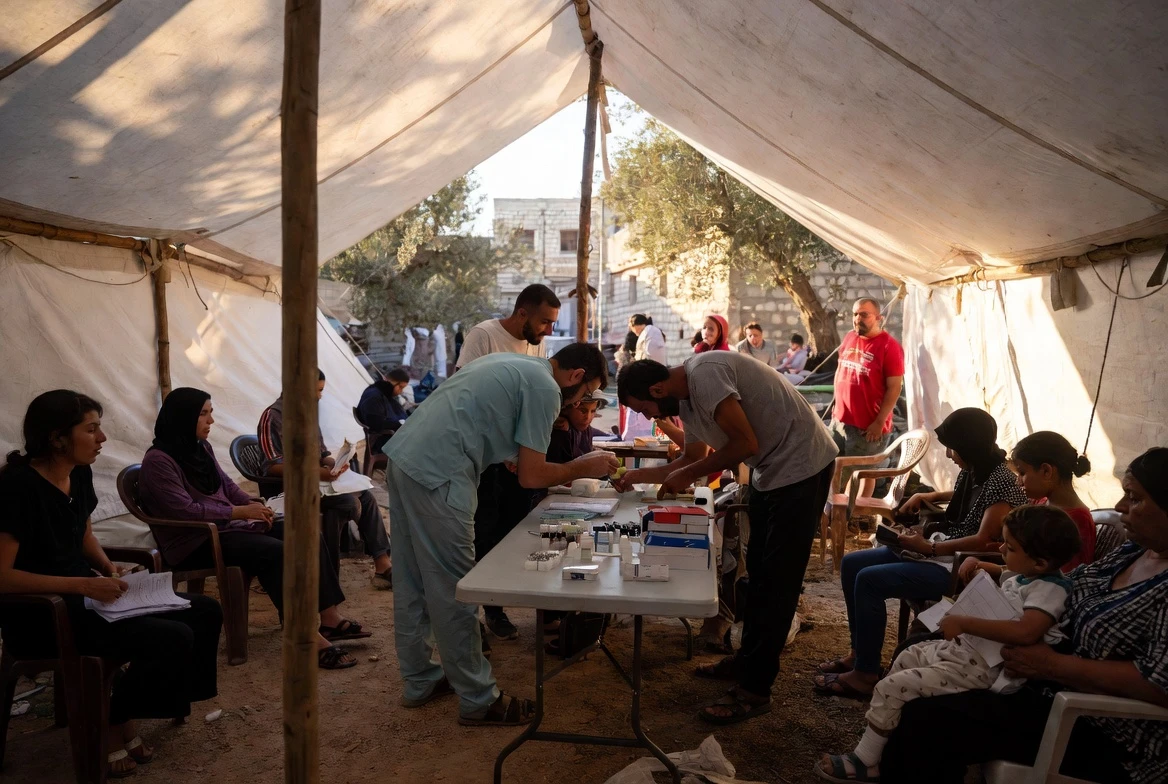
On June 9, PHRI volunteers set up a mobile clinic in the village of Nasariya near Nablus. Over roughly seven hours, Palestinian doctors treated 371 people, examining patients, running tests, and handing out medication free of charge. Haj Yahya said early June brought another surge near Jenin, where more than 750 people came through in a single day. “In the past, we would see 200 or 250 patients in a day. When 300 showed up, we would say it had been a crazy, exhausting day,” he added. “But in early June, more than 750 people came to a treatment day in a village near Jenin. The doctors worked from the morning until almost six in the evening.”
Qudami joined the Nasariya clinic, the first time in several weeks he had practiced medicine. He described deep frustration with salaries still being slashed and his ability to treat patients eroding. His routine has shifted from treating patients in a clinic to handing out what little medication PHRI volunteers can spare in village tents. He is one of hundreds of doctors across the West Bank who have effectively stopped doing their day jobs as the strike grinds on.
A patient comes to the clinic, and I have no medication to give him. I don’t have the ability to run tests. What am I supposed to do? If the patient doesn’t receive treatment, his condition will continue to worsen until he dies.
An Israeli Medical Warning to Netanyahu
Israel’s medical establishment is starting to treat the crisis as its own. On June 7, Israel Medical Association head Prof. Zion Hagay sent a letter to Netanyahu warning that the closure of clinics, medication shortages, and surgical delays are creating “a severe humanitarian crisis with direct implications for public health and regional stability.” Hagay urged Netanyahu to reconsider the withholding of Palestinian tax revenues and to find a mechanism that would allow transfers to resume, particularly for healthcare. His letter marks a rare instance of the IMA attempting to steer foreign policy. The association has faced calls within the World Medical Association for a boycott over the war in Gaza.
Netanyahu has not publicly responded to Hagay’s letter. Egypt’s condemnation of Israel’s West Bank land registration is part of the same regional pushback. The broader economic backdrop underlines how thin the safety net has become: a World Bank report published in May, cited by Le Monde, found unemployment above 27 percent in the West Bank, with 18 percent of the population living in poverty. Asked whether he fears the collapse of the West Bank healthcare sector, Qudami responded with a bitter laugh: “Doctors have stopped showing up to primary healthcare centers. They’re closed. The collapse has already happened.”
