
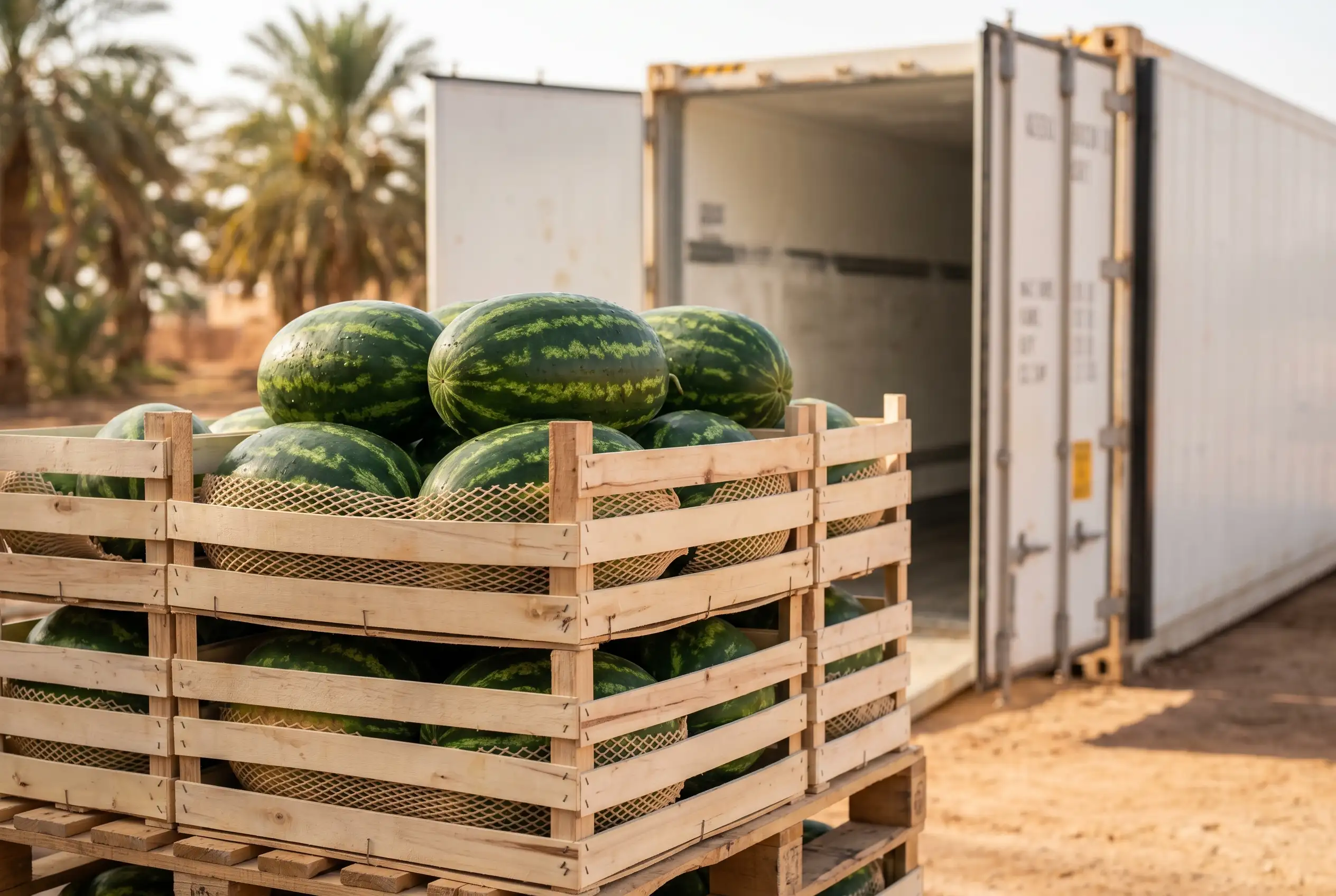
Egypt has sent its first containers of watermelon to Europe this season, and the test market is Austria. Walid Sallam, head of export at Suez Canal Trade & Agricultural Development Company, says one trial container went out, sold through to repeat orders, and the firm now ships three a week into a continent that buys close to half a million tonnes of imported watermelon a year.
Egypt is arriving in the middle of summer against Morocco, Spain, Italy and Greece, suppliers with decades of shelf space, and under a food-safety regime that has already flagged residue problems on other Egyptian fruit. The first deliveries sold fast, and Sallam wants a permanent place on European shelves within a few years.
Three Containers a Week, Starting in Austria
Sallam’s company picked Austria for its first European shipment this season. The trial container moved despite landing in a window already crowded with fruit from Morocco, Italy and Greece, and the buyers came back for more. From there the firm scaled to three containers a week, its first season of European trade after years of selling mainly into the Gulf.
Getting the fruit to land in good condition took planning before a single box was loaded. Sallam says the company drew its watermelons from Upper Egypt, picking harvests that met European residue limits and the size and look that European buyers expect. The transport protocol controlled temperature, humidity and ventilation, and routed the fruit on the shortest possible run straight to importers’ warehouses.
We shipped our first trial container of watermelons to the European market this season, specifically to Austria. The trial was a success despite overlapping with well-established suppliers such as Morocco, Italy, and Greece, and we are currently shipping three containers a week for our very first season.
That is Walid Sallam, head of export at Suez Canal Trade & Agricultural Development Company, a grower and exporter based in Egypt. Timing helped him. The first deliveries coincided with a warm spell across several European regions, the kind of weather that empties watermelon shelves fastest.
Why Does Egypt Export Crimson but Eat Giza?
Most watermelon grown in Egypt never leaves the country. The dominant variety is Giza, developed by the Egyptian Agricultural Research Centre, and it covers about 80% of the country’s watermelon area. It is round, dark green, heavy and sweet, with a Brix (a measure of sugar content) of 12 to 13. Egyptian shoppers like it that way and tend to buy whole, large fruit, which keeps domestic demand high.
Crimson is the export answer. Known across world markets for its elongated shape, dark-green stripes and a slightly lower Brix of 10 to 12, it went into Egyptian fields only about five to seven years ago, and almost entirely for buyers abroad. Local appetite for it was thin next to the pull of Giza.
To get growers to plant a fruit their neighbours would not buy, exporters leaned on contract farming, guaranteeing a home for the crop before it went in the ground. That model let Crimson acreage expand season by season and gave shippers the volumes they needed to chase foreign orders.
| Trait | Giza | Crimson |
|---|---|---|
| Share of Egyptian area | About 80% | Growing minority |
| Shape | Round | Elongated |
| Skin | Dark green | Dark green with stripes |
| Brix (sugar) | 12 to 13 | 10 to 12 |
| Main market | Domestic | Export |
The Suppliers Egypt Has to Squeeze Past
Europe is a big, growing buyer. Imports climbed from 428,000 tonnes in 2019 to 496,000 tonnes in 2023, a 16% rise over five years, according to the watermelon import volumes recorded by the CBI, the Centre for the Promotion of Imports from Developing Countries (CBI), the Dutch foreign ministry’s trade agency. Outside its own summer, the bloc leans on imports from roughly October to April, with non-EU fruit starting to arrive as early as late March.
The supply map is already drawn. Africa accounts for about 50% of Europe’s watermelon imports, almost all of it Moroccan; Latin America adds 20%, led by Costa Rica; and the Middle East supplies 15%, mostly Turkey. France sources 88% of its imported watermelon from Morocco, Spain 69%. Inside the EU, Spain and Italy are the heavyweight growers.
| Supplier | European window | Volume / share |
|---|---|---|
| Spain | Peak summer | ~484,000 t, EU’s largest supplier |
| Italy | Summer | ~185,000 t, second EU producer |
| Morocco | April to June | ~159,000 t to EU (9.6%) |
| Egypt | May to July | Trial volumes, near zero |
Egypt is the name missing from that picture. The CBI’s market profile does not list it among watermelon suppliers at all, which is the gap Sallam is trying to fill.
A Harvest Calendar That Lines Up With European Demand
Egypt’s edge is timing and geography. The watermelon season opens in May and fresh fruit keeps coming until late July, the exact window when European demand peaks. Production rolls across the country to keep the harvest continuous:
- Upper Egypt and Aswan open the season in the south.
- Minya, in the centre, picks up next.
- The northern provinces of Damietta and Beheira close it out.
That rolling harvest, paired with Egypt’s location, lets exporters run weekly shipments to several European markets. Morocco fills the early slot from April to June, before French production arrives; Egypt’s May-to-July run overlaps the back half of that and the start of the EU’s own season, when shelves move fastest. The cold-chain and documentation demands behind those shipments are spelled out in the European melon import requirements outlined by the CBI, and they apply from the first pallet.
The Compliance Wall at the EU Border
The hard part is not growing the fruit. It is clearing European food-safety checks. Sallam says the company specifically selected harvests that meet EU maximum residue levels (MRLs, the legal ceilings on pesticide traces allowed on food sold in the bloc). Buyers reject loads that fail, and a single bad shipment can cost an exporter the relationship.
Egypt knows the stakes from its biggest fruit category. The EU has flagged a 168% jump in consignments of Egyptian mandarins testing positive for banned pesticides, a warning shot for every grower in the country eyeing European shelves. The market-entry rules for watermelon set out by the CBI make residue compliance, traceability and cold-chain paperwork the price of admission, not optional extras.
For a first-season watermelon exporter, that is the wall between a promising trial and a repeatable business.
Watermelon’s Place in an $11.5 Billion Export Push
Watermelon is a small piece of a machine that is running hot. Egypt’s fresh and processed agricultural exports hit a record in 2025, the government’s year-end agricultural review reported, and fruit leads the mix.
- $11.5 billion in fresh and processed agricultural exports in 2025, about 24% of Egypt’s total exports.
- 9.5 million tonnes shipped, up more than 800,000 tonnes on the previous year.
- 405 farm products sold to 167 countries.
Egypt is the world’s largest orange exporter for the sixth year running and ranks first in frozen strawberry exports, the same official review of Egypt’s agricultural year notes. Fruit alone made up 38.5% of the country’s agriculture market in 2025, according to Mordor Intelligence research on Egyptian agriculture.
Watermelon is following the path citrus cut years ago: a European-spec variety, contract farming, cold-chain logistics and a push to put the Egyptian label on the shelf. Sallam expects demand to grow this year and next, and says the company will expand its own watermelon acreage next season. Egypt’s name is not yet on Europe’s watermelon map; Sallam is betting the next two seasons put it there.
