
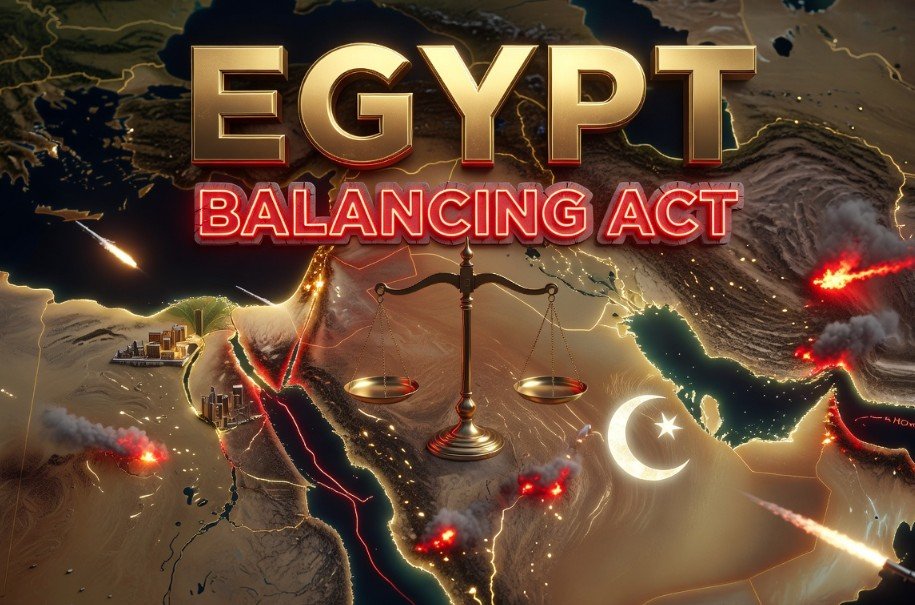
Egypt deployed fighter jets to the UAE, condemned Iran in the strongest terms, and stood visibly beside its Gulf allies. Yet Cairo never cut the line to Tehran. That is the paradox defining Egypt’s foreign policy right now, and the question on every analyst’s mind is how long President Abdel Fattah El Sisi can keep walking this impossibly narrow line.
Cairo Backs the Gulf, But Keeps Tehran Close
“Egypt’s position is one of balance but it’s not neutral,” said Samir Ragheb, a retired Egyptian army general who has become a strategic and military analyst. “Egypt stands with its brothers in the Gulf, and that’s not a tactical position,” he added. At the same time, Egypt works to prevent the region from sliding into a costly military confrontation with heavy sectarian undertones that would hurt its Arab allies and damage its own economy. Egypt, with its mostly Sunni population, and predominantly Shiite Iran have in recent years started to thaw relations after decades of tension, but have yet to restore full diplomatic ties. Analysts widely interpret this as a deliberate nod to Cairo’s Gulf Arab friends, who have long-standing grievances with Tehran. Egypt’s reluctance to establish full diplomatic relations with Iran is widely considered an act of solidarity with Cairo’s Arab allies in the Gulf, who strongly oppose Tehran’s perceived meddling in Arab affairs and support for militant groups such as Hezbollah in Lebanon and Yemen’s Houthis. Cairo is also heavily indebted to many of the Gulf states that Iran has targeted in its response to the 2026 war, with Gulf Cooperation Council members pouring tens of billions of dollars in grants, central bank deposits, and investments to help Egypt weather serious economic troubles over the years.
Egyptian Fighter Jets Now Flying in UAE Skies
Egypt has deployed Dassault Rafale multirole fighters to the United Arab Emirates, which the UAE Ministry of Defence revealed on May 7, 2026. It announced that Emirati President Sheikh Mohamed bin Zayed al-Nahyan and Egyptian President El Sisi had conducted an inspection visit to the Egyptian fighter detachment stationed in the UAE. In a notable statement, Sisi emphasized that “what hurts the UAE hurts Egypt,” affirming full solidarity with Abu Dhabi in facing the threats it encounters. Since the Iran war broke out in late February, El Sisi has made two tours of Gulf Arab nations, including the UAE. The optics could not be more deliberate. A sitting head of state visiting troops deployed in an ally’s territory is a powerful signal, both to the Gulf and to Tehran. The scale of the Iranian assault on the UAE puts the visit in sharp focus. As of early April, the UAE had intercepted and destroyed 537 ballistic missiles, 2,256 drone attacks and 26 cruise missiles fired from Iran using THAAD and Patriot missile defence systems. Those are not just statistics. They represent months of relentless attacks on a country that millions of Egyptian workers call home. Millions of Egyptian workers are employed in Gulf countries and send foreign currency home to their families. Any serious damage to the Gulf economy hits ordinary Egyptian households almost immediately.
A $10 Billion Reason to Keep Iran Talking
Egypt’s diplomatic dance with Tehran is not just about politics. The economics are brutal. Suez Canal revenues reached approximately $10.2 billion in 2023 before falling to around $4 billion in 2024, a decline of nearly 61 percent due to regional tensions. In 2025, revenues rose slightly to about $4.1 billion but remained below pre-crisis levels. President El Sisi said regional conflicts have caused a $10 billion loss in Suez Canal revenues, stating that the EGP 500 billion decline in Suez Canal receipts, combined with global supply chain disruptions and rising energy costs, has placed Egypt at a “historical crossroads.” Recent reports indicate that several major global shipping companies including Denmark’s Maersk, France’s CMA CGM, and Germany’s Hapag-Lloyd have suspended the transit of some vessels through the canal. Here is what makes Egypt’s connection to Iran particularly vital at this moment:
- Egypt’s relations with Iran may have meant that Tehran’s proxies in Yemen, the Houthis, were allegedly persuaded not to make good on threats to close the Bab Al Mandeb, the Red Sea’s southern gateway.
- Had they done that, most shipping in the strategic waterway would have come to a halt, with cash-strapped Egypt losing billions of dollars in Suez Canal transit fees.
- The Bab al-Mandeb Strait is responsible for approximately 10 percent of global trade and 12 percent of global oil transport. With the Strait of Hormuz closed, reliance on alternative maritime routes has increased, making potential disruption in the Red Sea extremely perilous.
In short, Egypt keeping a line open to Iran is not weakness. It may be the single act that has kept Egypt’s most critical economic lifeline from collapsing completely.
Egypt’s Quiet Role in Stopping a Wider War
Egypt’s General Intelligence Service, which played a critical role in the Gaza ceasefire, frequently engages in backchannel diplomacy by carrying messages, transmitting clarifications of red lines, and negotiating de-escalation terms without forcing any party into direct public engagement. Egyptian intermediaries reportedly relayed US concerns about an escalation in the Gulf, while also transmitting Iranian warnings about potential retaliation if the conflict widened. This back-and-forth helped reduce the risk of miscalculation and allowed both sides to test possible off-ramps before making any public commitments. While formally asserting its neutrality in the conflict, Cairo, along with Pakistan and Turkey, helped devise a diplomatic path that led to the two-week US-Iran ceasefire. On April 18, 2026, Foreign Minister Badr Abdelatty announced that Egypt was working with Pakistan, Turkey, and Saudi Arabia to reach a broad security deal that would end the conflict altogether. However, Cairo’s ability to effect change should not be exaggerated. Egypt cannot dictate Tehran’s decisions, nor can it shape Washington’s broader strategy. Egypt does not have the leverage for meaningful mediation between Israel and Iran. Its role is limited to facilitating coordination among Arab states and relaying messages, described by analysts as “useful convening, not mediation.”
The Pressure Egypt Faces From Both Sides
Skeptics in the Gulf are now asking whether Cairo really has the Gulf Cooperation Council’s interests at heart, given Egypt’s failure to provide military support in their ongoing confrontation with Iran. Egyptian sources have reported dissatisfaction in Kuwait and the UAE with Egypt’s approach. Those messages were conveyed to diplomatic officials in the Gulf, prompting Egypt to work to warm relations again. Egypt’s economy is also screaming for attention. Egypt suffers from high inflation above 15 percent in March 2026, lower economic growth of 4.2 percent in 2026 caused in part by a serious decline in Suez Canal revenue, and a very high debt-to-GDP ratio of around 83 percent. Foreign portfolio investors, on whom Egypt relies heavily to finance its fiscal deficit, have pulled some $6 billion out of the Egyptian market because of concerns about the impact of higher import costs, the potential loss of revenue from tourism and the Suez Canal, and the risk of a fall in remittances from Egyptians working in the Gulf. On top of all this, Egypt sees Iran as a major asset in its own efforts to counterbalance the rapidly spreading influence of Israel. “The number-one enemy in the Egyptian military doctrine is Israel and that constitutes a strong bond between Cairo and Tehran,” said one Cairo-based source. Another factor driving Cairo’s approach is concern about the possible collapse of the Iranian regime.
Since the Islamic Revolution of 1979, the two countries have maintained deep rivalry despite occasional warming of relations. Nevertheless, Egypt appears to prefer the current balance of power. Egypt is not a country that can afford to make enemies in every direction at once. Egypt’s unique position of being a strategic US ally while maintaining channels of communications with Israel, Iran and Hamas has benefited Cairo on several levels, enabling it to assume a high profile globally as a key mediator in the October 2025 ceasefire in Gaza. As the fragile ceasefire between the US and Iran continues to face pressure, and as the Bab Al Mandeb remains one bad decision away from triggering a global shipping catastrophe, Egypt finds itself at the center of a crisis it did not start but cannot afford to ignore. Every phone call El Sisi makes, every fighter jet he dispatches, and every backchannel his intelligence chief manages is part of a calculated effort to keep the region from tumbling into something far worse. The world may not always see Cairo’s hand in these negotiations, but make no mistake: its fingerprints are everywhere. What do you think about Egypt’s approach to this conflict? Share your thoughts in the comments below.
