
ArcBest is buying two Tesla Semi trucks for its ABF Freight fleet after a 2025 pilot that beat the 1.7 kWh per mile figure Elon Musk promised when Tesla first unveiled the truck in November 2017. The pilot averaged 1.55 kWh per mile over 4,494 miles, the lowest energy use logged in any independent fleet test of the Semi. The order is small in dollar terms, two trucks, but it’s the first fleet buy directly anchored to the new result.
For a vehicle Tesla pulled the cover off more than eight years ago and then shelved while it pursued driverless cars, humanoid robots, and AI, the Semi has spent most of its life as a punchline about missed deadlines. The ArcBest result, plus a recent run of fleet orders from WattEV, DHL, and Forum Mobility, has the program quietly moving from controlled trials to commercial purchases.
What ArcBest’s Three-Week Pilot Confirmed
ArcBest’s less-than-truckload carrier ABF Freight ran the pilot over a three-week period in 2025, with the truck operating across typical dispatch lanes. The pilot included over-the-road routes between service centers in Reno, Nevada and Sacramento, California, plus regional Bay Area runs and rail shuttle operations. The vehicle handled the 7,200-foot climb over Donner Pass and generally matched the performance of its diesel counterparts, ArcBest said in its pilot announcement and the full results.
The truck logged 4,494 miles over the test, averaging 321 miles per day, with an energy use of 1.55 kWh per mile. That is the lowest energy use recorded in any independent fleet test of the truck, and below the 1.72 kWh per mile DHL recorded on a 390-mile route in its own 2024 test of the truck in Livermore, California. Driver feedback was positive, with operators noting the vehicle’s comfort, safety and ease of use, ArcBest said. Features like the center seat configuration, wide visibility and intuitive controls contributed to the experience, the company reported.
Freight transportation is a vital part of the global economy, and we know it also plays a significant role in overall greenhouse gas emissions.
Dennis Anderson, ArcBest’s chief innovation officer, said in the company’s pilot announcement. The full pilot details, daily mileage, and route mix are published on ArcBest’s investor relations site.
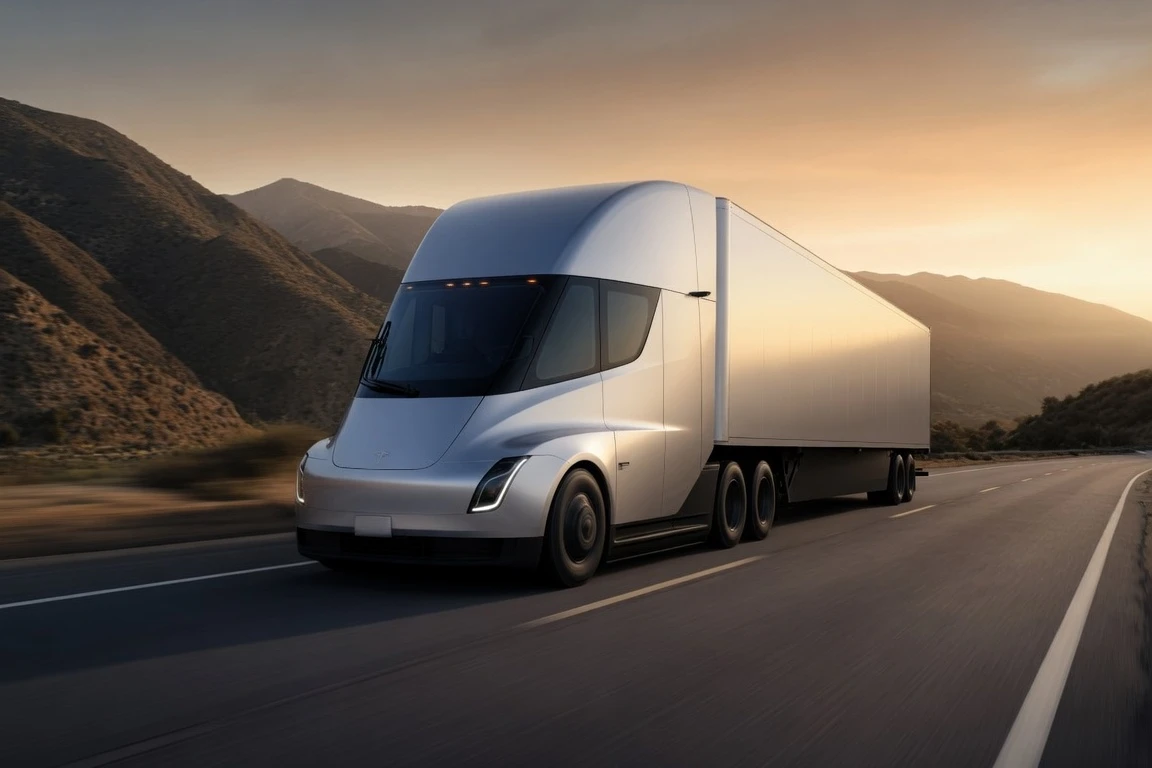
A 2017 Promise That Finally Outperformed Itself
When Tesla pulled the cover off the Semi in November 2017, Musk said the truck would deliver 1.7 kWh per mile in real-world operation, with what he called a ‘clear path’ to 1.6 kWh per mile. The figure has been the program’s benchmark ever since, and independent fleet tests have circled it without beating it by a wide margin. DHL Supply Chain logged 1.72 kWh per mile on a 3,000-mile test out of Livermore, California in October 2024, per DHL’s October 2024 Tesla Semi test results. Saia, a less-than-truckload carrier, reported 1.73 kWh per mile from its own Tesla Semi demonstration.
ArcBest’s pilot is the first independent fleet figure to come in well below Musk’s original promise, and Tesla is starting volume production of the truck just as the data is starting to clear. The company did not break out the conditions that produced the lower number, but ArcBest’s pilot included a mix of highway, regional, and rail-shuttle work, plus the 7,200-foot climb over Donner Pass. For an electric big rig, holding the result while climbing the Sierra Nevada is the number buyers will remember.
Why ArcBest Is Putting Money Where Its Pilot Was
ArcBest is converting the pilot into a real fleet order, purchasing two Tesla Semis for ABF Freight. The new trucks will be based primarily in California, with planned extension into Reno, Nevada, and potentially other locations, a wider lane footprint than the pilot’s Reno-Sacramento corridor. The move is a small purchase for a company with 14,000 employees across 250 campuses. But it’s the first fleet buy that directly cites the new efficiency figure from ArcBest’s pilot.
Matt Godfrey, ABF Freight’s president, set the bar for the decision in plain terms. “We’re not looking for a truck that performs well ‘for an EV.’ It must meet or exceed the performance and total cost of ownership targets of our most efficient diesel units,” Godfrey said. He framed the next step as benchmarking the new electric trucks against the existing diesel fleet on the same metrics ArcBest uses for any fleet investment.
ArcBest already operates nine electric yard tractors, two electric forklifts, and two Class 6 electric straight trucks at its facilities, and last year deployed 14 electric terminal tractors. The Tesla Semi purchase slots into a broader effort to electrify the company’s equipment.
The pilot, and the order that followed, position ArcBest as a test case for whether the Tesla Semi can hold up outside of controlled trials. ABF Freight’s plan to use the same diesel-fleet metrics for the new trucks is the closest thing in the industry to a head-to-head verdict on the Semi’s ability to replace diesel outright. If the new trucks clear those bars, ArcBest has said it will look at expanding the deployment to other lanes and operating conditions. The pilot, the order, and the larger fleet trend all point in the same direction, but the program’s still running on the limited scale that has defined it since 2017.
The Rivals the Semi Has to Beat
On the metrics that matter to a long-haul fleet buyer, the Tesla Semi is the only electric big rig in production that can match 500 miles of range and hold it on a real route. Its 822 kWh battery and the efficiency numbers ArcBest demonstrated give it a combination the closest electric competitors cannot reach. The two electric Class 8 trucks most often lined up against the Semi are the Freightliner eCascadia and the Volvo VNR Electric, and both fall short on the range metric, a gap sharpened by the battery fire probe that recalled a rival’s trucks.
The Freightliner eCascadia, Daimler Truck’s Class 8 electric flagship, tops out at around 230 miles of range with a 550 kWh battery. The Volvo VNR Electric, Volvo Trucks North America’s Class 8 entry, maxes out at about 275 miles with a 564 kWh battery. Neither can match the Tesla Semi’s combination of range and efficiency. The Semi runs the 500-mile range at the efficiency levels ArcBest demonstrated, and ArcBest’s test included the 7,200-foot climb over Donner Pass, a grade that exposes any weakness in a heavy-duty EV’s cooling and regen systems.
| Truck | Battery | Range |
|---|---|---|
| Tesla Semi | 822 kWh | 500+ miles |
| Freightliner eCascadia | 550 kWh | ~230 miles |
| Volvo VNR Electric | 564 kWh | ~275 miles |
The Order Book Outgrew the Production Line
ArcBest is the latest in a string of fleet operators moving from pilot to purchase on the Tesla Semi, a list that already includes WattEV’s 370-truck order, two port drayage operators’ combined 60-Tesla-Semi order through Forum Mobility, and DHL’s first production unit delivered in December 2025, per the purchase decision and the wider order book. WattEV’s order is worth approximately $100 million and is the largest single electric truck deployment in California. DHL is operating its first production Tesla Semi in Central California on routes of about 100 miles per day.
The first Tesla Semi rolled off the high-volume production line in late April 2026 at a new dedicated factory adjacent to Gigafactory Nevada. Analyst estimates peg 2026 production between 5,000 and 15,000 units, well below the order book that has accumulated from WattEV alone.
DHL’s deployment profile is the closest precedent to what ArcBest is attempting, with the first truck in DHL’s fleet running approximately 100 miles per day in Central California and typically requiring charging only once per week. DHL projected the unit would reduce greenhouse gas emissions by 50 metric tons annually, and the company plans to add more Tesla Semis in 2026 as volume production scales. ArcBest’s order is the same shape, a small initial deployment with room to expand if the numbers hold up.
- WattEV: 370 trucks, worth approximately $100 million, the largest single electric truck deployment in California.
- DHL Supply Chain: first production Tesla Semi delivered December 2025, now running approximately 100 miles per day in Central California.
- Forum Mobility: 60 Tesla Semis ordered by two port drayage operators.
- ArcBest (ABF Freight): two Tesla Semis announced June 2026, anchored on the new efficiency figure from the 2025 pilot.
What Could Still Trip the Comeback
ArcBest’s pilot, the order, and the wider fleet trend are all positive, but the Semi is still running into the same two limits that have defined the program since 2017: charging infrastructure and Tesla’s own production ramp. The pilot “highlighted the need for continued development of charging infrastructure to support broader deployment across longer routes,” ArcBest said in its release, with the Donner Pass grade working only because ArcBest had depot charging on both ends of the route.
The other limit is on Tesla’s side. The first truck off the high-volume line rolled out in late April 2026, more than eight years after the truck’s unveiling. Analyst estimates of 5,000 to 15,000 units in 2026 are a small share of the order book that has already been written, which is why fleet operators are starting to read the Semi’s commercial momentum as a production question, not a demand question. The market profile of the Tesla Semi, compared to other electric big rigs in production, is what the next fleet purchase decisions will turn on, per John Boesel’s interview on Tesla’s truck program.
The Tesla Semi has the potential to be a game changer. No other electric big rig on the market can say that.
John Boesel, the former CEO of CALSTART, a clean transportation nonprofit, said in an interview with Automotive News. He led the organization for 2.5 decades before stepping down in 2025.
Frequently Asked Questions
What is the Tesla Semi’s energy efficiency?
ArcBest’s 2025 pilot measured 1.55 kWh per mile across 4,494 miles of mixed highway, regional, and rail-shuttle work. The figure is the lowest energy consumption reported in an independent fleet test of the truck, and it was achieved on a route that included the 7,200-foot climb over Donner Pass. Earlier tests from DHL and Saia logged 1.72 and 1.73 kWh per mile respectively, both slightly above the 1.7 kWh per mile Musk promised at the 2017 unveiling of the truck.
When did Tesla Semi enter mass production?
The first Tesla Semi rolled off the high-volume production line in late April 2026 at a new dedicated factory next to Gigafactory Nevada. Volume production started more than eight years after Tesla first unveiled the truck in November 2017. Analyst estimates put 2026 output between 5,000 and 15,000 units, a small share of the order book that has accumulated from buyers like WattEV, DHL, and Forum Mobility.
How far can a Tesla Semi drive on a single charge?
Tesla’s published range for the Semi is 500 miles on a full charge, achieved with the truck’s 822 kWh battery. That is the largest battery in any electric Class 8 truck in production, and it gives the Semi a range advantage over the Freightliner eCascadia and Volvo VNR Electric, which both top out at under 280 miles per charge. DHL’s first production Tesla Semi runs about 100 miles per day in Central California, well under the truck’s full range, which is why the unit only needs one charge per week on those routes.
Who is ArcBest and what did it test?
ArcBest is a US-based integrated logistics company founded in 1923, with about 14,000 employees across 250 campuses and service centers. ABF Freight, ArcBest’s less-than-truckload subsidiary, ran the Tesla Semi pilot. ArcBest is also publicly traded on Nasdaq under the ticker ARCB.
Why is the ArcBest result significant?
The ArcBest pilot is the first independent fleet result to come in well below the figure Musk cited at the 2017 unveiling. Earlier tests from DHL and Saia confirmed his projection but did not beat it by a wide margin. The result positions ABF Freight as a test case for whether the Tesla Semi can replace diesel in long-haul LTL operations, with the new efficiency number anchoring the first buy of its kind.
