
Prime Minister Mostafa Madbouly said completed projects under Egypt’s Hayah Karima (Decent Life) initiative have drawn more than 450 billion Egyptian pounds in funding and reached about 20 million people across more than 1,450 villages. Speaking after inspecting work in Gharbia governorate on 12 August 2026, he called the effort Egypt’s project of the 21st century and said Phase One handovers are finishing governorate by governorate.
The numbers mark more than new pipes and clinics. They lock in lower subsidy bills, higher financial inclusion and a deliberate tilt toward Upper Egypt that alters how the national economy is balanced.
What the Latest Tallies Show
Madbouly’s 450 billion figure covers projects already finished nationwide. Ministry of Planning data from the end of June 2025 put Phase One total allocations at 350 billion Egyptian pounds, with 306 billion disbursed and an overall implementation rate of roughly 89 percent. That phase targeted about 23,000 projects in 1,477 villages across 52 districts in 20 governorates, aiming to benefit nearly 18 million citizens at the time of the review.
| Metric | Phase One Figure | Source Note |
|---|---|---|
| Total allocations | EGP 350 billion | Ministry of Planning, June 2025 |
| Disbursed | EGP 306 billion (93% of investments) | Same review |
| Implementation rate | ~89% | Overall Phase One |
| Villages completed | 620 fully developed | Quality of Life Index up ~69 points |
| Upper Egypt share | 68% of allocations | ~11 million beneficiaries (61%) |
| Recent completed total | Over EGP 450 billion | PM Madbouly, Aug 2026 |
Gharbia is among the first governorates to finish its Phase One slate. Madbouly said wastewater coverage in its villages rose from 26 percent in 2014 to 77 percent after the first phase. National Phase One results show drinking-water access reaching 100 percent in target villages and sanitation coverage climbing from 20 percent to 90 percent.
Water Plants Built for 2050 Demand
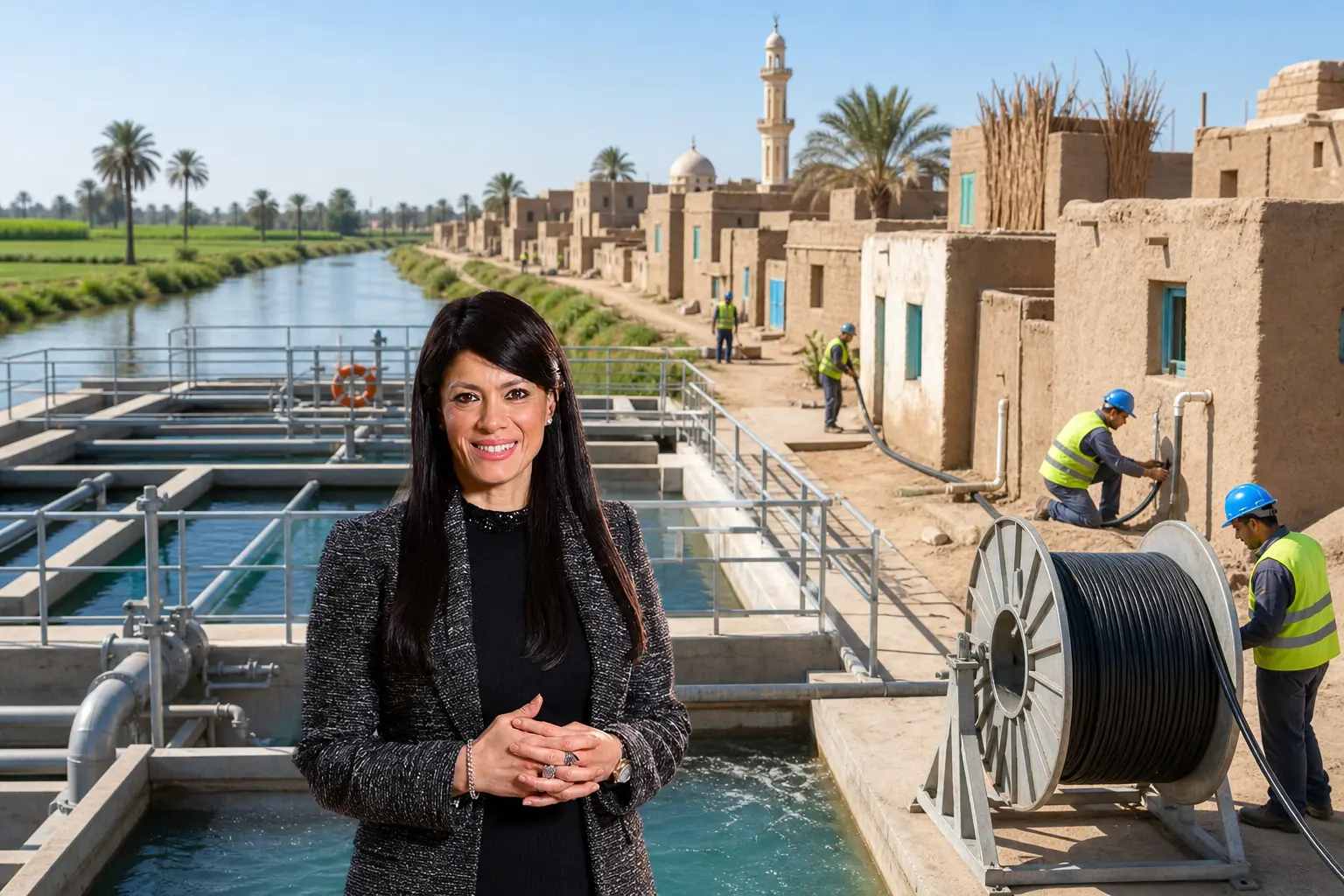
Water and sanitation absorbed the heaviest engineering lift. Officials completed 349 drinking-water treatment plants, 463,000 household water connections and 6,700 km of water networks. On the sanitation side they delivered 29 wastewater treatment plants, 719 sanitation projects and 1.4 million household connections.
- Drinking water: 100% access in target villages; plants sized for demand through 2050.
- Sanitation jump: Coverage from 20% to 90%; 128% rise in subscribers.
- Gharbia example: Village wastewater from 26% (2014) to 77% post-Phase One.
- Health package: 796 health units, 2 central hospitals, 367 ambulance units finished.
Madbouly stressed that the new water-treatment facilities already meet projected needs out to 2050, so the next phases can focus elsewhere. Healthcare upgrades run in parallel: health units, medical centers and hospitals plus better medicine access in rural zones.
Upper Egypt Took Nearly Seven in Ten Pounds
Sixty-eight percent of Phase One money went to Upper Egypt. That share served roughly 11 million people, or 61 percent of the early beneficiaries. The tilt shows up in every major ledger line.
Natural-gas networks reached 637 villages and produced a 421 percent jump in subscribers. Officials calculate EGP 1.6 billion in annual savings on LPG subsidies and about EGP 1.5 billion in household savings each year, plus lower carbon emissions and less foreign-currency demand for fuel imports. Fiber-optic lines reached 940 villages, lifting telecom subscribers 55 percent. Financial inclusion improved 19.4 percentage points to 75 percent in target villages; female inclusion rose 19.9 points. ATMs now cover every local administrative unit.
MSMEs and microfinance absorbed EGP 68.7 billion, reaching 3.2 million recipients (55 percent women). Upper Egypt took 67 percent of microfinance association financing and 79 percent of MSME agency financing. Agriculture saw 947 canal rehabilitation projects covering 3,000 km, 326 agricultural service centers and 20 milk collection centers.
by all measures, Egypt’s project of the 21st century
Madbouly used that phrase for the initiative after the Gharbia tour. He also noted the unemployment rate has fallen below 6 percent and that the work created large employment opportunities during construction.
Partners, Monitoring and the Green Village Track
The Haya Karima Foundation coordinates volunteers and works with more than 20 ministries, government agencies, 23 civil-society organizations and thousands of volunteers. It frames the effort as human development that localizes the Sustainable Development Goals and Egypt Vision 2030. The initiative itself is listed on the UN SDG Acceleration Platform.
A “Sharek 2030” mobile app now publishes data on roughly 10,000 completed projects so residents can track progress and give feedback. Fifteen villages are being prepared for “Tarsheed” environmental certification under the Green Village track; field visits have already covered 11 of them.
An earlier progress report on village upgrades on this site tracked the same Phase One momentum before the latest 450 billion confirmation.
Phase Two Opens with Sanitation First
Phase Two began in the 2025/2026 fiscal year with an initial EGP 25 billion allocation focused on drinking water and sanitation. It is set to cover 20 governorates, 52 centers and 1,667 villages, reaching another 21.3 million citizens. Planned works include 2,350 km of new water networks, 18 drinking-water plants, 315,000 household connections, 97 wastewater facilities and 1.8 million household sewage connections.
Madbouly said the second and third phases will use more centralized management, especially on procurement, and will sequence work by citizen priority: sanitation and water quality first, then health facilities and schools. Across all three phases the government targets improved living standards for more than 60 million Egyptians.
During the same tour the prime minister also referenced medical and tourism projects in Matrouh, including Ras El Hekma development work, as part of the wider push to spread services and jobs beyond the old urban cores.
The Structural Payoffs Beyond the Pipes
The concrete is only the visible layer. Gas connections cut recurring subsidy outflows and household fuel costs. Full water and sanitation coverage removes a daily time tax, especially for women and girls, and reduces disease pressure on the new health units. Fiber and ATMs pull rural households into formal finance and digital services. The heavy Upper Egypt weighting begins to close a decades-old spatial gap that once pushed migration toward Cairo and the Delta cities.
Ministry figures show 70 percent of Phase One investment directed toward human development. Classrooms completed number 15,300; youth centers 937; social-solidarity facilities 307. Literacy programs enrolled hundreds of thousands. Quality-of-life scores in the finished villages rose by about 69 percentage points.
Madbouly acknowledged the early obstacles: incomplete baseline data on existing services, complex multi-ministry delivery, and land allocation fights. Overcoming them required consulting firms, universities and construction companies working at scale. That accumulated delivery capacity is now being applied to the remaining Phase One handovers and the tighter Phase Two priorities.
The result is a rural map that is no longer defined mainly by what it lacks. Water plants sized for mid-century demand, gas grids that pay for themselves in subsidy savings, and digital links that raise financial inclusion are the quieter returns. They give the next phases a foundation that is already generating measurable national balance-sheet and social effects while the last villages of Phase One come online.
