
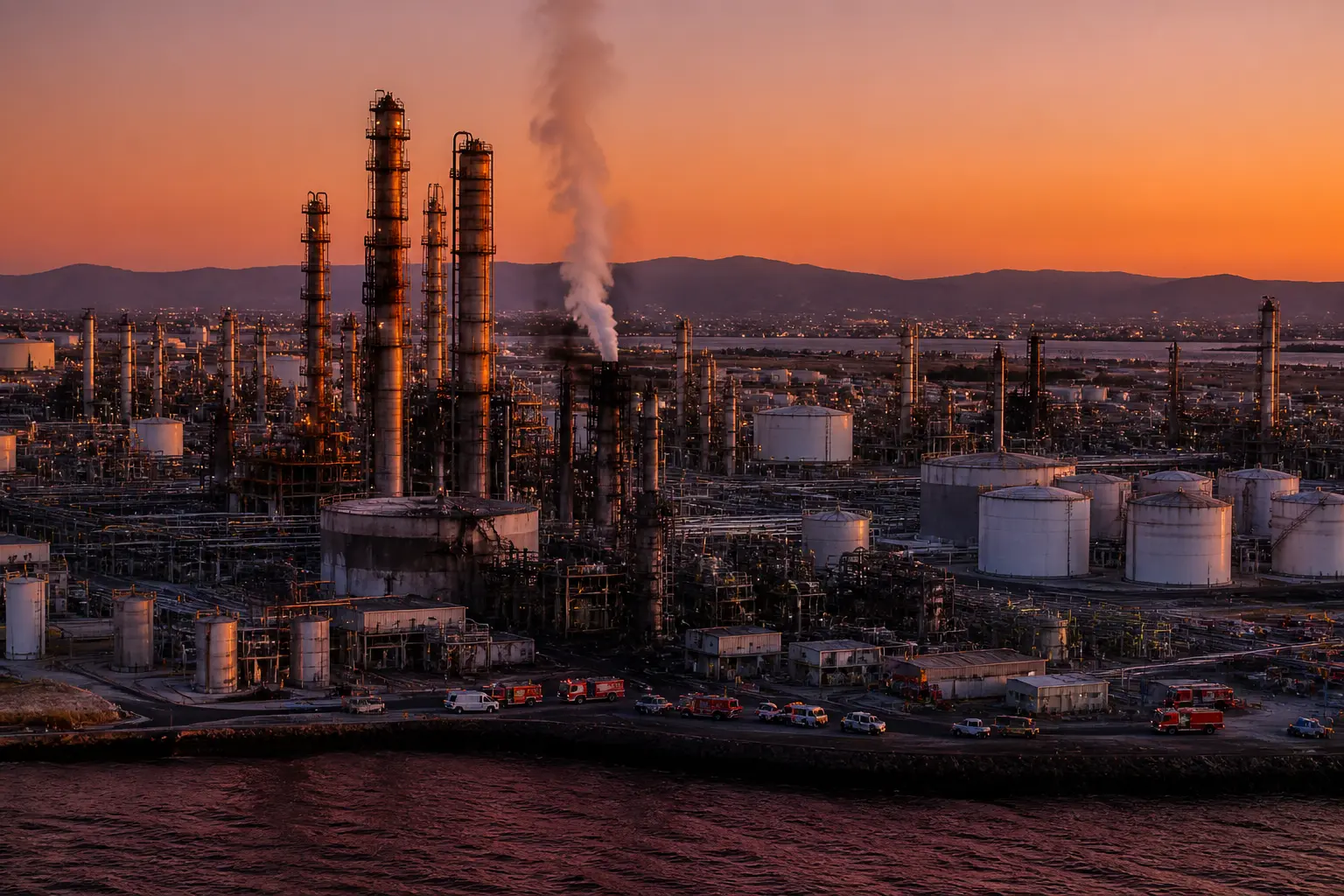
Yemen’s Houthis claimed a drone strike on Saudi Aramco’s Jazan refinery on Sunday, two days after Riyadh sealed a mutual defense pact with Turkey and Pakistan. Saudi authorities reported a fire that crews extinguished with no injuries at the 400,000-barrel-per-day plant.
In a parallel operation the same day, Houthi missiles and drones hit the government-held Mocha port on Yemen’s Red Sea coast, killing seven people and damaging commercial quays and storage, according to Yemeni officials.
The two claims arrived on the same calendar day and pointed at different kinds of targets. One struck a major Saudi energy complex already offline from earlier damage. The other hit a Yemeni commercial port that sits near a critical shipping lane. Together they compressed a political test and a practical supply shock into a single news cycle.
Two Strikes, One Message
Houthi military spokesperson Yahya Saree posted that the group used a drone for a “precise hit” on the Jazan facility. He framed it as a response to Saudi drone flights over Hajjah and Saada provinces.
Saree issued a separate claim of missile and drone strikes on Mocha, saying the targets were Saudi troops and a weapons arsenal. Yemeni government sources told Reuters that air defenses engaged incoming drones over the commercial quay and storage areas.
- Jazan: drone claim, fire extinguished, zero injuries reported by Saudi Energy Ministry
- Mocha: multi-missile and drone barrage, seven dead, severe infrastructure damage per Yemeni transportation ministry
- No Saudi confirmation of the cause at Jazan or comment on Mocha losses
The transportation ministry called the Mocha assault “yet another assault on a vital civilian facility that serves citizens and contributes to boosting commercial and maritime activity in the Red Sea.”
The pairing mattered as much as either claim alone. A drone against an industrial plant already under repair tested Saudi infrastructure resilience. A multi-weapon barrage against a working port tested civilian logistics and any residual Saudi-linked presence on the ground. Saree’s dual posts presented both as deliberate and connected rather than random.
Saudi silence on the cause at Jazan and on Mocha losses left the Houthi narrative as the loudest public account for hours. That gap itself became part of the message: the attackers spoke first and framed the motive before official counters arrived.
The Pact That Arrived Too Late to Deter
On Friday in Mecca, Saudi Crown Prince Mohammed bin Salman, Turkish President Recep Tayyip Erdogan and Pakistani Prime Minister Shehbaz Sharif signed the Mecca Joint Defence Agreement. The text treats an armed attack on any one of the three as an attack on all.
Turkish Foreign Minister Hakan Fidan stressed the same day that the deal was not aimed at Iran or any other country. It was a general pledge of security support.
The allies would decide through consultations what degree, form and format of support they would ask for in the event of an attack on any of them.
Fidan’s words set the limit. Pakistan’s offices and the Turkish government gave no immediate public response to Sunday’s claims. The consultation clause left room for delay or calibrated help rather than automatic joint action.
Analysts on X and in early coverage immediately labeled the strikes a live test of the days-old arrangement. The timing undercut the deterrence message without forcing the new partners into a visible collective reply.
Forty-eight hours separated the signing ceremony from the dual claims. That interval was long enough for the pact’s language to circulate and short enough that no operational habits among the three capitals could yet form. Deterrence depends on an adversary believing a costly reply will follow. A consultation-first design signals caution to partners and adversaries alike.
The absence of any joint statement by Sunday evening did not breach the text. It did illustrate how the text works in practice when the first probe arrives before the ink is dry.
Jazan Already Offline From the July Wave
The Jazan complex processes 400,000 barrels of crude per day in southwestern Saudi Arabia near the Yemen border. It had already been shut since a late-July Houthi missile and drone attack that damaged the integrated gasification combined-cycle unit and tank farm.
Aramco expected gradual resumption around mid-August. Sunday’s claimed drone added a fresh fire that authorities put out quickly. The plant’s status kept refined-product output offline at a moment of tight regional fuel markets.
| Facility / Event | Capacity or Scale | Status after Aug 9 claim |
|---|---|---|
| Jazan refinery | 400,000 bpd | Fire extinguished; already offline since late July |
| Prior July strike | IGCC and tank farm damage | Repairs targeted mid-August |
| Mocha port | Commercial quay and storage | Severe damage, 7 killed |
| Aramco prior hits | Yanbu and earlier Jazan | Pattern of Red Sea coastal targets |
Aramco CEO Amin Nasser said last week that recent attacks caused some interruptions but no material operational or financial impact overall. Aramco shares and company profile remained the market’s main window on the producer.
Because the plant was already shut, Sunday’s fire did not remove fresh barrels from a running unit. It did threaten the mid-August restart timetable and forced crews to divert from repair work to firefighting. Each delay keeps gasoline and diesel volumes off the regional balance at a time when alternatives are scarce.
The July damage to the IGCC unit and tank farm had already defined the plant’s near-term ceiling. A second incident inside the same repair window compounds scheduling risk even when the new fire is small and quickly contained.
Mocha Sits on the Alternative Energy Gate
Mocha lies close to the Bab el-Mandeb strait, the southern Red Sea chokepoint linking to the Gulf of Aden and Indian Ocean. A prolonged closure would strip Saudi Arabia of a key alternative route when the Strait of Hormuz faces pressure from the wider U.S.-Israeli war on Iran that began February 28.
Houthis declared a naval blockade against Saudi Arabia in the Red Sea last month, citing a supposed Saudi siege. Riyadh denies the charge. The Mocha hits extend that pressure onto the Aden-based government’s infrastructure and any residual Saudi-linked forces in the area.
Yemen’s presidential council head Rashad al-Alimi briefed the U.S. mission chargé on the developments and urged the international community, especially Washington, to move beyond containment of the Houthis to their sources and instruments.
Commercial quay and storage damage reduces the port’s ability to move goods for civilians and traders who depend on Red Sea access. That local harm sits inside a larger geometry: any friction near Bab el-Mandeb raises the cost of the very route that energy shippers use when Hormuz grows risky.
Al-Alimi’s appeal to Washington framed the strikes as more than a Yemeni domestic problem. He tied them to the instruments that enable repeated Houthi reach into Saudi and Red Sea targets, pressing for action upstream of the drones and missiles themselves.
Who Feels the Pressure First
Refined product markets lose Jazan’s gasoline and diesel contribution while the plant stays down. Crude export capacity itself has held, yet shipping risk premiums climb. Brent crude trading near 84 dollars on August 9-10 reflected broader Hormuz uncertainty more than this single fire.
The internationally recognized Yemeni government loses port capacity that supports commercial traffic and civilian supply. Saudi forces, if present as claimed, face direct targeting. Global energy buyers, especially those already rerouting around Red Sea threats, confront higher insurance and longer voyages.
Earlier incidents fit the same pattern. An earlier Houthi strike on a Saudi tanker and reports of Saudi tankers already turning back from Red Sea routes showed the blockade’s bite before the pact was even signed.
The pressure lands unevenly. Refiners and product importers notice Jazan’s absence first. Port users and coastal communities feel Mocha’s damage in delayed cargo and broken infrastructure. Tanker operators price the cumulative Red Sea risk into freights and routes. Crude producers can still load elsewhere, which is why the single fire did not dominate the Brent move on its own.
- Late July: Houthi missile and drone attack damages Jazan IGCC and tank farm, plant shuts
- Last month: Houthis declare naval blockade against Saudi Arabia in the Red Sea
- Friday: Mecca Joint Defence Agreement signed by Saudi Arabia, Turkey and Pakistan
- Sunday: Claims of drone hit on Jazan and missile-drone barrage on Mocha
That sequence shows how infrastructure damage, declared blockade and alliance politics stacked inside a few weeks. Each layer raises the cost of the next incident even when no single strike closes a strait or empties a market.
Alliance Silence Leaves the Deterrent Unproven
No joint statement or visible reinforcement followed Sunday’s claims. The pact’s strength rests on future consultations rather than automatic triggers. That design avoids automatic escalation yet also leaves the first real probe unanswered in public.
What we know
- Fire at Jazan extinguished, no injuries
- Seven dead and infrastructure damage at Mocha
- Pact signed 48 hours earlier with consultation clause
- Houthi claims of drone on Jazan and missiles/drones on Mocha
What’s unconfirmed
- Exact damage extent inside the already-shuttered Jazan plant
- Whether Saudi air defenses engaged at Mocha
- Any private consultations among the three Mecca partners
- Timeline for full Jazan restart
The wider conflict supplies the backdrop. Iran and its allied groups have targeted Saudi and Gulf energy assets and shipping since the February escalation. Peace talks continue to stall over Hormuz access. Houthi actions in the Red Sea compound the supply disruptions.
These dual strikes fit into the new fronts locking the wider Middle East blaze without offering a clean off-ramp. The Mecca partners now hold a paper commitment that has met its first practical examination and produced no visible collective reply.
Consultation Mechanics Shape the First Reply
Fidan’s description of the pact put consultations at the center of any response. Degree, form and format of support would be decided after an attack, not before. That structure protects the three governments from automatic entanglement. It also means the first hours after a strike belong to national statements, if any, rather than a joint posture.
Sunday’s claims therefore met a system built for deliberation. Pakistan and Turkey issued no immediate public reply. Saudi authorities addressed the Jazan fire as an industrial incident without tying it in public to the new allies. The consultation clause functioned exactly as written: it created space, not obligation.
- Automatic trigger language: absent from the public description
- Support type: decided case by case after talks
- Public joint reply after Sunday claims: none reported
- Deterrent signal in the first 48 hours after signing: untested in practice until the strikes, then unanswered in public
For observers, the gap between signing ceremony and silent aftermath is the first data point on how the arrangement behaves under pressure. Future incidents may produce different results once channels mature. This one did not force a visible collective step.
Two Targets Tighten the Same Supply Corridor
Jazan and Mocha are different assets under different authorities, yet both touch the same energy and shipping corridor that links the Red Sea to global markets. Jazan’s offline refined-product capacity removes local gasoline and diesel volume. Mocha’s damaged quay and storage weaken a port near Bab el-Mandeb that supports commercial traffic along that route.
The July shutdown at Jazan already cut into product supply. The mid-August restart target offered a path back. Sunday’s fire put that path at risk again. Mocha’s losses, measured in seven dead and severe infrastructure damage, reduce the government’s ability to keep civilian and commercial flows moving on the same coast.
| Pressure point | Immediate effect | Corridor link |
|---|---|---|
| Jazan offline | Gasoline and diesel volumes absent | Product supply tightness in regional markets |
| Mocha damage | Quay and storage impaired, 7 killed | Port capacity near Bab el-Mandeb reduced |
| Declared Red Sea blockade | Shipping risk premiums higher | Tankers already turning back on some routes |
| Hormuz backdrop since Feb 28 | Alternative routes gain value | Red Sea path becomes more critical when eastern options shrink |
When Hormuz faces pressure, the Red Sea path gains weight as an alternative. Hits that keep a Saudi refinery dark and a Yemeni port impaired work in the same direction: they raise the cost of using or relying on that alternative. Earlier tanker strikes and turn-backs had already shown the blockade’s reach. Sunday’s dual claims added infrastructure damage on top of route risk.
None of this requires a full strait closure to matter. Cumulative friction on products, ports and insurance is enough to stretch voyages and lift costs for buyers already navigating the wider conflict.
The fire at Jazan went out. The questions around the new alliance’s real weight remain open.
