
Air Canada has pushed the restart of its Dubai and Tel Aviv flights to mid-January 2027, the latest in a string of extensions that began right after fighting flared in late February. The carrier’s August update leaves both routes dark through the peak winter season.
What started as a short safety pause now stretches nearly a full year. Local Gulf carriers keep operating while Canadian travellers hunt alternatives and the airline’s Middle East footprint shrinks.
The Mid-January Restart Date Lands
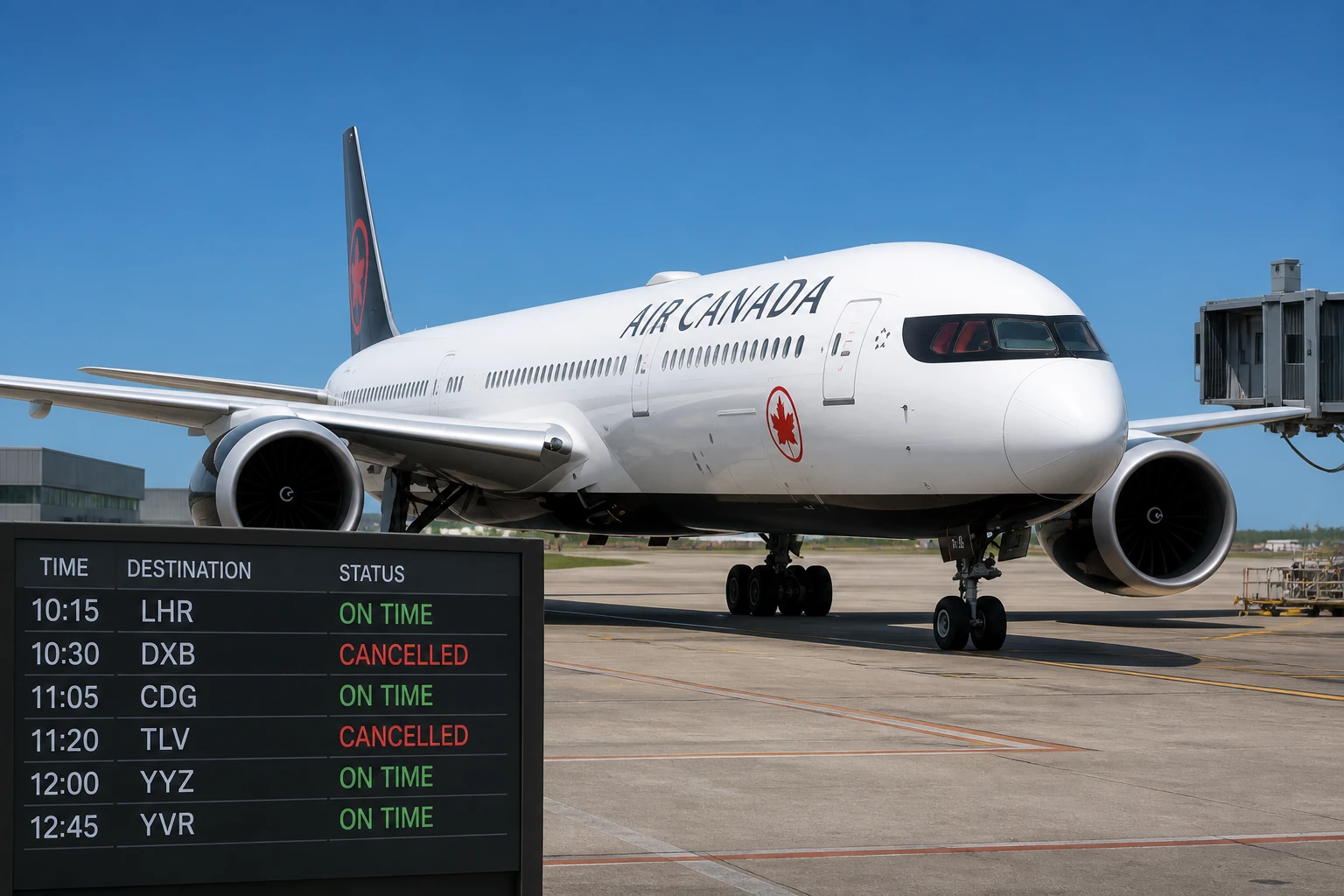
On its official Middle East travel update, Air Canada stated that flights to and from Dubai (DXB) and Tel Aviv (TLV) remain cancelled until mid-January 2027. The note, dated August 4, replaced the previous target of October 24, 2026.
The airline first grounded the routes in early March after the U.S. and Israel’s conflict with Iran began on February 28. It has since lengthened the blackout multiple times. Passengers holding tickets receive rebooking or credit options under the carrier’s flexible policy, though exact terms depend on the original fare rules.
Air Canada said it will keep assessing conditions before any return. Safety remains the stated priority. No new frequency or aircraft type has been announced for the eventual restart.
How One Pause Became a Year-Long Blackout
The timeline of extensions shows a pattern of caution that outpaced initial hopes for a quick return.
- March 2, 2026: Flights cancelled until March 22, with restart planned for March 23.
- March 6: Dubai extended to March 28; Tel Aviv to May 2.
- March 13: Dubai pushed to April 30; Tel Aviv held at May 2.
- March 26: Both routes cancelled until September 7.
- June 9: Both held until October 24.
- August 4: Both extended to mid-January 2027.
Each step cited the evolving military situation and airspace risks. The same page that carried the earlier cancellation of the same routes now shows the longest horizon yet. Winter schedules that once listed Dubai service never materialised.
Carriers Still Flying Versus Those Still Grounded
Emirates and flydubai continue regular operations at Dubai International. Other international airlines have taken mixed paths. Some remain fully or partially suspended; others offer limited service with longer routings that avoid contested airspace.
| Carrier | Dubai / Tel Aviv Status (as of early August) | Notes |
|---|---|---|
| Air Canada | Suspended to mid-January 2027 | Both DXB and TLV |
| Emirates / flydubai | Operating | Local carriers continue |
| British Airways | Suspended or flexible to 31 October 2026 | Refunds available even if flight operates |
| Cathay Pacific / Singapore Airlines / KLM | Uncertain or suspended into autumn | Schedules under review |
British Airways has extended a British Airways Middle East flexibility window that lets customers request full refunds for travel up to the end of October even if the flight still appears on the schedule. That approach differs from Air Canada’s credit-and-rebook focus. Similar Gulf route withdrawals by other carriers show the same pressure on western networks that once linked North America and Europe directly to the region.
The result is a split market. Gulf hubs stay open for those willing to fly local metal. Direct Canada-to-Dubai or Canada-to-Tel Aviv seats from Air Canada stay off the board until at least January.
What Passengers Can Still Do With Bookings
Air Canada’s flexible booking policy, first rolled out in March, remains the main tool for affected customers. Options vary by ticket purchase date and original travel window, but the core choices have stayed consistent:
- Rebook the same destination on a later date with no change fee, subject to cabin availability on Air Canada metal.
- Change to another Air Canada destination in Europe, the U.K., India or Africa inside defined date ranges.
- Cancel and take an AC Wallet credit (Aeroplan members) or a future travel credit arranged through the contact centre.
- Seek a refund where fare rules allow it; the airline states refunds remain subject to those rules.
Travellers must retrieve the booking online or contact the airline before making airport plans. The carrier notes it will reach out by email and text when further changes occur. Anyone already in the region is told not to head to the airport unless holding a confirmed seat on an operating flight of another airline.
The policy covers a wide set of other Middle East airports for tickets bought by mid-March, including Abu Dhabi, Amman, Doha, Riyadh and Beirut. Those routes were never the core long-haul product, yet the same goodwill umbrella applies.
Government Advisories Still Flag the Region
Canada’s official guidance matches the airline’s caution. The Government of Canada lists the United Arab Emirates under an avoid non-essential travel advisory because of the volatile security situation. Missile and drone activity continues to affect the broader region, with potential for further flight disruptions.
Similar language applies to Israel. Citizens are told to register with the Registration of Canadians Abroad service and to prepare contingency plans that do not rely solely on government evacuation help. The advisory notes that military activity can change airspace availability with little notice.
Those warnings give Air Canada cover for the repeated delays. They also explain why insurance and operational approvals remain harder for western carriers than for airlines based inside the Gulf.
The Quiet Cost of a Missing Year
Direct Toronto-Dubai service had become one of Canada’s more popular long-haul leisure and business links. Removing it for the better part of a year forces passengers onto one-stop itineraries through Europe or other Middle East hubs. That adds flying time, connection risk and often higher fares.
Family visits, business trips and religious travel between Canada and Israel face the same friction. Dual nationals and diaspora communities absorb the inconvenience first. Cargo that once rode the belly of passenger flights must find other paths. Air Canada loses the revenue and the network feed that those flights once provided into its North American hubs.
Gulf carriers gain the displaced traffic. Every month the Canadian flag carrier stays away, those competitors deepen customer habits and corporate contracts. When Air Canada finally returns in January 2027, it will re-enter a market that has adjusted to its absence. The restart date itself may slip again if conditions do not improve; nothing in the current update guarantees the mid-January window will hold.
The second-order effect is already visible. A temporary safety measure has become a structural gap in Canada’s long-haul map. Passengers and communities will keep paying the price of that gap until the aircraft actually leave the gate again.
