
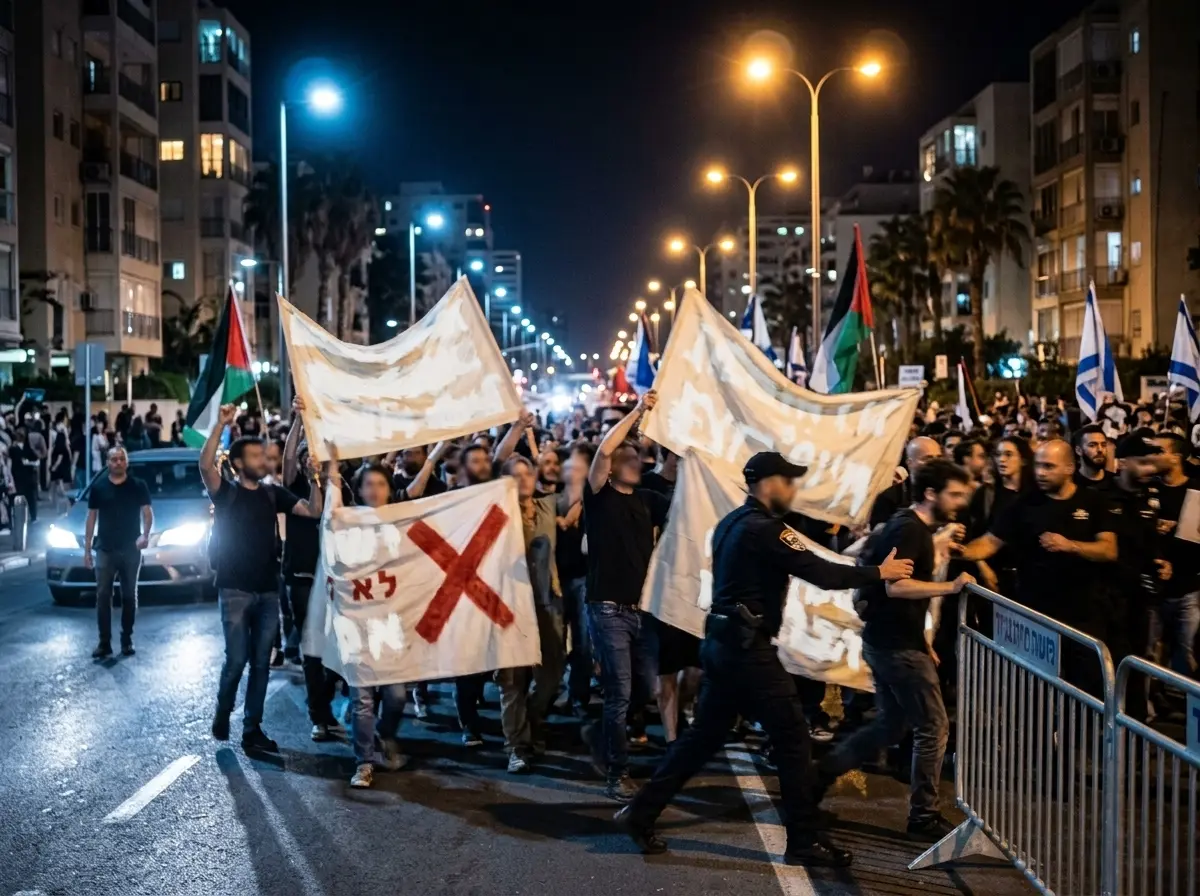
Israeli police arrested nine demonstrators on Tel Aviv’s Kaplan Street on Saturday, a day after a settler raid near the West Bank village of Tal left four Palestinians and two Israelis dead. The rally, organized by the Jewish-Arab Hadash party and the group Mothers Against Violence Israel, drew more than 200 people protesting settler violence and military rule in the occupied territory.
Police called the gathering unauthorized and said it blocked traffic. Knesset member Ofer Cassif, who organized it, says the arrests were never really about the road.
Nine Names on an Arrest Sheet
Israeli media, citing police, reported that Saturday’s demonstration had gone ahead without authorization and that protesters had begun to disrupt public order and block the roadway. Police said everyone detained had taken part in an illegal protest.
Mothers Against Violence Israel, known as MAVIsrael, gave a different account. The group said more than 200 people attended and accused officers of using force against participants, including the nine who were arrested.
“We organized the Tel Aviv demonstration because we refuse to remain silent while state-sanctioned settler terror and government escalation ignite the occupied West Bank,” Cassif, who has represented Hadash in the Knesset since 2019, told The New Arab.
How a Hiking Trip Near Havat Gilad Turned Deadly
The protest followed a chain of events that started Friday outside Tal, a Palestinian town near the settlement of Havat Gilad and the city of Nablus. A group of settlers, some of them minors accompanied by armed adults, entered the town claiming to be on a hike. The army later said the group’s presence in the area, which is off limits to Israelis under military rules, had not been coordinated.
Residents moved to stop the group from forcing their way into two homes. In the clash that followed, a Palestinian man grabbed the rifle of Benayahu Mellet, a 32 year old member of Havat Gilad’s civil security squad who had been sent to the scene, and shot him. The same gunfire killed Maj. Yuval Ezra, an Israeli military officer also dispatched to the confrontation. Soldiers then shot the Palestinian man dead.
Three more Palestinians were killed in the same clash and four were wounded, bringing the Palestinian death toll to four. The sequence, drawn from Israeli police accounts and reported by the Times of Israel, set off three days of escalation across the territory.
- Friday: Settlers enter Tal near Havat Gilad; a clash leaves four Palestinians and two Israelis dead. Netanyahu’s government orders a large scale military operation across the West Bank.
- Friday night into Saturday: Israeli forces arrest nearly 50 Palestinians in Tal and search around 70 homes. Funerals for the four dead Palestinians are held before dawn under tight attendance restrictions.
- Saturday: The Palestinian Prisoner’s Society says at least 80 Palestinians are detained across the West Bank, calling the sweep collective punishment. Hours later, Hadash and MAVIsrael hold the Kaplan Street rally; police arrest nine.
- Sunday: Settlers attack villages across the northern West Bank, torching two mosques and spray painting graffiti on buildings, part of what the Times of Israel described as overnight rampages across more than a dozen communities.
Why Israeli Police Called the Rally Illegal
Israeli law lets police restrict gatherings they deem unauthorized, and officers used that standing to justify moving on the Kaplan Street crowd. Cassif rejects the framing entirely, arguing the designation is a tool aimed less at traffic than at the message the crowd was carrying.
The police have increasingly become a politicized militia that shields violent settlers while using brutal force to silence peaceful citizens protesting for human rights. The arrest of nine demonstrators in Tel Aviv is a blatant attempt to criminalize dissent and protect government backed extremism.
Cassif told The New Arab. He said Saturday’s crowd reflected a shift in Israeli public opinion after a year of incidents in which dozens of Palestinians were killed and hundreds more injured, according to UN and Palestinian Authority figures.
“Mainstream political and media discourse continues to whitewash state aggression,” he said. “However, video evidence makes it harder to deny the truth.”
Hadash and the Camp It Says Keeps Growing
Hadash, formally the Democratic Front for Peace and Equality, is Israel’s main Jewish-Arab joint party, built on a platform that pairs opposition to occupation with domestic economic and civil rights organizing. Cassif is one of its most visible Knesset figures and frequently the party’s voice on West Bank policy.
He describes the coalition behind Saturday’s rally in terms rarely applied to Israeli protest politics: a joint Jewish-Arab bloc that he says is expanding even as it gets arrested.
“A growing, courageous joint Jewish-Arab camp realizes that settler violence is not a fringe issue, it is a core tool of state policy designed to dispossess Palestinians,” Cassif said. “Settler terror does not happen in a vacuum; it is armed, funded, protected by the [Israeli military], and politically championed by government ministers. The state is a full accomplice and driver of this violence.”
The Data Behind a Core Tool of State Policy
Cassif’s claim that settler violence functions as policy rather than fringe behavior lines up with figures tracked by the United Nations and Israeli rights groups over the same stretch of 2026.
| Metric | Figure | Source |
|---|---|---|
| Palestinians killed in West Bank, 2026 (as of July 19) | 68, including at least 13 by settlers | UN OCHA |
| Settler attacks’ share of Palestinian injuries, 2026 | 55 percent | UN OCHA |
| Attack frequency, 2020 versus 2026 | One every 3 days, up to 3+ per day | UN OCHA |
| Palestinians displaced since January 2026 | Over 2,200 across 230+ communities | UN OCHA |
| Palestinians killed by settlers, 2008 to 2025 | 61 killed, 3,778 injured | B’Tselem |
| Palestinian communities uprooted, 2025 | 21 | B’Tselem |
The UN’s humanitarian affairs office, OCHA, has recorded more displacement from settler violence in 2026 than in all of 2025 combined. Israeli rights group B’Tselem keeps its own running record of settler attacks it classifies as state violence, and says Israeli authorities rarely investigate or prosecute the people responsible.
Separately, at least 1,097 Palestinians have been killed by Israeli forces or settlers in the West Bank since the Gaza war began in October 2023, according to Palestinian officials, a toll spanning nearly three years rather than the single calendar year covered by OCHA’s count.
Fifty Arrests, Seventy Homes, One Military Operation
The government’s response to Friday’s killings looked nothing like the response to Saturday’s protest in scale.
- Israeli forces arrested nearly 50 Palestinians in Tal in the hours after the clash.
- Roughly 70 homes were searched during the same operation.
- At least 80 Palestinians were detained across the West Bank the following day, according to the Palestinian Prisoner’s Society.
- Funerals for the four Palestinians killed were held before dawn, with attendance tightly restricted.
- Only nine arrests came out of the Tel Aviv rally, but Cassif argues the intent behind them matters more than the count.
The Palestinian Prisoner’s Society described the West Bank sweep as collective punishment. The Palestinian Authority, which administers parts of the territory including the area around Tal, went further, calling the pattern of settler attacks a broader campaign against Palestinians.
“Israeli state backed settler terrorism is intensifying into systematic pogroms across the occupied West Bank,” the Palestinian Prime Minister’s Office said in a statement posted on X.
Annexation Advances While the Rally Gets Policed
The political backdrop to both the settler raid and the Tel Aviv arrests is a government that has stopped describing annexation as a distant goal. Finance Minister Bezalel Smotrich and other far-right ministers have pushed to annex the West Bank outright while rejecting Palestinian statehood and backing continued settlement growth.
Days before the Kaplan Street rally, Israel’s cabinet approved 13 new settlements along Route 60, a move Smotrich framed as part of a broader settlement expansion he has publicly called a revolution. It builds on a pattern flagged in earlier reporting on settlers pushing West Bank annexation ahead of elections, and follows a February cabinet decision that Amnesty International says already amounts to unlawful annexation enabled by impunity.
Human Rights Watch went further still in a report issued the same day as the Tal killings, warning that the surge in settler violence risks tipping into mass atrocities. Cassif frames the choice facing Israel in blunter terms than any government minister has offered.
“Occupation and settler terror bring bloodshed and moral destruction to everyone. Real security for anyone will never be achieved through oppression,” Cassif told The New Arab. “The only path forward is ending the occupation, stopping settler terror, and recognizing Palestinian rights to self-determination.”
