
Two American soldiers died Friday defending a Jordanian air base from Iranian missiles. A third was killed in Iraq while disposing of a downed Iranian drone. The US combat death toll since February has now climbed past 17, and Iran spent the same week firing on Kuwait, Bahrain and Qatar too, shutting the Strait of Hormuz to tankers once again.
Five months into a war that keeps almost ending, the casualties point to something quieter than the headlines. Jordan, Kuwait, Bahrain and Qatar keep absorbing Iranian fire for hosting American troops, and several are now visibly limiting what Washington can actually do from their soil, even while the missiles keep landing on it.
The Strike That Killed Three Americans
Iran’s ballistic missiles and drones hit Muwaffaq Salti Air Base on July 17, a facility used by both Jordanian and American coalition forces. US Central Command, known as CENTCOM, said two service members were killed in action defending against the attack, with a third reported missing and four more medically evacuated.
Secretary of State Marco Rubio told reporters that American defenses intercepted most of the incoming missiles, but one “leaked through.” He called the deaths “heartbreaking” and said “our hearts go out to the families of the heroes that paid the ultimate price.”
A separate American service member died in Iraq that Saturday during the controlled detonation of a downed Iranian drone, CENTCOM said. It was the first run of US combat deaths in the war since March. President Trump ordered retaliatory airstrikes “to swiftly punish” Iranian forces, hitting Iranian surveillance sites, air defenses, maritime assets and missile and drone storage.
- What we know: Two US troops died at Muwaffaq Salti Air Base on July 17.
- A third service member was killed in Iraq while disposing of a downed Iranian drone.
- CENTCOM ordered retaliatory strikes on Iranian military, air defense and maritime targets.
- The war’s combat toll has reached at least 17 dead and more than 400 wounded since Feb. 28.
- What’s unconfirmed: Whether remains found at the Jordan site belong to the missing third service member, which would raise that attack’s toll to three.
- Iran’s claim that two US fighter jets were destroyed in the strike.
- Whether Qatar’s Al Udeid Air Base was actually hit, as Iran’s Revolutionary Guard claims.
- The extent of damage from a reported strike near Iran’s Darkhovin nuclear plant site, which the International Atomic Energy Agency says it is investigating.
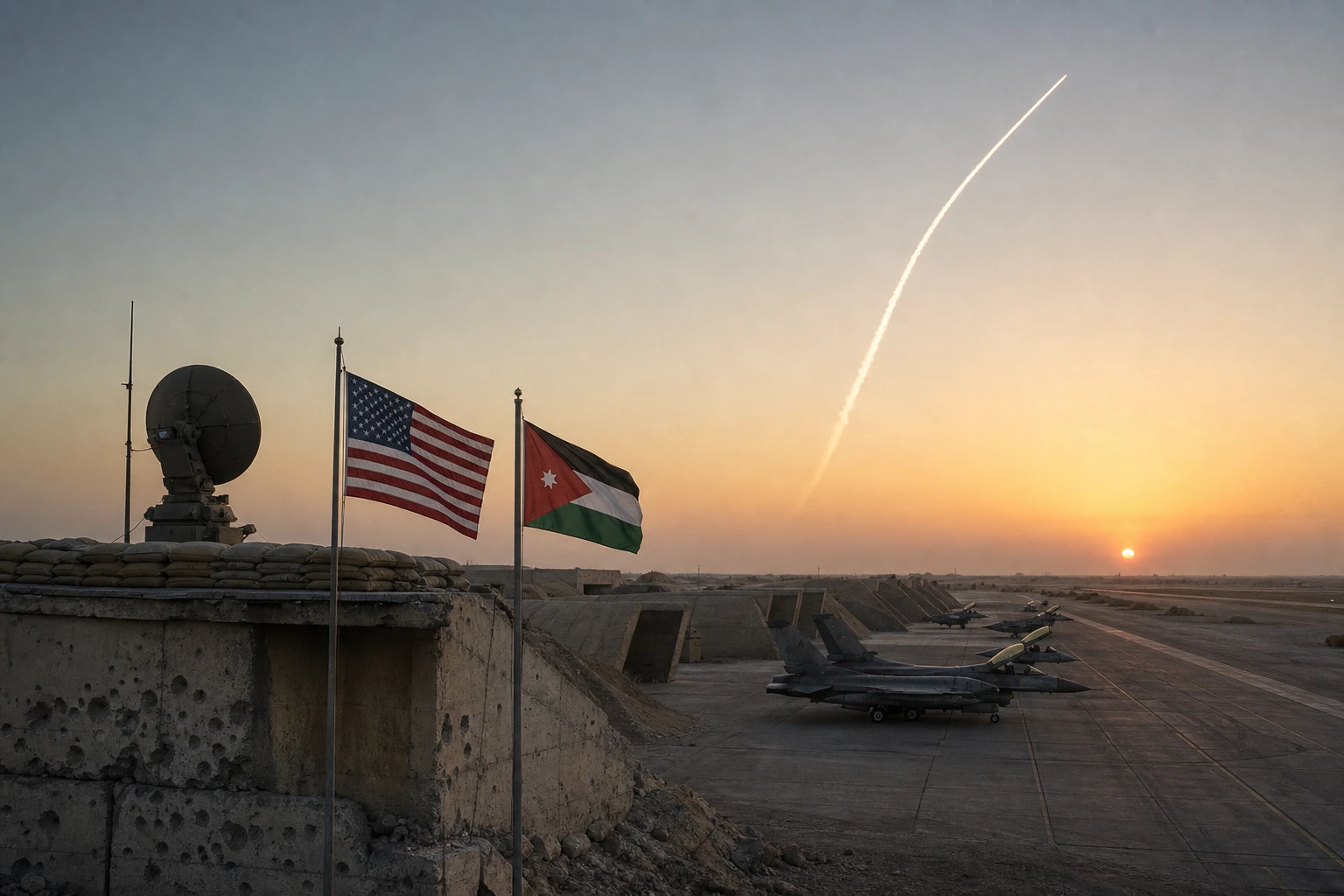
Where Iran Struck This Week
Jordan was not the only partner hit. Iran’s military and its Islamic Revolutionary Guard Corps, known as the IRGC, claimed strikes on American-linked facilities in at least four other countries over the same stretch, forcing air defenses onto alert night after night.
| Country | Facility Targeted | Iran’s Stated Target | Confirmed Outcome |
|---|---|---|---|
| Jordan | Muwaffaq Salti Air Base | US-Jordanian coalition installation | Two troops killed, one missing, remains under examination |
| Iraq | Unnamed coalition base | Downed Iranian drone awaiting disposal | One service member killed during detonation |
| Kuwait | Power plant and desalination facility | US military support operations | Hit twice in two days, fire reported |
| Bahrain | Sakhir airbase | US helicopters and reconnaissance aircraft | Targeted per Iranian statement, damage unconfirmed |
| Qatar | Al Udeid Air Base | Largest US installation in the region | Security alert raised, strike unconfirmed by either side |
Kuwait’s electricity ministry said Iran struck the power and desalination plant twice in two days, sparking a fire. Kuwait’s army said its forces were “confronting hostile missile and drone attacks.” In Doha, Qatar’s interior ministry confirmed a child was hurt by falling shrapnel as sirens sounded during the strikes near Al Udeid. Qatar has repeatedly said the base has not been used to launch strikes on Iran, even as Tehran claims to have hit it anyway.
Jordan, which also hosts 1.3 million Syrian refugees, about 15% of its population, was already stretched before this week’s strikes landed.
How Many Times Has This Ceasefire Broken?
At least twice in five months. A rough truce held from around April until early July, when Iran attacked tankers near Hormuz and the US resumed strikes. Each pause has looked like an ending. Not one has lasted more than a few weeks.
- Feb. 28, 2026: The US and Israel launch a joint air campaign against Iran. Tehran retaliates across the Gulf and effectively shuts the Strait of Hormuz.
- April 13 to May 29, 2026: The US Navy blockades Iranian ports as the fighting grinds on.
- June 17, 2026: Washington and Tehran sign a memorandum of understanding reopening the strait, with Iran promising 60 days of toll-free safe passage.
- Early July 2026: Iran attacks three tankers near Hormuz. Trump declares the ceasefire dead, orders new strikes and revokes Iran’s oil-sale license.
- July 14 to 17, 2026: Iran fires on Jordan, Kuwait, Bahrain, Qatar and Oman as the US bombs Iran’s southern coast for a seventh consecutive night.
- July 17 to 18, 2026: The strike on Muwaffaq Salti Air Base kills two US troops in Jordan and a third dies in Iraq. Washington orders retaliatory strikes.
The Strait Becomes Leverage Again
Until the war started, roughly a quarter of the world’s seaborne oil trade and a fifth of its liquefied natural gas passed through the Strait of Hormuz. Iran’s on-and-off blockade since February has produced, by one count from the Arab Center Washington DC, the biggest shock to global energy supply chains in 50 years.
Iran’s March strike on Qatar’s Ras Laffan facility alone wiped out 17% of the country’s liquefied natural gas export capacity, with losses expected to last years. Oil prices have lurched with every flare-up since. Brent crude jumped 3% to $74.16 a barrel on July 7 after Iran struck a Qatari LNG tanker, then popped another 5.6% after hours once Washington revoked Iran’s license to sell oil.
Tanker traffic through Hormuz fell from an average of 33 ships a day to just 13 on one Wednesday this month, according to the trade intelligence firm Kpler. Windward, a maritime risk firm, called the pattern “the most significant escalation of the conflict since its opening phase” in a client note. Andy Lipow, president of Lipow Oil Associates, wrote that markets seem to be pricing in “a new normal” of intermittent skirmishes squeezed between calmer stretches that still let tankers through.
Gulf Allies Start Hedging in Plain Sight
Saudi Arabia has kept its airspace closed to American and Israeli warplanes for the entire war, even as Iranian missiles have struck Saudi territory. Crown Prince Mohammed bin Salman branded those strikes “cowardly,” a charge easier to make from a position of having refused to let Washington or Jerusalem launch attacks from Saudi skies in the first place.
The Gulf Cooperation Council, which groups Saudi Arabia, the UAE, Qatar, Oman, Kuwait and Bahrain, has floated more permanent fixes too. Former Qatari prime minister Hamad bin Jassim Al Thani called in March for a NATO-style regional alliance, reviving an idea that has failed to gain traction since at least the aftermath of Iraq’s 1990 invasion of Kuwait.
The Gulf states are in a bind because they’re being targeted due to their relationships with the US, but their relations with the US and the presence of those bases have also meant that many of the attacks have largely been thwarted or their consequences diminished.
Simon Mabon, a professor of international relations at Lancaster University, offered that assessment to Al Jazeera as air defenses across the Gulf activated yet again this month. No Gulf state has cut ties with Washington. Each is asking, in effect, to be defended without being implicated.
Jordan Carries the Risk Without the Cushion
Jordan’s position is starker than the wealthy Gulf producers around it. It has no oil income to cushion the political cost of hosting American troops, and its economy leans hard on outside help.
Washington has pledged at least $1.45 billion a year in economic and military aid under a seven-year agreement running through 2029. Total US assistance to Jordan since the 1950s adds up to roughly $33.8 billion, and the State Department has funneled in enough military financing since 2015 alone to make Amman the third-largest recipient of that funding worldwide.
The money has not bought comfort. Jordan’s public debt runs well over 100% of GDP, and average incomes in the kingdom remain below where they stood before the 2008 financial crisis, according to the same congressional research. A base like Muwaffaq Salti buys Amman American backing it cannot easily replace, and leaves it very little room to say no when Washington needs the runway.
From Proxy War to Open War
This is not the first time Americans have died on Jordanian soil. In January 2024, a drone launched by an Iran-backed militia struck Tower 22, a small US logistics outpost near the Syrian border, killing three soldiers and wounding dozens. Iran denied any role, pinning the attack on the Islamic Resistance in Iraq, an umbrella of Iran-aligned militias.
That distance is gone now. The strikes on Muwaffaq Salti came from Iran’s own military and the IRGC, claimed openly, alongside simultaneous attacks on Kuwait, Bahrain and Qatar as part of a declared war rather than a deniable proxy campaign. A later US Army investigation found the Tower 22 attack had most likely been preventable, citing complacency and indecisiveness in the ranks. This time, Iran is not hiding behind anyone. Its regular forces are naming their own targets in real time.
Both governments say they still want the ceasefire restored. Rubio’s own comments over the weekend carried both notes at once, mourning the dead while insisting Washington’s regional commitments have not changed. For Jordan, Kuwait, Qatar and Bahrain, that commitment is exactly what they cannot walk away from and exactly what they cannot fully control the cost of.
Tankers are moving through the strait again, slowly. Ceasefire talks are moving too. Neither has held for long yet this year.
Frequently Asked Questions
How many US troops are stationed in the Middle East?
The US operates military facilities in at least 19 locations across the Middle East and North Africa, including Bahrain, Egypt, Iraq, Jordan, Kuwait, Qatar, Saudi Arabia and the UAE, with roughly 50,000 troops stationed across the region.
Has the Strait of Hormuz reopened to oil tankers?
Not fully. Some tankers, mostly bound for China and India, keep crossing on a northern route that Iran controls, while ships relying on the US-patrolled southern route near Oman have faced repeated attacks.
Did the strikes reach Israeli territory?
Indirectly. Israel’s military issued a warning for the southern city of Eilat, across the border from Jordan’s Red Sea port of Aqaba, as Iranian missiles were intercepted nearby on July 19.
Are commercial flights and shipping still being rerouted?
Yes. Qatar, Kuwait, Bahrain and the UAE all briefly closed their airspace when the war began in February, and Yemen’s Houthi movement has kept forcing Suez Canal traffic around Africa’s Cape of Good Hope by threatening Red Sea shipping.
