
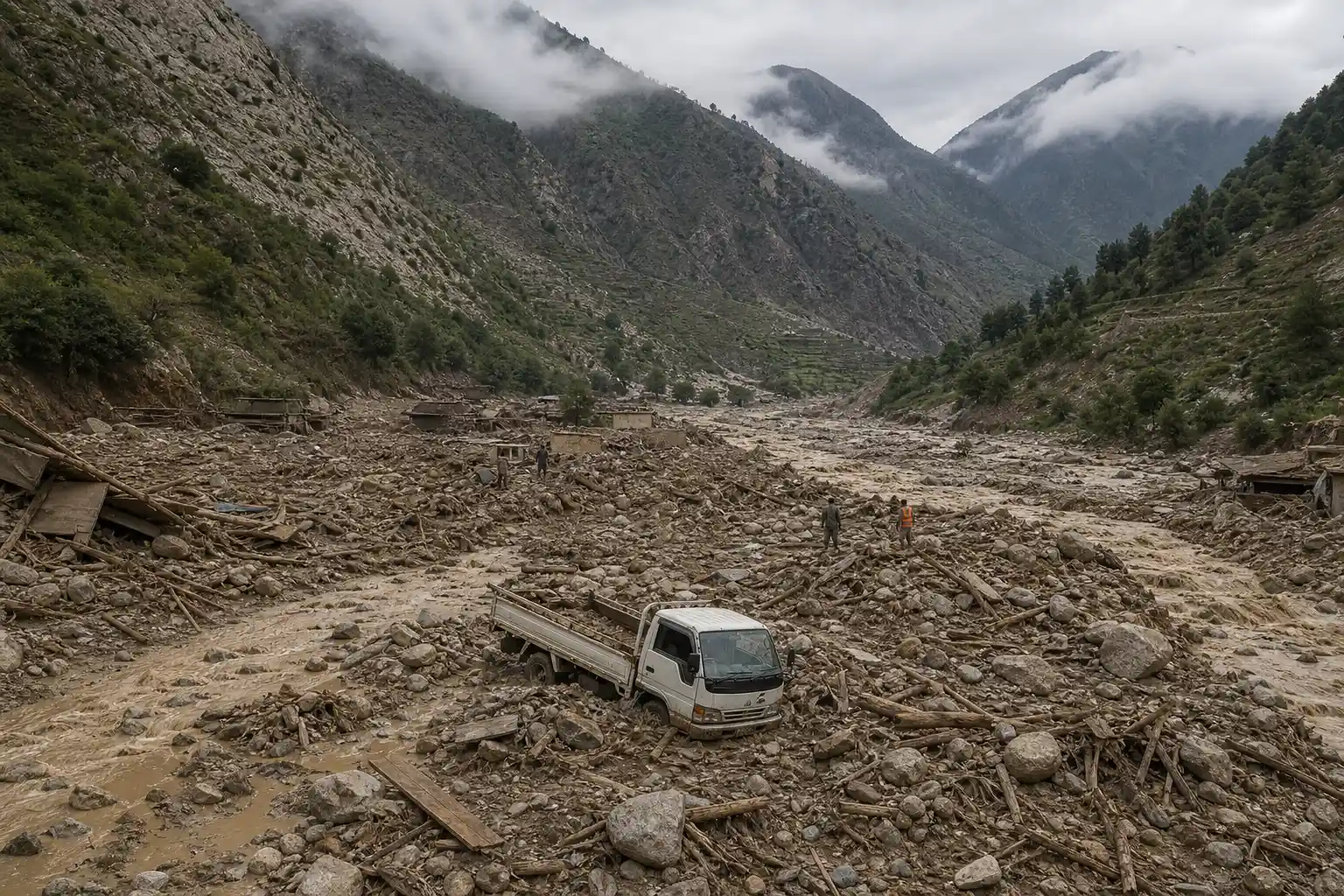
Flash floods killed at least 20 people and left more than 100 others missing in Afghanistan’s Nuristan province on Monday, officials said. Rescue teams are still digging through mud, rock and splintered wood in Parun, the provincial capital, where the town’s mayor is among the missing and roughly 80 people were hurt.
The disaster is landing on a humanitarian system that donors have funded at barely 17 percent of what the United Nations says Afghanistan needs this year, among the thinnest response budgets of any crisis on earth. That gap will decide how fast, or how slowly, Parun comes back.
Mud Where the Riverside Market Once Stood
Officials from Afghanistan’s National Disaster Management Authority (ANDMA) said the floods hit Monday, sending water loaded with rocks and debris through homes, roads, farmland and public buildings in and around Parun. A hotel and dozens of shops were flattened.
“Nine dead bodies are recovered,” Feraidon Samim, spokesman for the Nuristan governor, told AFP, adding that 105 people were missing in Parun town alone. Government employees, including the mayor, were among them. ANDMA’s broader tally for the province stood at 20 dead and more than 100 missing as search crews fanned out beyond the town itself.
Ashiqullah Safi, who heads the local NGO Shpoul, said the flood had “completely destroyed the municipality” along with hotels and shops near the river. Zabihullah Mujahid, the Afghan government’s top spokesman, confirmed the deaths and property damage in a post on X. Footage of the destruction, including video shared from the flood zone Monday, showed brown water carrying debris through what had been a riverside market. Hafiz Mohammad Yousuf Hamad, ANDMA’s spokesman, said search and rescue operations were continuing and warned the death toll would likely climb.
Why Is Nuristan So Hard to Reach?
Nuristan is a knot of steep valleys along Afghanistan’s border with Pakistan, cut by rivers that turn violent fast when monsoon rain hits bare mountain slopes. Roads wash out, and what took hours to reach in dry weather can take days once bridges and tracks are gone.
That geography is compounding a broader climate shift. Afghanistan ranks among the countries most exposed to climate change, with some regions turning drier while others take on heavier rainfall, a whiplash that is straining a country already six years into drought-like conditions in many provinces, according to the International Organization for Migration’s 2026 crisis response plan. Mawlavi Mati-ul-Haq Khalis, head of Afghanistan’s environmental protection agency, said this month that flooding nationwide had increased, and that environmental damage “have severely affected the Afghan people and have contributed to a humanitarian crisis.”
The Same Valley Flooded Five Years Ago
Nuristan has drowned before, and recently. In 2021, flooding in the province’s Kamdesh district killed 113 people and damaged more than 170 houses. Afghanistan’s disaster agency has logged a steady run of destructive floods and storms since, and Nuristan keeps appearing on the list.
| Event | When | Area Affected | Toll |
|---|---|---|---|
| Nuristan floods | July 2021 | Kamdesh district and surrounding Nuristan | 113 dead |
| Seven-province floods | July 2023 | Kabul, Maidan Wardak and five other provinces | 31 dead, 41+ missing |
| Winter storms and avalanches | January 2026 | 15 provinces, including Nuristan | 61 dead, per ANDMA |
| Spring flash floods | March-April 2026 | All eight regions of Afghanistan | 8,400 people reached with aid |
| Parun flash flood | July 2026 | Parun and surrounding Nuristan | 20 dead, 100+ missing, 80 injured |
Back in 2021, Mujahid, then speaking for a Taliban government only weeks into power, ordered the movement’s own rescue crews into the flood zone and pledged 5 million Afghanis, about $62,000, for cleanup. That sum looks small against what Nuristan needs now, and the country’s finances have only tightened since. An OCHA flash update on this year’s spring floods had already flagged Nuristan, alongside Kunar, Nangarhar, Khost, Paktia and Paktika, as provinces where families were displaced and still needed help months later.
Just 17 Cents on Every Dollar Afghanistan Needs
The United Nations says 21.9 million Afghans, roughly 45 percent of the population, will need humanitarian help this year. Meeting that need was supposed to cost $1.71 billion under the 2026 Humanitarian Needs and Response Plan. It hasn’t come close.
- $1.44 billion – the funding gap left in Afghanistan’s 2026 aid plan as of late May, according to OCHA’s humanitarian update for that month
- 16.9 percent – the share of that plan actually funded by June 24, ranking Afghanistan among the world’s five least-funded crises alongside Yemen, Niger, Burkina Faso and Mali
- 422 – health facilities that closed across Afghanistan in 2025 for lack of money, cutting three million people off from care
- 2.6 million – Afghans forced back across the border in 2025 alone, adding fresh strain on services in exactly the provinces now flooding
Jan Egeland, secretary general of the Norwegian Refugee Council, called the funding level “shockingly inadequate” for a country carrying one of the world’s largest caseloads of need. Tom Fletcher, the UN’s emergency relief coordinator, told the Security Council in December that more than 300 nutrition centers had already shut, leaving 1.1 million children without treatment, and that the response was “stretched to breaking point” even before this week’s floods. The 2026 appeal itself was already 29 percent smaller than what agencies said they needed in 2025, not because fewer people are suffering but because planners scaled back expectations of what donors would actually pay, according to a UN briefing launching the appeal in December.
Rescuers Arrive With Less Than They Used To
Even when money and teams are available, reaching Nuristan is its own battle. A prior flood update from OCHA laid out the obstacles crews face across the country’s disaster zones this year, and they read like a checklist written for Parun specifically.
- Damaged and impassable roads that cut off entire valleys after a single storm
- Access restrictions in remote and insecure districts far from provincial capitals
- Limited pre-positioned relief stocks, meaning supplies often start the journey only after a disaster hits
- Funding shortfalls that delay response in the hardest-to-reach districts, even after needs are confirmed
The International Federation of Red Cross and Red Crescent Societies (IFRC) has already tapped its Disaster Response Emergency Fund once this year, allocating 750,000 Swiss francs on May 4 for an earlier round of Afghan flooding, describing a country where communities were already barely coping before that disaster hit.
This new disaster is piling yet more pressure on a country already battered.
Necephor Mghendi, head of the IFRC’s country delegation said in that response announcement, adding that the level of suffering in Afghanistan was “already beyond words.” Mawlawi Mutiul Haq Khales, acting president of the Afghan Red Crescent Society, said the group’s own volunteers were first on scene in the earlier floods and know the terrain better than outside responders ever could. Nuristan will test whether that local knowledge can make up for what national and international budgets can’t cover.
A Monsoon Battering Three Countries at Once
Parun’s flood arrived inside a wider monsoon season that has hammered South Asia since June. Al Jazeera reported that floods and landslides killed at least 25 people across northern and northeastern India on the same day Nuristan flooded, with dozens more dead over recent weeks in India and Nepal combined.
Parun sits about 465 kilometers (290 miles) from Jammu, where a separate flash flood caused extensive damage this season. None of these disasters share a cause beyond geography and timing, but together they show a monsoon pattern that has stopped respecting borders, and a string of governments now competing for the same stretched pool of international disaster funding.
Diplomatic Recognition Grows While the Aid Money Doesn’t
Afghanistan’s international standing has shifted in ways that don’t track with its humanitarian budget. Saudi Arabia recently moved to reopen its embassy in Kabul, a step toward normalizing ties with the Taliban government that iAqaba covered in its report on Saudi Arabia’s decision to reopen its Kabul embassy. That kind of diplomatic gesture has not translated into bigger checks from the humanitarian donors who fund flood response.
Cross-border relations with Pakistan, the country Nuristan borders, remain frozen at a different level entirely. Talks in Riyadh meant to ease tensions between Kabul and Islamabad ended without resolution, a stalemate iAqaba detailed in its coverage of the stalled Pakistan-Afghanistan talks. That friction matters here because it is Pakistan’s own mass deportations that have sent millions of Afghans back across a border that runs a few valleys from Parun, adding population to provinces that now also have to absorb flood damage.
ANDMA’s Hamad said Monday evening that search teams would keep working through the night and into the following days, and that the count of dead and missing was expected to change again before rescuers finish combing the debris field where Parun’s market used to stand.
