
Egypt now ranks 14th globally in kaolin production and 24th in talc output, according to the World Mining Data 2026 report. The country’s kaolin production climbed by more than 218% between 2020 and 2024, and talc output rose by nearly 67% over the same period. Egypt’s Open Blocks licensing system, a year-round framework launched in June 2026, was designed to convert that ranking progress into industrial investment.
Egypt Lands 14th in the Global Kaolin Ranking
An infographic from Egypt’s Ministry of Petroleum and Mineral Resources carries the numbers behind the new ranking, including the 218% kaolin figure and the 67% talc rise. The Federal Ministry of Finance of the Republic of Austria compiles the World Mining Data report annually in cooperation with the International Organizing Committee for the World Mining Congresses. The report is published in Vienna and tracks production across iron, non-ferrous metals, precious metals, industrial minerals, and mineral fuels. The framework spans 168 countries and 65 mineral commodities.
Northern Africa’s combined mineral output registered a year-on-year drop in 2024. The same data set puts Egypt among the leading kaolin producers tracked by the report. Egypt’s individual climb lands even as the region’s aggregate volume has slipped.
Kaolin and talc are industrial minerals, used in ceramics, glass, paper, paints, plastics, and cosmetics manufacturing, per Egypt’s Ministry of Petroleum and Mineral Resources. The ministry also classifies them as strategic minerals whose domestic expansion is meant to support industrial growth, exports, value-added manufacturing, and employment. Egypt Oil & Gas and el-Barima, two outlets that carried the World Mining Data 2026 data, attributed the climb to Egypt’s expanding mining capabilities. Egypt now sits inside the top bracket of producers the same report tracks.
- 14th: Egypt’s rank in global kaolin production, per World Mining Data 2026.
- 24th: Egypt’s rank in global talc production, same source.
- More than 218%: Egypt’s kaolin production growth, 2020 to 2024.
- Nearly 67%: Egypt’s talc production growth across the same period.
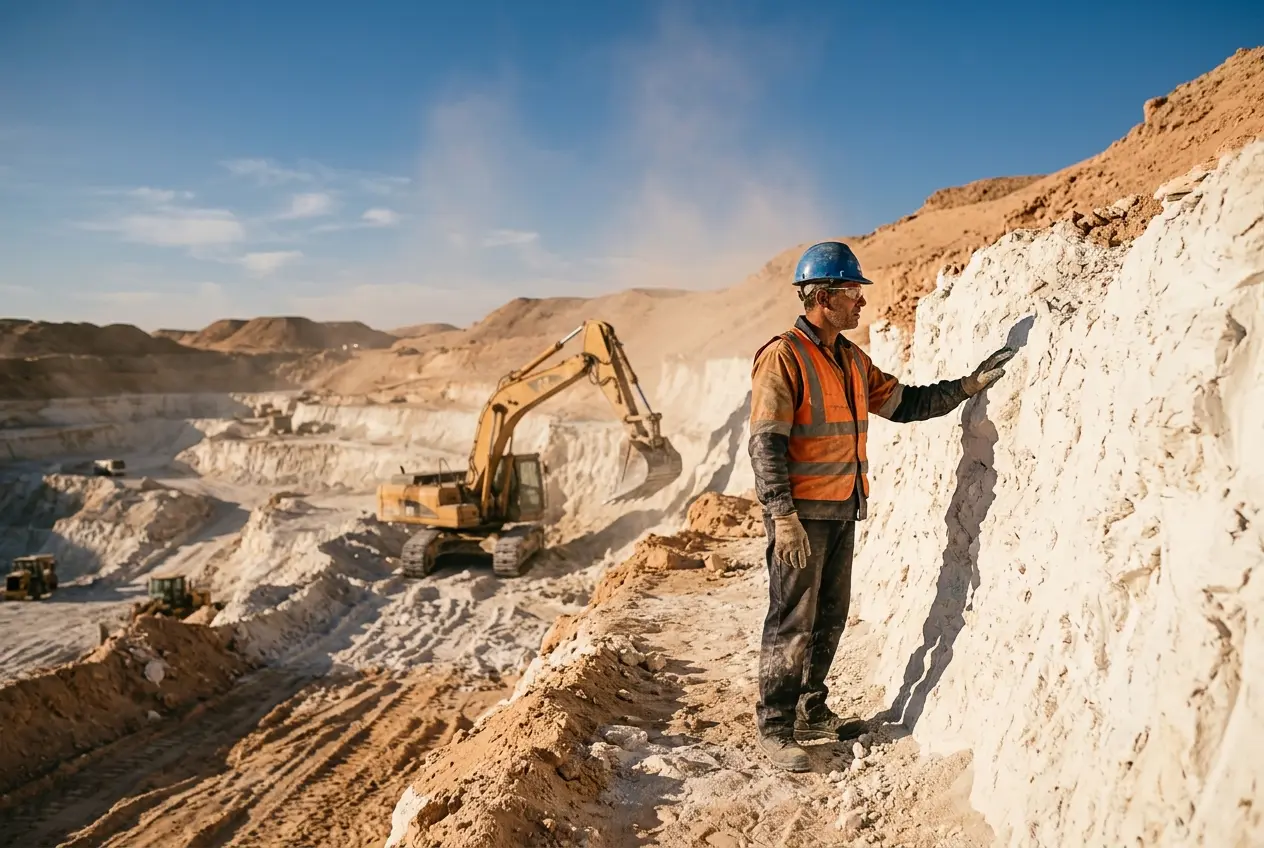
Open Blocks Tries to Convert Rankings Into Investment
Egypt’s Mineral Resources and Mining Industries Authority, called MRMIA, launched its Open Blocks System on Wednesday, June 10, 2026, at 12:00 PM Cairo time, opening year-round applications for exploration and exploitation rights, per the ministry release on the rankings and Open Blocks System. The system covers gold, phosphate, talc, and kaolin, designed to keep bidding open across the calendar. The launch makes licenses available year-round and was framed by officials as a milestone in modernizing Egypt’s mining investment framework.
The bidding operates on a continuous timeline. Companies can apply for any open mineral exploration block at any time, and after the first offer is submitted on a block, a 30-day competitive window opens for other bidders. Blocks that attract no first-round bids stay open, and MRMIA plans to add new blocks in succession as existing ones are taken. The framework gives priority to projects that include local value-added processing over raw ore exports, per details of the bidding window and block geographies.
- Launched: June 10, 2026, at 12:00 PM Cairo time.
- Eligibility: Year-round applications with no fixed bid-round close.
- 30-day competitive window: Begins after the first offer on a block.
- Commodities: Gold and associated minerals, phosphate, talc, kaolin.
- Priority: Projects that include local value-added processing.
Where the New Concessions Sit on the Map
The first wave of concessions sits mostly along the Red Sea coast and on the Eastern Desert’s Arabian-Nubian Shield. MRMIA’s published maps divide the offering into mineral-specific blocks that span Hurghada, Safaga, El Quseir, Marsa Alam, and Bernice. Gold concessions spread the widest; phosphate, talc, and kaolin cluster on smaller, targeted sites.
Phosphate blocks cluster at Hamrawein, on the Red Sea coastal strip between Safaga and El Quseir, with major interior deposits in the Nile Valley and at Abu Tartour in the New Valley Governorate. Talc blocks sit near Marsa Alam. Kaolin lands in two specific zones: West-Central Sinai near Abu Zenima, and southwest of Aswan in Wadi Kalabsha. Companies that win concessions can expand their operations to explore for other minerals inside their assigned sectors, subject to regulatory approval.
The framework’s bidding rules favor projects that include local value-added processing over raw ore exports. Interested bidders purchase the terms and conditions files directly from MRMIA’s main headquarters in Cairo. The same rules apply equally to gold, phosphate, talc, and kaolin applications.
- Gold and associated minerals: Arabian-Nubian Shield across the Eastern Desert, parallel to the Red Sea (Hurghada, Safaga, El Quseir, Marsa Alam, Bernice).
- Phosphate: Red Sea coast at Hamrawein (Safaga to El Quseir), plus Nile Valley and Abu Tartour in the New Valley Governorate.
- Talc: Near Marsa Alam.
- Kaolin: West-Central Sinai near Abu Zenima, and southwest of Aswan in Wadi Kalabsha.
What Kaolin and Talc End Up In
Both minerals feed into industries Egypt is targeting for domestic expansion. Kaolin’s downstream customers include ceramics, paper, paints, plastics, glass, and cosmetics manufacturers; talc’s downstream uses overlap with similar supply chains. Egypt’s stated strategy frames the production climb as upstream fuel for value-added manufacturing. The aim is converting mineral output into domestic manufacturing capacity over commodity export volume.
The Open Blocks licensing rules give priority to projects that pair mineral rights with local value-added manufacturing. MRMIA describes the open-block licensing model as a milestone in modernizing Egypt’s mining investment framework. The same framework builds a more transparent environment for exploration, private investment, and downstream processing. The bidding mechanics aim to convert proven mineral potential into on-shore industrial output. Both kaolin and talc are listed as strategic minerals, per Egypt’s Ministry of Petroleum and Mineral Resources.
Egypt Against a Bigger Northern African Picture
Egypt’s individual climb sits against a falling regional backdrop. Northern Africa’s mineral output totaled 313.82 million metric tons in 2024, down from 361.36 million metric tons the year before. Egypt Oil & Gas framed that drop as institutional and consistent with a deliberate shift toward higher-value processing instead of raw extraction. Egypt’s own production rise landed inside that regional picture.
Asia accounted for a 62.7% share of the global output the report tracks, with the African continent at 4.8%. Northern Africa, Egypt’s region, recorded a year-on-year drop in aggregate mineral tonnage. The figures help frame Egypt’s kaolin and talc rankings inside a much smaller continent of producers.
The report draws on official statistics and national reports, plus data from the British Geological Survey and the United States Geological Survey. Egypt lands inside a regional trend toward processing over raw extraction. The minerals tracked include iron, non-ferrous metals, precious metals, industrial minerals, and mineral fuels. The priority for value-added processing in Egypt’s licensing rules fits the broader regional shift.
- 62.7%: Asia’s share of global mineral production, per World Mining Data 2026.
- 4.8%: The African continent’s share of the same total.
- 313.82 million metric tons: Northern Africa’s 2024 mineral output.
- 361.36 million metric tons: Northern Africa’s 2023 output, before the drop.
Mining’s Place in Egypt’s Diversification Push
Kaolin and talc sit inside Egypt’s broader mining strategy. Egypt has stated its aim to position mining as a pillar of economic diversification, with emphasis on industrial processing over raw commodity exports. The Open Blocks System launched in June 2026 was framed by officials as a key milestone in modernizing that framework. Egypt’s open-block licensing framework is designed to enhance competition and prioritize local value-added processing, part of Egypt’s wider mining reform push. MRMIA frames the reform as converting proven mineral reserves into domestic manufacturing capacity.
Mineral production has already climbed. MRMIA plans to add new blocks in succession as existing ones are taken. The licensing rules give priority to projects that include local value-added processing over raw ore exports. MRMIA describes the framework as building a transparent environment for exploration, private investment, and downstream processing.
