
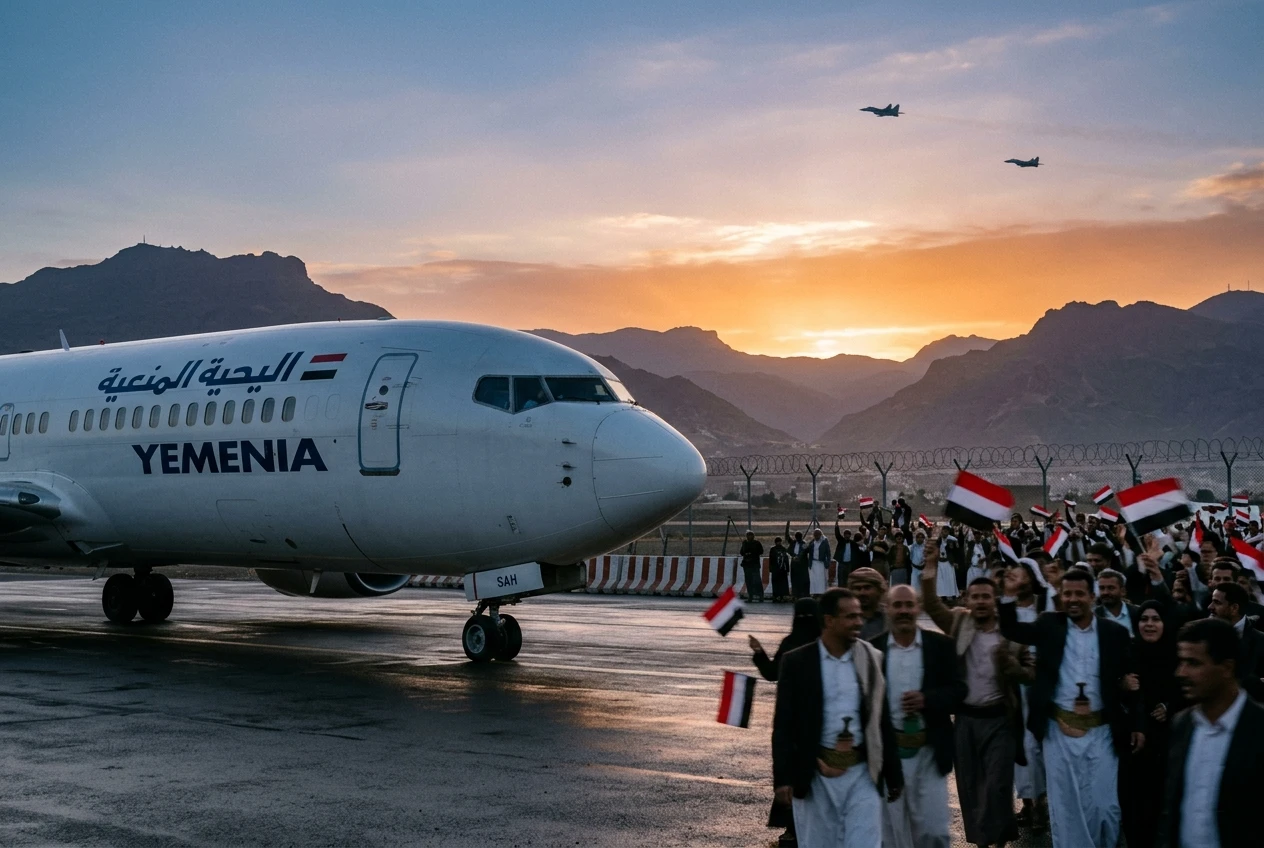
A civilian aircraft touched down at Sanaa International Airport at dawn on July 3, the first publicly confirmed Iranian flight to land in the Houthi-held capital in roughly a decade. The plane carried more than 200 stranded, wounded, and sick Yemeni citizens, alongside a Houthi delegation travelling to Tehran for the funeral of Ayatollah Ali Khamenei, who was killed by a joint US-Israeli strike on February 28. Saudi coalition warplanes approached the airport in an attempt to intercept the flight, and Yemeni air defences fired missiles that the Houthis say forced the Saudi jets to leave Yemeni airspace.
By evening, tens of thousands of Yemenis had packed Al-Sabeen Square in Sanaa to thank Iran for what rally organisers called the breaking of an eleven-year siege on the airport. Saudi coalition spokesperson Major-General Turki al-Maliki responded on July 4, accusing the Houthis of trying to export economic hardship and of undermining regional security. The coalition also warned it would respond with “unprecedented determination and force” to any attempt to target the kingdom or violate Yemeni sovereignty. Yemen’s internationally recognised Presidential Leadership Council separately condemned the flight as a violation of Yemeni sovereignty. The Sanaa flight lands the same week as the next scheduled round of US-Iran negotiations in Pakistan.
What Happened at Sanaa Airport
Houthi military spokesman Brigadier General Yahya Saree placed the Saudi intercept attempt at 5:20 AM on July 3. Yemeni air defence forces fired what he described as a number of air defence missiles, after which the Saudi coalition formation left Yemeni airspace. The Iranian aircraft then completed its landing at Sanaa International Airport. Saree also declared that flights between Sanaa and Tehran would continue regardless of any consequences.
- 5:20 AM: Saudi coalition warplanes attempt to intercept the incoming Iranian civilian aircraft.
- Yemeni air defence forces fire on the Saudi formation, which the Houthis say withdraws.
- The Iranian aircraft lands at Sanaa International Airport with more than 200 passengers aboard.
- Houthi spokesman Yahya Saree warns Saudi Arabia against any further airspace violation.
- A Houthi delegation departs Sanaa for Tehran to attend Khamenei’s funeral.
Saree declared that flights between Sanaa and Tehran “will continue, regardless of any consequences, to break the siege and alleviate the suffering of the Yemeni people.” He warned Saudi Arabia against any repeat of the airspace violation, threatening a “comprehensive response” targeting Saudi airports and vital interests on land and sea. The aircraft’s successful landing was, in the words of the Houthi organisers, a major breach of an eleven-year siege, and Yemen’s Deputy Foreign Minister Abdulwahid Abu Ras called it “the beginning of a new phase of reclaiming rights.”
Abu Ras described the morning as two contrasting scenes, pitting the civilian aircraft against the warplanes. He put it this way: “Today, Yemen’s skies witnessed two contrasting scenes.” He contrasted the humanitarian flight with the Saudi warplanes overhead. “The first was a civilian aircraft carrying patients, wounded people, humanitarian cases, and official delegations,” he said. “The second was warplanes carrying bombs and missiles to kill Yemenis and destroy infrastructure,” he added.
Saudi Arabia’s Coalition Vows a Forceful Response
The Saudi-led coalition issued its response the day after the landing. Spokesperson Major-General Turki al-Maliki dismissed the Houthi threats as an attempt to “divert attention from the group’s actions against the Yemeni people.” He accused the Iran-aligned movement of seeking to export economic hardship it had itself caused and to deflect from domestic political and social challenges. “The claims they made are an extension of escalations and hostile behaviour demonstrated by the Houthi Militia,” al-Maliki said in a statement carried by the Saudi coalition statement on the Sanaa flight.
The coalition will respond with unprecedented determination and force to any and all attempts to target the Kingdom, its citizens and residents and national assets, or any attempt to violate the sovereignty of the brotherly Republic of Yemen.
Al-Maliki’s statement named the Yemeni ports of Hodeidah, Ras Isa, and as-Salif, along with Sanaa International Airport, power stations, and industrial facilities, as civilian infrastructure the coalition said the Houthi posture had exposed to potential targeting. The coalition also repeated earlier accusations that the Houthis have attacked shipping lanes and international trade in the southern Red Sea and the Bab al-Mandeb Strait. Yemen’s internationally recognised Presidential Leadership Council held an emergency meeting on Friday and condemned the Iranian flight as a violation of Yemeni sovereignty.
An Eleven-Year Airport Siege, Cracked in One Flight
Sanaa International Airport has been under a Saudi-American blockade for nearly eleven years. The blockade was enforced in parallel with the broader air campaign that began when the Saudi-led coalition intervened in Yemen in 2015 after the Houthis seized the capital and ousted the internationally backed government. The July 3 landing was, according to Al Jazeera’s reporting, the first publicly confirmed Iranian aircraft to land in Sanaa in roughly a decade. The Iranian mission framed the route as humanitarian transport for patients, wounded travellers, and stranded Yemenis. The political signal landed anyway, and Saudi airspace denial had failed on its first real test since normalisation with Iran.
The new air corridor sidesteps the maritime smuggling routes that Western naval task forces have spent years policing in the Bab el-Mandeb Strait and the Gulf of Aden. Civilian-flagged aircraft are far harder to intercept without triggering international political fallout. The July 3 flight shows that Tehran has found the legal-seeming wrapper the coalition’s air force could not peel off. The political cost of shooting at a passenger plane has already been priced into the calculus.
Saree used the moment to stake out permanence. He declared that flights between Sanaa and Tehran “will continue, regardless of any consequences,” and warned that all Houthi units were prepared to implement any decision made by the Ansarullah leadership. The eleven-year siege, in Houthi framing, is now over by force of one successful landing.
The blockade was not strictly an air blockade on the airport’s runways. Sanaa International Airport had been closed to most commercial traffic since 2016. Yemenia operated the limited flights the United Nations brokered. The Iranian flight’s successful landing marked a major breach of that closure.
The 2023 Beijing Deal That Was Supposed to Stop This
In March 2023, China brokered a normalisation agreement between Saudi Arabia and Iran meant to draw a line under years of proxy conflict. Talks ran from March 6 to March 10 in Beijing. The parties agreed to restore diplomatic ties and reopen embassies within two months.
The deal was billed as a strategic reset that would pull the region back from the brink. The premise, as later described in regional analysis, was that economic engagement would tether Tehran to international norms and persuade the Islamic Republic to abandon proxy warfare. Iran reportedly agreed to stop encouraging Houthi rebel attacks on Saudi territory, an understanding the Atlantic Council’s one-year review said had produced limited concessions in the year that followed. Saudi Arabia got a regional de-escalation in exchange for accepting Iran’s return to the diplomatic stage. The deal was meant to lower the regional temperature, not to set the stage for an Iranian air bridge into Saudi Arabia’s most volatile neighbour.
The premise now sits in tatters. The Houthis resumed attacks on Israel on March 28, 2026, with a ballistic missile at Beersheba. By June 8 they had declared a complete and total ban on Israeli maritime navigation in the Red Sea. The Sanaa landing on July 3 closed the loop, turning a normalised Saudi-Iran relationship into the cover for an unhindered Iranian air bridge into Yemen’s capital.
Israel and the Red Sea Pay the Freight
The Israeli defence establishment has watched the trajectory since March. The Houthis paused their attacks on Israel after the Gaza peace plan took effect on October 10, 2025, then resumed with a Beersheba missile on March 28, 2026. Israeli retaliation has hit Houthi targets in Sanaa in past exchanges, with earlier Israeli strikes on Houthi targets in Sanaa illustrating the cycle of escalation.
- March 28, 2026: Houthis fire a ballistic missile at Beersheba, ending the post-Gaza-war pause.
- April 2, 2026: Houthis claim coordinated barrages at Tel Aviv alongside Hezbollah and Iran.
- April 4, 2026: Houthis claim to have targeted Ben Gurion Airport with a cluster missile and drones.
- June 8, 2026: Houthis declare a “complete and total ban” on Israeli shipping in the Red Sea.
- July 3, 2026: Iranian civilian aircraft lands at Sanaa, ending the airport’s eleven-year siege.
The Red Sea dimension matters as much as the missile count. The Houthis have not ruled out closing the Bab el-Mandeb Strait, with the group warning that closure is “likely.” Roughly 30 tankers near the Saudi port of Yanbu sit within Houthi strike range, per reporting cited by The Times in March. An unhindered Iranian air corridor into Sanaa shortens the resupply loop for the very missile and drone components the maritime interdiction campaigns were designed to deny. The full chronology of the 2026 Houthi strikes on Israel runs from late March into early July without a meaningful pause.
The Houthi Delegation’s Theatrical Arrival in Tehran
The Houthi delegation that crossed to Tehran on July 3 joined funeral ceremonies for Khamenei that opened at the Imam Khomeini Grand Mosalla Complex on July 4 and were scheduled to run for six days. Iranian state media reported an enormous turnout in central Tehran. The visit doubled as a regional alignment display, with delegations from Hezbollah, Iraq’s Popular Mobilization Forces, and Yemen’s Houthis named in published reports while Western governments largely stayed away.
The Houthi arrival in Tehran the same morning their airport siege was broken served as a high-profile endorsement of Iran’s post-Khamenei order. It also served as a deliberate signal that the Iranian proxy network has not been weakened by months of US-Israeli strikes. The theatrics matter because the audience reading the photos is in Washington, Riyadh, and Jerusalem. The message the Houthis wanted sent was that the network still flies.
The funeral’s guest list has been read as a regional alignment map. Western governments stayed away in numbers, leaving the field to delegations from Hezbollah, the Houthis, and Iran’s other regional allies. Khamenei was buried after six days of mourning ceremonies that concluded on July 9.
The Islamabad Talks Await the Aftermath
The next round of US-Iran negotiations is set for Pakistan on July 11, with sanctions, frozen Iranian funds, and nuclear issues on the agenda, according to Al Arabiya. Iran’s delegation will be named after the conclusion of Khamenei’s funeral ceremonies, i24News reported. The Sanaa flight lands the same week as those talks. It is the first concrete answer to a question both sides have spent two months avoiding.
Whether the Saudi-Iran March 2023 normalisation was a strategic reset or a strategic pause has been the open question of 2026. Al Arabiya reports Iran and the US will discuss sanctions, frozen Iranian funds, and nuclear issues when the next round opens in Pakistan. The next round of the July 11 Islamabad talks opens the same week as the first publicly confirmed Iranian flight to Sanaa in roughly a decade.
Frequently Asked Questions
What happened at Sanaa airport on July 3, 2026?
A civilian aircraft landed at Sanaa International Airport at dawn on July 3. It marked the first publicly confirmed Iranian flight to the Houthi-held capital in roughly a decade. Saudi coalition warplanes approached the airport to intercept the flight, and Yemeni air defences fired missiles that the Houthis say forced the Saudi jets to withdraw. The plane carried more than 200 sick and wounded Yemeni passengers, plus a Houthi delegation bound for Ayatollah Khamenei’s funeral in Tehran.
Why is the Saudi-led coalition threatening “unprecedented” force?
Coalition spokesperson Major-General Turki al-Maliki said on July 4 that the coalition “will respond with unprecedented determination and force to any and all attempts to target the Kingdom.” He accused the Houthis of seeking to export economic hardship and to undermine regional security. Yemen’s internationally recognised Presidential Leadership Council separately condemned the Iranian flight as a violation of Yemeni sovereignty.
What was the March 2023 Saudi-Iran normalisation deal?
In March 2023, China brokered an agreement between Saudi Arabia and Iran to restore diplomatic relations and reopen embassies after seven years of estrangement. Talks ran from March 6 to March 10 in Beijing. The deal was billed as a regional reset that would lower tensions between the two countries. Regional analysts argued at the time that economic engagement with Tehran would restrain Iranian proxy warfare, including Houthi attacks on Saudi Arabia.
How does the Sanaa flight affect Israel?
Israeli air defences have intercepted the bulk of Houthi missile and drone launches in 2026, including a Beersheba attack on March 28, claimed Tel Aviv barrages in April, and repeated attempts on Eilat. The June 8 Houthi declaration of a “complete and total ban” on Israeli shipping in the Red Sea has raised the cost of the Houthi threat to Israeli ports and to global transit through the Suez Canal. An Iranian air bridge into Sanaa increases the speed at which the Houthis can be resupplied.
What are the Islamabad talks on July 11?
The next round of US-Iran negotiations is scheduled for Pakistan on July 11, according to Al Arabiya. The agenda includes sanctions, Iranian funds frozen abroad, and nuclear issues. Iran’s delegation will be confirmed after the conclusion of Khamenei’s funeral ceremonies. The Sanaa landing lands the same week as the talks open.
