
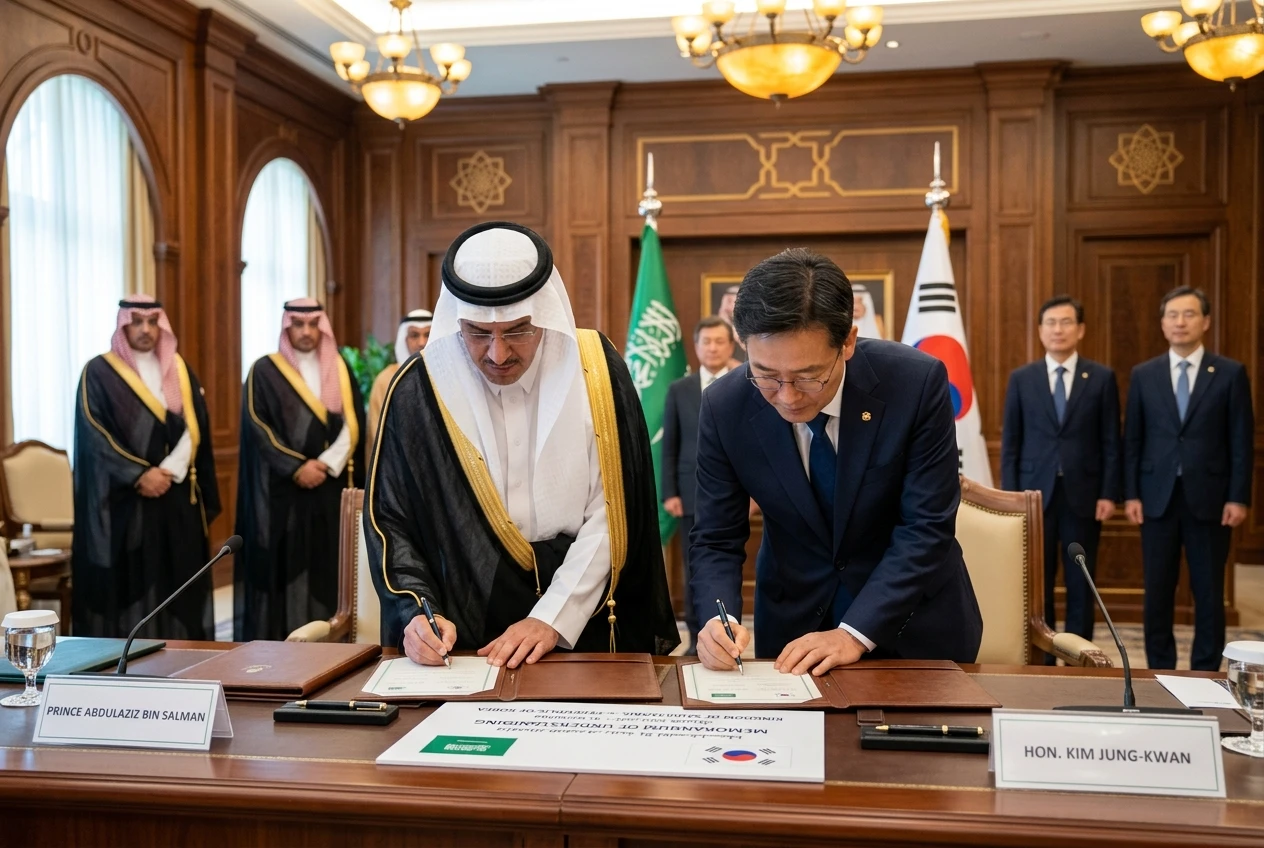
Saudi Arabia and South Korea signed a memorandum of understanding in Riyadh on Sunday, June 14, 2026, to deepen cooperation across the oil and gas value chain. The text also paves the way for Saudi crude to be stored inside South Korea’s Strategic Petroleum Reserve, a hedge against a Strait of Hormuz that Gulf producers can no longer count on.
Energy Minister Prince Abdulaziz bin Salman met South Korea’s Minister of Trade, Industry and Resources Kim Jung-kwan in the Saudi capital, and the two sides signed the MoU after bilateral talks that ran into Sunday evening. South Korea’s industry ministry framed the agreement as a long-term supply framework for “key resources, such as crude oil and naphtha” secured against “lingering instability in global supply chains.” The text also covers the development of energy-related investment partnerships, including expanding Saudi crude oil storage within the Korean Strategic Petroleum Reserve. The clause sits inside a broader deal that South Korea’s Ministry of Trade, Industry and Energy said was signed to “establish a framework for long-term cooperation in the supply of key energy resources.”
The Riyadh Signing and What the Document Covers
The MoU was announced by Saudi Arabia’s state news agency on June 14, with the full text of the energy MoU published the same day. The signing followed a bilateral meeting in which both ministers “reviewed areas of mutual interest and discussed opportunities to expand energy investment and cooperation.”
Prince Abdulaziz bin Salman hosted the talks, with Kim Jung-kwan representing Seoul. The text covers petroleum and gas and their derivatives, refining and petrochemicals, and the development of energy-related investment partnerships. The MoU’s stated goal for the partnership is to “enhance supply stability and resilience.” It also covers crude oil pipeline infrastructure connecting production and export facilities, technology and innovation, digital transformation, research and development, and sustainability initiatives.
Saudi Energy Minister Prince Abdulaziz bin Salman and Minister of Industry and Mineral Resources Bandar Alkhorayef also held parallel talks on the critical minerals sector. Alkhorayef wrote on X that he and Kim “discussed ways to enhance economic partnerships and bilateral cooperation in the critical minerals sector and a number of advanced industries, serving the shared interests of our two countries.” South Korea’s industry ministry singled out artificial intelligence and digital technologies as a focus area for the energy partnership.
| Area of cooperation | What the MoU covers |
|---|---|
| Petroleum and gas | Crude, natural gas, and their derivatives |
| Refining and petrochemicals | Cooperation in refining and petrochemicals |
| Crude storage | Expanding Saudi crude storage in South Korea’s Strategic Petroleum Reserve |
| Pipeline infrastructure | Crude oil pipelines linking production and export facilities |
| Technology and R&D | AI, digital transformation, research and development |
| Sustainability | Sustainability initiatives and energy infrastructure development |
The Crude Storage Clause in a Strait of Hormuz World
The agreement says the two sides will work to “expand Saudi crude oil storage within South Korea’s Strategic Petroleum Reserve” to enhance supply stability and resilience. South Korea’s reserve, run by the state-owned Korea National Oil Corporation, holds capacity of 146 million barrels across nine stockpiling bases, making it the world’s sixth-largest emergency oil reserve. Saudi Arabia is one of several Gulf producers South Korea has been talking to about using that capacity. The timing comes as the Strait of Hormuz has been closed since late February.
That capacity has become a piece of regional real estate. With the strait effectively closed since the start of hostilities in late February in the wake of the US-Israel war on Iran, Gulf oil producers have watched their own storage tanks fill with nowhere to ship. South Korea’s Ministry of Trade, Industry and Energy confirmed that “several countries have approached South Korea with inquiries and requests for consultations” about storing crude at Korean reserve bases, with Saudi Arabia, Kuwait and the United Arab Emirates among them, per a report on Gulf interest in Korean reserve bases.
For Saudi Arabia, storing crude inside South Korea’s reserve is a way to keep barrels moving to a reliable Asian buyer when the Gulf’s main shipping lane is unreliable. For South Korea, hosting Saudi crude inside its own Strategic Petroleum Reserve is a way to harden the supply line from the other direction. The two interests meet in the same underground tank. The arrangement is a hedge against a single shipping lane failing, which is exactly what has happened since late February. Seoul has been on a parallel Gulf energy diplomacy push this year, with the current trip taking in Saudi Arabia, Qatar, and the UAE.
South Korea’s reserve bases were originally built after the oil crises in 1973 and 1979 hit the country’s economy. They are now being put to use in a different geopolitical setting, against a backdrop of a war on Iran’s doorstep.
How Big the Saudi-Korea Energy Trade Already Is
The MoU formalises a relationship that is already large in dollar terms. UN Comtrade data cited in a regional report shows that in 2024, Saudi Arabia’s imports from South Korea reached $6.09 billion, while Saudi exports to South Korea stood at $1.03 billion, per a breakdown of the trade data and signing details. South Korea is among Saudi Arabia’s top 10 import sources, accounting for 2.6 percent of the Kingdom’s total imports.
Energy is the spine of that trade. Saudi crude oil and refined petroleum products are heavily imported by South Korea, and Seoul’s industry ministry has now tied naphtha, a petrochemical feedstock, into the same supply framework. The Riyadh MoU does not publish specific volumes, but it is the legal scaffolding for the kind of long-term contracts that have already defined this decade. Samsung E&A and GS Engineering & Construction are running the $7.2 billion Fadhili gas plant expansion in Saudi Arabia, the largest South Korean construction order in the Middle East. That deal was signed in 2024 and is now in execution, a sign of how the energy relationship has been moving from one-off contracts to multi-year frameworks.
Kim’s Wider Gulf Mission and the Earlier Space Pact
Kim Jung-kwan’s two-day visit to Saudi Arabia began on Saturday, with stops planned in Qatar on Monday and the United Arab Emirates on Tuesday, his ministry said, in a Gulf sweep that has so far produced one signed MoU in Riyadh.
Amid lingering instability in global supply chains, we have secured a stable supply of key resources, such as crude oil and naphtha, and established a foundation for long-term cooperation in the energy sector with Saudi Arabia.
Kim Jung-kwan, the South Korean Minister of Trade, Industry and Resources, said this in a release issued after the signing in Riyadh. He also met with Saudi Investment Minister Fahad Al-Saif and Industry and Mineral Resources Minister Bandar Alkhorayef on Sunday, reviewing the progress of Korean projects in the Kingdom. South Korea’s industry ministry said the agreement covers AI and digital technologies in the energy industry alongside the storage and pipeline clauses. The Riyadh stop is the centrepiece of a wider Gulf swing that will take him to Qatar on Monday and the UAE on Tuesday.
The energy MoU is the latest in a list of bilateral agreements that has grown across the past year. In 2025, the Saudi Space Agency and the Korea AeroSpace Administration, known as KASA, signed an MoU at the SSA’s headquarters in Riyadh, covering deep space technology and communication, human spaceflight programs, satellite launches and payloads, and space science and engineering, per KASA’s announcement of the 2025 Saudi-Korea space cooperation MoU. The agreement aligned with Saudi Arabia’s push under Vision 2030 to build a competitive commercial space sector, an industry now driven largely by the private sector, with over 250 companies operating in the Kingdom and more than 20 government agencies regulating and supporting the field.
What the Deal Asks of Both Sides
For Saudi Arabia, the MoU is a way to lock in offtake from one of the most consistent buyers of Middle Eastern crude, even as Gulf shipping lanes face disruption. The clause on Saudi storage inside the Korean Strategic Petroleum Reserve gives Riyadh a place in a strategic asset that Seoul itself relies on. Saudi Arabia’s interest in placing crude outside the Gulf is grounded in this year’s storage squeeze at home, where exporters have watched domestic tanks fill with nowhere to ship. The Korean reserves offer a way to keep oil moving toward Asian buyers without depending on a single shipping lane. Neither side has yet published storage volumes, but the framework now exists.
For South Korea, the agreement hardens the supply chain from a direction that has just been tested. The country routes the bulk of its crude imports through the Strait of Hormuz, and the alternative supply it has spent the year securing has not displaced Middle Eastern grades in its refining diet. The MoU keeps the Saudi relationship formal and friendly at a moment when Seoul cannot afford for it to be anything else.
Neither side has published volumes, prices, or timelines for the storage expansion. The MoU is the framework, and the contracts inside it have yet to be written. The next public signpost will be Kim’s stop in Qatar, where Seoul is also negotiating long-term energy supply arrangements. The Riyadh document is part of a Gulf sweep that ends in the Emirates on Tuesday.
Frequently Asked Questions
Does the Riyadh MoU commit Saudi Arabia to sell a specific amount of oil to South Korea?
No. The text published by the Saudi Press Agency and South Korea’s industry ministry is a framework agreement covering petroleum and gas, refining, petrochemicals, storage, pipelines, AI and digital technologies, research and development, and sustainability. Specific volumes, prices, and timelines are left to follow-on contracts, which have not been announced.
Why does the MoU mention Saudi storage inside the Korean Strategic Petroleum Reserve?
The clause allows Saudi crude to be physically held in South Korea’s emergency oil reserve, a network of stockpiling bases with a combined capacity of 146 million barrels run by the Korea National Oil Corporation. For Riyadh, it is a way to keep barrels moving when Gulf shipping is constrained. For Seoul, it is a way to deepen the supply relationship with a major producer in a year of disrupted Gulf shipping.
How much oil does South Korea currently import from Saudi Arabia?
South Korea is one of the largest buyers of Middle Eastern crude, with Saudi Arabia among its top suppliers. Bilateral energy trade is the largest single component of a relationship that, by UN Comtrade data, ran to $6.09 billion in Saudi imports from South Korea and $1.03 billion in Saudi exports to South Korea in 2024.
What is the Strategic Petroleum Reserve and how big is South Korea’s?
A strategic petroleum reserve is a stockpile of crude oil held by a government or state-owned company to be released during supply emergencies. South Korea’s reserve, built up after the 1973 and 1979 oil crises, holds capacity of 146 million barrels across nine stockpiling bases and is the world’s sixth-largest by capacity.
Does this energy deal overlap with the Saudi-Korea space agreement signed in 2025?
They are separate agreements with separate scopes, but both sit inside the same broader Saudi-Korea partnership. The 2025 MoU between the Saudi Space Agency and the Korea AeroSpace Administration covered deep space technology, human spaceflight, satellite launches, and space science. The 2026 MoU covers oil and gas cooperation, including refining, pipelines, AI and digital technologies, and Saudi storage in the Korean Strategic Petroleum Reserve. Saudi officials have framed the two as part of a wider set of bilateral pacts spanning defense, energy security, and technology.
