
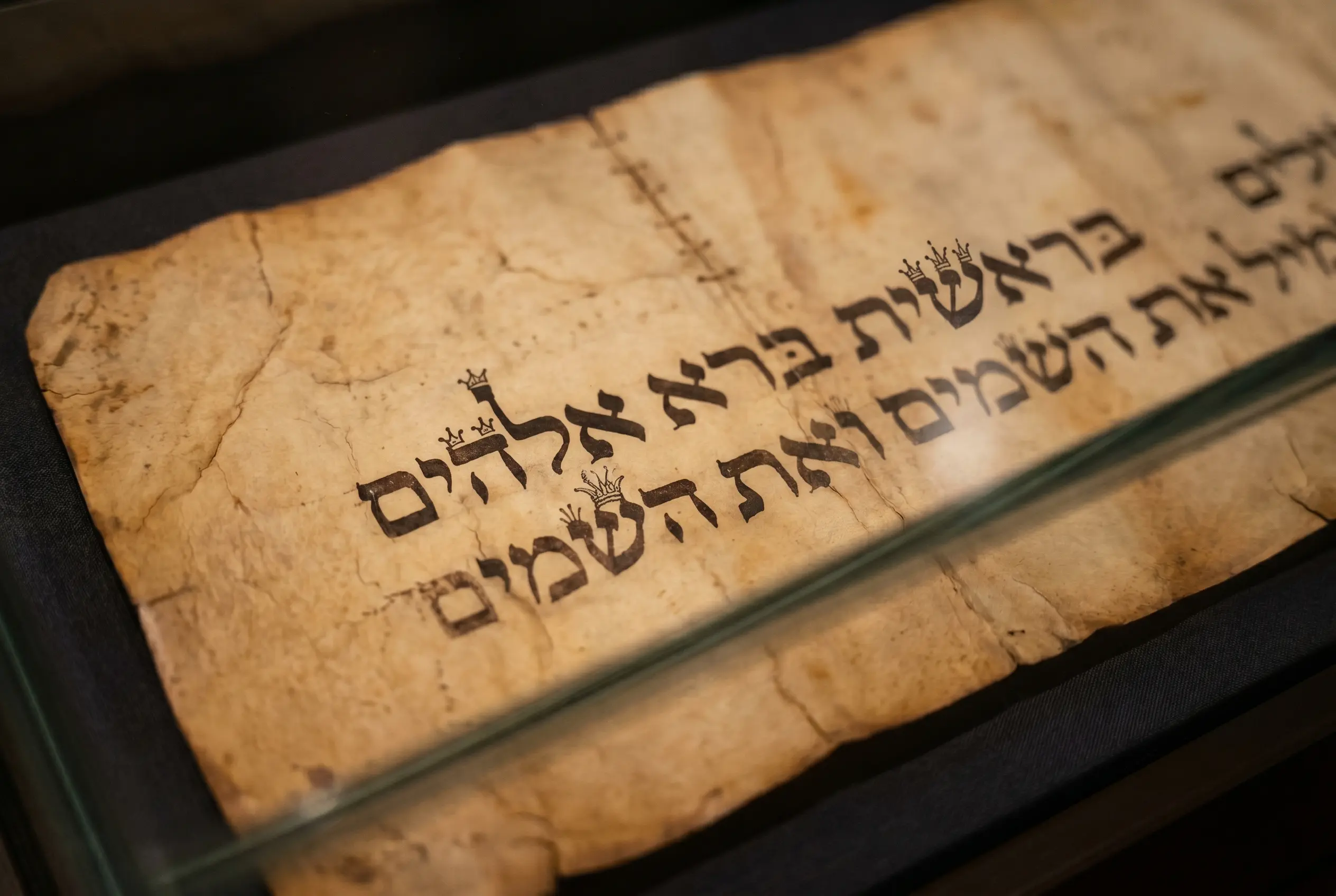
A set of parchment leaves from a medieval Sephardi Torah scroll, copied in Spain in the late 13th or early 14th century, has gone on display at ANU, the Museum of the Jewish People in Tel Aviv. The fragments are among only five early Spanish Torah scrolls known to survive anywhere, and they carry chapters from the Book of Genesis written well over a century before the 1492 expulsion of the Jews from Spain.
What makes the leaves so rare is close to what nearly destroyed them. Spain’s Jews left behind almost none of their Torah scrolls, and these pages lasted only because the scroll they came from was used hard, repaired, and finally pulled apart.
What the Genesis Leaves Reveal About Pre-Expulsion Spain
The leaves are written in ink on parchment, in the square Spanish Hebrew script that scribes used across the Iberian Peninsula. They hold chapters 28 through 33 of the Book of Genesis, the stretch that runs from Jacob’s dream at Bethel through his years with Laban to his reunion with Esau. The Jerusalem Post, which first reported the display, dates the writing to the late 13th or early 14th century; Hebrew-language reporting added that carbon testing puts the parchment at roughly 700 years old.
For visitors, the pull is partly the script and partly the marks around it. Alongside the standard Torah lettering, the scribe used a tradition that halachic literature calls “unusual letters,” a set of special forms and decorative signs that scribes no longer reproduce. The pages now sit inside the museum’s permanent exhibition, on loan from the Feld Family Collection.
- Five early Spanish Torah scrolls are known to survive worldwide.
- ~700 years old, by carbon dating of the parchment.
- Pre-expulsion work, copied before Jewish life in Spain ended.
Why So Few Spanish Scrolls Survive
The scarcity traces back to two things: how Jewish life in Spain ended, and how Judaism treats books it can no longer use. Together they meant no scroll meant for daily use was built to last as an artifact.
The Erasure of 1492
In the spring of 1492, Ferdinand and Isabella signed the Alhambra Decree, giving the kingdom’s Jews months to convert or leave. The National Library of Israel’s history of the expulsion and the Sephardic diaspora traces how communities that had lived in Iberia for centuries scattered across North Africa, the Ottoman lands and Italy. Scrolls carried out by refugees travelled hard roads and often did not outlast the journey. Scrolls left behind fell to the Inquisition or to neglect. Some were hidden by conversos, Jews who converted under pressure and kept practicing in secret.
A Tradition That Buries Its Own Books
Jewish law also works against survival. A Torah scroll that becomes pasul, or unfit for ritual use, cannot be thrown away, because it carries the name of God. Under the custom that My Jewish Learning’s guide to burying the genizah sets out, an unfit scroll goes into a storage room and is later buried, usually in a cemetery. The practice guards the text’s dignity and guarantees that most worn scrolls disappear into the ground rather than into archives.
Put together, the forces working against any single scroll are blunt:
- Daily ritual reading wore scrolls out within a few generations.
- Worn scrolls were buried under genizah law, not preserved.
- The expulsion scattered or destroyed what was still in use.
- The Inquisition treated Hebrew books as evidence to be seized and burned.
The Crowns That Scribes Stopped Drawing
The “unusual letters” that catch the eye on these leaves belong to one of the oldest and strangest corners of Jewish scribal practice.
What the Marks Meant
Hebrew scribes add tiny strokes to certain letters, called tagin, the Aramaic word for crowns. They look like little spikes, shaped like miniature versions of the letter zayin, and in standard practice they sit on the seven letters that take three crowns each: gimel, zayin, tet, nun, ayin, tzadi and shin. The Jewish Encyclopedia’s entry on the tagin crowns traces the custom to Talmudic times and to a famous legend, in which Moses climbs Sinai, finds God tying crowns onto the letters, and is told that generations later Rabbi Akiva will read whole bodies of law out of them. The forms catalogued in Sefer Tagin, a medieval handbook of these markings, went well past the crowns most scrolls still carry. According to the museum, the shapes were read as carrying interpretive, spiritual and even mystical meaning, not as ornament.
Why the Practice Faded
That layer of meaning thinned as Torah writing became standardized. The museum links the older tradition to the Hasidei Ashkenaz, the medieval Ashkenazi pietists, and to Sefer Tagin, but notes that the special forms dropped away as scribes converged on a uniform text. A modern scroll still keeps crowns on a handful of letters; the wider repertoire on these Spanish pages is mostly gone from living practice. Dr. Orit Shaham-Gover, the museum’s chief curator, has described the leaves as a window onto “a world that was almost lost,” down to the secrets of the calligraphy.
How the Leaves Outlived the Scroll
The pages carry their own biography. Corrections sit between the lines, and later repairs show where the parchment was mended, signs that the scroll stayed in service for generations after it was written. At some point it became unfit for use. Instead of being buried whole, it was taken apart, and only some leaves survived. Those pages passed eventually into the Feld Family Collection, which has lent them to the Tel Aviv museum.
Oded Revivi, the museum’s CEO, said the display carries weight beyond its age.
Beyond its extraordinary historical value, it reminds us that throughout the generations, the Torah scroll was a focus of identity, memory, and Jewish creativity.
He added that every letter and ornament in the leaves carries the story of a community and of a spiritual world handed down across centuries.
Where It Sits Among the Oldest Torah Scrolls
These leaves are old, but they are not the oldest Torah scroll known. The record for a complete scroll belongs to the Bologna Torah Scroll, held at the University of Bologna and rediscovered in 2012 by Mauro Perani, a professor of Hebrew studies who realized a scroll catalogued as 17th-century material was far older. The Biblical Archaeology Society’s account of the Bologna find describes how carbon dating placed the writing between the late 12th and early 13th century.
| Feature | Spanish Genesis leaves | Bologna Torah Scroll |
|---|---|---|
| Origin | Spain, Sephardi tradition | Italy, Italian-Ashkenazi style |
| Date | Late 13th / early 14th century | Late 12th / early 13th century |
| Extent | Partial, Genesis section | Complete Pentateuch, about 36 metres |
| Distinctive trait | “Unusual letters” and extra crowns | Full continuous early text |
| Current home | The museum, Tel Aviv (on loan) | University of Bologna |
That scroll is whole and written in a separate regional hand; the Spanish pages are fragments of a tradition that mostly vanished. Set against the many scrolls Spanish Jewry once used, only five are known to survive, and these Genesis leaves are one of them.
Frequently Asked Questions
What is the medieval Sephardi Torah scroll on display at the ANU Museum?
It is a set of parchment leaves from a Torah scroll copied in Spain in the late 13th or early 14th century, now shown at ANU, the Museum of the Jewish People in Tel Aviv. The pages hold chapters from the Book of Genesis and are on loan from the Feld Family Collection.
How old are the Torah scroll leaves?
The museum dates the writing to the late 13th or early 14th century. Carbon dating cited in Hebrew-language reporting puts the parchment at roughly 700 years old, written well before the 1492 expulsion.
What are the “unusual letters” on the scroll?
They are special letter forms and decorative markings, related to the crowns called tagin, that scribes once added to certain Hebrew letters. Halachic literature treated them as carrying interpretive and mystical meaning. Modern scrolls keep only a small set of these crowns.
Why are so few early Spanish Torah scrolls left?
Daily use wore scrolls out, and Jewish law requires unfit scrolls to be buried rather than kept. The expulsion and the Inquisition then scattered or destroyed most of what remained, leaving only a handful of early Spanish scrolls known today.
Where can visitors see the leaves?
The leaves are part of the permanent exhibition at ANU, the Museum of the Jewish People, on the Tel Aviv University campus. They were unveiled to the public ahead of Shavuot.
What is the oldest known Torah scroll?
The Bologna Torah Scroll, held at the University of Bologna, is the oldest complete Torah scroll known. Carbon dating placed it between the late 12th and early 13th century. The Spanish leaves at the Tel Aviv museum are partial and slightly later.
