
Super Micro Computer rolled out 12 new server platforms built on Intel’s Xeon 6+ processors at Computex this week, packing up to 576 efficiency cores per machine for cloud, virtualization and 5G analytics. The launch landed mid-rally: the stock has climbed about 70% in a month to roughly $46, which sits near 24% above the price most Wall Street analysts peg as fair value.
Here is the wrinkle the rally keeps skating over. Intel says the same Xeon 6+ processors are available immediately through systems from Dell Technologies, Hewlett Packard Enterprise, Lenovo and Supermicro, and the new boxes aim at the price-sensitive cloud and telecom buyers who sit at the thin-margin end of Super Micro’s catalog. That puts a celebrated product launch in the corner of the business least able to justify a move this big.
Twelve Platforms, 576 Cores, One Familiar Chip
The new lineup, branded X14, spans four of Super Micro’s server families and is tuned for Intel’s latest efficiency cores (E-cores). Supermicro launched 12 new X14 server platforms powered by Intel Xeon 6+ processors, targeting large-scale cloud and data centers, with up to 288 efficiency cores per socket and 576 E-cores per server. The pitch is density and power: cram more compute into each rack while trimming the electricity bill. The four families cover different shapes of that same idea:
- Hyper rackmount systems, built for performance, memory capacity and networking flexibility.
- SuperBlade, a 6U blade platform supporting up to 10 compute nodes for high rack density.
- FlexTwin, a liquid-cooled design with independent dual-socket nodes that share power and cooling.
- GrandTwin, single-socket multi-node systems tuned for efficiency-core workloads.
On paper, the generational jump is real. Intel says Xeon 6+ offers double the core count, up to 17% higher instructions per clock, five times more last-level cache and 25% faster memory support than the prior generation. Charles Liang, president and chief executive of Supermicro, framed the launch around customer economics.
By working closely with Intel, we have optimized our DCBBS with the new Xeon 6+ processors to deliver breakthrough core density and efficiency. These new X14 platforms, with up to 576 E-cores per server, dramatically improve performance-per-watt and help customers shorten time-to-deployment while lowering TCO and energy consumption in large-scale cloud and enterprise data centers.
DCBBS, the company’s Data Center Building Block Solutions, is its model for selling complete racks rather than loose servers, and TCO is shorthand for total cost of ownership. Super Micro showed the systems at Computex in Taipei. The full configuration list sits in the company’s X14 Xeon 6+ platform announcement.
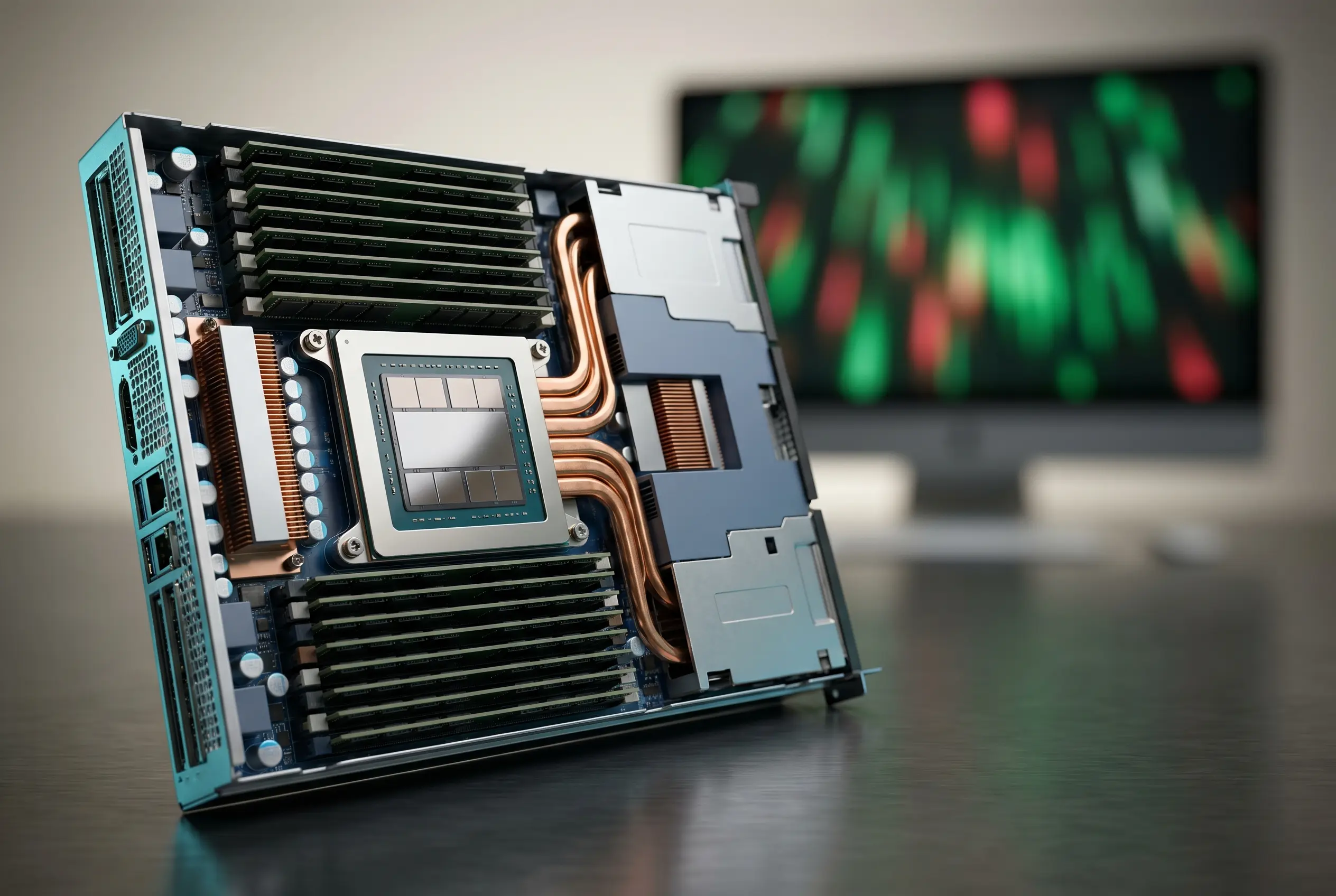
The Stock Has Run Past the Street’s Consensus
The launch has been catnip for a stock that was already running hot. Super Micro shares have gained roughly 70% over the past month to about $46, and that price now sits well above where the sell-side pegs value. By the snapshot that prompted this look, the stock trades about 24% above the consensus analyst target of roughly $37 and around 21% above one widely used fair-value estimate. Some of that launch-day jump is captured in Super Micro’s stock reaction to the Xeon 6 server launch.
Wall Street is not chasing it. The rating split runs two strong buys, three buys, nine holds, two sells and two strong sells, and only about 28% of analysts are bullish. The consensus rating has been a hold. When a stock blows past the average target, the crowd is setting the price, not the analysts.
The spread of published targets shows how wide the disagreement runs:
| Analyst reference | 12-month target | Implied move from the current price |
|---|---|---|
| Consensus (hold-leaning) | $37.13 | about 19% below |
| Street-high (most bullish) | $58.00 | about 26% above |
| Goldman Sachs (sell) | $30.00 | about 35% below |
| Northland Capital (Street-low) | $22.00 | about 52% below |
So the bullish case is not dead; the most optimistic target on the Street implies real upside from here. But the weight of opinion clusters far below the current quote, and the most bearish marks, a sell rating from Goldman Sachs analyst Katherine Murphy and a Street-low call from Northland Capital Markets, imply the stock could lose a third to half its value if the doubters are right.
The Servers Land in the Low-Margin Lane
To see why the launch may not move the needle on valuation, follow the margins. Super Micro’s problem has never been demand; it has been how little of each sales dollar survives to the bottom line. The new servers do little to change that math.
The Same Chip Dell and HPE Also Ship
Intel’s Xeon 6+, codenamed Clearwater Forest, is its first high-volume data-center chip on the 18A process, with up to 288 efficiency cores and a huge on-package cache. Intel says the processors are available immediately through systems from Dell, HPE, Lenovo and Supermicro. In other words, the same silicon underpins every major vendor’s box, so Super Micro competes on price, integration and speed, not on an exclusive part. Intel lays out the design in its Xeon 6+ Clearwater Forest processor overview.
The chips are aimed squarely at efficiency-core territory: cloud-native services, virtualization, content delivery, telecom and big databases. Intel built the Xeon 6+ E-core line specifically to fight off cheaper Arm cores for cloud-native workloads and keep them on x86. That is a strategically sensible market to defend. It is also one where buyers negotiate hard and switching costs are low.
Where the Margin Pressure Sits
The thin-margin reality shows up in the filings. On a non-GAAP basis, Super Micro’s gross margin fell to 6.4% in the December 2025 quarter from 11.9% a year earlier. Measured under generally accepted accounting principles (GAAP), it compressed to roughly 6% before clawing back to about 9.9% in the March quarter. Bulls cheered that rebound, and the stock jumped after the spring results. The detail sits in the gross-margin reconciliation in its quarterly results.
The catch is what drove both the squeeze and the bounce. Analysts tied the recent revenue miss to cloud customers pushing out orders, while margins were helped by a favorable product mix and lower costs. Optimists argue the commodity servers pull through higher-margin full-rack deals and direct liquid cooling, which can carry better economics than basic server shipments. Even so, selling more efficiency-core boxes to the same price-sensitive buyers is unlikely by itself to rebuild the double-digit gross margins this valuation is reaching for.
A Balance Sheet That Punishes Surprises
A run this steep leaves little room for error, and Super Micro’s balance sheet is not built for forgiveness. The company funded its AI-era growth with debt and convertible notes and ties up a lot of cash in inventory and receivables as it scales, as its fiscal third-quarter balance sheet shows.
- $4.11 billion in lines of credit and term loans as of March 31, 2026, per the quarterly filing.
- $7.5 billion in estimated net debt once convertible notes are counted.
- 1.68 beta, a sign the shares tend to swing far more than the broad market.
None of that is fatal while orders keep flowing. It does mean the stock is wired to overreact in both directions. Shares moved more than 23% in a single week heading into late May, and a cash conversion cycle that doubled in one quarter sits high on the bears’ worry list. When a company is this leveraged and this volatile, a momentum price is a fragile thing.
The Accounting Crisis Still Shadows the Stock
There is a reason Super Micro trades at a discount to peers even after this month’s surge, and it is not the hardware. The company spent late 2024 and early 2025 in an accounting crisis, documented across Super Micro’s SEC filing history, that nearly cost it its Nasdaq listing, and the legal tail is still attached.
- August 2024: short seller Hindenburg Research published a report alleging accounting red flags, and the company delayed its annual 10-K report days later.
- September 2024: Nasdaq warned Super Micro it was out of compliance with listing rules over the late filing.
- October 2024: auditor Ernst & Young resigned, saying it was unwilling to be associated with management’s financial statements.
- Late 2024: the stock was removed from the Nasdaq 100 index, after the company appointed BDO USA as its new auditor in November.
- February 2025: Super Micro filed its overdue 10-K and disclosed Department of Justice and Securities and Exchange Commission document requests.
Crucially, the filings did not force a major restatement of past revenue. They came with an adverse opinion on internal controls, confirming the numbers were accurate but the processes used to generate them remained risky. That distinction is why the stock survived; it is also why a slice of the market still treats Super Micro as a show-me story.
The overhang has a live date. A shareholder class action covering losses between April 2024 and March 2026 set a lead-plaintiff deadline of May 26, 2026. For a stock priced on momentum, headlines from that case are exactly the kind of surprise the share price is not braced for.
The August Earnings Test for the Margin Story
The next real test is on the calendar. Super Micro is expected to report fiscal fourth-quarter results around August 3, 2026, after the close. That print, not the server launch, will decide whether the re-rating sticks.
Two things matter most. Full-year fiscal 2026 guidance has been raised to a range of $38.9 billion to $40.4 billion, nearly double the prior year’s $21.97 billion. Nobody disputes the growth; the question is its quality.
The margin line is the tell that matters. Management guided fourth-quarter gross margin to a range of 8.2% to 8.4%. A reading near the top of that range would suggest the spring rebound was structural rather than a one-off.
So here is the setup into August. If gross margin holds at or above 9% and the cloud orders that slipped finally convert, the 70% run looks like the market pricing in a genuine turn before the analysts catch up. If margin drifts back toward the mid-single digits, a stock trading a quarter above consensus has a long way to fall toward the targets, and a commodity-CPU launch will not be the thing that catches it.
Frequently Asked Questions
Are Super Micro’s new Xeon 6+ servers AI or GPU systems?
No. The X14 platforms are CPU-only systems built on Intel’s efficiency-core Xeon 6+ chips, aimed at cloud, virtualization, 5G analytics and content delivery. That is a separate product line from Super Micro’s GPU-based AI servers and direct-liquid-cooled racks.
When does Super Micro Computer report its next earnings?
Super Micro is expected to report fiscal fourth-quarter results around August 3, 2026, after market close, covering the quarter that ends June 30, 2026.
What is the analyst price target for SMCI stock?
The consensus 12-month target is roughly $37 with a hold-leaning rating. Published targets range from about $22 at the low end to around $58 at the high end, a spread that reflects deep disagreement over margins and execution.
Why did Super Micro’s gross margin fall?
Margins were squeezed by a shift toward large, lower-margin cloud orders and pricing pressure, pulling GAAP gross margin into the mid-single digits before it recovered to about 9.9% in the March 2026 quarter. Management has guided fourth-quarter gross margin to 8.2% to 8.4%.
Is Super Micro still under regulatory scrutiny?
The company disclosed Department of Justice and Securities and Exchange Commission document requests following a 2024 short-seller report, and it filed its overdue annual report in February 2025 with an adverse opinion on internal controls. A related shareholder class action carried a lead-plaintiff deadline of May 26, 2026.
Disclaimer: This article is for informational purposes only and is not investment advice. It discusses equities that carry market risk, including the risk of loss, and reflects figures accurate as of publication. Consult a qualified financial professional before making any investment decision regarding Super Micro Computer or related securities.
