
Brent for July rose 2% to $98.26 a barrel in Asian trading on Tuesday, while West Texas Intermediate for the same month sat 5.1% lower at $91.73 against Friday’s close after a U.S. holiday paused Monday’s session. The two benchmarks rarely move in opposite directions on the same headline. This morning they did, opening a spread of roughly $6.50 a barrel that is the cleanest read on where global crude risk is now being priced.
U.S. Central Command said its forces struck two Islamic Revolutionary Guard Corps (IRGC, Iran’s parallel military arm) vessels and a surface-to-air missile site in southern Iran on Monday, framing the action as self-defense even as President Donald Trump told allies that peace talks were “proceeding nicely.” Traders treated the strikes as a Hormuz story rather than a Houston story, and split the tape accordingly.
The Tape Split Between Brent and WTI
Brent’s 2% gain on Tuesday morning in Asia reversed a flat finish in London on Friday. WTI’s 5.1% drop, by contrast, registered against the same Friday close because Memorial Day kept the U.S. market dark on Monday, Reuters reported. The catch-up trade was already going to be loud. The strikes set the direction.
The split tells you which contract reads which fear. Brent reflects waterborne barrels passing the Strait of Hormuz: ships, tankers, mines, the price of a re-route. WTI reflects Cushing, Texas, and a refining base mostly insulated from a Persian Gulf chokepoint. When CENTCOM hit IRGC vessels near Bandar Abbas, Brent rewarded the danger and WTI sold off the headline that maybe a deal was close enough to spare U.S. drillers another year of $90-handle restraint.
That divergence is the trade. Holding both contracts side by side, the market is telling a two-track story before the diplomats can write a single press release.
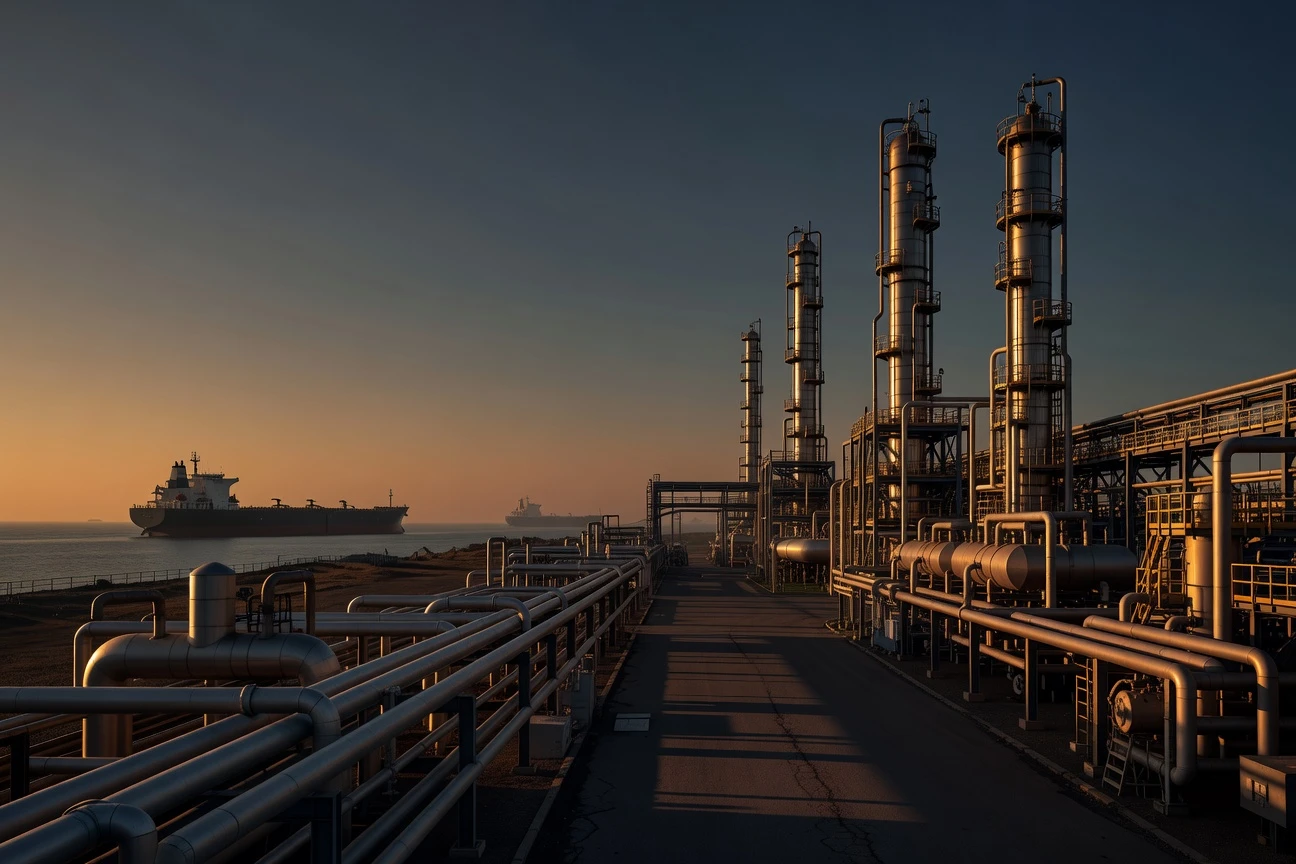
What CENTCOM Hit and Why the Map Matters
The U.S. strike list, as described by CENTCOM spokesperson U.S. Navy Capt. Tim Hawkins, named a tight cluster of targets across a narrow stretch of coast and water. Hawkins said in a statement that “U.S. forces conducted self-defense strikes in southern Iran today to protect our troops from threats posed by Iranian forces.”
- Two IRGC Navy vessels in the Strait of Hormuz, accused of preparing to lay naval mines along the shipping corridor
- A surface-to-air missile site at Bandar Abbas that U.S. officials said had been tracking American aircraft operating in the region
- Missile launch infrastructure in southern Iran linked to recent strikes against regional bases
Together the targets cluster around the same 90-mile stretch of water that handles roughly a fifth of seaborne crude. That is the geography moving Brent. The picture is uncomfortable: the U.S. is shooting at mine-laying boats inside the same lane the global market needs unobstructed, and it is doing so while telling Tehran the bigger talks are still on.
CENTCOM’s “self-defense” phrasing is doing work too. It positions the operation as a narrow protective measure rather than a return to wider war, which would have spiked Brent harder. Tehran’s negotiators were reportedly in Qatar at the time, sitting opposite U.S. envoys. That they did not walk out is its own market signal, and one of the reasons WTI traders read the day as deal-positive even while Brent traders did the opposite. For an inside look at how regional capitals are absorbing the parallel military and diplomatic tracks, see our reporting on how Gulf Arab nations have become Iran’s prime retaliation targets.
The 246-Million-Barrel Hole Under the Rally
The price action is only the surface. Underneath, Swiss multinational investment bank UBS published a Friday note warning that observed global oil inventories had drained by a combined 246 million barrels across March and April, and that cumulative production losses linked to Hormuz disruptions could top 1 billion barrels by the end of May. The bank described the market as “strongly undersupplied”.
Three figures frame the strain:
- 246 million barrels: observed global inventory drop across March and April, per UBS
- 1 billion barrels: cumulative production losses UBS sees by the end of May if Hormuz disruptions persist
- 8.5 million barrels per day: the average Q2 inventory draw flagged by the EIA Short-Term Energy Outlook for global oil markets
These are not soft numbers. UBS noted that on-land crude and refined product stocks have kept falling even while floating storage has risen, because U.S. shippers are diverting cargoes from Europe to Asia along longer routes. The on-water build is a logistics tic, not a supply cushion. Refiners cannot pull from a tanker mid-voyage.
The point most investors are skipping over is that the inventory floor beneath the Hormuz story has already been spent. The market is now trading off depleted buffers, which is why a relatively contained strike, two boats and one missile site, was enough to lift Brent two full percentage points. A larger event into a fuller inventory base would have produced a smaller move. A smaller event into a near-empty base produced what landed on screens this morning.
Trump’s Abraham Accords Demand Lands in Silence
The peace track had its own complication. In a Truth Social post Monday, Trump said he had told the leaders of Saudi Arabia, the United Arab Emirates, Qatar, Pakistan, Turkey, Egypt, Jordan and Bahrain that joining the Abraham Accords, the 2020 framework normalizing relations between Israel and several Arab states, was effectively mandatory if any Iran deal was to hold. He described the Tehran talks as proceeding nicely, but cautioned that Washington could resume military action if they collapsed.
It will only be a Great Deal for all, or no Deal at all.
Trump wrote that line on Monday, hours before the CENTCOM strikes were announced. The countries he named greeted the demand with what one U.S. official described to Axios as silence on the call, with the president joking on the line to check whether anyone was still there. Pakistan rejected the proposal outright. Saudi Arabia, Qatar and Pakistan still have no formal diplomatic relations with Israel; Egypt normalized in 1979 and Jordan in 1994. The list, in other words, conflated three separate diplomatic categories into a single ask.
For oil, the mechanism matters less than the optics. If the Iran track is now tethered to a parallel normalization track that several named capitals are unwilling to walk down, the path to a sanctions-easing settlement just lengthened. Brent traders read that as a thicker risk premium. WTI traders read the same news as the deal being close enough that U.S. domestic supply might soon face a softer geopolitical bid. Both reads cannot be right; that is why the spread blew out. Our earlier piece on Egypt’s case against a military exit in the Middle East spelled out how Cairo and several Gulf capitals are already pushing back on framing the war as a transactional package.
Brent and WTI Are Now Pricing Different Wars
| Factor | Brent (July) | WTI (July) |
|---|---|---|
| Tuesday move | +2% to $98.26 | -5.1% to $91.73 |
| Primary risk anchor | Strait of Hormuz transit | U.S. domestic supply |
| Reaction to CENTCOM strikes | Supply-threat read | Deal-proximity read |
| Sensitivity to peace talks | Lower | Higher |
| Spread vs counterpart | +$6.53 over WTI | -$6.53 below Brent |
The table is doing what the chart will do by Wednesday: showing that the two benchmarks are no longer pricing the same news. Historically the Brent-WTI spread has tracked freight, refining margins and pipeline capacity through Cushing. This week it is tracking geopolitical optionality. UBS sized the missing barrels; the spread is now sizing the missing trust.
For a refiner buying both grades, the risk is that the gap widens further if mines actually deploy. For a producer hedged on WTI, the risk is that the spread compresses fast if a deal lands; July’s settlement could carry that compression straight into the next quarterly hedge book.
The Window Into June
By the second week of June, three things will know themselves. The Qatar talks will either still be running or have stalled. The Strait of Hormuz will either be carrying its normal load of tankers or be visibly thinner on automatic-identification-system tracking. And UBS’s billion-barrel cumulative-loss estimate will either have validated or undershot. Each of those answers feeds the spread that opened on Tuesday.
If the talks hold and Hormuz traffic normalizes, Brent gives back this week’s premium quickly and the gap to WTI compresses below $4 a barrel. If a mine actually goes off, or a Saudi or Emirati cargo gets struck in transit, Brent prints north of $105 and U.S. drivers feel it at the pump within ten days as refiners reprice imports.
What today’s split between the two benchmarks tells you is which scenario the market is hedging against more aggressively. Right now it is the first one for WTI traders and the second one for Brent traders. By June one of them gets to be right.
Disclaimer: This article is provided for informational purposes only and does not constitute investment advice. Trading in commodity futures, including crude oil contracts, involves substantial risk and may not be suitable for all investors. Readers should consult a qualified financial professional before making any investment or hedging decision. Prices, spreads and inventory figures cited are accurate as of publication on May 27, 2026, and may change without notice.
