
Strohm has booked its first Egyptian order, a 2,000-metre carbon-fibre flowline that will replace a steel line on one of Burullus Gas Company’s deepwater developments in the Mediterranean. The pipe is bound for the West Delta Deep Marine concession, the 17-field gas complex some 90 kilometres off the Nile Delta that has been Shell’s only producing Egyptian asset for two decades.
The order is small next to the $3 billion 2025 import contract Cairo signed with Shell and TotalEnergies for liquefied natural gas cargoes. It matters because of what it signals about how the Burullus partners are now trying to hold the line on a basin Egypt cannot afford to lose.
Inside the WDDM Replacement Job
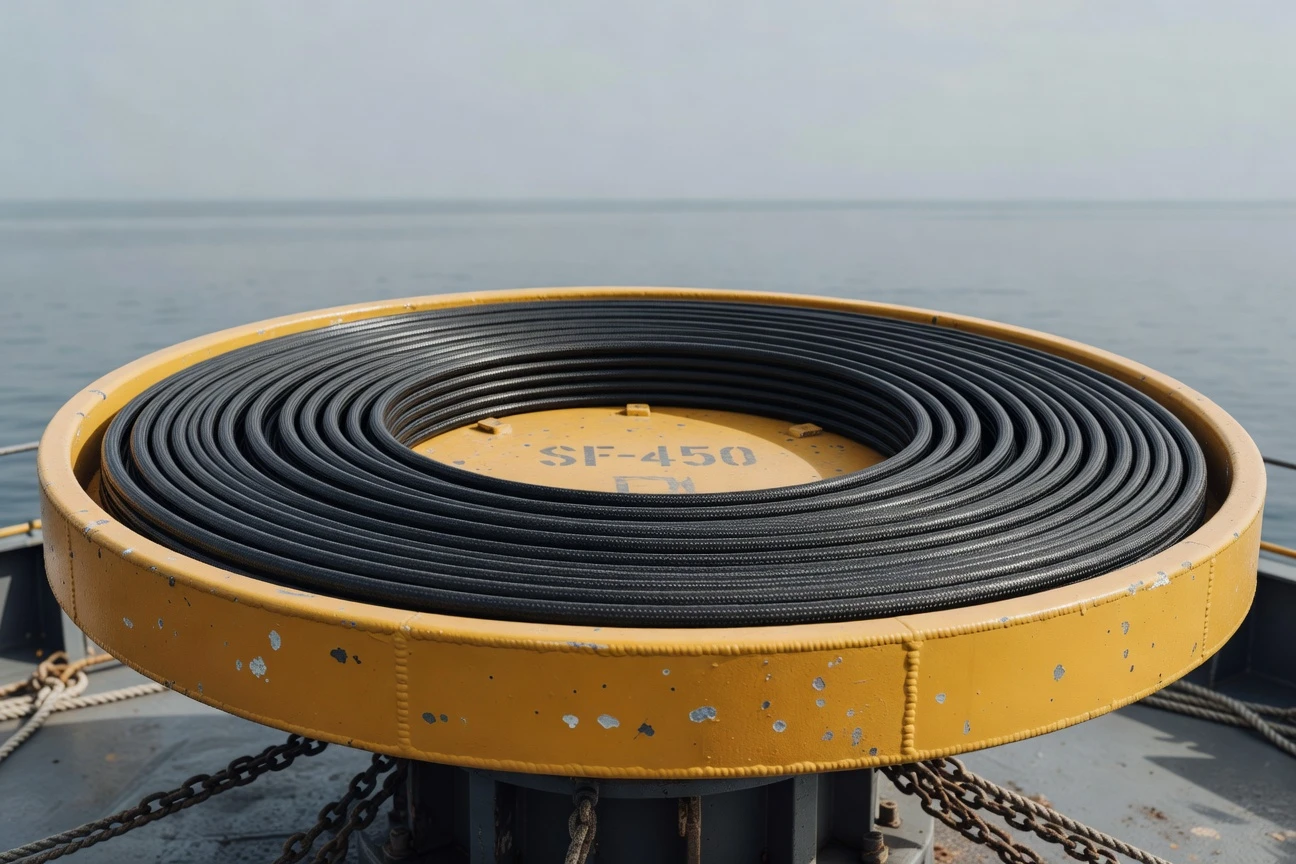
The Dutch manufacturer will build the 2,000-metre line at its plant in IJmuiden using a carbon-fibre and PA12 polymer composite, then ship it to Egypt for installation by Oceaneering’s offshore projects group. The pipe carries a 5,000 psi design pressure and is qualified to DNV-ST-F119, the standard DNV wrote for fully bonded composite pipes carrying hydrocarbons.
Installation runs at almost 600 metres of water using a horizontal lay method, which spools the pipe off a single multi-purpose vessel instead of the dedicated lay ship a comparable steel line usually demands. The composite line takes the place of a steel flowline old enough to warrant a swap rather than a patch, on one of the 17 WDDM fields whose water depths range from 300 to 1,200 metres.
Oceaneering disclosed its share of the work on 21 May. The contract covers transportation, offshore installation and commissioning of the new pipe plus a refurbished subsea umbilical that travelled to Egypt from the company’s umbilical plant in Rosyth, Scotland. Chris Dyer, senior vice president for the offshore projects group, said the firm had been able to fold logistics, refurbishment, vessel and ROV (remotely operated vehicle) work into a single contract on what he described as an expedited timeline. The integrated scope skipped the months of cross-vendor coordination a split contract normally requires.
This will be the first TCP solution of this type used on the Egyptian shelf. TCP (thermoplastic composite pipe, a fully bonded carbon-fibre line that behaves like steel under pressure but ships onto a vessel as a single spool) eliminates most of the offshore welding work a steel job requires.
A Basin Working Against Its Own Decline Curve
A pipe swap on a 20-year-old gas field is the sort of work that rarely makes headlines, and it tells you almost everything about where WDDM sits today. In 2008 the concession produced 2 billion cubic feet of gas a day, its all-time peak. By 2024 output had collapsed to 180 million cubic feet, an 80% drop in Shell’s Egyptian volumes over 16 years.
Phase 10 and Phase 11, sanctioned in 2023 and brought online through August 2025, hauled the production curve back up to roughly 400 million cubic feet a day. Both phases were drilled by the Scaraboe 9 rig in sequence, an operational stack the partners have called the most efficient way to defend the field. That 400 number is what Burullus is now trying to hold.
The Mediterranean offshore wells decline fast, and even the next sanctioned phases (Phase 12a plus the separate Mina West discovery Shell is planning) are not enough to get the company anywhere near its 2030 target of 800 million cubic feet a day, double current Egyptian output. Replacement flowlines, refurbished umbilicals and small interventions are how operators stretch a producing basin without committing to a new platform, and a composite line going into 600 metres of water is one of those bets. The math behind the bet is unforgiving: every percentage point of decline the joint venture cannot offset has to be replaced by an LNG cargo landing at Ain Sukhna or Damietta. Cairo has been doing exactly that for 18 months, and the country now imports more gas than its own deepwater fields produce.
Why Operators Are Picking Composite Over Steel
Strohm and a small group of competitors have spent the past 15 years pitching subsea engineers on the same trade.
A fully bonded carbon-fibre pipe weighs roughly a tenth of a steel one of the same internal diameter, does not corrode, and arrives on the vessel as a single spool rather than a yard’s worth of welded joints. Operator data on horizontal-lay jobs has put the as-installed cost saving at around 40%, though that figure varies with water depth and field geography.
The qualification piece was settled in 2022, when DNV signed off on the Evonik-supplied PA12 carbon-fibre tape for sour-service hydrocarbons, qualifying the material for a 30-year design life at operating pressures up to 700 bar and 80°C. What slowed adoption until then was the sheer cost of running a new material through a qualification programme operators were unwilling to bankroll on greenfield jobs.
The side-by-side comparison Burullus’s procurement team was working from when it picked the composite line:
| Attribute | Carbon-fibre TCP | Carbon-steel flowline |
|---|---|---|
| Weight per metre | About one tenth of steel | Baseline |
| Installation speed | Five to ten times faster | Baseline |
| Corrosion behaviour | Non-metallic, immune to sour service | Requires inhibitor and coatings |
| As-installed cost (horizontal lay) | Around 40% cheaper | Baseline |
| Qualified design life | 30 years (DNV-ST-F119) | Project-dependent |
| End-of-life handling | 100% recyclable thermoplastic | Cut, scrap, restart |
What pushed this particular order across the line is brownfield arithmetic. On a replacement job the operator is not paying for the qualification, the design or the well; it is paying for a pipe and a single vessel mobilisation. The composite line saves time on both. The same calculus is starting to show up across other Mediterranean and West African operators, including Eni and TotalEnergies, who have used carbon-fibre lines on shorter tie-back jobs in the past 18 months. Each one shrinks the qualification overhang that has historically kept thermoplastic composite work out of the deepwater main scope.
The Three Partners Splitting the Bill
Burullus is the operating vehicle for WDDM. It is not a single corporate but a joint venture between three groups whose calculus on this contract is not identical:
- EGAS and EGPC, the Egyptian state holdings, want the cheapest possible barrel of indigenous gas, because every domestic molecule shaves the cargo bill at the country’s FSRU terminals.
- Shell, which has named Egypt one of three growth basins it plans to lean on by 2030, needs to prove that brownfield economics still work on a 20-year-old field.
- Petronas, the Malaysian state oil company, sits across both Rashpetco and Burullus and has been pushing for accelerated drilling in deep water as it shifts from a long conventional position into newer exploration plays.
Rashpetco, the sister vehicle that handles the production side, has set a target of doubling Egyptian gas output by fiscal 2029-30, a deadline that runs parallel with Shell’s. The split of work between the two JVs is not public, but the upstream investment is being made under unified pressure: Cairo is funding offshore activity because every cubic foot it does not import lands in the country’s hard-currency account. The composite flowline order is the kind of decision a JV makes when nobody wants to authorise a new platform but everyone needs the existing one to keep working. A similar logic drove the recent Aquaterra subsea services extension offshore Egypt, where the operator chose to renew rather than retender.
Strohm’s Africa Order Book Just Got Deeper
The IJmuiden-based manufacturer counts ExxonMobil’s Guyana programme, TotalEnergies’s Brazilian developments, and a Malaysian insulated jumper project among its 2024-2025 deliveries. Africa, where the company has had a business development office for three years under Norman Lentsch, has been the slowest of its target regions despite repeated qualification rounds with West African majors.
That is changing. Egypt joins Namibia, Mauritania, Morocco and the established West African producers on a list of countries Lentsch has flagged as candidates for thermoplastic composite work, with several projects in qualification or execution.
This contract marks an important milestone for us as we enter the Egyptian market for the first time. Our entry into the local market underscores the confidence operators have in our TCP products, our extensive track record and our ability to deliver consistent quality and performance.
That is Norman Lentsch, Strohm’s business development manager for Africa, in the contract announcement on the company’s news page dated 26 May.
Order intake has accelerated since the Baker Hughes ultradeepwater partnership was disclosed earlier in May, with the new Egyptian flowline arriving inside the same quarter. Both deals are anchored by replacement and tie-back work on mature fields rather than new sanctioned developments, which fits the broader composites story: the easy wins are the ones nobody wants to weld twice. For a private manufacturer that has yet to publish the kind of disclosure its larger rivals routinely file, the run of brownfield contracts also makes the order book more visible to potential financial sponsors.
Egypt’s Import Math Is Why This Contract Matters
The bigger picture sits at the country’s import desks. Egypt brought in 8.92 million tonnes of LNG in 2025, a national record. Year-on-year volumes jumped 188% in the first 11 months of last year. S&P Global has projected 2026 imports at 11.14 million tonnes, another 26% step up.
To handle that flow Cairo chartered three additional floating storage regasification units (FSRUs, vessels that turn liquefied gas back into pipeline-grade gas at port) for service at Ain Sukhna on the Gulf of Suez and at Damietta on the Mediterranean. The bottleneck through next summer is not LNG availability; it is FSRU capacity to receive it. The US Energy Information Administration’s brief on Egypt’s gas deficit walks through the supply-and-demand gap driving the chartering.
Every additional cubic foot of indigenous gas the Burullus partners can hold on the WDDM curve removes a notch from that bottleneck. That is the lens through which this scale of replacement work looks consequential. It is one of perhaps a hundred small infrastructure decisions across the basin this year that, taken collectively, will determine whether Egypt’s 2027 power season runs on imported molecules or on its own.
The other lens is geopolitical. Shell and TotalEnergies are simultaneously the country’s biggest LNG suppliers and two of its biggest upstream operators. The same companies underwriting the import bill are the ones being paid to keep the offshore concession productive. The brownfield pipe order is part of how that loop closes.
Mobilisation on the Oceaneering vessel is set for the back half of this year. If the composite line spools off the reel on schedule and gas pressure holds through next summer’s demand peak, the next Burullus replacement order will likely also bypass steel. If anything stops the lay, the country’s import statistics will absorb the gap before the project does.
